

Felony DUI law finally within sight

After several failures in recent years, an effort to create a felony drunken-driving charge in Colorado is finally on its way to becoming law.
But House Bill 1043 comes with a price tag that will only increase in the coming years, which could impact future legislative priorities, warns a key budget lawmaker.
The bill would create a felony for drivers who receive their fourth DUI conviction. Current law counts a DUI as a misdemeanor, regardless of how many offenses a driver racks up.
“We are finally sending a signal to taxpayers and victims of DUI that we’re finally taking DUI seriously in Colorado,” said Rep. Lori Saine, R-Dacono, a bill sponsor.
The bill received overwhelming bipartisan support in both legislative chambers this session, most recently on May 6, as it passed the Senate on a 34-1 vote. Sen. Owen Hill, R-Colorado Springs, cast the only no vote. It previously passed the House on a 64-1 vote, with Rep. Justin Everett, R-Littleton, voting no.

The governor has made the creation of a felony DUI a priority and is expected to sign the bill once it gets to his desk.
The bill beefs up penalties for repeat DUIs, but it also gives offenders opportunities to avoid long jail terms along the way.
Current law requires an offender to forfeit his or her driver’s license upon receiving an initial DUI conviction. For a second conviction, the new law would mandate the use of an ignition interlock device – a device that requires the driver to be sober before operating a vehicle – for at least two years.
A third conviction requires significant community corrections involvement. On a fourth conviction, a judge could sentence an offender to up to six years behind bars.
But jail time is the last resort because a judge would be required to first “consider whether all reasonable and appropriate alternative sentences have been exhausted,” according to a state fiscal analysis of the bill.
Sen. Mike Johnston, D-Denver, who is also a bill sponsor, said the bill ensures several layers of intervention prior to a repeat DUI offender receiving significant jail time.
But Johnston stressed during a May 5 Senate floor debate that justice demands stiffer penalties when all other options have been exhausted.
Johnston referenced last year’s death of 17-year-old Juan Carlos Dominguez-Palomin, who was killed on Colfax Avenue in Aurora after being struck by a drunken driver. The man accused of killing the teenager, Ever Olivos-Gutierrez, had multiple prior DUI charges and allegedly was driving at a very high rate of speed prior to the crash.
“If that person decided to get drunk on a Friday night and walk outside and shoot a shotgun down the middle of Colfax, they would be facing, on their first offense, 24 to 48 years in jail,” Johnston said.
“This offers us a balance to say we want to make sure all interventions are exhausted, we want to make sure we do everything we can on treatment, on interlock devices and community corrections,” Johnston later said. “But if you are someone who persistently continues to demonstrate that you are going to put high school seniors with their whole lives ahead of them or two or six-year-old kids with their whole lives ahead of them (in danger)… we need the ability to say, ‘You don’t have the right to put those families at risk any longer.”
During the floor debate, lawmakers shared stories about how difficult the issue of drunken-driving is and how it can impact families.
Sen. John Cooke, R-Greeley, talked about an accident that occurred near his Weld County home, where a car-full of family members were struck by a drunken-driver.
Cooke said the driver was a seven-time DUI offender. A father and his two young children died in the crash.
“I wish that this bill would have been passed a couple of years ago,” Cooke said. “Maybe this family would have been alive today.”
Sen. Lucia Guzman, D-Denver, said alcoholism plagued her family, including a brother of hers who was arrested multiple times in Texas for driving drunk.
Guzman, who supports the bill, said her brother never received alcohol treatment or counseling while behind bars, which she believes needs to be a part of any sentencing equation.
“It is about a disease and it’s about death,” Guzman said. “And the only way we can add the third dimension, which is life, is to take the step and make a decision like this bill moves us toward.
“Hopefully this bill won’t imprison their soul and mind so they don’t get better, but prevent them to be in a place where they harm someone.”
While Democrats and Republicans support the legislation, one lawmaker reminded his colleagues about the financial reality that will come with a felony DUI law.
During a Senate Appropriations Committee hearing last year, Sen. Pat Steadman, D-Denver, cast the deciding no vote on a felony DUI bill. This year, Steadman voted for the effort.
That’s in part because of the reduced price tag of this year’s bill. The bill would cost the state about $1.4 million this fiscal year, which is a lower cost estimate than those of previous efforts.
But the cost to the state will rise every year after, as more people go to prison as a result of the new law. The bill’s fiscal analysis estimates that the law will cost the state more than $4 million in the 2016-17 fiscal year and nearly $8 million the following fiscal year.
Steadman said that money will impact how lawmakers on the Joint Budget Committee do business on what is expected to be “a particularly tight budget” next year.
Steadman also said that alcohol tax revenue should be used similarly to how taxes are collected from the sale of recreational marijuana.
Much of the revenue collected from pot taxes is specifically marked for drug treatment and law enforcement programs, allowing the drug to pay its own way, Steadman said. However, alcohol excise taxes go to the general fund and do not directly offset the financial consequences that can come with alcohol consumption.
“Our taxes on alcohol are wholly inadequate,” said Steadman, who pointed to several other states that have much higher alcohol taxes than in Colorado. “I think we need to start talking about this”
While there remains uncertainty around the bill and its cost, those who have long-backed the effort are feeling a sense of accomplishment.
The bill has failed numerous times in previous legislatures. Former Minority Leader Mark Waller, a Republican from Colorado Springs, has been at the forefront in recent years in trying to get this bill through the General Assembly.
Waller said the passage of the bill “is the culmination of a lot of hard work from a lot of people” and that the measure is necessary to public safety.
“Protection of Colorado citizens on the roadways is one of the most important priorities in any legislative year,” Waller said. “And if we don’t pass the bill now, with Colorado having a record budget, it will never, never happen.”
– Twitter: @VicVela1


Dispute over nuclear inspections clouds US-Iran teams’ work to finalize a war-ending deal
Jon Gambrell
jon.gambrell@associatedpress.com
Updated 9 minutes ago
ISLAMABAD (AP) — The U.S. and Iran were in dispute Tuesday over whether Tehran had agreed to allow U.N. inspectors to view bombed Iranian nuclear sites, as officials mediated talks on a permanent end to their war and violence broke...
Aurora creates police oversight office in final vote
Kyla Pearce
kyla.pearce@gazette.com
Updated 44 minutes ago
The Aurora City Council voted unanimously Monday to create a police oversight office as the city’s consent decree comes to an end. Without discussion, council members approved a final ordinance creating the Office of Public Safety Accountability, prompting city officials...
Aurora City Council requires ICE facility inspections, regulated disease reporting
Kyla Pearce
kyla.pearce@gazette.com
Updated 45 minutes ago
The Aurora City Council passed two ordinances requiring periodic inspections of and more regulated disease reporting from detention facilities in the city, including the GEO Immigration and Customs Enforcement facility. Both ordinances passed in a final vote Monday night with...

Municipal sentencing bill in Denver moves forward
Deborah Grigsby
deborah.smith@denvergazette.com
Updated 42 minutes ago
The Denver City Council introduced legislation Monday aimed at aligning municipal penalties with state law to “stop criminalizing poverty.” The bill, which was heavily revised and amended, was moved forward on a 10 to 2 vote, with Councilmembers Darrell Watson...

10th Circuit grants Boulder-Weld district’s fire chief immunity for firing union leader
Michael Karlik
michael.karlik@coloradopolitics.com
Updated 16 hours ago
The Denver-based federal appeals court decided on Monday that the chief of a fire protection district spanning Boulder and Weld counties could not be held liable for terminating a union leader through the process outlined in the collective bargaining agreement....
Michael Allen says a weakened justice system, rising crime drove him to run for attorney general
Thelma Grimes
thelma.grimes@coloradopolitics.com
Updated 15 hours ago
Michael Allen said he is running for attorney general because he believes Colorado’s criminal justice system has been weakened by recent legislation and that rising crime is directly increasing the cost of living. A Navy veteran and longtime prosecutor, Allen...

Colorado House ethics committee delays hearing to allow Rep. Lindsay to seek legal counsel
Marianne Goodland
marianne.goodland@coloradopolitics.com
Updated 20 hours ago
The Colorado House ethics committee voted Monday to pause the ethics complaint against Rep. Mandy Lindsay while she seeks legal counsel. The hearing was scheduled to begin with two days of testimony, during which Lindsay could present evidence and call...
Polis administration awards $30 million for local climate policy projects
Scott Weiser
scott.weiser@gazette.com
Updated 35 minutes ago
Gov. Jared Polis and the Colorado Energy Office announced $30 million in grants Thursday to 18 local and tribal governments for projects to reduce emissions, improve air quality and promote energy efficiency. This second and final round of the federally...

State Supreme Court oral arguments, 10th Circuit nominee recuses from cases | COURT CRAWL
Michael Karlik
michael.karlik@coloradopolitics.com
Updated 14 hours ago
Welcome to Court Crawl, Colorado Politics’ roundup of news from the third branch of government. The state Supreme Court will hear its last set of oral arguments this week before breaking for the summer, and the nominee for a vacancy...
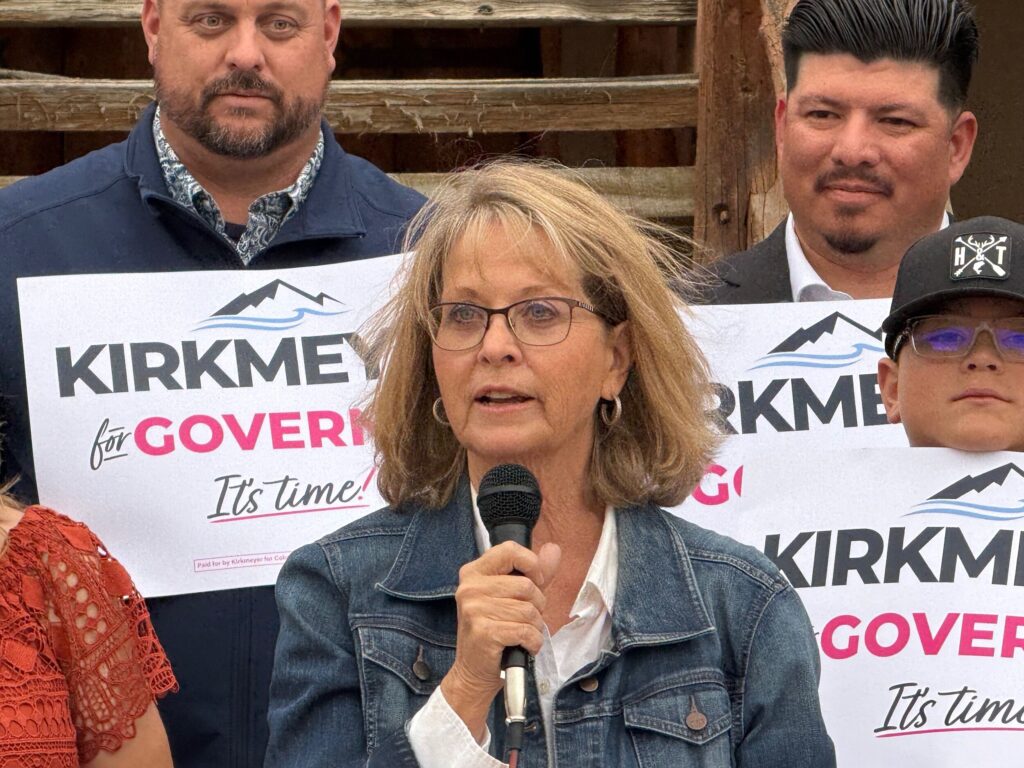
‘Peaking at the right time’: Barbara Kirkmeyer is confident as ballots go out
Thelma Grimes
thelma.grimes@coloradopolitics.com
Updated 15 hours ago
Calling 2026 an “interesting” year, Sen. Barbara Kirkmeyer said the race for the Republican nomination has taken her from a “bizarre debate” to a broader effort to maintain the party’s integrity, while making the case that she’s ready to lead...