

Condo construction defects discussion at an end
The 2014 legislative session ended with a whimper, not a bang, on the condo construction defects issue. This year’s session on the same issue will end the same way.
But supporters of the efforts vow they will be back next year.
Last week, Speaker of the House Dickey Lee Hullinghorst, D-Boulder, assigned the Senate’s major construction defects bill, Senate Bill 15-177, to the House’s “kill” committee, the House State, Veterans and Military Affairs Committee. They voted along 6-5 party lines to kill the bill after a five-hour hearing Monday.
At the same time, House Democrats have their own fix for the problem. Three bills, sponsored by Rep. Max Tyler, D-Lakewood, go after what Democrats say is the real issue: affordable condo housing.
But chances that the Republican-controlled Senate will view those bills favorably are virtually nil.
SB 177 sought to modify construction defects laws, first passed in 2001 and amended in 2003, 2007 and 2010. The bill would have required a condo homeowners’ association to go to mediation and/or binding arbitration prior to filing a class-action construction defects claim. Prior to filing a claim, the HOA board would have had to obtain written consent from a majority of unit owners after disclosing projected costs, duration and financial impact.
Earlier in the day a press conference was hosted by the Homeowners’ Opportunity Alliance. Mayors Michael Hancock of Denver and Bob Murphy of Lakewood led the pleas of dozens of supporters to Hullinghorst to give the bill a “fair hearing.”
Last fall, the Lakewood City Council approved an ordinance to allow builders and developers an opportunity to repair construction defects before homeowners and condo associations could sue. As with SB 177, the ordinance requires condominium boards to receive permission to sue from a majority of their homeowners. Several other municipalities have passed their own ordinances, some modeled after Lakewood’s.Supporters warned during the press conference that should the bill fail, more communities intend to go down Lakewood’s path. Mayor Phil Cernacec of Littleton said his council is already at work on such an ordinance.
Throughout the hearing later in the day, Vice-Chair Rep. Joe Salazar, D-Westminster, asked proponents if they could guarantee that changing the law would result in construction of affordable condo housing in the $150,000 to $200,000 price range. “We can’t guarantee it,” replied co-sponsor House Minority Leader Rep. Brian DelGrosso, R-Loveland. But nothing’s being built now, and the bill will start the process, he added.In response to the same question, Murphy pointed out that passing the ordinance in Lakewood brought developers into his community. As to whether those future projects are “affordable,” Murphy said the market and the need are in that price range.
Those against SB 177, including attorney Molly Foley-Healy, legislative liaison for the Community Associations Institute, said the bill “is window-dressing for the destruction of homeowners’ rights.” She said arbitration is often more expensive than going to trial, and to require a majority of homeowners to approve a lawsuit is unrealistic. The committee also heard from economist Pat Pacey, who pointed out her study showed the lack of condos is due to a combination of market and economic factors rather than the construction defects law.
But builder Chris Waggett of D4 Urban, LLC, who testified in favor of SB 177, told The Colorado Statesman that without a fix in the law, he won’t be building any multi-family condos anytime soon.
Waggett is a partner in several housing projects in Denver, including market-rate apartments adjacent to several RTD light rail stations. “I have a passionate commitment within my land holdings for diverse housing at diverse price points,” Waggett said.
His next project is slated for the largest vacant property in Denver, at 73 acres. Waggett said he wants to divide it into three types of housing: senior, rental and condo units ranging from $250,000 to $500,000. But said he won’t build the condo portion until the law changes.
“I’d love to do a condo product, but I won’t do it if I know I’m going to get sued,” he said. Waggett indicated it is too easy to sue on condos in the metro area, in part because it’s “a viable business model” for trial lawyers.
On Tuesday, CAI, which represents homeowners’ associations, held out an olive branch to the Homeowners Opportunity Alliance and other bill supporters. The organization has been frustrated because they claim they have never been allowed a seat at the table on negotiations around the law.
Foley-Healy suggested the Alliance and CAI “create an environment where builders and homeowners can work in good faith to resolve construction defects during the notice-of-claims stage.” Such an alternative, she said would incentivize builders and homeowners to resolve defects early in the process.
SB 177 co-sponsor Senate Majoirty Leader Mark Scheffel, R-Parker, told The Statesman this week he was disappointed by the House action Monday. “There will continue to be an issue with the demise of SB 177,” he said Tuesday. Most of all, he said he was disappointed for the Alliance that spent countless hours on the effort.
But Scheffel is far from done fighting for changes to the construction defects law. “Our system of government mandates that we continue to work on this. Even in the face of discouragement, you have to continue.”
A second bill, to cut in half the statute of limitations for filing a claim, also went down to defeat in the same committee. SB 91 would have cut the total time for filing a claim from eight years to four years. The House State Affairs committee killed that bill on a 6-5 party-line vote on April 22.
With both Senate bills gone, what remains are three Democratic bills. All three flew through the House State Affairs Committee Wednesday.
House Bill 15-1383 modifies the state’s low-income housing tax credits issued by the Colorado Housing and Finance Authority. Those tax credits are allocated to builders of low-income rental housing developments. HB 1384 allows the State Treasurer to transfer one-third of the available balance in the state’s Unclaimed Property Trust Fund to CHFA and then to the state Division of Housing. The money would be used for rental assistance or to help construct owner-occupied or rental housing for low-income households. The third bill, HB 1385, sets up a voluntary external review process for construction of new multi-family housing, to be paid for by builders, to prevent construction defects.
But all three bills are most likely dead on arrival in the Republican-controlled Senate, in part because they all lack Republican sponsors, and the Senate is still smarting over the defeat of SB 177. Tyler is on the House State Affairs committee and voted to kill SB 177.
Two of the bills, on the review process and the low-income tax credit, were sent to the House Finance Committee for further action. The third, on using the Unclaimed Property Trust Fund money for low-income rental assistance, is awaiting action from the full House.


Lauren Boebert’s hard ‘no’ on Pentagon Iran funding request puts Mike Johnson in tough spot
Emily Hallas, Washington Examiner
emily.hallas.washington.examiner@gazetteedit.wpenginepowered.com
Updated 7 hours ago
Colorado U.S. Rep. Lauren Boebert announced on Thursday that she will not support further funding for the United States’s war in Iran, marking an uphill battle for the Trump administration’s effort to secure additional financing from Congress. “I’ve already told...

Rubio gains ground in 2028 jockeying as Iran war elevates his profile
Samantha-Jo Roth, Washington Examiner
samantha-jo.roth.washington.examiner@gazetteedit.wpenginepowered.com
Updated 7 hours ago
Secretary of State Marco Rubio’s high-profile role in the Trump administration’s response to the Iran war is boosting his standing in the early jockeying for the 2028 Republican presidential nomination — and positioning him as a possible rival to Vice...

Federal judge dismisses claims against medical contractor for Eagle County jail suicide
Michael Karlik
michael.karlik@coloradopolitics.com
Updated 5 hours ago
A federal judge dismissed the claims against a medical contractor for the Eagle County jail and its employees earlier this month, concluding there were insufficient allegations that they violated the constitutional rights of a man who died by suicide in...

Colorado Senate committee advances bill increasing overtime threshold for farmworkers
Marianne Goodland
marianne.goodland@coloradopolitics.com
Updated 5 hours ago
The struggle to balance farmworker protections with the survival of Colorado’s family farms took center stage Thursday as senators debated two competing overtime bills. The Senate Business, Labor and Technology Committee held a rare double-bill hearing that led to a...

Colorado bill to fund mental health care with alcohol taxes defeated in House committee
Marissa Ventrelli
marissa.ventrelli@coloradopolitics.com
Updated 7 hours ago
A second measure proposing that alcohol producers and wholesalers in Colorado help fund mental health care treatment in the state was narrowly defeated in the House Health and Human Services Committee on Wednesday. House Bill 1301, sponsored by Rep. Bob...

Lawsuit targets Gov. Polis, Colorado officials for holding juveniles after court‑ordered release
Marissa Ventrelli
marissa.ventrelli@coloradopolitics.com
Updated 7 hours ago
Colorado officials are facing a lawsuit alleging the state has kept minors in juvenile detention for days or months after judges ordered them released, largely because appropriate foster or community placements were not available. Two minors involved in Colorado’s criminal...
Federal judge advances lawsuit seeking overtime compensation for Aurora firefighter trainees
Michael Karlik
michael.karlik@coloradopolitics.com
Updated 11 hours ago
A federal judge gave preliminary approval earlier this month to a class of Aurora firefighter trainees who may sue the city over allegations that they were denied overtime pay in violation of federal law. Joseph Elias, who attended Aurora’s fire...
Appeals court says jury not obligated to apply discounts to determine value of stolen merch
Michael Karlik
michael.karlik@coloradopolitics.com
Updated 11 hours ago
Colorado’s second-highest court concluded on Thursday that it was up to a Douglas County jury to determine the value of stolen merchandise at a defendant’s theft trial, after both sides presented different estimates of the items’ value. Under state law,...

Trump switches endorsement back to Jeff Hurd, says Hope Scheppelman is ending run in Colorado’s 3rd CD
Ernest Luning
ernest.luning@coloradopolitics.com
Updated 5 hours ago
In a surprise twist, President Donald Trump on Friday said he was again endorsing Republican U.S. Rep. Jeff Hurd after pulling his support from the Grand Junction Republican last month and instead backing Hurd’s primary challenger in Colorado’s 3rd Congressional...
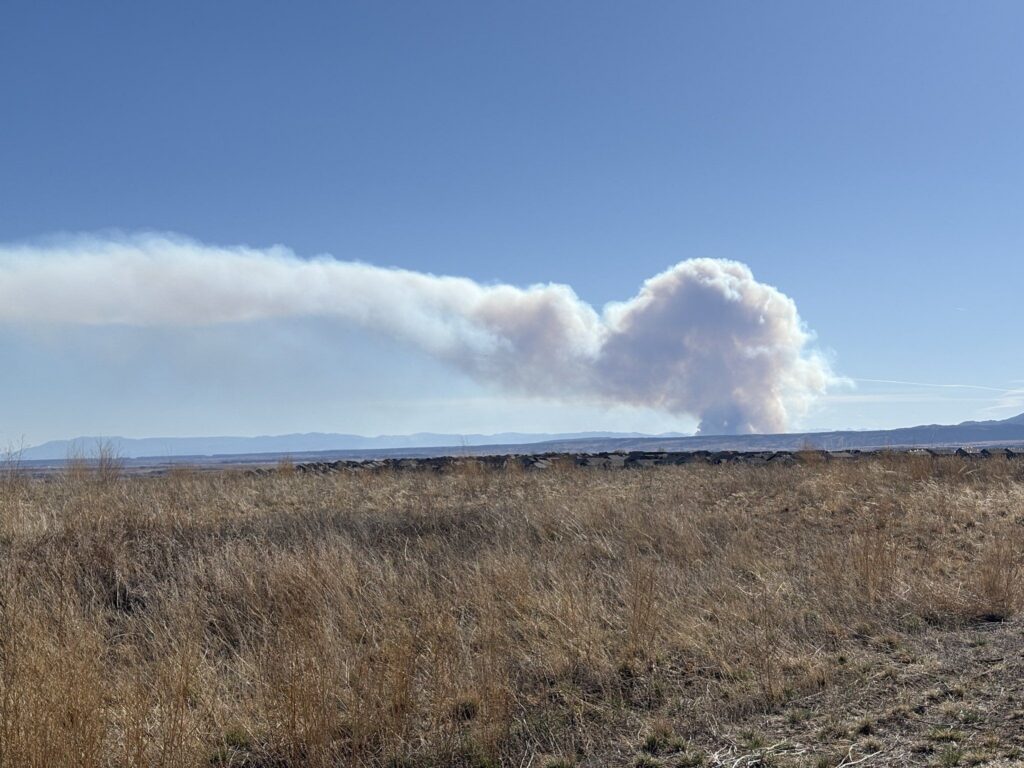
Highway 115 fire blows up, road closed south of Colorado Springs
Nick Smith
nick-smith@coloradopolitics.com
Updated 10 hours ago
A fast-moving fire burning along Colorado 115 south of Colorado Springs blew the containment line Thursday, spreading farther east onto Fort Carson and scorching nearly 700 acres, officials said. The blaze, known as the 24 fire, was fully uncontained as...
PREV
PREVIOUS

Letters to the Editor
Dear Editor, Please identify the organization Americans for Prosperity. It is the voice of the Koch Brothers. It is not a grassroots organization. It has no roots in Colorado. It should not be able to present its agenda in a public forum without disclosing its ownership. Every columnist should be identified by his employment as a starting point. Good luck on […]
American Indian mascot bill dies in committee
The use of American Indian mascots by Colorado public schools can continue unfettered after a bill requiring tribal approval of their use died on a party-line vote during an April 29 Senate committee hearing. House Bill 1165 would have created an approval committee made up of representatives from American Indian tribes for schools seeking to […]