

DPS meets Marrero’s academic goals, but most students remain below state standards
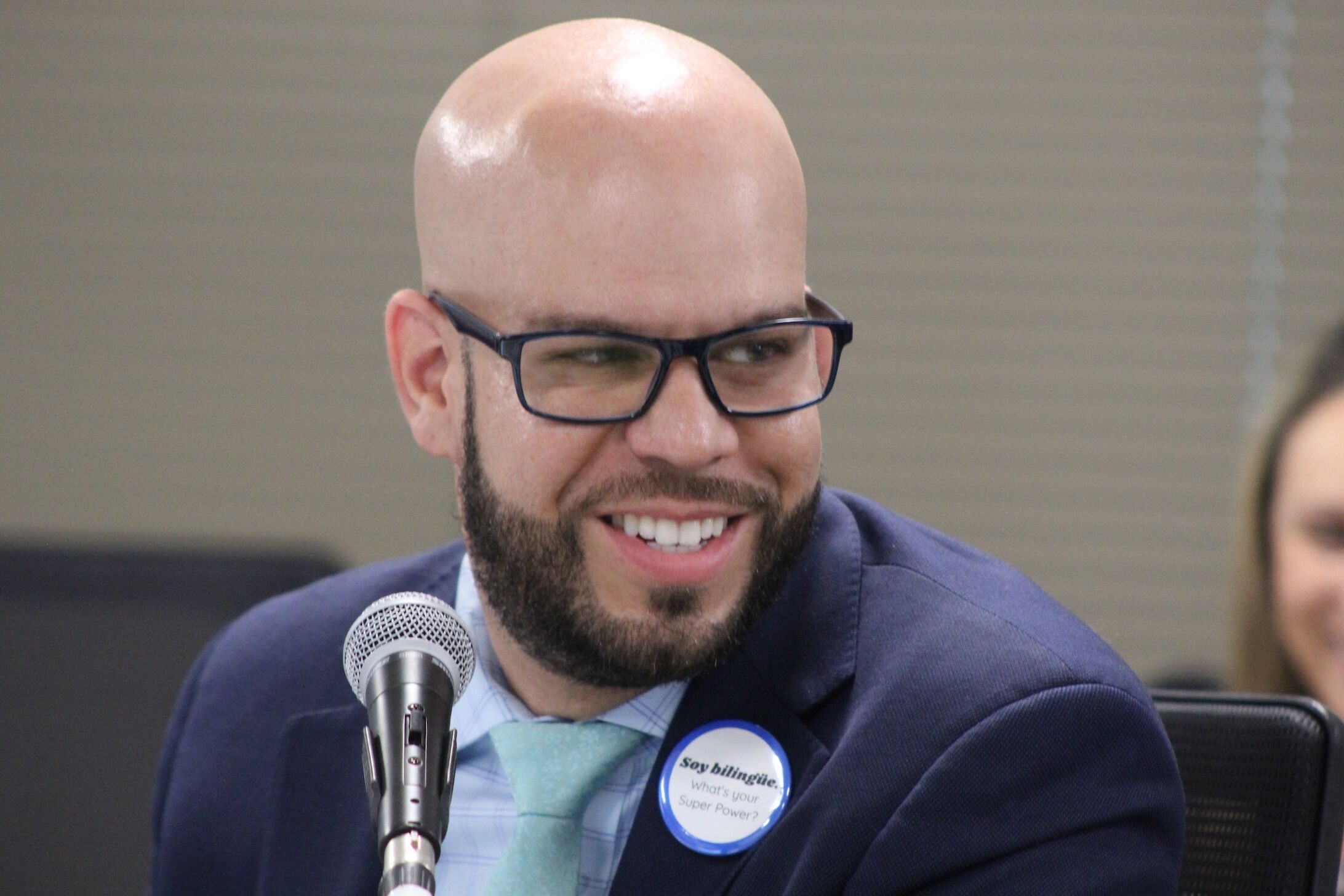
The majority of Denver Public Schools students do not meet state standards — and the academic goals set by Superintendent Alex Marrero’s administration do not expect them to.
Marrero’s first strategic road map in 2021 set a goal of 10% improvement by 2026.
“The tragic truth is that, when we don’t narrow gaps in access and opportunity, it perpetuates the advantage of some over others,” Marrero’s plan for success said in 2022. “When we don’t eliminate these gaps, we are contributing to an oppressive system.”
In 2022, 39.4% of Denver students met or exceeded state expectations in English Language Arts and 28.8% in math, according to the Colorado Measures of Academic Success or CMAS. Four years later, those numbers are 42.46% in English and 34.99% in math.
On Thursday, the education board received Marrero’s monitoring report, which is used to gauge his job performance.
Marrero’s target was 42% proficient in English and 35% in math. Those goals, if met, mean 58% of students still do not meet state expectations in English and 65% in math.
In his July 31 monitoring report, Marrero described the district’s responsibility more broadly.
“I interpret that I must ensure the district’s primary responsibility is to ensure every student demonstrates continuous academic growth and achieves proficiency in core subjects that prepare them for postsecondary and lifelong success,” Marrero wrote. “Progress toward this End requires equitable access to rigorous instruction and safe, supportive learning environments. We have a collective responsibility to close the gap for our historically underserved and underestimated communities.”
Board President Xóchitl Gaytán told The Denver Gazette before Thursday’s meeting that she was unsure who created the benchmark.
“I’m not sure if it’s determined by us or by the state,” Gaytán said of Marrero’s goals.
Gaytán pushed back on characterizing the majority of DPS students as falling short of state standards, noting that the group includes students who partially met or approached expectations. She also pointed to challenges associated with educating students in a large urban district, where schools often serve higher concentrations of low-income students and students with needs that extend beyond the classroom.
The monitoring is used, in part, to determine Marrero’s compensation.
A satisfactory evaluation triggers the district’s purchase of an additional year of service credit with the Public Employees’ Retirement Association (PERA) on his behalf. Under his previous contract, his evaluation also determined whether he received a performance bonus, which totaled $17,326 or 5% of his base pay, in 2024. The bonus is not included in his current contract.
The CMAS targets were developed by Marrero and district leadership.
“The district sets annual targets using a combination of historical data trends, cohort growth projections, and the strategic milestones outlined in DPS’s Strategic Roadmap,” Scott Pribble, a district spokesperson, said in an email. “These benchmarks are calculated using standard district-level progress models that measure expected year-over-year percentage-point gains rather than assuming a single-year jump to universal proficiency.”
Marrero’s goals, Pribble added, were “explicitly designed as incremental benchmarks.”
Director Kimberlee Sia told The Denver Gazette that she would like board to think about academic progress differently.
If a struggling sixth grader’s academic performance, for example, only improves by 1% or 2% each year, there’s a good chance that student will still not be proficient at graduation, she said.
“The increases every year don’t feel like we’re pressing as hard as we can,” Sia said.
The board also received other monitoring reports that include discipline and school resource officer citations.
During this monitoring cycle, DPS reported that just 1% of discipline resolutions were considered impermissible, below its 7% target. And school resource officers issued 55 citations, below the district’s target of 65.
The board accepted the monitoring reports — as encouraged by Marcus Johnson, senior attorney and policy director for the district — without discussion.
The board reserved its questions for Marrero’s strategic road map, which several said they found lacking.
The administration presented a strategic roadmap containing desired directions — increase proficiency and graduation rates, decrease absenteeism — without saying how much improvement would constitute success.
Several board members pushed Marrero to put numbers behind his goals.
Marrero expressed concern about numerical targets being tied directly to his performance evaluation — saying no other employee is judged that way — but ultimately agreed that the roadmap needs specific “X to Y” targets and proposed working them out with the board.


Aurora student journalist cleared of disciplinary charges after ignoring ‘gag order’
Kyla Pearce
kyla.pearce@gazette.com
Updated 2 hours ago
An Aurora Community College student who accused the college of putting an “unconstitutional gag order” on his student-run publication was cleared of disciplinary charges against him. CCA student Andrew Green tried to register his independent student publication, called “FoxTalk,” as...

Douglas County School District, Castle Rock clash over school land and fee use
Nicholas Fogleman
nicholas.fogleman@denvergazette.com
Updated 2 hours ago
The Town of Castle Rock and the Douglas County School District are at odds over a proposed ordinance change that would give the town greater discretion over how land and cash dedicated for school facilities can be used. Under Castle...

Federal science agency gives CU Boulder $37.5M to supercharge its quantum studies
Bernadette Berdychowski
bernadette.berdychowski@denvergazette.com
Updated 1 day ago
The University of Colorado Boulder was awarded $37.5 million from a federal research agency to propel its quantum research, the U.S. National Science Foundation announced Tuesday. The school was one of eight academic institutions to receive a total of $290...

Denver Public Schools welcomes 89,000 students back to the classroom
Elizabeth Pond
elizabeth.pond@denvergazette.com
Updated 3 days ago
A swarm of students — some happily greeting teachers and reuniting with friends, others nervously clinging to their parents’ legs and rubbing bleary eyes — kicked off the first day of the new school year on Monday at Newlon Elementary...

Colorado schools reopen with measles vaccination rates below protective threshold
Nico Brambila
nico.brambila@denvergazette.com
Updated 4 days ago
Colorado is entering the new school year without active measles transmission, but health officials remain concerned as kindergarten MMR coverage sits at just 87.8% and most counties fall below the 95% threshold considered protective against outbreaks. “These declining vaccination rates,...
Jeffco Public Schools board votes to put $133M mill levy override before voters
Matt Kyle
matt.kyle@denvergazette.com
Updated 4 days ago
Voters in Jefferson County will decide this November whether or not to approve a $133 million mill-levy override that Jeffco Public Schools officials say is needed to cover funding shortfalls in the district. The Jeffco Public Schools Board of Education...
District 49 dissolves longtime provider of special services
Eric Young
eric.young@gazette.com
Updated 1 week ago
A longtime education service provider that has been subject to recent public and government scrutiny is shutting down. School District 49’s Board of Education approved the dissolution of the Education ReEnvisioned Board of Cooperative Education Services (ERBOCES) during a special...
Colorado math scores hit record high as Denver-area districts show gains
Nico Brambila
nico.brambila@denvergazette.com
Updated 1 week ago
Despite gains, the majority of students do not meet or exceed expectations in math or English Math emerged as a bright spot in Colorado’s latest standardized test results, with students posting record scores in a subject where they have historically...
District 49 dissolves longtime provider of special services
Eric Young
eric.young@gazette.com
Updated 2 weeks ago
A longtime education service provider that has been subject to recent public and government scrutiny is shutting down. School District 49’s Board of Education approved the dissolution of the Education ReEnvisioned Board of Cooperative Education Services (ERBOCES) during a special...

DPS board sends $44 million tax increase to Denver voters
Nico Brambila
nico.brambila@denvergazette.com
Updated 2 weeks ago
The Denver Public Schools board on Thursday unanimously voted to place a mill levy override on the November ballot that — if approved by voters — would raise taxes by $43.9 million annually, largely to fund employee raises. The request...
PREV
PREVIOUS

WATCH: Republican US Rep. Jeff Crank, Democratic challenger Jessica Killin debate in Colorado’s 5th CD
Republican U.S. Rep. Jeff Crank and Jessica Killin, his Democratic challenger, are scheduled to meet for a televised debate in the race to represent Colorado’s 5th Congressional District on Thursday night. The candidates are set to take the stage at 6 p.m. at the Pikes Peak Center in Colorado Springs for a debate sponsored by […]

5th Congressional debate watchers hope for civility, truthfulness
A few hundred people watched Rep. Jeff Crank and veteran Jessica Killin square off in a debate for the 5th Congressional District at the Pikes Peak Center for the Performing Arts on Thursday evening. Many of them sported campaign insignia in what they described as a pivotal midterm election in November. Crank is seeking re-election […]