

Someone’s lying in latest activist embarrassment for Polis’ CPW Commission | Rachel Gabel

Either Samantha Miller is lying, or Gov. Jared Polis is. If Miller is lying, she is so secure in the red carpet rolled out for animal activists by this administration she is willing to put words in the governor’s mouth. If Polis is lying, the deck is stacked against his own agencies and their expertise is worthless. No matter the truth, the governor has a problem on his hands. His CPW Commission, filled with his own appointees who make no attempt to mask their intentions, ignored CPW staff, attorneys, stakeholders, and even his brand-new director, and jumped into chaos in the name of ideology.
Miller, formerly the front woman for Cats Aren’t Trophies, who pushed the failed mountain lion, bobcat and lynx hunting ban last year, is now with the Center for Biological Diversity. She is the proponent who brought forward a citizen petition to ban the sale of furs in the state, and the Commission voted to move it forward to rule making.
In a social media post, Miller told her followers:
“This will probably be a two-meeting process,” Miller said. “What we have been directed from the Governor’s office is ‘don’t let us be shown up in Denver. The next meeting will be in Grand Junction, but you guys are in Denver. Don’t let them show you up in Denver.’ Everyone needs to show up.”
This is a big problem for the governor’s office because CPW is a Type 1 agency, which means the governor is limited to budget management functions, and not rule-making, regulation, licensing and general political interference.
A representative for the governor’s office, after being sent Miller’s video, told me:
“While the Governor didn’t have a position on the petition and doesn’t take positions on petitions, and Colorado Parks and Wildlife staff recommended opposing the petition, we are committed to working with stakeholders to craft a rule that supports sportsmen and women while conserving and restoring furbearer species in Colorado. The governor believes that the outdoors are for everyone including hunters and anglers who are a key part of funding and benefiting from the important work of CPW.”
Commissioner Jessica Beaulieu made a motion even CPW’s legal expert struggled to clarify. It was clear and repeatedly verbalized by commissioners that they weren’t sure what they were voting on. You’ll recall Beaulieu represents state parks and recreation, though at the time of her appointment she had never held a state parks pass or visited state parks outside of the metro area.
Chair Richard Reading, who also voted to move the petition forward, had ample opportunity to resolve the chaos and confusion that has plagued recent commission meetings. Someone, who I’m sure is quite wise, once suggested if you can’t dazzle them with your brilliance, baffle them with your bullshit. That jives.
Mark Viera, CPW Carnivore and Furbearer Program Manager, gave a thorough and concise wrap-up of current fur bearer management, the fur bearer stakeholder group recommendations, and laid out a litany of explanations of why the petition shouldn’t go forward. The Commission ignored their own experts and even offered their own director a vote of no confidence.
The petition seeks to ban the sale, barter, or trade of furs from furbearers except handtied fishing flies, felt hats and fur for scientific research, education, or museum collections. However, according to a letter from Roberta Sakata, acting commissioner of Agriculture, there is a conflict in the petition with the authority granted to agricultural producers under Title 35. This is also addressed repeatedly by staff and even detailed by the director as one of the issues with the petition. Under state statute, a landowner or his or her employees may hunt, trap, or take a variety of animals, including furbearers, without securing a license to remedy damage to crops, real or personal property, or livestock. That take does not inform CPW’s estimates and are under the authority of CDA and not the rulemaking authority of the Commission. By voting the petition forward, the Commission gave away the ability to gather the data from this take, further reducing the ability to manage the 17 species. The biologists, scientists, hunters, trappers, ag producers and staff in the room understand that and it was clear that was only one of the consequences the commissioners voting for the petition didn’t understand.
The commissioners who voted for the petition — Beaulieu, Emerick, Murphy, Tutchton, Vardy (production agriculture representative), and Reading — listened to Viera’s comprehensive, research, data, and science-based explanations borne of days of stakeholder engagement and sent him back to the drawing board to appease activists.
Rachel Gabel writes about agriculture and rural issues. She is assistant editor of The Fence Post Magazine, the region’s preeminent agriculture publication.


Colorado’s GOP at its best — and worst | Dick Wadhams
Dick Wadhams
dick-wadhams@coloradopolitics.com
Updated 2 days ago
By Dick Wadhams Colorado Republicans are fighting to be relevant in the face of gross mismanagement by Democrats who totally control state government. While the Colorado Republican Party is mired in controversy, several Republican elected officials and candidates represent the...

Ask Secretary of State candidates if they’re in favor of independent election audits | Jon Caldara
Jon Caldara
jon-caldara@coloradopolitics.com
Updated 3 days ago
This part will disappoint angry people on Twitter: Relax. Put the pitchforks down. I am not relitigating the 2020 election or mail ballots or even Tina Peters. But I am saying people don’t trust elections like they used to. And...
Redistricting plan to give Colorado Dems 7 members of the U.S. House will split El Paso County | Bob Loevy
Bob Loevy
bob-loevy@coloradopolitics.com
Updated 2 days ago
A proposed redistricting plan, which would give Colorado seven Democratic members of the U.S. House of Representatives and only one Republican, will split El Paso County into two parts and thereby weaken the county’s influence in Congress. El Paso County,...

Can deliberation save democracy? | Vince Bzdek
Vince Bzdek
vince.bzdek@gazette.com
Updated 1 day ago
In September 2019, 523 Americans traveled to Dallas for an experiment called “America in One Room.” The gathering was designed to test a theory: Could representative citizens deliberate productively even in an era of intense polarization? The event took place...
Another TABOR fight: Democrats plan to redirect residents’ refunds to K-12 spending
Marianne Goodland
marianne.goodland@coloradopolitics.com
Updated 2 days ago
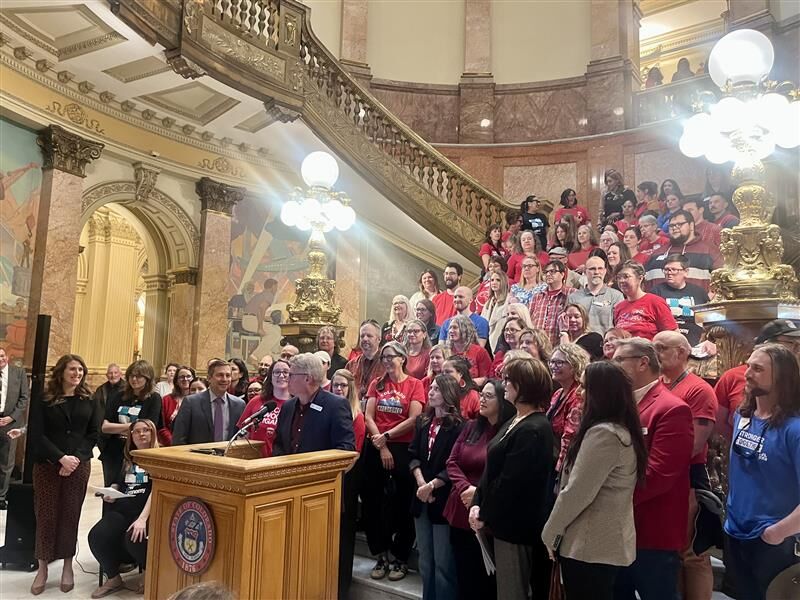
Colorado voters could decide this fall whether billions of dollars that would otherwise be returned as refunds under the Taxpayer’s Bill of Rights should instead go to public schools under a ballot measure unveiled Thursday by Democrats. Supporters say the...

Colorado House committee advances bills regulating AI in therapy, insurance decisions
Marissa Ventrelli
marissa.ventrelli@coloradopolitics.com
Updated 3 days ago
Colorado lawmakers are moving to place guardrails on the growing use of artificial intelligence in mental health care and insurance decisions. The House Health and Human Services Committee on Thursday approved two bills that would limit how therapists and insurers...

Colorado Democrats, Republicans fight over ballot fiscal information
Marissa Ventrelli
marissa.ventrelli@coloradopolitics.com
Updated 2 days ago
Republicans and Democrats clashed anew over legislation that would require identifying which programs would see a funding reduction if a ballot measure passed, with the former saying it’s yet another way for the government to control the campaign narrative and...

Democrat Dwayne Romero jumps in primary to challenge Republican Jeff Hurd in Colorado’s 3rd CD
Ernest Luning
ernest.luning@coloradopolitics.com
Updated 3 days ago
The Democrat who has been running for nearly a year to unseat Republican U.S. Rep. Jeff Hurd in Colorado’s 3rd Congressional District got some company in the primary this week. Dwayne Romero, a Snowmass Village business owner and decorated Army...
Pueblo board violates Open Meetings Law | Dennis Maes
Dennis Maes
dennis-maes@coloradopolitics.com
Updated 3 days ago
By Dennis Maes I recently witnessed two serious violations of the Colorado Open Meetings Law by the Pueblo Urban Renewal Authority (PURA) board. Both were brought to the attention of the board in an open meeting and entered on the...

Legislation would undermine educational opportunity | OPINION
Colorado Politics
colorado-politics@coloradopolitics.com
Updated 3 days ago
By Norton Rainey and Weston Kurz New legislation under consideration by Colorado lawmakers could have far-reaching consequences for Colorado students and families looking for new educational options. HB26-1292, currently under consideration by the Colorado General Assembly, would severely limit the...
PREV
PREVIOUS

Ask Secretary of State candidates if they're in favor of independent election audits | Jon Caldara
This part will disappoint angry people on Twitter: Relax. Put the pitchforks down. I am not relitigating the 2020 election or mail ballots or even Tina Peters. But I am saying people don’t trust elections like they used to. And here in Colorado we can do a rather simple thing to reverse that. And progressives […]

Colorado’s GOP at its best — and worst | Dick Wadhams
By Dick Wadhams Colorado Republicans are fighting to be relevant in the face of gross mismanagement by Democrats who totally control state government. While the Colorado Republican Party is mired in controversy, several Republican elected officials and candidates represent the very best of what the party should be and how the state should be led. […]