

Appeals judges tell Boulder students about workload, ‘attack mode’ during school visit
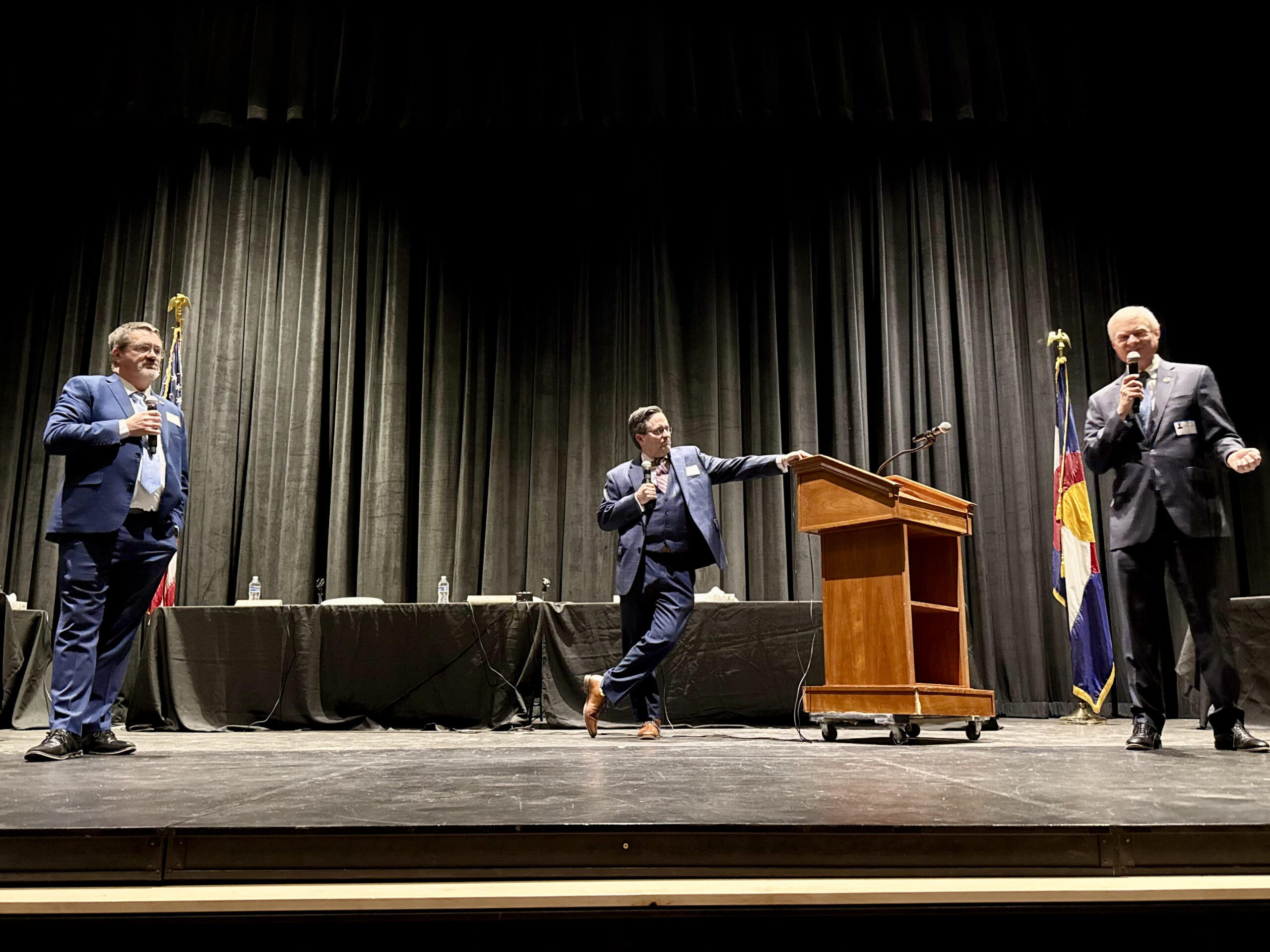
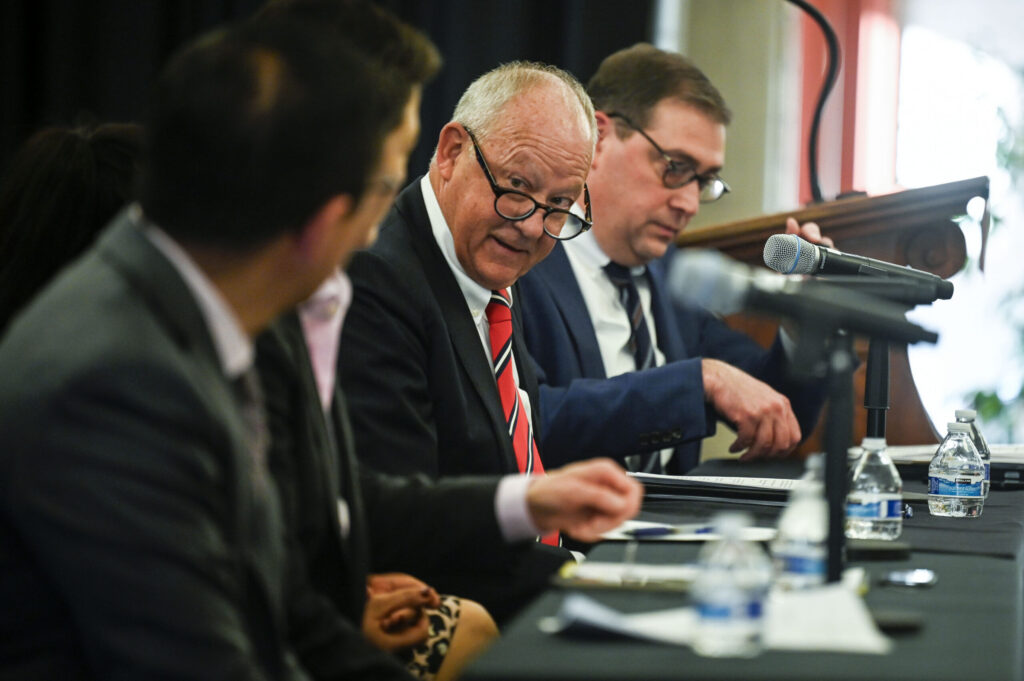
Three judges on Colorado’s second-highest court traveled to Boulder on Tuesday to hear oral arguments in real cases and field questions from students about their professional paths, their workload on the Court of Appeals, and their approach to interacting with attorneys.
“Sometimes, I regret my tone. I will admit that I get a little too into it sometimes and lose perspective that the person that’s up here is really nervous and trying to do their best,” said Judge Craig R. Welling. “I’ve been trying to keep that in mind. I think Judge Tow got a note today before our argument that you might want to share.”
“Generally, ‘be nice,'” responded Judge Ted C. Tow III.
“That was a text from his clerk,” added Welling, to laughter.

For 40 years, the Colorado Supreme Court and the Court of Appeals have traveled outside their downtown Denver courthouse to hold oral arguments at other venues as part of the “Courts in the Community” program. A three-judge appellate panel heard two criminal cases in the auditorium of Fairview High School and subsequently engaged in a Q&A with students.
“I do tend to cross-examine and I do kind of get into — unfortunately — too much of attack mode,” said Tow, adding that there are two different views that judges hold about oral arguments.
“Some judges feel like oral argument is the lawyers’ time to kind of bolster what they’ve written in the briefs. I’m of the opinion that that’s my time,” he said. “I have 15 minutes to fill in the holes that I have with questions that I have from reading the briefs. So, I’m gonna get right to the point.”
“When I’m on (a panel) with Ted, I also view that it’s his time,” quipped Welling.
Judge Lino S. Lipinsky de Orlov said that by the time the appellate judges interact with the lawyers, they have a similar level of familiarity with the underlying case.
“Sometimes, the lawyers are going on regarding a particular issue that we may have made our minds up on. Not always,” he said. “But when we ask questions, it’s not just to ask questions. It’s certainly not to be mean. We are asking the questions because we need to get those answered to write an opinion.”
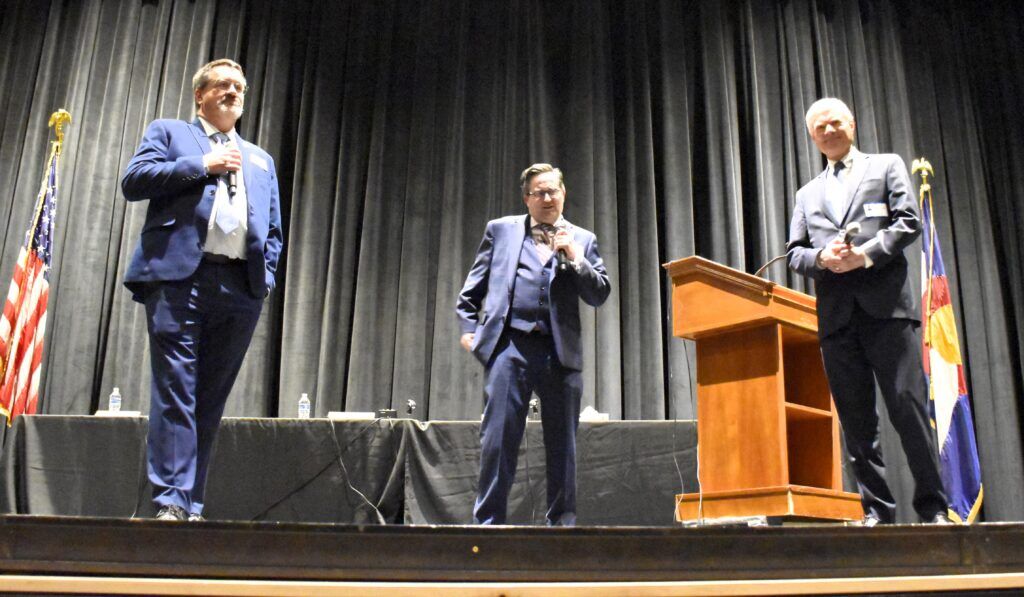
Tow, who was a trial judge in Adams County prior to his 2018 appointment to the appellate court, said he appreciated being able to look at someone in his courtroom as he explained why he was making a particular decision. In contrast, the Court of Appeals communicates primarily through its written opinions each Thursday.
“I thought all I cared about was the law ‘puzzle,’ and that’s why I got on the path that I chose,” he said. “I really wish I could do both jobs so that I could also see the people while I’m helping them understand why we’re doing what we’re doing when we impact their lives.”
The judges also explained that the relatively short length of arguments — usually 15 minutes per side — reflects the volume of appeals the court hears. Although most cases do not receive oral arguments, the Court of Appeals issues around 1,700 opinions each year.
“Last year, I think I announced 60 opinions. More than one a week. So, we have a limited time,” said Lipinsky.
“My average is authoring about 75 cases a year in the eight years that I’ve been here,” said Tow. “The Supreme Court, as a whole court, authored 60 cases last year.”
“It’s not a commentary, but you can do the math,” added Welling.
The Supreme Court will travel to Holyoke in April for its own Courts in the Community event.

Daniel Domenico to take over as Colorado’s chief federal judge
Michael Karlik
michael.karlik@coloradopolitics.com
Updated 3 hours ago
Daniel D. Domenico will become the new chief judge of Colorado’s federal trial court next week, a role that encompasses the administration of the court as well as a judicial caseload. Under federal law, the chief judge of a U.S....
10th Circuit upholds violations, sanctions against Colorado Springs mental health hospital
Michael Karlik
michael.karlik@coloradopolitics.com
Updated 3 hours ago
The Denver-based federal appeals court agreed earlier this month that the government properly cited and penalized a Colorado Springs psychiatric hospital for failing to protect its staff from known risks posed by patients. The Occupational Safety and Health Administration inspected...

Judge: CBI ordered to provide access to thousands of DNA cases
Jenny Deam
jenny-deam@coloradopolitics.com
Updated 21 minutes ago
Boulder County District Judge Nancy W. Salomone on Monday ordered the Colorado Bureau of Investigation to provide access to thousands of cases where past DNA analysis could be in question or show a pattern. The ruling came in a pre-trial...

Trial delayed for former Fountain city councilwoman accused of public assistance theft
Nick Smith
nick-smith@coloradopolitics.com
Updated 7 hours ago
The trial for a former Fountain City Councilmember accused of stealing over $37,000 in public assistance funds has been pushed to July. Detra Duncan, 55, resigned in mid-September 2025 after El Paso County investigators say they found forged documents that...
Judge Timothy Tymkovich to step aside, create Colorado-based vacancy on 10th Circuit
Michael Karlik
michael.karlik@coloradopolitics.com
Updated 37 minutes ago
Judge Timothy M. Tymkovich of Colorado has announced his intent to step aside as an active member of the Denver-based federal appeals court, creating the first vacancy for President Donald Trump to fill in his second term. In a Feb....
Divided appeals court reverses murder convictions due to faulty self-defense instruction
Michael Karlik
michael.karlik@coloradopolitics.com
Updated 41 minutes ago
Colorado’s second-highest court concluded last week that an incomplete self-defense instruction required the reversal of an El Paso County defendant’s murder convictions. Demetrius Montez Martin was among those present late at night at a club in Colorado Springs. An argument...

New Supreme Court member announced, justices hear oral arguments | COURT CRAWL
Michael Karlik
michael.karlik@coloradopolitics.com
Updated 2 days ago
Welcome to Court Crawl, Colorado Politics’ roundup of news from the third branch of government. The governor announced his pick to fill a vacancy on the state Supreme Court, and the justices heard oral arguments in multiple criminal and civil...
Colorado’s federal judges maintain approach to immigration detentions while escalating warnings
Michael Karlik
michael.karlik@coloradopolitics.com
Updated 4 days ago
Colorado’s federal judges are maintaining their view that the government’s assertion of broad immigration detention authority is unlawful, casting aside a recent appellate decision to the contrary as “unpersuasive” and out of step with the predominant interpretation by the judiciary....
U.S. Supreme Court strikes down Trump’s tariffs, upending central plank of economic agenda
Lindsay Whitehurst
lindsay.whitehurst@associatedpress.com
Updated 5 days ago
WASHINGTON • The Supreme Court struck down President Donald Trump’s global tariffs on Friday, handing him a major loss on an issue crucial to his economic agenda. The 6-3 decision centers on tariffs imposed under an emergency powers law, including...
Federal judge partially allows challenge to proceed against Colorado unclaimed property program
Michael Karlik
michael.karlik@coloradopolitics.com
Updated 5 days ago
A federal judge allowed some claims to proceed last week against Colorado’s treasurer, based upon alleged constitutional violations flowing from the state’s process for reuniting people with their unclaimed property. Previously, U.S. District Court Judge Charlotte N. Sweeney dismissed the...
PREV
PREVIOUS

Ex-Cherry Creek superintendent must repay one month’s salary after abrupt resignation
Former Cherry Creek School District Superintendent Chris Smith must repay one month’s salary for failing to provide the board of education with three-month’s notice of his resignation, The Denver Gazette has learned. The board of education has not waived the requirement, Ashley Verville, a district spokesperson, said in an email. Verville declined to say what […]

Bipartisan opposition sinks eviction bill in Colorado
Two Democrats sided with Republicans on the House Judiciary Committee to kill a bill that would have made several changes to eviction filings and proceedings, including requiring judges to suppress court records. Sponsored by Rep. Junie Joseph, D-Boulder, House Bill 1047 would also have required landlords to provide tenants with an additional rent payment option […]