

Colorado justices question process for parole board appeals
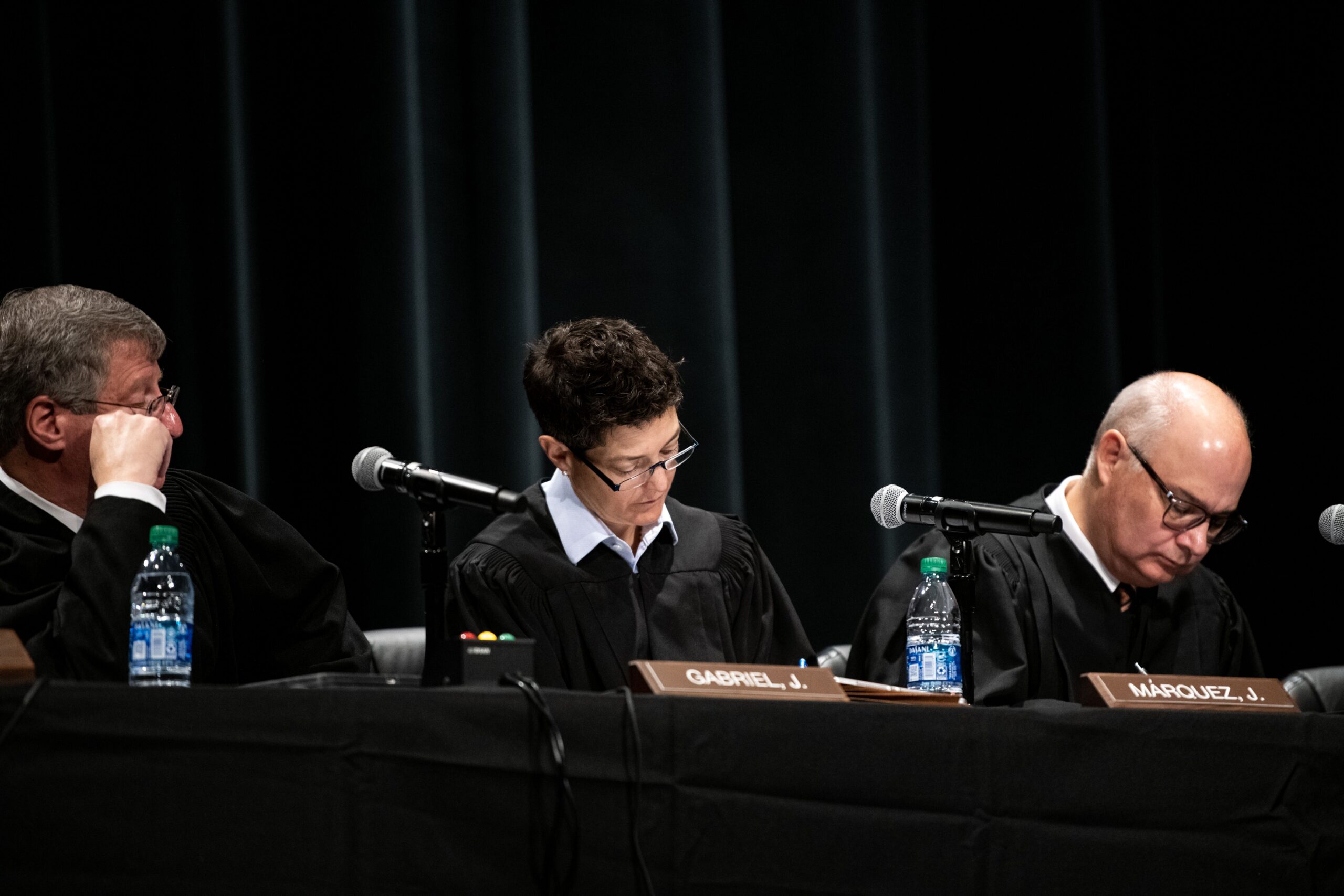
The Colorado Supreme Court considered on Tuesday whether criminal defendants whose parole is revoked must appeal the decision internally to the state’s parole board before seeking review by a judge.
The process for returning someone to incarceration for violating the conditions of their parole first entails a hearing by one member of the Colorado State Board of Parole. Afterward, the defendant “may appeal” the decision to two other members of the parole board. Separately, defendants can file a petition for postconviction relief based on “unlawful revocation of parole.”
But if a defendant “may appeal” with the parole board and chooses not to, can he still seek relief from the courts?
The legislature “could’ve said, ‘If the defendant here chooses to appeal, they shall….’ Something like that,” said Justice Richard L. Gabriel during oral arguments. “How do we get from ‘may’ to require that?”
Yet, the parole board appeal is “just another layer of due process. I kind of feel, what’s the harm in having that?” wondered Justice Brian D. Boatright.
In 2024, a divided three-judge panel of the Court of Appeals ruled for the first time that judges may hear challenges to parole revocations without the defendant needing to go through a parole board appeal. The majority concluded that the law does not require an appeal.
Judge Grant T. Sullivan dissented, worrying that the ability of defendants to “leapfrog” a parole board appeal would result in negative consequences.
“For example, allowing parolees to bypass the appellate body’s review will deprive the Board of its ability to correct errors committed by the single Board member who presided over the initial revocation hearing, potentially leading to even more protracted litigation that could have been avoided,” he wrote.
Sullivan added that the requirement in other contexts for a person to go through an executive agency’s internal grievance process before filing suit is intended to promote efficiency, allow subject matter experts to weigh in first, and conserve judicial resources.

The Colorado Attorney General’s Office appealed, arguing that it is a defendant’s choice whether to accept the revocation or challenge it, but that challenge must first go through the parole board.
By going straight to the courts, defendant Shams Abdul-Rahman “had to wait for three years now to get the decision,” said Assistant Attorney General Fellow Leo T. Nguyen. “The appellate body process would have afforded him potentially quicker relief.”
Jeffrey C. Parsons, representing Abdul-Rahman, argued that a parole board appeal can correct “narrow” errors, but he worried that defendants would lose the chance to seek judicial review if they do not understand the appeal process.
“I think it’s sometimes difficult as lawyers to put ourselves in the shoes of people who aren’t lawyers, and don’t understand the process and the procedures and what the failure to do that appeal my result in,” he said. “Frankly, when my clients get initially re-incarcerated, there’s a whole period of time just as a practical matter where it’s difficult for them to even get paper or to get into the law library.”
“My only experience was when I was a trial court judge; they would conduct parole hearings in my courtroom when I wasn’t using it. So, I kind of observed it seemed like it was a conversation,” said Boatright. “Seems like that’s a more friendly environment.”
While that may be the case for the initial hearing, responded Parsons, defendants do not participate in the parole board appeal.
Gabriel agreed that the parole board appeal could be a “trap” for defendants who are not told what they must do.
“They don’t have to be notified that they have this application and it’s probably a very short fuse to file by this administrative deadline,” he said. “I would fear many, many defendants would just blow this.”
“As a practical matter, what are these defendants notified of?” asked Chief Justice Monica M. Márquez.
Nguyen said he did not know.
The case is People v. Abdul-Rahman.


Colorado leaders weigh next steps after Supreme Court rejects state ban on ‘conversion therapy’
Marissa Ventrelli
marissa.ventrelli@coloradopolitics.com
Updated 15 hours ago
Colorado leaders said they are weighing next steps after the U.S. Supreme Court on Tuesday rejected the state’s ban on “conversion therapy” for children, as critics and supporters cheered or lambasted the ruling. The court’s near-unanimous decision called the Colorado...
Federal judge dismisses U.S. government lawsuit against Colorado, Denver’s ‘sanctuary’ laws
Michael Karlik
michael.karlik@coloradopolitics.com
Updated 14 hours ago
A federal judge dismissed the U.S. government’s lawsuit against Colorado and Denver on Tuesday, which alleged that various local policies impermissibly infringed on federal immigration enforcement. U.S. District Court Judge Gordon P. Gallagher followed the lead of judges in Illinois...
Federal judge finds DOJ adequately searched for, disclosed records related to Bidens
Michael Karlik
michael.karlik@coloradopolitics.com
Updated 19 hours ago
A federal judge determined on Friday that the U.S. Department of Justice adequately searched for and disclosed records to a Colorado attorney in response to his request for documents related to former President Joe Biden’s son and brother. In November...
10th Circuit warns lawyers after finding fake case in filing
Michael Karlik
michael.karlik@coloradopolitics.com
Updated 13 hours ago
The Denver-based federal appeals court warned attorneys to be more careful last month after discovering one lawyer cited a fake case in his arguments. In recent months, federal and state judges in Colorado have begun cautioning lawyers explicitly about the...

10th Circuit rules cognitively impaired man’s risk of lobotomy, mistreatment in Mexico not ‘torture’
Michael Karlik
michael.karlik@coloradopolitics.com
Updated 1 day ago
The Denver-based federal appeals court concluded last month that a man’s risk of mistreatment or forced lobotomy in his native Mexico did not amount to “torture” that should shield him from deportation. A three-judge panel of the U.S. Court of...
Colorado justices side with news organizations for disclosure of high-level child abuse data
Michael Karlik
michael.karlik@coloradopolitics.com
Updated 16 hours ago
The Colorado Supreme Court ruled on Monday that the state must disclose the number of child abuse reports at individual group living facilities in response to an open records request, as the addresses are already in the public domain. The...
Divided Colorado Supreme Court finds Denver detective did not violate defendant’s Miranda rights
Michael Karlik
michael.karlik@coloradopolitics.com
Updated 1 day ago
The Colorado Supreme Court determined on Monday that a Denver detective did not improperly resume questioning of a defendant in custody after he invoked his right to counsel. By 4-3, the justices reversed a trial judge’s order that found a...

Out-of-state judges address ex-discipline director’s lawsuit, Colorado justices accept federal invitation | COURT CRAWL
Michael Karlik
michael.karlik@coloradopolitics.com
Updated 2 days ago
Welcome to Court Crawl, Colorado Politics’ roundup of news from the third branch of government. A pair of out-of-state judges got down to business in a lawsuit brought by Colorado’s former judicial discipline director, plus the state Supreme Court has...
Federal judge upholds constitutionality of Colorado campaign contribution limits
Michael Karlik
michael.karlik@coloradopolitics.com
Updated 5 days ago
A federal judge upheld Colorado’s individual campaign contribution limits as constitutional on Thursday, finding that three Republican plaintiffs failed to prove the campaign finance framework violates their First Amendment rights. U.S. District Court Senior Judge John L. Kane recognized that...

Appeals court rejects theory that existing tax revenue undermines need for new fees
Michael Karlik
michael.karlik@coloradopolitics.com
Updated 5 days ago
Colorado’s second-highest court rejected a plaintiff’s claim on Thursday that the tax revenue generated by an existing activity should prevent local governments from imposing new fees aimed at regulating the activity. The question stemmed from Colorado’s unique constraints on taxation...
PREV
PREVIOUS

Leaders, past and present, inducted into Colorado Business Hall of Fame | NONPROFIT REGISTER
JUNIOR ACHIEVEMENT ROCKY MOUNTAIN DENVER METRO CHAMBER OF COMMERCE Denver News: The men and women who were inducted into the Colorado Business Hall of Fame this year made their marks in different ways, yet they had this in common: They dared to take a chance. And they had the courage to see things through when others questioned the wisdom of […]

Missy Woods pleads not guilty; trial set for fall
The former Colorado Bureau of Investigation DNA expert charged with more than 100 felonies entered a plea of not guilty to all of them Wednesday in a packed Jefferson County courtroom. The plea was entered by her defense attorney Tom Ward. Yvonne Woods, who goes by the name Missy, was the state’s former top DNA […]