

‘Utterly no precedent’: Federal judge expresses concerns about Jeffco’s early appeal in jail death case
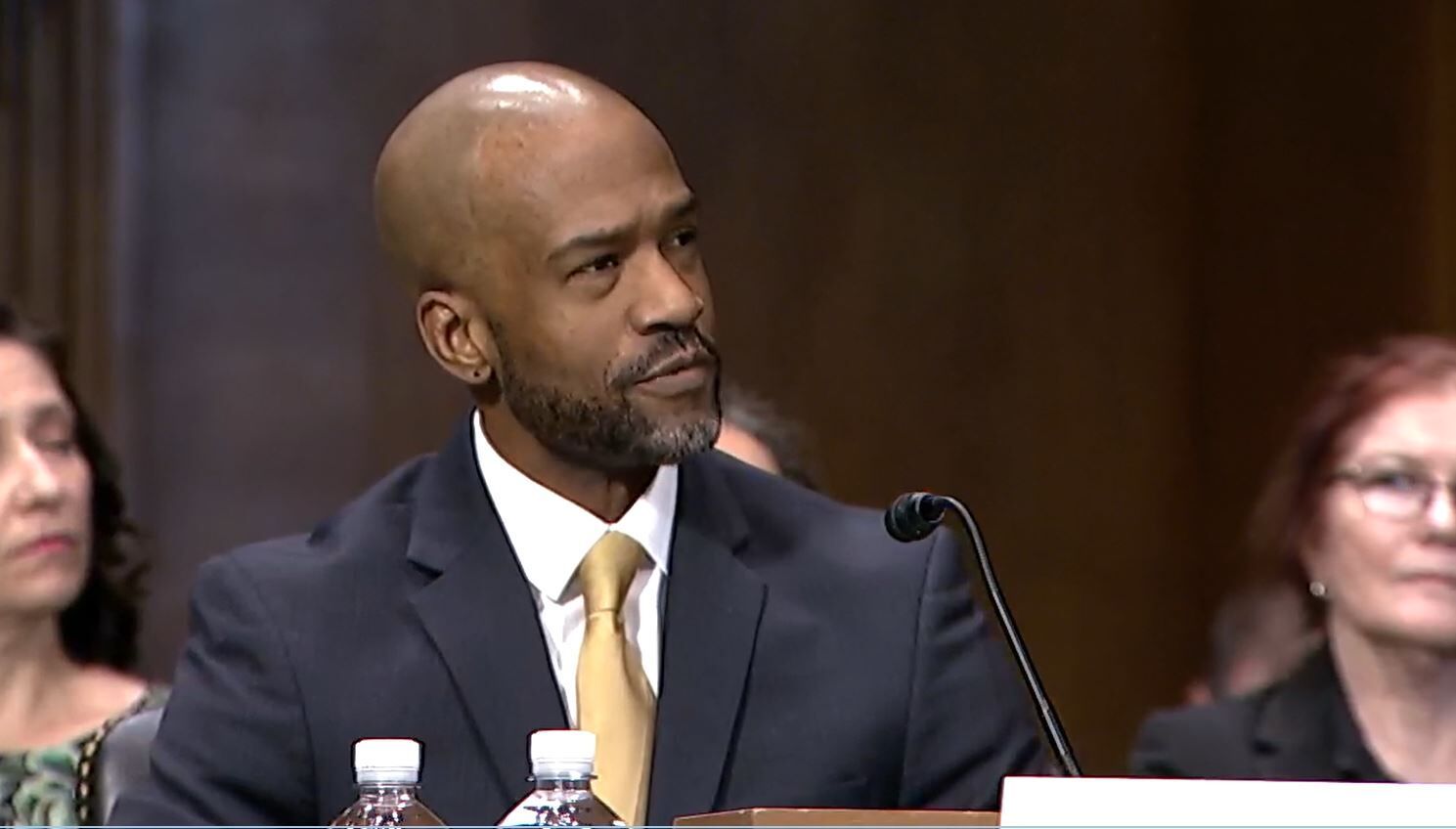
A federal judge shared his concerns on Monday about Jefferson County’s appeal of a routine procedural order in a constitutional rights case, which the plaintiffs argued could spawn appeal-related delays in countless lawsuits against the government.
During a hearing, U.S. District Court Judge S. Kato Crews noted he could find no decisions backing up the county’s position that judges must halt, or stay, civil lawsuits until they determine whether government officials are entitled to immunity. Consequently, he took offense to Jeffco’s claim that Colorado’s federal judges have developed a habit of improperly “citing themselves rather than binding precedent” when deciding whether to stay cases.
“I take that seriously. I think that gets thrown out too easily these days, accusing courts of not following precedent,” he said.
In the underlying lawsuit, the surviving family of James Purdy has sued Jefferson County, its elected sheriff, several jail personnel and the jail’s medical contractor. The family alleges Purdy, 76, died in custody after numerous falls that jail staff knew about, yet failed to prevent. The claims include violations of Purdy’s constitutional right to adequate medical care, the Americans with Disabilities Act, and Colorado’s constitution and laws.
The Jeffco sheriff’s defendants moved in April to dismiss the claims against them. For the federal constitutional claim specifically, they invoked qualified immunity, a judicially created concept that shields government employees from civil lawsuits unless they violate a person’s clearly established rights.
Government defendants can assert qualified immunity early on with a motion to dismiss, or they can raise it in a motion for summary judgment after the discovery of evidence has run its course. Notably, unlike most orders that can only be appealed at the conclusion of a case, a defendant can appeal a trial judge’s order denying qualified immunity immediately.
Shortly after the Jeffco defendants filed their motion to dismiss, they also asked the court to stay the case until Crews could determine whether the individual employees were entitled to immunity. U.S. Magistrate Judge Timothy P. O’Hara responded that he was “not persuaded” Jeffco demonstrated a need to pause the proceedings. Instead, he allowed for “staggered” witness depositions to occur between September and November.
Jeffco challenged O’Hara’s decision to deny a stay, but Crews found the order justified.
“Judge O’Hara’s order is consistent with a long line of cases that find the assertion of qualified immunity alone does not entitle a defendant to a stay,” he wrote on Oct. 7. “Moreover, due to the related state law claim which affords no Defendant qualified immunity, the Sheriff Defendants will have to participate in discovery anyway.”
Then, Jefferson County did something unusual: It immediately appealed Crews’ decision to the U.S. Court of Appeals for the 10th Circuit.
Under the county’s logic, a key purpose of qualified immunity is to protect government employees from “the ordinary burdens of litigation.” If defendants have to sit for depositions, they are experiencing the burdens of litigation and, effectively, have been denied qualified immunity. Therefore, defendants are entitled to appeal immediately.
“There’s utterly no precedent for what they are doing here,” Darold W. Killmer, the plaintiffs’ attorney, told Crews.

He asked Crews to label Jeffco’s appeal “frivolous,” a move that would enable Crews to forge ahead with the case even as the 10th Circuit resolves the appealed issue. In doing so, Killmer asserted that government defendants already seek to delay civil rights cases. If the courts treated other types of rulings against the government as entitled to immediate appeal, it would be an opportunity for further setbacks.
“Families are grieving. They are certainly far less resourced than the defendants,” Killmer said. “A ruling in favor of Jefferson County on this will open a Pandora’s box for all defendants.”
Crews, meanwhile, grappled with the mechanics of Jeffco’s appeal. If his denial of a motion to stay was the equivalent of him denying qualified immunity, “what’s the motion to dismiss worth then?” he wondered. “Why would we then spend time on a motion to dismiss that raises that issue?”
Assistant Deputy County Attorney Rebecca P. Klymkowsky, in denying her office purposefully seeks to delay cases, responded that “the law is very clear” about public officials’ entitlement not to be burdened with litigation where they are immune. Practically, requiring the defendants to give testimony was one such burden.
“Qualified immunity was not any part of the analysis or anything I ruled upon,” countered Crews. “As I understand your argument, this would apply in any cases where qualified immunity is raised. That once a motion to dismiss is filed, an automatic stay of discovery should enter as to those defendants. Is that your view?”
“I don’t know that anyone has explicitly said that stays in this context are automatic,” Klymkowsky responded.
Crews said he will issue a written order on the plaintiffs’ request to declare Jeffco’s appeal frivolous.
The case is Estate of Purdy et al. v. Jefferson County, Colorado et al.


Federal judge recommends dismissing trans athletics lawsuit by area school districts
Eric Young
eric.young@gazette.com
Updated 10 hours ago
A judge has recommended dismissing a federal lawsuit filed by multiple school districts against the Colorado Attorney General’s and Civil Rights Offices over their policies dictating students’ participation in athletics and activities based on their biological sex rather than gender...
Appeals judge asks Colorado Supreme Court to once again clarify magistrate rules
Michael Karlik
michael.karlik@coloradopolitics.com
Updated 11 hours ago
A member of Colorado’s second-highest court urged the state Supreme Court last week to revise confusing language in the rules governing magistrates, less than two weeks after an attempted cleanup of the rules took effect. Magistrates are judicial employees who are...

10th Circuit dismisses paralyzed man’s claims against Colorado Springs, officer
Michael Karlik
michael.karlik@coloradopolitics.com
Updated 18 hours ago
The Denver-based federal appeals court upheld the dismissal last week of a man’s excessive force claims against the city of Colorado Springs and the officer who tased him, causing him to fall down a sloped surface and break his neck....
Colorado justices weigh overlap between child prostitution offenses
Michael Karlik
michael.karlik@coloradopolitics.com
Updated 9 hours ago
Members of the Colorado Supreme Court last week appeared willing to uphold a man’s conviction for an attempted child prostitution offense, which the state’s second-highest court previously found to be a violation of his right to equal protection under the...

State Supreme Court holds oral arguments, 10th Circuit revives dormant initiative | COURT CRAWL
Michael Karlik
michael.karlik@coloradopolitics.com
Updated 2 days ago
Welcome to Court Crawl, Colorado Politics’ roundup of news from the third branch of government. The state Supreme Court heard oral arguments last week in multiple civil and criminal cases, plus the Denver-based federal appeals court is doing something unusual...
Is a pardon for Tina Peters coming? Colorado governor confirms he is weighing options
The Denver Gazette
the-denver-gazette@coloradopolitics.com
Updated 1 day ago
Gov. Jared Polis on Friday strongly indicated he is considering clemency for Tina Peters, the former county clerk convicted of a security breach at her election office. When pressed about the matter, Polis didn’t offer an explicit answer, but he...
10th Circuit oral arguments to feature trial judges for first time in 12 years
Michael Karlik
michael.karlik@coloradopolitics.com
Updated 4 days ago
When the Denver-based federal appeals court convenes next week to hear oral arguments, six new faces will be staring down from the bench. No, the U.S. Court of Appeals for the 10th Circuit has not added six new members. It...
Federal judge says ICE cannot impose monitoring conditions beyond immigration judge’s order
Michael Karlik
michael.karlik@coloradopolitics.com
Updated 5 days ago
A federal judge told U.S. Immigration and Customs Enforcement on Thursday that it cannot impose additional restrictions or monitoring conditions beyond those ordered by an immigration judge when releasing a person on bond. In November, U.S. District Court Judge Gordon...
Colorado justices weigh constitutionality of student backpack search based on confidential tip
Michael Karlik
michael.karlik@coloradopolitics.com
Updated 3 days ago
The Colorado Supreme Court considered on Wednesday whether a tip submitted through the state’s confidential school safety system provided a Douglas County administrator with reasonable suspicion to search a student’s backpack for drugs. A trial judge blocked evidence from the...
10th Circuit rebuffs Jeffco’s attempt to expand immunity footprint
Michael Karlik
michael.karlik@coloradopolitics.com
Updated 5 days ago
The Denver-based federal appeals court confirmed on Wednesday that it would not treat a judge’s decision to move a civil case forward as the automatic equivalent of denying immunity to governmental officials. The order from the U.S. Court of Appeals...
PREV
PREVIOUS

Justice Hart's absence continues, state Supreme Court hears oral arguments | COURT CRAWL
Welcome to Court Crawl, Colorado Politics’ roundup of news from the third branch of government. One member of the Colorado Supreme Court remains on an unusual leave of absence, plus the court heard oral arguments in eight more cases last month. Justice Hart’s absence continues • Previously, Colorado Politics reported that Justice Melissa Hart has been […]

Copper Creek yearling wolf blamed for livestock death in Gunnison County
A heifer found dead in eastern Gunnison County on Nov. 22 was killed by one of the yearlings from the Copper Creek wolf pack, according to a rancher, who did not want to be identified. It’s the fourth livestock death in November attributed to wolves. Two calves and a ewe were also killed by wolves […]