

Residents brace for change as Salvation Army transitions from operating Denver’s hotel shelters

It was a scorching day in Denver on Sept. 1, 2023, when Bernadette McMurrin’s aunt, Christina Martinez, passed away in a small apartment.
McMurrin, 41, who considered Martinez more of a godmother than an aunt, had moved back to Denver from Las Vegas to serve as her caretaker.
But because McMurrin was not explicitly named on her aunt’s lease, she had no legal rights to the West Second Avenue apartment nor to any of its household contents.
“She hadn’t even been gone for two hours,” McMurrin said of her aunt’s death. “They changed the locks, called me up, and told me I had to vacate the premises, and that I couldn’t take anything with me because they couldn’t decipher whose belongings belonged to who.”
With the few clothes and personal items she managed to grab, McMurrin, who struggled not only financially but also with addiction, was forced to live in her truck.
That was the day, McMurrin said, she became homeless in Denver.

But now, as strings of holiday lights signal a transition to the holiday season, McMurrin and other residents of the Tamarac Family Shelter, where she now resides with her infant daughter, see those lights signaling a transition of a different kind – that of an impending change in the shelter’s service providers.
On Dec. 31, The Salvation Army, which has operated Denver’s three largest homeless hotel shelters, will pass the baton to three new contractors selected by the city in October.
The shelters have played a prominent role in Mayor Mike Johnston’s “All In Mile High” project, which the new mayor launched in 2024 to end homelessness.
Urban Alchemy, a new provider to Denver that operates shelters in cities across the country, including San Francisco, Los Angeles, Birmingham, Santa Fe, Atlanta and Portland, will take over the former DoubleTree, now known as The Aspen, at 4040 Quebec St. in Denver.
Bayaud Works and St. Francis Center will expand their existing roles in Denver’s homelessness response. The St. Francis Center will operate the Stone Creek Shelter at 4595 Quebec St., and Bayaud will serve as the provider for the Tamarac Family Shelter at 7525 E. Hampden Ave.

The selections mark the first step after the city’s decision to transition from flat-fee service-provider contracts to performance-based contracts, and its intent to focus on “throughput,” meaning moving people out of shelters faster and into permanent housing.
The switch comes on the heels of a breakdown between city officials and The Salvation Army, which will conclude operations at the three shelters at the end of the year.
However, for shelter residents, McMurrin said, such a change can often be frightening for those who have developed relationships with staff and caseworkers.
HOTEL SHELTER MODEL PROBLEMATIC
It’s not difficult to find troubling stories related to the city’s hotel shelters.
With security failures, poor building maintenance and a lack of financial oversight from the city’s Office of Housing Stability, the challenges for both the city and The Salvation Army in attempting to serve the homeless population became clear over time.
The Salvation Army began operating shelters in the city in April 2020, at the request of then-Mayor Michael Hancock, to provide housing for the homeless during the pandemic.
But as the years passed and the administration changed, the city’s mission to house the homeless grew significantly, and it added multiple facilities at record speed, according to officials.
During an earlier interview with The Denver Gazette, Salvation Army Communications Director Jennifer Forker said one of the organization’s most significant challenges has been “just the sheer volume” of Denver’s sheltering needs.
“Turning a very large hotel into a sheltering site is new for Denver; it’s new for The Salvation Army,” Forker said. “The Salvation Army took on the All In Mile High initiative to serve the city, as well as some of its most challenging people, with the greatest of needs — and we do that with a glad heart.”
However, the city’s hotel-shelter model is no longer a “sustainable” one for The Salvation Army, according to Maj. Nesan Kistan, the charity’s intermountain division commander.

Kistan told The Denver Gazette that, over the past five years, the city’s shelters have taken a toll on his organization.
“What we discovered post-pandemic was that while we were still stepping in good faith, these shelters were costing The Salvation Army a considerable amount of its own resources,” he said. “In fact, as we estimate, since April 2020, the number (of operational dollars) is well over $21 million.”
Kistan said the pace of spending was becoming problematic and The Salvation Army could no longer sustain the level of cost “that was now showing as an operational deficit.”
“It is also important to note,” he said, “that for more than six months of the 2025 calendar, The Salvation Army was operating the three hotel shelters without any reinvestment while we were trying to resolve some of the contractual challenges (with the city).”
Late contract extension requests put Denver councilmembers over a proverbial barrel.
During a June council meeting, District 10 Councilmember Chris Hinds said he was concerned with the late contract addition for services at The Crossroads, a 300-bed emergency shelter for the homeless, describing it as placing the council in “a bit of a hostage situation.”
“On one hand, we’re being asked to approve a contract with a provider who has some serious allegations against (them),” City Council President Amanda Sandoval said. “And on the other hand, not approving this contract would mean displacing nearly 300 people every night and put them back on the streets and exposing them to harm.”
DENVER SHIFTS HOMELESS STRATEGY
Although fewer people are sleeping on the streets in Denver, the total number of homeless individuals in the city has grown, even after significant spending by the city.
This year, a total of 7,327 people were counted as homeless — a number that grew by 788 over 2024, according to the newest annual point-in-time (PIT) count released by the Metro Denver Homeless Initiative in June.
The count is a nationwide, yearly, unduplicated count of the homeless population conducted on a single night in January.
City housing officials have indicated that Denver is “not planning” to add additional beds but instead will focus resources on “throughput,” moving those in shelters toward more permanent housing.
Johnston’s efforts to house the homeless have cost a lot more than anticipated.
A briefing from the city’s Department of Housing Stability (HOST) last June revealed the city was on track to spend $155 million between July 2023 and December 2024 — $65 million more than the mayor previously said it would cost.
But 2025 brought new complications for the city, including a funding cliff triggered by the loss of the city’s $308 million, one-time American Rescue Plan Act funding and an impending $250 million city budget deficit, spanning two fiscal years.
“Now, we’re at the point in our strategy where we’re really focused on how do we get those folks that we brought indoors into shelter, out of shelter, into permanent housing,” Denver Senior Advisor for Homelessness Resolution Cole Chandler said at a news conference announcing the new PIT numbers.
Part of that strategy is the city’s move from its previous flat-fee service shelter service provider contracts — such as those with The Salvation Army — to performance-based contracts.
As envisioned, the move means new vendors will see increased security from the city.
Rather than reimbursing providers for their expenses, HOST will pay shelter service providers based on agreed-upon performance metrics, such as bed count, case management and the number of completed housing assessments.
The new contracts are for shelter services and do not include housing placement.
City officials tout the new contracts’ structure as a way to improve shelter performance and safeguard taxpayer dollars.
“Under the new performance-based contracting model, HOST will closely monitor provider performance to ensure accountability and improved outcomes,” Julia Marvin, a HOST spokesperson, said.
In theory, the frequency of performance evaluations and contract benchmarks will align with specific targets designed to reward “high-performing programs” that deliver “real results” for the city’s homeless initiatives.
All expected outcomes are client-focused, and data will come from the Homeless Management Information System managed by the Metro Denver Homeless Initiative, officials said.
“In this pay for performance model, providers have a financial incentive to achieve the expected outcomes,” Marvin added. “If a provider fails to meet critical benchmarks, HOST will work closely with them to implement corrective action plans. If issues persist, HOST has the flexibility to terminate the contract.”
While 2026 will be a year of change for The Salvation Army, Kistan said that his organization is only “pivoting.”
He said The Salvation Army is not stepping away from its sheltering mission, only from the city’s hotel-based sheltering program.
“We recognize that this model may not be best suited to what our deemed strategy is in addressing and resolving homelessness,” he said.
The Salvation Army will continue to operate the Lambuth Family Center, a short-term family shelter; the Connection Center, which provides access to The Salvation Army and community resources and services; the Harbor Light Center, a place for men recovering from addiction or looking to prevent a relapse; and the Crossroads Center, a 24/7 emergency shelter serving at least 250 men daily in partnership with the city.
SALVATION ARMY PIVOTS BACK TO REHABILITATION
Salvation Army officials said the organization plans to redirect many of the resources it had invested in the city’s hotel shelters back into drug and alcohol rehabilitation, a core mission of the organization.
“I want to be abundantly clear that we’re not diminishing our footprint or our support,” Kistan said. “We’re actually putting better quality resources into the programs that we have had to rob from so that we could help the city with its challenge and its initiatives at that critical point and juncture. We’re actually putting back the level of investment that’s needed for drug and alcohol rehabilitation.”
Kistan said that, after the first of the year, The Salvation Army will reinject “some significant investment” into the Harbor Light Center, its signature rehabilitation program, located on Champa Street.
Additionally, more resources will be allocated to family sheltering and to the Connection Center, The Salvation Army’s central point of contact for individuals and families seeking shelter referrals, cold weather resources, financial aid for rent and utilities, and referrals to other community programs.
Kistan said he also hopes to see overall improvements in technology infrastructure and to incorporate artificial intelligence into the Connection Center to increase its capacity to handle the city’s growing needs.
“Lambert needs an urgent series of property and capital reworks,” he said. “It needs better heating and better cooling systems; the rooms need urgent attention – a better investment of personnel, infrastructure, and capital. We’ve neglected a lot of those things because we’ve been distracted by this other urgent situation.”
SOME SHELTER RESIDENTS WORRY
For many of the city’s shelter residents, a safe place to sleep is only part of the equation to getting back on their feet.
It’s the sense of community and connections with trusted staff members and caseworkers that help bring stability to even the most difficult of situations, they said.
News of the city’s plan to transition shelter operations from The Salvation Army to new operators raised worries among some shelter residents.
McMurrin was first housed at the Stone Creek facility, a former Best Western converted by the city into an all-adult shelter.
Soon after, she discovered she was pregnant with her daughter Roseé.
Struggling with addiction off and on, McMurrin, who is currently sober, was uncomfortable staying at the Stone Creek facility.

“There’s just a lot of addicts over there,” she said. “There’s a lot of drugs, a lot of addicts. It’s an adult-only shelter – geared for adults.”
After pleading her case, a staff member transferred her to the Tamarac Family Shelter. She said she finally feels she’s in the “right” place.
But with news of the shelter’s transition to its new service provider, Bayaud, McMurrin is worried about losing many of the first solid connections she’s had.
“As far as my case management, I trust my case manager. I trust the people who are here,” she said. “That takes months and months and months to do, to be able to gain trust, you know, to be able to feel comfortable enough to let people know what you need.”
City officials said they expect no service interruptions during the transition period.
“Our goal is a seamless transition, and we are taking every step to make it so,” Marvin told The Denver Gazette. “HOST is prioritizing continuity of care for residents and is working to retain as many current staff as possible by helping match them with open roles at the new provider agencies or within Denver’s broader homelessness response system.”
Salvation Army officials said they have been meeting weekly with HOST and other stakeholders to ensure a smooth transition.
The Denver Gazette spoke briefly with Raven Sexton, Bayaud Works’ corporate liaison officer, who agreed to a telephone interview to discuss the upcoming transition.
At the scheduled interview time, Sexton’s phone went to voicemail. Multiple attempts to contact her, including emails, went unanswered.
A HOST spokesperson said that “leadership from the new providers has been onsite at each shelter for orientation and training, working side-by-side with current teams to prepare for the handoff.”
The spokesperson added that HOST has arranged listening sessions with shelter guests at all three sites, giving residents the opportunity to share feedback and “shape the future of shelter operations.”
Salvation Army Non-congregate Shelter Director Tyler Burwell said his organization has been working closely with its successors.

“Although we have deemed these projects something that we can no longer shoulder, we take a lot of pride in the work we do, in supporting the people that we support, and so we want the transition to be as smooth as it possibly can be,” Burwell said.
He said that The Salvation Army is working to account for everything, including the transition of the shelter facilities, as well as the associated programs and documentation, “so that everybody’s in alignment, and that guests really see very little transition.”
Kistan said time was a precious commodity his organization didn’t have when it began operating the city’s hotel shelters.
“We didn’t have transitional time; we stepped right into the mix,” Kistan said. “He (Mayor Mike Johnston) wanted 1,800 people off the streets within a calendar year. We didn’t have the opportunity to slowly find our way, to do the lateral thinking, to do the vetting.”
Kistan said The Salvation Army is not looking for applause, adding that, when it comes to publicity, it is “very silent in this space.”
“But each of these (new) operators have been given significantly more prep time, planning time, thinking time, reviewing of security issues and challenges. None of which was afforded to The Salvation Army,” Kistan said.
Salvation Army officials said that as the city moves from a single service provider to three, it will allow more focus to be placed on the work being done and less on the provider.
SHELTER STAFF IN TRANSITION
Across the three transitioning shelters, there are close to 230 Salvation Army staffers and caseworkers.
New service providers mean that employees must interview and reapply for their current — or other — positions within the shelters.
“We deeply value the dedication of current staff and are committed to ensuring this transition is handled with transparency, respect, and support for everyone involved,” Marvin of HOST said.
Burwell noted that a “significant amount of folks” have already accepted positions with the new providers, but specific numbers were not yet available as each provider operates on a different timeline, making it challenging to track the numbers.
The Salvation Army has also hosted a job fair and regularly shares job postings from the new providers with its current staff in hopes of retaining top talent, as well as those who wish to continue working with the same shelter population.
Shelter employees that were contacted by The Denver Gazette were reluctant to comment on the process or their job status.
SHELTER RESIDENTS ARE GRATEFUL
Martina Rodriguez and her four children will soon put up a Christmas tree inside their room on the seventh floor of the Tamarac Family Shelter.
The kids are very excited.
Rodriguez, who suffers from seizures, is deaf.

Very protective of her husband and her children, Rodriguez said she is grateful for the opportunity to stay in the family shelter.
When The Denver Gazette informed her of the forthcoming change in service providers, she seemed taken by surprise.
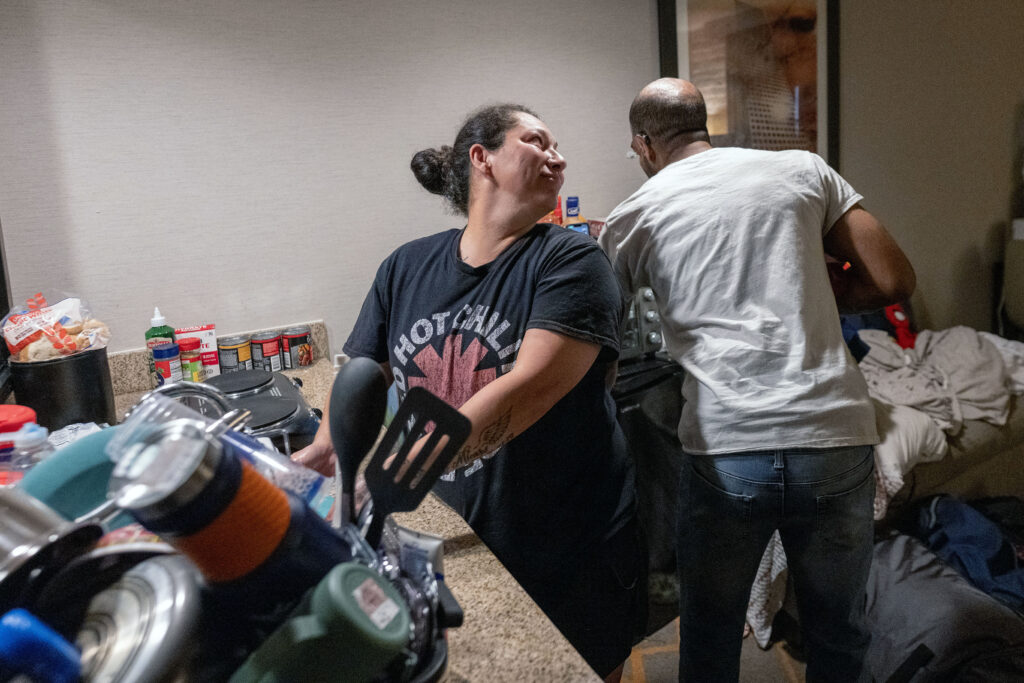
“I don’t trust people, you know, strangers or what have you, until I get some time with them, and they’ve been nice and friendly, and I develop that trust,” Rodriguez told The Denver Gazette through an American Sign Language interpreter. “But I am on guard, a little bit, about being taken advantage of.”
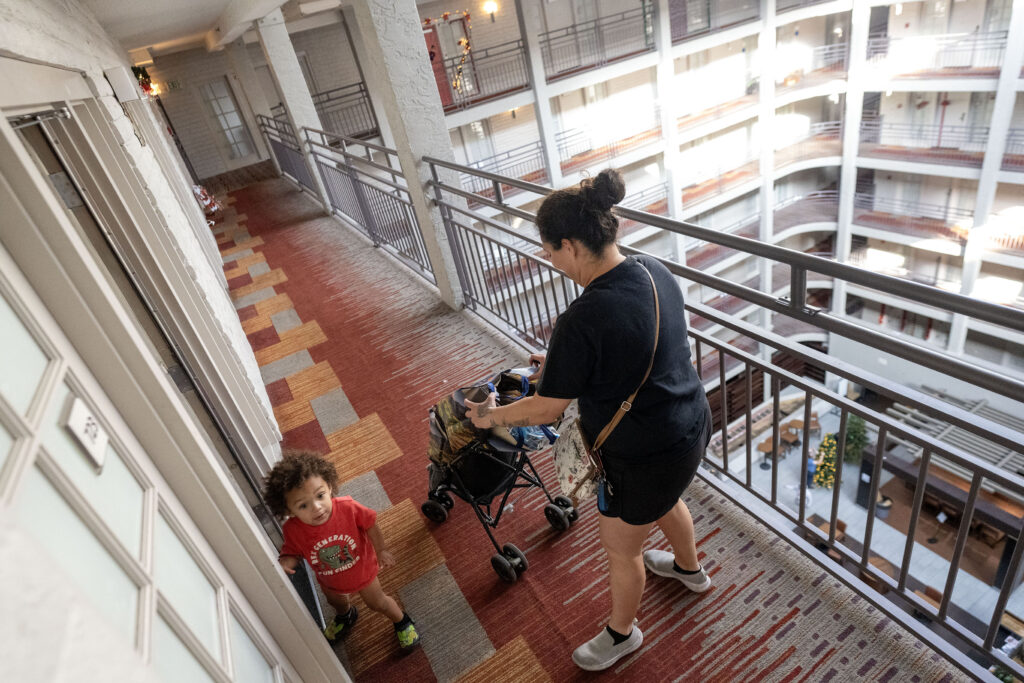
Rodriguez said that while she has a preference for the current shelter staff, and will remain guarded, she is open to changes.
Of the new staff, she asks only for clear communication, proper identification and a respect for her boundaries.
She’s even set up wireless security cameras in her room for “safety reasons.”
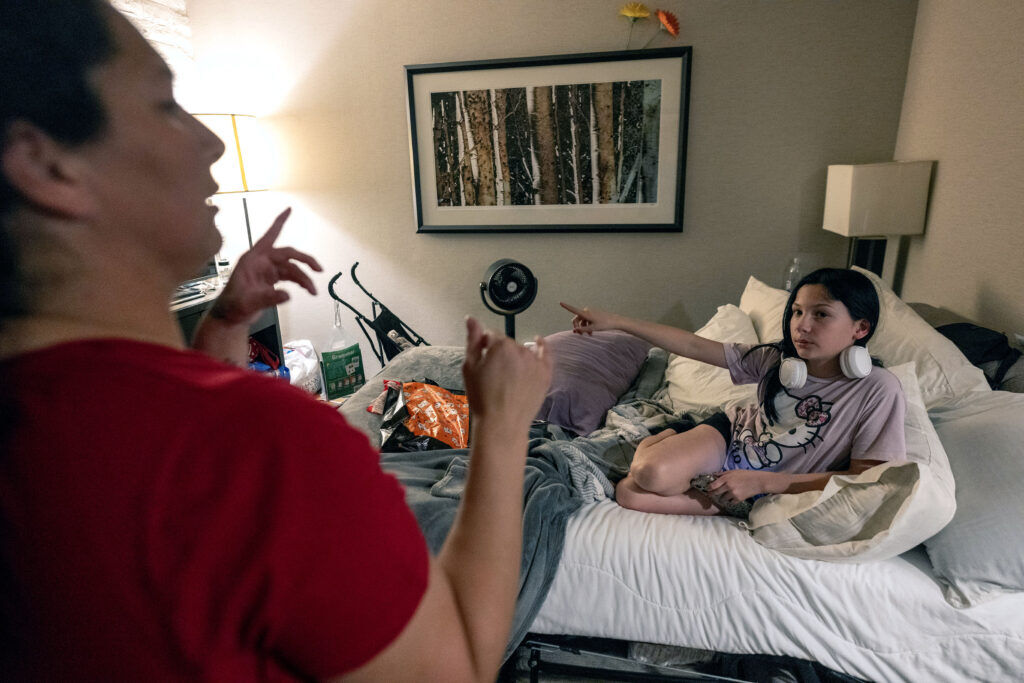
This year, her wish list includes permanent housing and she is excited about the possibility of getting an apartment of her own.
José, whose last name has been withheld by The Denver Gazette, moved to Denver from Mexico over a year ago with his family seeking stability and better opportunities.
“My country is wonderful. Mexico is also a very welcoming place to people from other countries,” José said, using a Spanish translator. “But we decided to come here because Mexico faces a lot of insecurity — cartels, assaults, robberies. There is a lot of insecurity in the streets.”
José and his family came to the Tamarac through a referral from the Colorado 2-1-1 resource line. He said the shelter has given the family the support they needed.
A former maintenance systems technician in his home state of Aguascalientes, José has worked odd jobs in the U.S., sweeping floors, cleaning bathrooms and washing windows to support his family.
“It is honest work, but completely different from my previous experience,” he said. “But we do it to adapt to the country that has offered us many opportunities.”
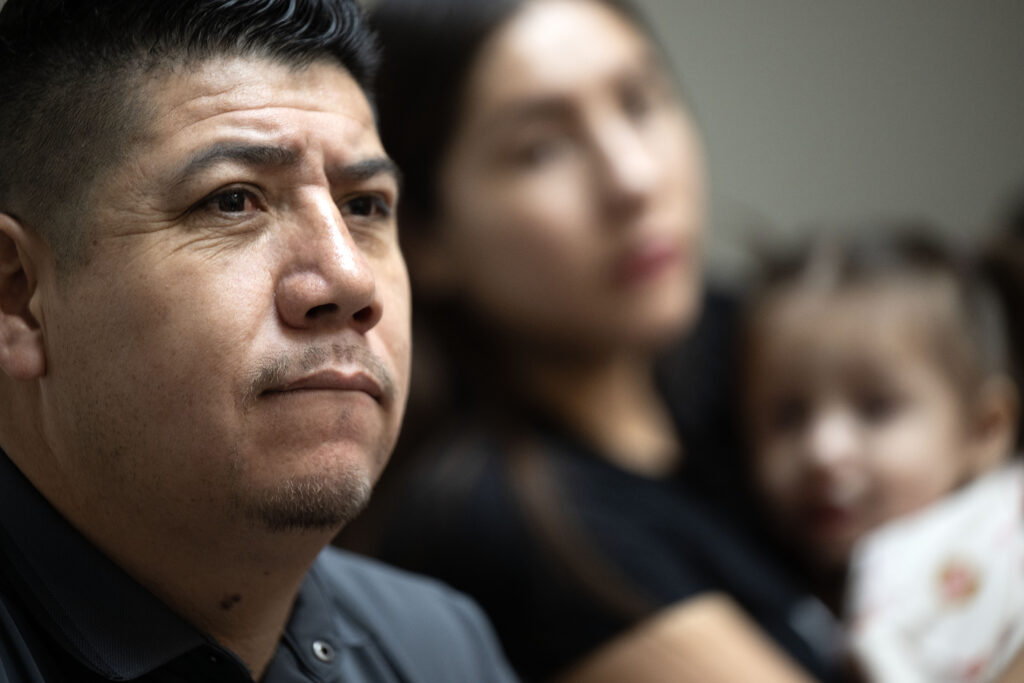
Now, a year later, the family of four, soon to be five, has secured permanent housing and José has a full-time job.
“I’m working. I have my own company doing construction and remodeling: bathrooms, kitchens, full apartments; we do plumbing and electrical work,” he said. “The Salvation Army gave us the foundation to start.”
José added, “We are super happy because we are in a new place, a safe place for our kids. We will have a beautiful Christmas. Our American dream.”
Editor’s note: The original version of this story said Christina Martinez passed away in an apartment provided by the Denver Housing Authority. Officials at the Denver Housing Authority said it has no record of assisting Martinez.


Colorado Sen. Mike Weissman calls for cold water on heated hate speech
Marianne Goodland
marianne.goodland@coloradopolitics.com
Updated 2 hours ago
Likening the recent record-setting warm temperatures to hot political rhetoric, Colorado Sen. Mike Weissman, D-Aurora, pleaded for an end to death threats and other hate speech directed at lawmakers of both parties. “The increasingly tragic reality of our politics, however, like...

Ethics panel dismisses complaint against Colorado agency chief Dan Gibbs
Marianne Goodland
marianne.goodland@coloradopolitics.com
Updated 3 hours ago
A state ethics panel has dismissed a complaint against Dan Gibbs, executive director of the Colorado Department of Natural Resources. The complaint, filed in December 2021 by the Republican-affiliated group Defend Colorado, alleged Gibbs awarded the think tank Keystone Policy...

It’s time to let unaffiliated voters caucus | Vince Bzdek
Vince Bzdek
vince.bzdek@gazette.com
Updated 7 hours ago
There’s no getting around it: Colorado’s 3,000 county caucuses, which just wrapped up recently, left half the electorate out in the cold. Since unaffiliated voters now make up 51% of all Colorado voters, a majority of Colorado electors are barred...

Colorado Senate committee advances bill increasing overtime threshold for farmworkers
Marianne Goodland
marianne.goodland@coloradopolitics.com
Updated 2 days ago
The struggle to balance farmworker protections with the survival of Colorado’s family farms took center stage Thursday as senators debated two competing overtime bills. The Senate Business, Labor and Technology Committee held a rare double-bill hearing that led to a...

Proposed data center regulation in Colorado draws critics, backers
Scott Weiser
scott.weiser@gazette.com
Updated 1 day ago
A packed marathon hearing at the state Capitol in Colorado highlighted the sharp divide between two competing approaches to the effects of data centers, one of America’s fastest-growing technology sectors. Data centers are the physical facilities that host the servers,...

Colorado revenue forecast worsens, pushing budget shortfall to nearly $1.5B
Marianne Goodland
marianne.goodland@coloradopolitics.com
Updated 3 days ago
The latest revenue forecasts from economists at the state Capitol show that the state’s budget predicament has worsened — by hundreds of millions of dollars more. That, in turn, means cuts programs and services in next year’s fiscal budget will...

With jails overcrowding, Gov. Jared Polis asks for new prisons as lawmakers face budget shortfall
Marianne Goodland
marianne.goodland@coloradopolitics.com
Updated 3 days ago
The Polis administration is asking for hundreds of millions of dollars to expand the state’s prison system, just as Colorado’s legislators are bracing for a worsening fiscal outlook. The request sets up a clash over priorities at a time when...
Costs explode for Colorado program covering pregnant women and children living in the U.S. illegally
Marianne Goodland
marianne.goodland@coloradopolitics.com
Updated 4 days ago
A state program providing health care to pregnant women and children living in the country illegally is costing far more than lawmakers expected, with expenses nearly tripling in just a year and threatening to squeeze Colorado’s budget amid a nearly...

Costs explode for Colorado program covering pregnant women and children living in the U.S. illegally
Marianne Goodland
marianne.goodland@coloradopolitics.com
Updated 5 days ago
A state program providing health care to pregnant women and children living in the country illegally is costing far more than lawmakers expected, with expenses nearly tripling in just a year and threatening to squeeze Colorado’s budget amid a $1...

Universities sue to block dismantling of Boulder’s NCAR
Scott Weiser
scott.weiser@gazette.com
Updated 4 days ago
A consortium of universities filed a federal lawsuit Monday, alleging the Trump administration’s plan to dismantle the National Center for Atmospheric Research is unlawful retaliation against Colorado. The group also argued that the move violates federal law. The University Corporation...
PREV
PREVIOUS

Salvation Army's Harbor Light Center helps addicts get back on their feet
Dustin French walked through the doors of The Salvation Army’s Harbor Light Center in downtown Denver in July after 16 years as an addict. It had taken him more than half a year to muster the courage to do so, but he was determined to make a change in his life. It was during the […]

PERA to Pinnacol: $302 million, please
The Public Employees’ Retirement Association has come up with a number for Pinnacol Assurance, the state’s largest workers’ compensation insurer of last resort, to buy out its employees and retirees’ share of PERA’s pension. Pinnacol, with the support of Gov. Jared Polis, is hoping to privatize, a deal that would bring $400 million into state […]