

New vision for VA is taking shape amid hopes, uncertainty, staff reductions
The Trump administration’s final vision for a remade Department of Veterans Affairs is still coming into focus, but as staffing and budget bombs continue to drop, some employees and veterans are relieved, while others are fearful for the future.
Plans announced earlier this year to downsize the VA’s workforce by about 80,000 jobs were rolled back this month to 30,000, a goal the administration said should be achieved by the end of September.
With cuts of $12 billion proposed for the VA’s direct medical care budget in 2026, alongside a new injection to VA “community care” coffers of roughly the same amount, the model for how and where veterans receive services is changing, perhaps fundamentally.
Republican congressional leaders have repeatedly promised the cuts will not affect the quality or accessibility of care covered and provided by the VA. They argue a shift toward outsourcing a larger cohort of veterans to health care providers in the community is more fiscally sound, streamlined and efficient than what came before.
Others say their experiences paint a different picture of today’s liminal times, and offer a worrisome glimpse into how recent policy decisions may continue to play out in hospitals, clinics and homes across the state.
Union representative and Rocky Mountain Regional VA Medical Center nurse Sharda Fornnarino said the impact of staff shortages and slow hiring timelines already have resulted in more veterans being referred to community medical providers in her clinic, when they would prefer to stay with the VA.
“This has been one of the most confusing and difficult times that I have ever had at the VA,” Fornnarino said.
Golden Dome expected to ‘supercharge’ space economy, development challenges ahead
Sparse details on job cuts
As of June 1, the VA had eliminated 17,000 positions of its 484,000 employees and said it anticipates another 12,000 workers will leave. The reductions will be rounded out by staff departures through normal attrition, as well as deferred resignation and early retirement programs put in place by the Department of Government Efficiency, or DOGE.
Precisely how the math has trickled down to Colorado VA locations is hard to parse.
When The Gazette requested a tally and breakdown of positions eliminated at VA’s Aurora hospital and its Lindstrom Clinic in Colorado Springs, the local public affairs office declined to provide numbers.
“These staff reductions have not affected Eastern Colorado Healthcare System, benefits or services,” the office said in an email. The office did not respond to a subsequent email with a list of follow-up questions about current conditions.
A lack of clarity about decisions being made behind closed VA doors already is worsening confusion, for both patients and the caregivers who treat them, said Colorado Springs Army veteran and Purple Heart recipient Joe Reagan, a former board member of El Paso County Progressive Veterans.
“I think the No. 1 takeaway that anyone involved in veterans affairs will tell you is, there’s still a lot of room for things to change, it’s changing quickly, and a lot of the details are not being communicated outside of, really, very inner circles,” said Reagan, who ran unsuccessfully as a Democratic candidate for the 5th Congressional District seat won in November by Republican Jeff Crank. “The administration is giving lip service to veterans but really not being open about how they plan to cut funding while still keeping the same level of services.”
More cuts planned
The scale-down of the VA isn’t done when the department hits its announced staff reduction goal later this year.
The agency’s budget for 2026 proposes cutting an additional 2,964 jobs, with 2,042 of those positions coming from the benefits administration, which manages claims for disability compensation and death benefits.
Although it has promised not to eliminate positions in mission-critical roles, such as direct health care, the VA has not yet released a breakdown of how this year’s job losses are spread across the agency’s departments: health care, disability benefits and veterans cemeteries.
“If you create barriers in the benefits side of things — which would not register as health care, so they could say ‘Oh, we didn’t cut any health care, we only cut administrative people’ — those administrative people are the ones processing claims,” Reagan said. “We’ve seen what happens when that backlog starts to build up.”
Reagan said he’s already heard from veterans complaining of recent roadblocks to their health care journeys thrown up by confusing messaging from the top, as well as a lack of understanding about the often unique needs and risks veterans face because of their service — toxic exposures, traumatic brain injuries and particular mental health struggles.
“I spoke yesterday with a veteran whose claim was denied for a TBI [traumatic brain injury] he suffered in service to his country,” Reagan said.
U.S. Sen. Michael Bennet, a Colorado Democrat, said there’s been an uptick in calls and emails reporting problems with the VA. His office took on 100 new advocacy cases just last week.
“These problems are not going away, and unfortunately, are worsening as the Trump administration axes jobs.”
Rep. Crank had previously expressed faith in the new secretary’s campaign to streamline the VA. Even so, in a statement this week, Crank said he was pleased to learn of the administration’s decision amending its original decision to cut 80,000 positions.
“We can never compromise on the quality of service provided to our national heroes, earned through sacrifice and service to the country. Secretary [Doug] Collins has already made significant reforms to cut red tape and improve veteran care, and I look forward to continuing to work with him to achieve that shared goal.”
Bipartisan bill would bolster care for military members with traumatic brain injuries
Brief relief
Fornnarino said when the agency’s announcement came down in early July, she was elated at first that tens of thousands of jobs would be saved.
“It shows when we are advocating for ourselves and our fellow patients and stand in force it helps, it works,” said Fornnarino, who is the Denver office director for National Nurses United Denver.
Union employees and veterans across the nation rallied in their local communities and in Washington against the cuts. The Unite for Veterans Rally in June drew about 5,000 people, Stars & Stripes reported.
Former VA psychologist Russell Lemle said he heard from current employees that the announcement helped alleviate some fear around potential layoffs, since under the current plan all the job cuts will happen as people leave voluntarily. It’s a shift from earlier in the year when many probationary employees lost their jobs, even if they been longtime workers who had just stepped into a new role.
“A lot of people feel better with the announcement,” Lemle said.
Fornnarino, however, said she is worried the additional jobs slated for elimination through September will cut into an agency already operating at “bare bones.” She noted the human resources office has lost 80% of its staff, and her nursing department has 17 open positions. In addition to facing a long hiring process because of the cuts in HR, prospective employees are nervous about applying at the VA.
The staff shortages have also meant that many of the dermatology patients Fornnarino works with have been referred out to other care within the community and organizing that care and transferring the appropriate records can be a confusing process.
While the Home Front Military Network in Colorado Springs is anticipating impacts, they have not hit yet, said Kate Hatten, executive director. A message echoed by other nonprofit groups that serve veterans.
“People tend to reach out to us when they are in a crisis,” she said. But the nonprofit hopes to be able to meet the needs in the future.
“There is a lot of stress out there,” Hatten said.
So far, 70 people have contacted the nonprofit with needs related to federal budget cuts, but she could not say how many were directly connected to VA.
Habitat for Humanity builds home for veteran family in Colorado Springs
‘Slow death spiral’
As senior policy analyst for the Veterans Healthcare Policy Institute, Lemle said he expects the conditions will get worse within the Veterans Health Administration, in part because $12 billion is slated to be cut from direct medical care, a 17% cut. The Trump administration proposed pulsing up funding for community-based care outside the VA by $11.4 billion, a 50% increase.
It’s a self-perpetuating cycle: As veterans shift to receiving health care from community providers and the money follows them, fewer dollars get reinvested in VA care and even more patients must be sent to community care.
“You see the slow death spiral of the VA,” Lemle said.
He said he expects the number of veterans receiving care in the community could be accelerated by a pilot program in pending legislation that would allow veterans to seek outpatient mental health and substance abuse services, without first getting a referral from the VA.
Currently, the VA can offer more affordable, integrated and preventive care with expertise in conditions that are seen more frequently in veterans, such as traumatic brain injury. Care outside the VA is necessary when veterans face long travel distances or unacceptably long wait times, but it is not a replacement for the VA, he said.
As the furious pace of change continues in the next few months, Fornnarino said that, as a veteran, she is invested in protecting the VA — the agency itself, and the dedicated doctors and nurses whose singular mission is to care for service members and their families, long into the future.
“We are going to continue to push back — that’s our only avenue,” Fornnarino said.


Colorado Supreme Court signals intervention in dispute over treatment for trans children
Michael Karlik
michael.karlik@coloradopolitics.com
Updated 18 hours ago
The Colorado Supreme Court ordered Children’s Hospital Colorado on Tuesday to explain why it should not direct the organization to resume providing certain types of services to transgender children in compliance with the state’s non-discrimination law. Last month, a Denver...

Trump faces first domestic test on Iran conflict with Senate war powers vote
Ramsey Touchberry, Washington Examiner
ramsey.touchberry.washington.examiner@gazetteedit.wpenginepowered.com
Updated 19 hours ago
Administration officials are scrambling to sell members of Congress on President Donald Trump’s military operations in Iran ahead of bipartisan attempts to limit his war powers in the Middle East without approval from lawmakers. The Senate and House are set...
Supreme Court hands California parents win over secret gender transition policy
Jack Birle, Washington Examiner
jack.birle.washington.examiner@gazetteedit.wpenginepowered.com
Updated 19 hours ago
The Supreme Court gave California parents a significant victory late Monday when it kept in place a lower court’s block of the Golden State’s public school policy hiding students’ gender identity and preferred pronouns from parents. A 6-3 majority on...

Judge nixes latest policy requiring 7 days’ notice for Congress members to visit ICE facilities
Michael Kunzelman
michael.kunzelman@associatedpress.com
Updated 19 hours ago
WASHINGTON (AP) — A federal judge agreed on Monday to temporarily suspend the latest version of a Trump administration policy that requires members of Congress to provide a week’s notice before they can visit immigration detention facilities. U.S. District Judge...
Judge nixes latest policy requiring 7 days’ notice for Congress members to visit ICE facilities
Michael Kunzelman
michael.kunzelman@associatedpress.com
Updated 17 hours ago
WASHINGTON • A federal judge agreed on Monday to temporarily suspend the latest version of a Trump administration policy that requires members of Congress to provide a week’s notice before they can visit immigration detention facilities. U.S. District Judge Jia...

Gov. Polis, Upper Basin states criticize federal draft plan for managing the Colorado River
Marianne Goodland
marianne.goodland@coloradopolitics.com
Updated 20 hours ago
With no agreement among the seven Colorado River states and federal deadlines now passed, the Upper Colorado River Commission on Monday sharply criticized the U.S. Department of the Interior’s draft plan for managing the river after current guidelines expire this...

Ballot access, dual-office ban bills move swiftly through Colorado legislature
Marianne Goodland
marianne.goodland@coloradopolitics.com
Updated 20 hours ago
With an eye on the 2026 election cycle and mounting tensions with the Trump administration, Colorado lawmakers are fast-tracking a pair of election bills they say will protect the state’s mail ballot system and tighten rules for elected officials. The...
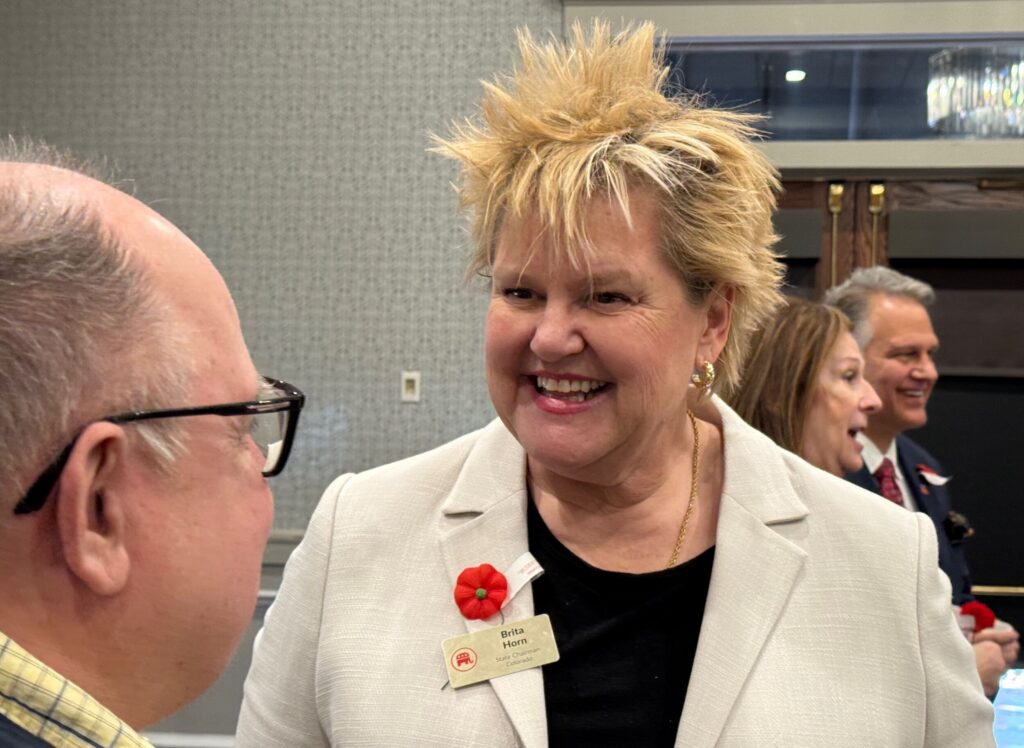
Colorado GOP chair Brita Horn loses ‘no-confidence’ vote, vows to refocus on ‘mending that divide’
Ernest Luning
ernest.luning@coloradopolitics.com
Updated 4 hours ago
The Colorado Republican Party’s state central committee approved a resolution expressing “no confidence” in state chair Brita Horn in a landslide late Monday night near the end of an online meeting marked by rancor and confusion. Almost 80% of the...

Trump to attend White House Correspondents’ Dinner for first time as president
Washington Examiner Staff, Washington Examiner
washington.examiner.staff.washington.examiner@gazetteedit.wpenginepowered.com
Updated 23 hours ago
President Donald Trump announced on Monday that he accepted an invitation to this year’s White House Correspondents’ Dinner. It would mark the first time Trump has attended the dinner, in either term, since he’s been president. Trump announced the decision...
Primary rival sues to prevent Democrat Eileen Laubacher from going through assembly in Colorado’s 4th CD
Ernest Luning
ernest.luning@coloradopolitics.com
Updated 1 day ago
Democratic congressional candidate Trish Calvarese on Monday asked a judge to prevent one of her primary rivals, Eileen Laubacher, from participating in the caucus and assembly process to seek the nomination to challenge Republican U.S. Rep. Lauren Boebert in Colorado’s...