

Downtown Denver looks to convert its one-way streets
Many of downtown Denver’s streets are designated for one-way traffic. But their future could eventually go in a different direction.
City planners have been looking into converting several downtown streets to allow cars to drive both ways, according to preliminary findings for downtown’s master plan shown at a public meeting on Tuesday.
The hope is it could help slow down traffic, encourage more economic activity and reflect how downtown is becoming more residential, leaders behind the Downtown Area Plan told The Denver Gazette.
Denver has been working on updating its Downtown Area Plan, a master document meant to shape policies and developments in the city center for the next 20 years.
Officials presented some of the proposed solutions they’re considering to improve the area, including converting one-way streets, at a final public meeting.
During the presentation, a map showed the city is considering converting one-way streets, such as Tremont Place and Welton, Champa, Arapahoe, Larimer and Blake streets. On the outskirts of downtown, the map shows Speer Boulevard, which is undergoing its own reconfiguration plan), Broadway and Lincoln Street should also be considered for conversion into a two-way street.
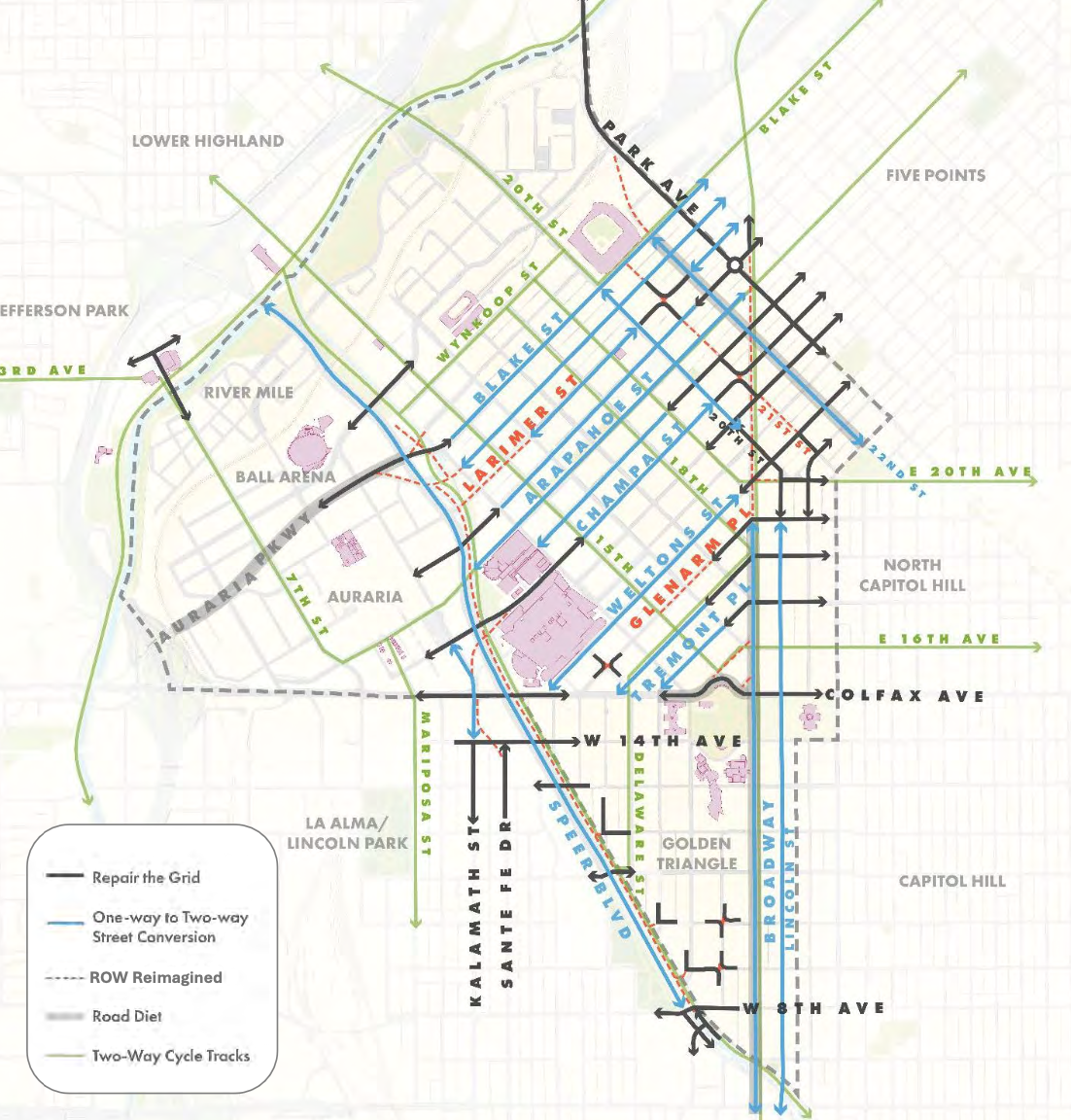
The streets where downtown and city leaders are suggesting to look into converting one-way streets for two-way traffic, according to a presentation from Downtown Area Plan leaders.
City and County of Denver, Downtown Denver Partnership

The plan recommends turning Broadway into a two-way “transit greenway” to connect Upper Downtown with the Golden Triangle neighborhood with major bike additions, extending transit like Metroride or the 16th Street shuttle, and growing a more robust tree canopy.
The plan seeks to push forward an idea that city officials have discussed and to start drawing “fat lines” on the map of where to begin, said Andrew Iltis, Downtown Denver Partnership’s vice president of planning and community impact and co-leader of the plan.
“We know that there’s a lot of circulation that’s happening as people look for parking or other things,” Iltis said.
And with the 16th Street, formally 16th Street Mall, where there’s no vehicle traffic, it means drivers may have to drive an additional block to get on a street that gets to their destination.
“When you have a one-way grid, you end up sometimes circling for two or three blocks to try to find where you want to get to,” he said.
How one-way streets in downtowns are evolving
When people moved out to the suburbs after World War II, one-way streets became incredibly prevalent in downtowns in the U.S., as cities worked to get downtown employees in and out as fast as possible.
These streets were designed to act as downtowns’ highways.
But as one-way streets took over during a time when downtowns became less residential, cities have reconsidered their use, as downtowns push to become residential again.
Denver leaders have been advocating to transform the Central Business District into a “Central Neighborhood District.”
As downtown struggles with high office vacancies, leaders hope encouraging residential development could make the area less dependent on the office market.
“Most of our neighborhoods, local streets, are two-way. And they work really well on that grid,” said David Gaspers, Denver’s principal city planner. “If we want to think of downtown as a neighborhood, we need to start treating it as such.”
The final downtown plan wouldn’t require conversions to happen, but it would have a policy statement saying the city should look into it.
Denver’s Department of Transportation & Infrastructure will have to lead the approach and conduct a formal study to see how it would affect the traffic network, he added, because “you can’t do one-off street conversions without thinking about the impacts to all the other streets around it.”
DOTI currently has “nothing in design,” Nancy Kuhn, a spokesperson for the agency, said in an email.
“At present, any reference to converting streets from one way to two way would be considered a recommendation requiring additional analysis from a feasibility standpoint,” she said.
Converting one-way streets into two-way streets has grown as a way to help economically revitalize city centers, according to a 2022 report on converting downtown’s one-way streets published in the Journal of Planning Education and Research.
Proponents of converting one-way streets say they’re not safer for pedestrians and offer a false sense of security to street crossers, the 2022 report said, while two-way traffic slows cars down and encourages people to look both ways before crossing the road.
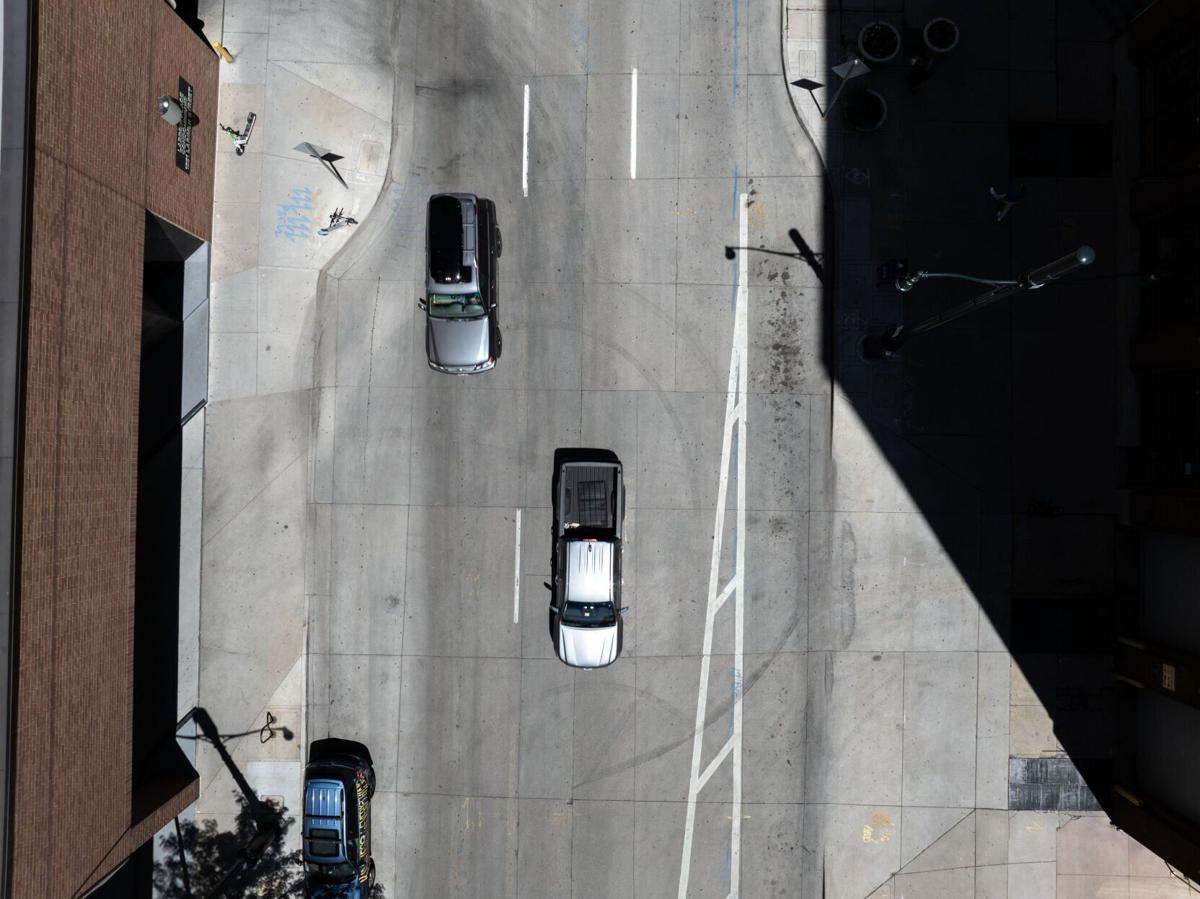
Cars drive down Arapahoe Street near 16th Street on Wednesday, May 21, 2025. The city is considering converting several one-way streets into two-way streets. (Stephen Swofford, Denver Gazette)
Stephen Swofford/Denver Gazette

There’s also a debate that two-way traffic is a better boon to businesses, as shopfronts will get better visibility from drivers coming from both directions.
“Two-way traffic actually is better for business access and actually can make it a more multimodal street that’s friendlier for pedestrians,” Gaspers said.
While DOTI hasn’t begun looking into downtown yet, it recently conducted a study on the East avenues that connect City Park to downtown and suggested looking into converting East 13th and 14th avenues between Broadway and Yosemite Street, and East 16th Avenue between Detroit Street and Colorado Boulevard, and East 17th between Colorado Boulevard and Yosemite Street.
There are several concerns of converting streets in general, according to DOTI’s report released in December. It mentioned research on conversions is limited and there’s mixed results on whether they reduce crashes or cause more.
“The safety effects of two-way conversion are unclear: two-way streets introduce more conflict points, create potential for head-on crashes, and can be more complex for pedestrians to cross,” the East Avenues Safety Study stated.
The cost of converting the East avenues could be high, the study found, totaling more than $5 million to meet DOTI’s standards.
The downtown plan doesn’t look into how much converting streets would cost, but the plan’s leaders said it would be a phased approach, rather than all at once. Conversions though would require doing it in batches, since downtown’s one-way street network is done in pairs.
Reexamining downtown’s unique grid
It’s not only the one-way streets that could see change within the next 20 years. Downtown’s entire uniquely-angled grid is also being reevaluated.
The 45-degree street grid is considered a pain point for downtown accessibility, according to the plan, as it creates awkward and confusing intersections on the edges of downtown and cuts off downtown from surrounding neighborhoods.
The Downtown Area Plan is spearheaded by Denver Community Planning and Development and the Downtown Denver Partnership, with the assistance of urban planning and design consultancy firm Sasaki.
The yearlong community-engagement process to create the city center’s guiding document is near the tail end, as city planners said they plan to release a draft this summer before it goes in front of City Council for approval.
At the meeting, they presented several solutions for downtown including establishing separate corridors prioritizing either pedestrians or transit, adding more green spaces like parks, and continuing the push to make Upper Downtown into a more residential neighborhood.
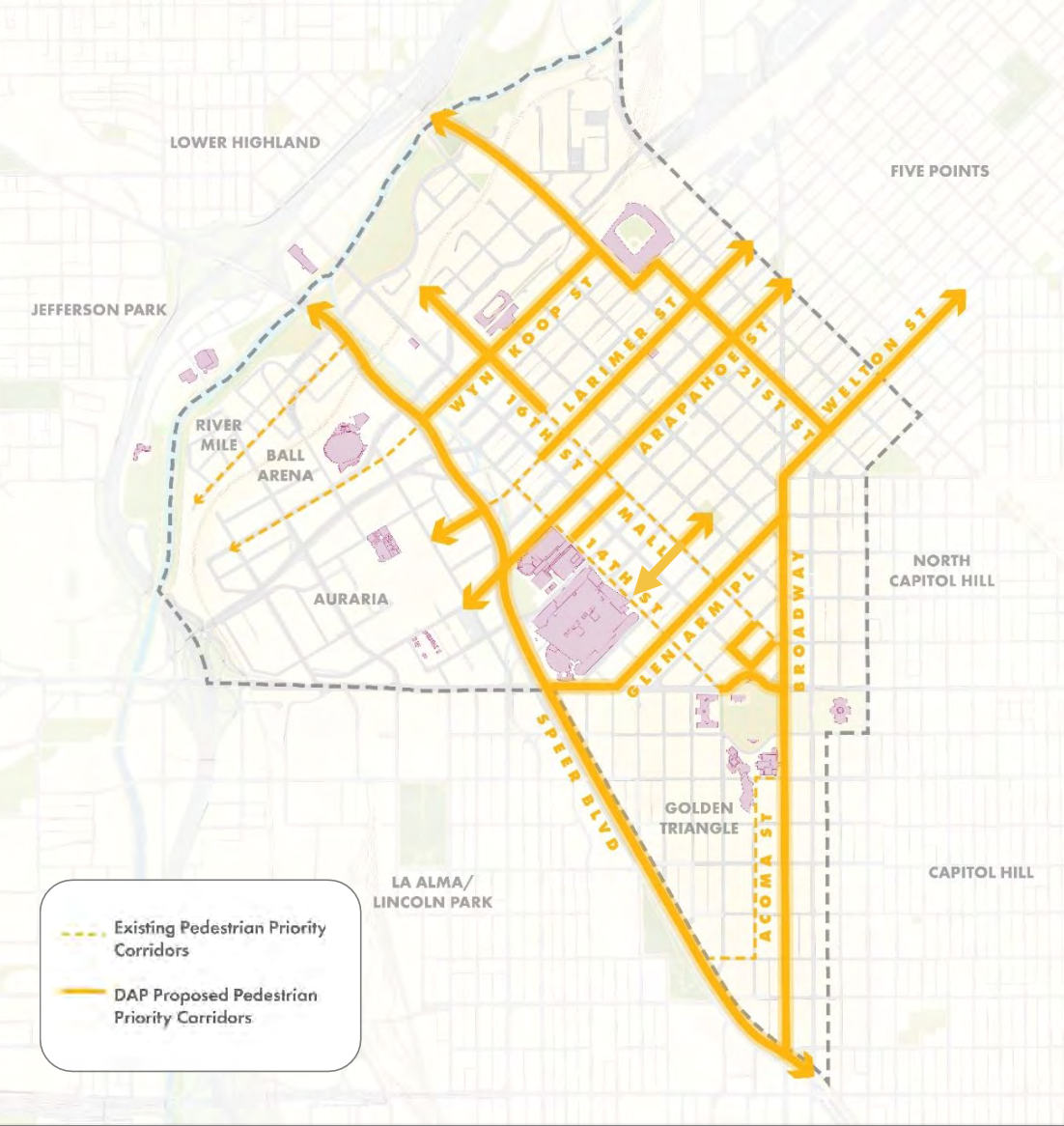
The streets where downtown and city leaders are considering advocating for pedestrian corridors in Denver's city center, according to a presentation from Downtown Area Plan leaders.
City and County of Denver, Downtown Denver Partnership

The Downtown Area Plan proposes turning Wynkoop, Larimer, Arapahoe, 21st Street, Broadway, Speer Boulevard and parts of Welton Street near Five Points neighborhood into pedestrian-centered streets.
The plan proposes creating a box around the city center of transit-focused streets, such as Market Street, Park Avenue, Welton Street and Speer Boulevard.
Some of these pedestrian corridors could look like expanding sidewalks, like 16th Street did to create more outdoor spaces for businesses, Iltis said.
“It’s really nice to have some sort of an amenity, whether that’s a tree lawn or maybe it’s used for bike parking or more additional café seating to have that separation from vehicular traffic,” he explained.
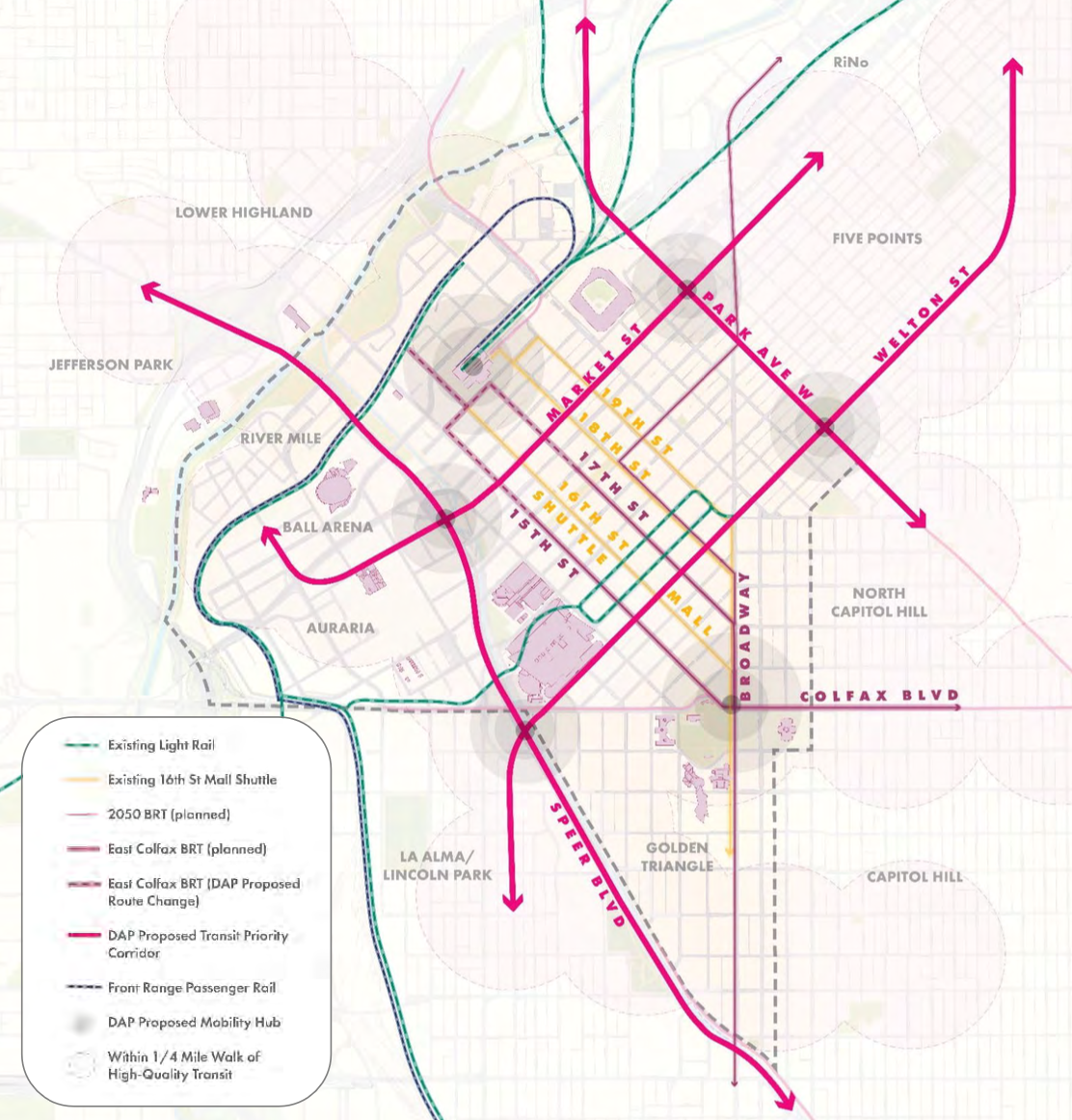
The streets where downtown and city leaders are considering advocating for transit corridors in Denver's city center, according to a presentation from Downtown Area Plan leaders.
City and County of Denver, Downtown Denver Partnership

Transit areas could look like consolidating bus routes and making popular transit areas more recognizable for downtown visitors, Iltis said, so they can go to one of the corridors and know one of the routes will take them to another part of downtown.
As part of the push to accommodate the shifting demographics planned for Upper Downtown and plans to develop the areas around Broadway and Arapahoe Square, city planners are also recommending to “reimagine” Welton Street — in the parts where there are several surface parking lots — as a commercial corridor to serve residents, businesses and transit riders.
It’s an area that is already delivering a lot of residential growth, the city planners said.
Overall, not all the one-way streets suggested in the plan may be converted.
The National Association of City Transportation Officials recommends reexamining one-way streets by either converting them into two-way streets or keeping them one-way but condensing the traffic and using the wider streets for designated bus, transit or bike lanes.
Denver’s city planners are taking a similar approach.
While they are looking at converting some streets to go two-ways, there may not be enough space to allow both two-way traffic and a better experience for pedestrians with more retail space, tree shade or even street parking.
“There are one-way streets that also can be pedestrian corridors, too,” Iltis said. “They don’t all have to go two way.”
Either way, downtown and city leaders are now looking in both directions.
Colorado Politics Must-Reads:

Colorado Supreme Court weighs trans rights case involving Children’s Hospital and federal threats
Michael Karlik
michael.karlik@coloradopolitics.com
Updated 13 minutes ago
Some members of the Colorado Supreme Court expressed discomfort on Tuesday with having to decide whether to order Children’s Hospital Colorado to resume providing certain services to transgender children, which could trigger a “death sentence” if the federal government imposes...
Senate Democrats outline amendment strategy as budget debate nears
Marissa Ventrelli
marissa.ventrelli@coloradopolitics.com
Updated 4 hours ago
Members of the Colorado Senate met with their respective caucuses on Tuesday to discuss the state’s proposed $46.8 billion budget for fiscal year 2026-2027, which passed through the House over the weekend following lengthy debate. The full Senate will begin...
Colorado business leaders, Gov. Jared Polis send warning as companies pack their bags
Mark Samuelson Special to The Denver Gazette
mark.samuelson@denvergazette.com
Updated 27 minutes ago
Is Colorado scaring away corporate expansions and entrepreneurs that had once made the state a magnet for high-tech business growth? That’s the assertion of a letter signed by more than 200 business and technology leaders, addressed to Gov. Jared Polis,...
Colorado justices weigh constitutionality of unique disclosure requirement for ballot measures
Michael Karlik
michael.karlik@coloradopolitics.com
Updated 8 hours ago
Members of the Colorado Supreme Court considered on Tuesday whether a unique feature of the state’s campaign finance system categorically violates the First Amendment by requiring the disclosure of a ballot measure committee’s legal representative on advertisements. No on EE...
Appeals court shuts down Boasberg contempt inquiry into Trump administration over El Salvador deportations
Kaelan Deese, Washington Examiner
kaelan.deese.washington.examiner@gazetteedit.wpenginepowered.com
Updated 9 hours ago
A federal appeals court on Tuesday ordered an end to U.S. District Judge James Boasberg’s criminal contempt inquiry into Trump administration officials over last year’s deportations of Venezuelans to El Salvador, delivering a second major rebuke to Boasberg and foreclosing...

Colorado marijuana regulators pledge crackdown on intoxicating hemp
Christopher Osher
chris.osher@gazette.com
Updated 9 hours ago
Citing potential tax avoidance, ‘serious risk to public safety,’ Marijuana Enforcement Division warns companies about swapping illegal chemically converted hemp for marijuana This article was produced for ProPublica’s Local Reporting Network in partnership with The Denver Gazette. Colorado regulators announced...
Redistricting battle narrows for US House as states seek partisan edge in November elections
David A. Lieb
david.a..lieb@associatedpress.com
Updated 10 hours ago
The battlefield is narrowing and the timeline is tightening in a congressional redistricting contest among states seeking a partisan advantage ahead of the November midterm elections. The end of Maryland’s legislative session this week marked the demise of Democratic efforts...
Redistricting battle narrows for US House as states seek partisan edge in November elections
David A. Lieb
david.a..lieb@associatedpress.com
Updated 10 hours ago
The battlefield is narrowing and the timeline is tightening in a congressional redistricting contest among states seeking a partisan advantage ahead of the November midterm elections. The end of Maryland’s legislative session this week marked the demise of Democratic efforts...
Polis pushes back after Trump administration again denies federal disaster aid
Marissa Ventrelli
marissa.ventrelli@coloradopolitics.com
Updated 3 hours ago
A dispute over federal disaster aid escalated Monday as Colorado Gov. Jared Polis faulted the Trump administration for rejecting the state’s appeals for assistance following last fall’s fires and flooding. The state initially filed for a Major Disaster Declaration for...

Cherry Creek school district plays defense | Jimmy Sengenberger
Jimmy Sengenberger
jimmy.sengenberger@gazette.com
Updated 11 hours ago
Cherry Creek Schools is a shadow of its former self. When I graduated from Grandview High School in 2008, the district still earned its motto: “Dedicated to Excellence.” These days, Colorado’s fourth-largest district clings to that antiquated reputation even as it unravels...