

Colorado Supreme Court to hear cases on rezoning via ballot box, defaulting defendants

The Colorado Supreme Court announced this week that it will decide whether entities can sidestep the normal procedures in state and local law and instead pursue rezonings via ballot initiative for planned-unit developments.
At least three of the court’s seven members must agree to hear a case on appeal.
The justices will also answer whether a civil defendant who does not participate and is automatically found liable may nonetheless testify at trial and potentially change the outcome in his favor.
Finally, the Supreme Court indicated it may intervene in two ongoing cases in the trial courts. First, it will look at whether a violation of a restraining order can necessarily prove someone committed burglary. Second, it will examine whether a judge in one jurisdiction can order prosecutors in a different jurisdiction to produce information in a criminal case.
A rezoning vote
In 1995, Brighton Properties, LLC sought approval of Butcher Creek, a planned-unit development in Telluride where zoning was set according to the plan. The PUD contained a mixture of homes and an open space known as “Lot A.”
Almost two decades later, Brighton Properties sought to amend the PUD plan to rezone Lot A for affordable housing. Telluride rejected the initiative, claiming an amendment to the PUD agreement needed the approval of the lot owners there. Brighton Properties then sued the town, seeking a declaration that it was legally allowed to pursue its rezoning via ballot initiative.
While she acknowledged the Supreme Court had labeled zoning a legislative act that would normally be subject to the initiative process, District Court Judge Mary E. Deganhart believed Brighton Properties’ case was “more complex than the simple rezoning of a single parcel.”
After a trial, she sided against Brighton Properties, concluding the land use designation for Lot A could not be changed without the consent of the Butcher Creek landowners.
Brighton Properties appealed, arguing that if original zoning decisions are legislative, so are rezoning decisions. A three-judge Court of Appeals panel agreed.
“Because zoning and rezoning have long been considered legislative matters subject to the initiative power, and because a PUD is a form of zoning or rezoning,” wrote then-Judge Anthony J. Navarro, “we conclude that the rezoning proposed here is a legislative matter subject to the initiative power.”
Telluride turned to the Supreme Court, arguing the ruling represented a “credible threat” to PUDs across Colorado by allowing them to be modified outside the process envisioned in state law and without input from municipal planning experts.
“While due respect is owed to the value of citizen-based initiatives,” wrote the town’s lawyers, “the electorate at large is ill-equipped to decide whether and how the Butcher Creek PUD would be affected by further development on a thirty-degree ridge. Indeed, the initiative and referendum process has no procedural safeguards that would require these complex issues to be vetted before the public voted to approve development.”
The Supreme Court will review the appellate panel’s decision.
The case is Kavanaugh et al. v. Telluride Locals Coalition Petitioners’ Committee et al.

Default judgments
When a defendant who is being sued does not respond to the allegations in time, the plaintiff can obtain a default judgment that establishes the non-appearing defendant’s liability. A judge can later determine the damages a defaulting defendant owes.
Last fall, the Court of Appeals answered a series of questions about how default judgments work:
• If there are multiple defendants and only one of them has defaulted, can another defendant call them to testify?
• If the jury sides with the non-defaulting defendant and necessarily finds the defaulting defendant did not cause damages, can a judge overturn the defaulting defendant’s liability?
A plaintiff identified as J.B. filed suit against Metro Taxi on behalf of their child, E.B., who is a disabled adult. J.B. alleged taxi driver Jesus Ortiz sexually assaulted E.B. while driving her to her day program. Prosecutors criminally charged Ortiz and a jury acquitted him.
Ortiz did not respond to the civil lawsuit, where he was also a defendant, and J.B. obtained a default judgment. At trial, Metro Taxi called Ortiz to testify, and he maintained he did not assault E.B. Although jurors were told the default meant Ortiz had admitted to the allegations, the jury found in Metro Taxi’s favor — meaning Ortiz did not assault E.B. and E.B. did not suffer damages.
After Denver District Court Judge Marie Avery Moses ordered Ortiz to pay nearly $700,000 because of his default judgment, Ortiz asked her to reconsider, arguing he did not understand what was going on with the civil case. Moses overturned the judgment, agreeing that Ortiz was clearly confused about the various components of the criminal and civil cases.
Later, District Court Judge Martin F. Egelhoff ended the case in Ortiz’s favor, reasoning the jury’s verdict “fully resolves all claims as to Defendant Ortiz.”
By 2-1, a Court of Appeals panel upheld the outcome. Judge Lino S. Lipinsky de Orlov rejected the idea that it was improper for Metro Taxi, which “followed the rules,” to defend itself by calling Ortiz as a witness.
“We are unaware of any case, from any jurisdiction, that would, in effect, impose sanctions against such a party solely because its key witness had not complied with the rules,” he wrote for himself and Judge Rebecca R. Freyre.

The majority also agreed it was proper to void the default judgment when a jury necessarily determined there was no wrongdoing.
Judge Timothy J. Schutz dissented, pointing out the central problem was that jurors were told Ortiz’s default meant he admitted the allegations, yet the trial judge still asked them to decide whether Ortiz committed an assault.
“Rather than holding Ortiz accountable for ignoring basic pleading deadlines, the rationale of the majority opinion results in a profound reward: a judgment entered in Ortiz’s favor without ever having to face a trial on the merits of E.B.’s claims against him,” Schutz wrote.
J.B. appealed, arguing a defaulting defendant “should not be allowed to defeat the claims against them by circumventing the litigation process in its entirety.” The Supreme Court agreed to review the Court of Appeals’ conclusions.
The case is J.B. v. MKBS, LLC et al.
Burglary
Weld County prosecutors charged Robert Dilka with second-degree burglary, which occurs when someone is unlawfully in a building “with intent to commit therein a crime against another person or property.” The other crime Dilka allegedly intended to commit was a violation of a protection order, also known as a restraining order.
In May, there was a preliminary hearing at which the prosecution needed to show probable cause existed to bring Dilka to trial. Dilka’s defense lawyer argued there was no “crime against another person or property” because the evidence showed Dilka was merely inside the home when he should not have been.
District Court Judge Audrey Galloway then raised a 1998 Supreme Court decision, People v. Rhorer. The court had analyzed whether violation of a municipal protection order counted as “a crime” under the state’s burglary law. The Supreme Court determined it did, but also appeared to go further.
The defendant’s “intent to violate the no-contact order by breaking into (the victim’s) home constituted an ‘intent to commit therein a crime against person or property’ and fulfilled that element of the crime of second degree burglary,” wrote Chief Justice Mary Mullarkey.

“It’s my opinion that the Colorado Supreme Court in that case specifically and unequivocally states not that a violation of a protection order can be a predicate offense for second-degree burglary, but that it is,” said Galloway in determining probable cause existed for Dilka’s burglary offense.
Appealing her ruling to the Supreme Court, Dilka’s lawyer argued it was problematic to find certain violations of a protection order amount to crimes against a person or property.
“Entering a home, alone, does not indicate force or threat of force to a person’s body or seeking to unlawfully benefit from or do damage to another’s property,” wrote public defender Glenna Gee-Taylor.
The Supreme Court ordered a response to the petition.
The case is People v. Dilka.
Jurisdiction dispute
Yvonne “Missy” Woods is a former Colorado Bureau of Investigation DNA scientist who stands accused of intentionally deleting data, manipulating procedures and compromising criminal evidence. She faces 102 felony counts in Jefferson County alleging systemic misconduct and is awaiting trial.
In May, Adams County defendant Juan Manuel Castorena sought to obtain the criminal file in Woods’ prosecution from the First Judicial District Attorney’s Office, which is not in the same jurisdiction as Adams County. The office objected, arguing the criminal rules refer to “the prosecuting attorney” — meaning the DA for Adams County.
District Court Judge Brett Martin disagreed.
“District courts have state-wide jurisdiction,” he wrote. Finding he did have authority to order disclosure, he directed Jeffco prosecutors to turn over the Woods file.
The First Judicial District Attorney’s Office appealed to the Supreme Court, arguing the proper procedure was for the defense to use a subpoena to access the file, with all of the safeguards built into that process. Moreover, Senior Appellate Deputy District Attorney Rebecca A. Adams noted two judges in Weld County had recently concluded, unlike Martin, that they lacked jurisdiction over the Jeffco prosecutors.
The Supreme Court ordered a response to the DA’s petition.
The case is People v. Castorena.


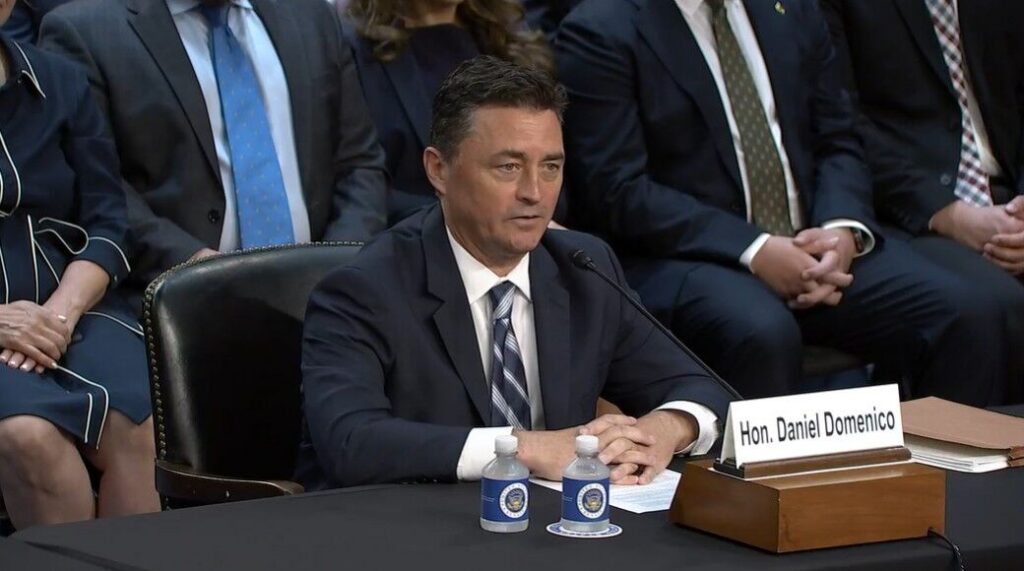
Senate committee advances Trump’s 10th Circuit nominee, as Domenico responds to questions about delays
Michael Karlik
michael.karlik@coloradopolitics.com
Updated 1 week ago
The U.S. Senate Judiciary Committee advanced President Donald Trump’s nominee to the Denver-based federal appeals court on Thursday by a party-line vote of 12-10. U.S. District Court Judge Daniel D. Domenico, who was Trump’s first-term appointee to Colorado’s federal trial...
Colorado justices to hear embryonic donation dispute
Michael Karlik
michael.karlik@coloradopolitics.com
Updated 1 week ago
The Colorado Supreme Court announced on Monday that it will decide whether lower court judges properly applied its framework for adjudicating disputes over the fate of pre-embryos, in which one person wants to use them to become a parent and...

Federal judge sentences African man to 67 years for torture in home country
Michael Karlik
michael.karlik@coloradopolitics.com
Updated 10 months ago
A federal judge on Friday sentenced an African man to 67.5 years in prison after jurors found him guilty on six torture-related counts for acts committed in his home country, The Gambia. Prosecutors in Colorado pursued the unusual criminal case...

Couple’s texts paint picture of failing 23-year marriage in James Craig murder trial
kyla-pearce
kyla.pearce@denvergazette.com
Updated 1 year ago
In the weeks before Angela Craig died in March of 2023, her husband James Craig, who is accused of poisoning her protein shakes, searched the internet for ways to make a murder look like a heart attack. Craig also searched...

Federal probe of judiciary scandal in Colorado requested at hearing
By David Migoya david.migoya@gazette.com
by-david-migoya-davidmigoyagazettecom@coloradopolitics.com
Updated 1 year ago
The Colorado commission responsible for disciplining state judges on Monday revealed it had quietly dismissed an elaborate, voluminous and far-reaching anonymous complaint that alleged an ongoing judicial conspiracy to conceal years of misconduct. That decision came months after the former...

State Supreme Court returns for arguments, judges hear requests to stay decisions | COURT CRAWL
Michael Karlik
michael.karlik@coloradopolitics.com
Updated 1 year ago
Welcome to Court Crawl, Colorado Politics’ roundup of news from the third branch of government. The state Supreme Court returns this week to hear arguments in several cases, plus multiple federal judges addressed requests to put their orders on hold...

10th Circuit: Sheriff’s deputies have no immunity for letting dog attack Highlands Ranch man
Michael Karlik
michael.karlik@coloradopolitics.com
Updated 1 year ago
'What are you talking about?' Judge Gregory Phillips asked the deputies' lawyer after hearing argument that it may have been reasonable if the dog had bitten a child

COURT CRAWL | Senators send judge recommendations to Biden, future of virtual court access
Michael Karlik
michael.karlik@coloradopolitics.com
Updated 2 years ago
Welcome to Court Crawl, Colorado Politics’ roundup of news from the third branch of government. The White House heard from Colorado’s senators about who should fill an upcoming judicial vacancy on the federal trial court, and an examination of audio...