

Denver homeless numbers up, but fewer sleep on the streets
Although fewer people are sleeping on the streets in Denver, the total number of homeless individuals in the city grew, a new report showed.
This year, a total of 7,327 people were counted as homeless — a number that grew by 788 over 2024, according to the newest annual point-in-time (PIT) Count released by the Metro Denver Homeless Initiative on Monday.
The count is a nationwide, yearly, unduplicated count of the homeless population conducted on a single night in January.
The mayor focused on the reduction in “unsheltered” homelessness, as he sought to tout the numbers as “the best in the country among cities with published reports.”
“Denver is proving that homelessness is solvable so long as we are willing to put in the work to solve it,” Mayor Mike Johnston said in a statement. “In less than two years, we have gone from a city that swept people from block to block to one that treats people with dignity and delivers real results. This policy is not only morally just but effective.”
The data showed a significant reduction in “unsheltered” individuals, which city housing officials touted as the “largest multi-year reduction in unsheltered housing in American history.”
“This year, we can definitely say that we have fewer people sleeping on our streets than we have at any time since before the pandemic,” Denver Senior Advisor for Homelessness Resolution Cole Chandler told reporters at an embargoed media roundtable on Friday.
The data showed that the city’s homeless numbers went up in almost every category except two — the “newly” homeless and the “unsheltered” homeless.
It indicated a slight increase in family homelessness in 2025 compared to the year before. The numbers of chronically homeless spiked. So did homeless veterans and young people.

“Unsheltered” homeless refers to people who live and sleep in public spaces, such as parks, cars, or under bridges.
Since 2023, unsheltered homelessness in Denver has dropped by 45%, from 1,423 to 785, which city officials attributed to efforts made by Johnston to move more individuals off the streets and into shelters.
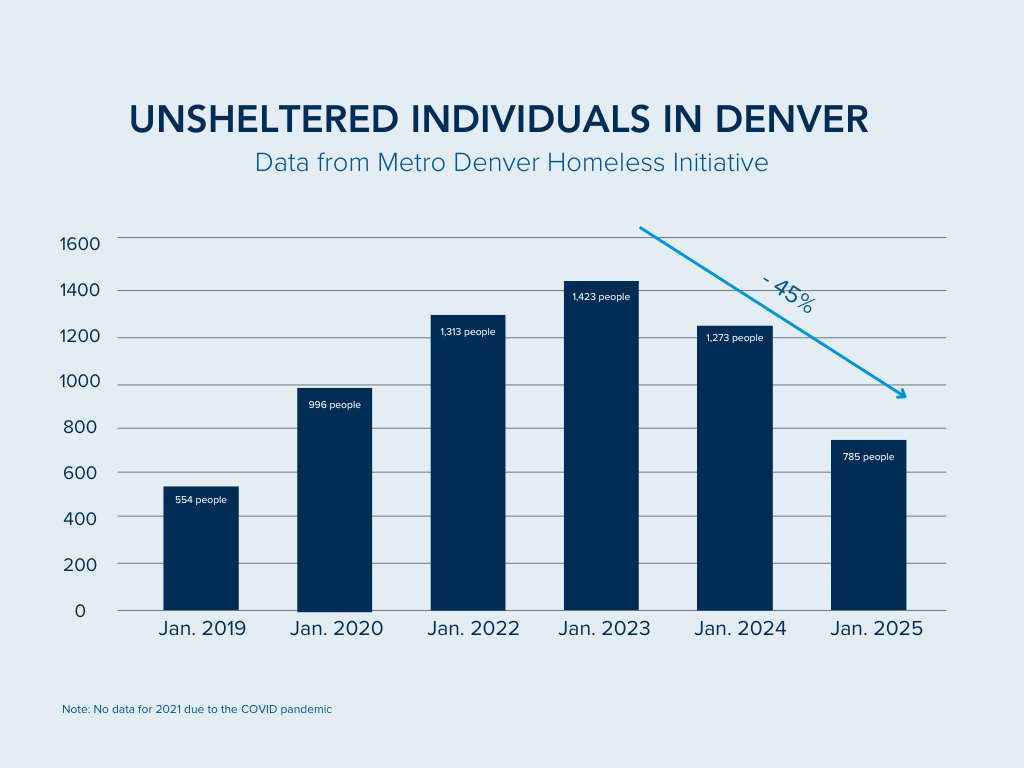
Unsheltered individuals in Denver. Data Source: Metro Denver Homeless Initiative
Courtesy City and County of Denver

“Throughout Metro Denver, we are seeing more people end unsheltered homelessness by coming indoors to access critically important, life-saving shelter and housing resources,” said MDHI Executive Director Jason Johnson. “Denver is a prime example that if you invest in appropriate levels and types of shelter and housing, people will use them to leave behind a life on the streets.”
Other major U.S. cities such as Atlanta, San Diego and Phoenix each saw 2025 unsheltered homeless numbers increase by 44%, 11% and 13%, respectively.
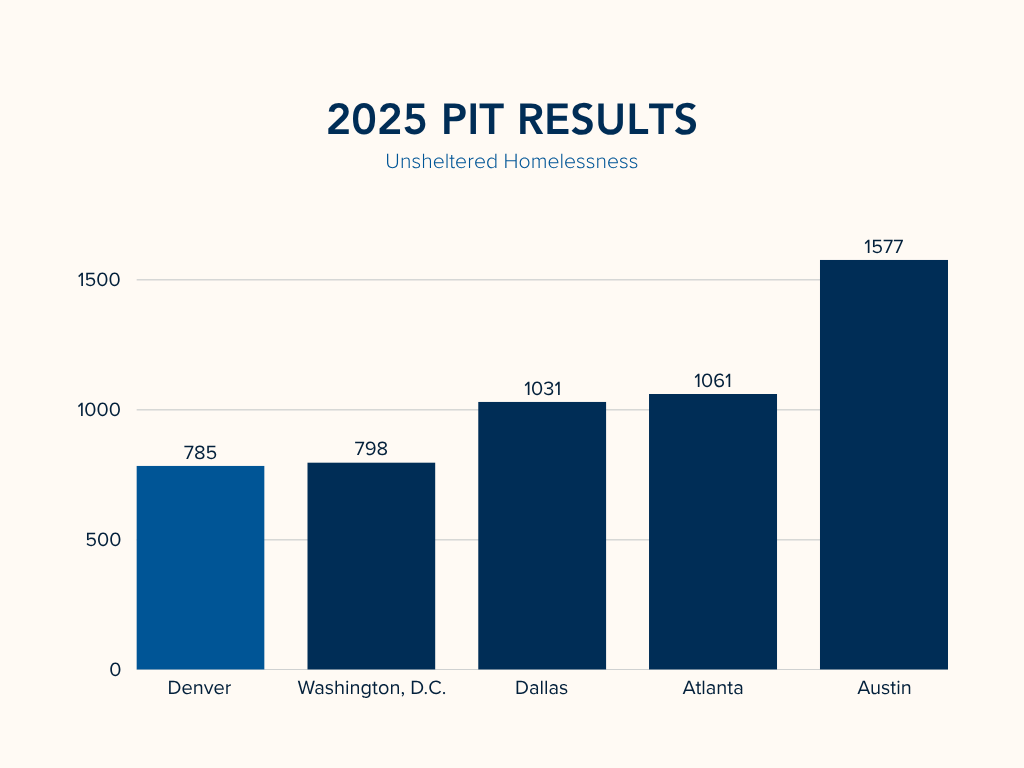
Denver's numbers for unsheltered homeless rank lower than other major U.S. metro areas, according to city officials. Data Source: Metro Denver Homeless Initiative
Courtesy City and County of Denver

As part of Johnston’s plan to reduce homelessness, the city added 1,000 beds across multiple shelter sites throughout the city, officials said.
With those additional beds, officials said they expected the number of sheltered homeless to increase.
“So, we’ve seen another rise in overall homelessness, but there are two really strong indicators that suggest it (homelessness) could be plateauing, and we could start to see a decrease in future years,” said Jason Johnson, noting the decline in the number of newly homeless individuals.
Chandler added that the city is “not planning” to add additional beds in 2025 but instead will focus resources on “throughput,” and exiting those in shelters toward more permanent housing.
“Now we’re at the point in our strategy where we’re really focused on how do we get those folks that we brought indoors into shelter, out of shelter, into permanent housing,” Chandler said.
But “federal headwinds” present challenges, Chandler said.
“The president’s bill basically says permanent supportive housing would no longer be a policy, and that could take away, you know, a lot of housing vouchers that we’re using across the city,” Chandler said. “Through the state’s budget shortfall, we’ve lost about 70 housing vouchers already this year, and so there’s some headwinds, but we’re really focused on, how do we help people exit homelessness from our shelters at this point.”
Chandler is likely referring to what many anticipated is a shift in the federal government’s focus away from “housing first,” the approach that is popular among advocacy groups. The idea behind “housing first” is to respond to an individual’s most acute need first, which is housing, and then offer other services later.
Some reported that Trump’s proposal to abolish two programs that provide long-term housing financing and increase dollars for the Emergency Solutions Grant Program would open the door to a more “treatment first” approach.
Supporters of “housing first,” including advocacy groups in Denver, insist that it has a tried and tested method to help homeless people. Critics said it has failed to tackle the root causes of homelessness, which they maintained are addiction and mental health issues. Denver has fully embraced the “housing first” approach, while Colorado Springs and Aurora have adopted a “treatment first” or “work first” model.
Johnston has allocated approximately $57.5 million for the homelessness initiative.
“That ($57.5 million) is intended to serve 2,000 people a year, which comes out to about $27,000 to $28,000 — something in that range per person served,” Chandler said. “Over time, we’ll keep refining that budget, but our operating costs are targeting $57.5 million and under $30,000 per person served. “
That figure marks a decrease from $85 million, Johnston noted in a Sept. 12, 2024 letter to the City Council, emphasizing the city’s use of one-time federal ARPA funding to develop the infrastructure to address homelessness.
The mayor’s campaign to move 2,000 homeless people off of the city’s streets between his inauguration last year and the end of 2024 has been expensive.
Johnston has insisted that his office has utilized taxpayer money “responsibly.”
His efforts have cost a lot more than anticipated.
A briefing from the city’s Department of Housing Stability last June revealed the city was on track to spend $155 million between July 2023 and December 2024 — $65 million more than Johnston previously said it would cost.
Colorado Politics Must-Reads:


Colorado State Fair youth golf tournament celebrates 11 years
Marianne Goodland
marianne.goodland@coloradopolitics.com
Updated 50 minutes ago
Twenty-eight teams tee off Friday at Walking Stick Golf Course in Pueblo for a tournament supporting 4-H, Future Farmers of America and capital improvements at the Colorado State Fair. Now in its 11th year, the Partners of Youth in Ag...

Controversial two-bag furbearer limit heads to CPW meeting under legal threat
Marianne Goodland
marianne.goodland@coloradopolitics.com
Updated 1 hour ago
Next week’s Colorado Parks and Wildlife Commission meeting in La Junta is likely to open under the cloud of threatened legal action. Safari Club International and the Sportsmen’s Alliance Foundation warned the commission this month that its July vote imposing...
Democratic-aligned poll shows big majority of swing-seat voters support routine childhood vaccines
Ernest Luning
ernest.luning@coloradopolitics.com
Updated 4 hours ago
A new poll conducted by Democratic-aligned groups found that voters in competitive U.S. House districts — including a battleground seat in Colorado — support routine childhood vaccinations by a wide margin and oppose a recent order by President Donald Trump...
Some Colorado hunters oppose right to hunt, fish proposal, group says
Marissa Ventrelli
marissa.ventrelli@coloradopolitics.com
Updated 3 hours ago
A group that says it represents hunters and anglers from across Colorado announced its opposition to a ballot measure that would establish the right to hunt and fish in Colorado’s constitution, saying it could result in the overturning of bans...
Coalition drops Colorado transportation ballot measure as long-term funding plan advances
Marissa Ventrelli
marissa.ventrelli@coloradopolitics.com
Updated 5 hours ago
The proposed constitutional amendment on Colorado’s transportation funding will be removed from the November ballot after its supporters said they reached an agreement with lawmakers following months of negotiations. Initiative 175, backed by the coalition Restore Our Roads, would have...

Iran and Oman come to agreement to open Strait of Hormuz, but await US buy-in
Claire Carter
claire.carter@washingtonexaminer.com
Updated 5 hours ago
Iran and Oman reached an understanding on a temporary shipping corridor through the Strait of Hormuz, clearing a major hurdle to reopening the critical waterway, but Tehran says implementation depends on the United States meeting a series of demands. The...

Trump faces warning signs among women ahead of midterm elections: Poll
Rena Rowe
rena.rowe@washingtonexaminer.com
Updated 5 hours ago
President Donald Trump is facing significant challenges among women voters heading into the 2026 midterm elections, with a new survey showing low approval of his job performance and broad opposition to key policies in his administration’s agenda. A national survey...

Colorado gubernatorial candidates Phil Weiser, Greg Lopez to face off in televised debate
Ernest Luning
ernest.luning@coloradopolitics.com
Updated 20 minutes ago
Two of the candidates for governor of Colorado are set to square off in a televised debate for the first time Thursday night, when Attorney General Phil Weiser, the Democratic nominee, and former U.S. Rep. Greg Lopez, an unaffiliated candidate,...
Republican US Rep. Jeff Crank, Democratic challenger Jessica Killin set to debate in Colorado’s 5th CD
Ernest Luning
ernest.luning@coloradopolitics.com
Updated 7 hours ago
Republican U.S. Rep. Jeff Crank and Jessica Killin, his Democratic challenger, are scheduled to meet for a televised debate in the race to represent Colorado’s 5th Congressional District on Thursday night. The candidates are set to take the stage at...
Wrongfully deported man to be returned to U.S., Colorado federal judge orders
Michael Karlik
michael.karlik@coloradopolitics.com
Updated 8 hours ago
Colorado’s chief federal judge took the extraordinary step of directing the government on Tuesday to do everything it can to return a man it deported in violation of his order. At the same time, Colorado’s chief magistrate judge has set...