

Despite 2020 change, Colorado justices rule positive drug test alone can lead to child neglect finding
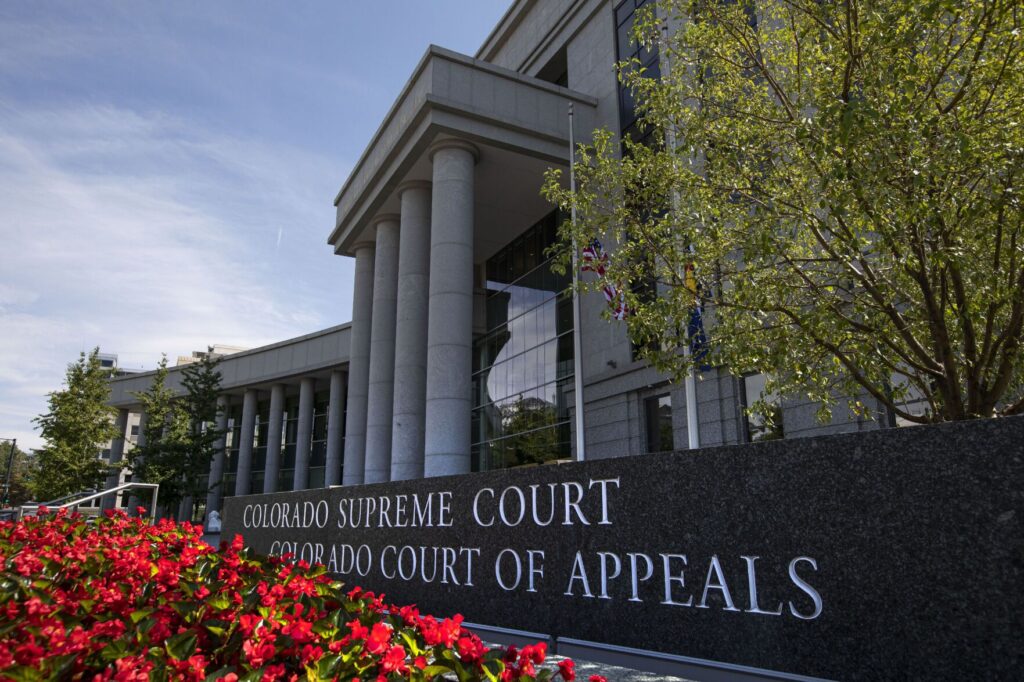
A divided Colorado Supreme Court ruled on Tuesday that a newborn’s positive drug test by itself can lead to a finding of child neglect, even though legislators amended the law five years ago to eliminate that trigger.
The legal debate centered on the wording lawmakers chose to replace the previous understanding that a child is neglected when he or she “tests positive at birth” for a controlled substance. Following the 2020 change, a child must now be “born affected by alcohol or substance exposure” and the “health or welfare is threatened by substance use.”
However, by 5-2, the Supreme Court decided a positive drug test is still enough to show a child is “born affected by” drugs.
“In our view, the presence of illicit substances in a newborn child’s body due to a mother’s use of such substances is plainly an effect of mother’s use,” wrote Justice Richard L. Gabriel in the May 27 opinion.

Chief Justice Monica M. Márquez dissented, arguing the majority had concluded that being exposed to drugs is the same as being affected by drugs. She believed the legislature’s change to the law did not support that equivalency.
“By striking the language referring to a positive drug test, the General Assembly made clear that a child’s mere exposure to alcohol or substances is no longer sufficient to find a child dependent or neglected,” Márquez wrote for herself and Justice Carlos A. Samour Jr. “Under the majority’s logic, however, no such effect is required because exposure alone (as reflected by a positive test) is sufficient.”
During the legislative debate five years ago over Senate Bill 28, which contained the amended substance exposure language, multiple witnesses spoke about the reasons for moving away from a positive drug test alone as a trigger for child neglect.
“The change in the children’s code is intended to decrease fear and stigma that parents would have in sharing they used substances during their pregnancy, to make it that much easier to get engaged and get involved in the services they’ll need long-term,” testified Jade Woodard of Illuminate Colorado.

Two years after the bill was enacted, El Paso County moved to declare a child, identified as B.C.B., neglected when he tested positive for methamphetamine at birth and his mother had a history of substance use. A jury heard evidence from three pediatricians that B.C.B. experienced some health issues and that meth exposure in the womb can impair cognitive and behavioral skills later in a child’s life.
However, none of the doctors could definitively point to B.C.B.’s meth exposure as the source of his symptoms, nor could they conclusively say B.C.B. would experience future effects from the drug.
The child’s father moved to end the case in his favor, arguing the county failed to establish B.C.B. suffered negative effects from the mother’s drug use. District Court Judge Jessica Curtis denied the father’s motion and the jurors deemed B.C.B. neglected — a step that can lead to the termination of the parent-child relationship.
On appeal, B.C.B.’s parents challenged the idea that the evidence supported a finding of neglect. By 2-1, a three-judge Court of Appeals panel deemed the evidence insufficient under the new standard.
Although the pediatricians testified there would be risks later in B.C.B.’s life, “none of the physicians was able to predict whether the child would actually suffer from these effects,” Judge Matthew D. Grove wrote for himself and Judge Grant T. Sullivan. “An adjudication cannot be premised on conjecture or speculation.”
Judge Terry Fox took a different view of the current law. The fact that B.C.B. did not have “the more pronounced and immediate signs of distress” was not the end of the road for her. She argued the majority’s interpretation meant a parent could actively use meth throughout pregnancy, “but if the child was not born prematurely, did not have immediate, detectable growth impairments, or was not experiencing withdrawal symptoms, the child would not be a dependent or neglected child.”

Gabriel, in the Supreme Court’s majority opinion, noted the new test for child neglect has two steps: the question of whether a child is born affected by drugs and then whether their health or welfare is threatened.
“As we read the amendment, the change in language from its focus on a positive drug test to an initial requirement that a child be born affected by alcohol or substance exposure reflects a broadening of the first element,” he wrote. “Whereas before, a positive test was necessary, under the current version of the statute, a positive test or other circumstances establishing an effect of exposure can satisfy the first prong of the statute.”
Gabriel wrote that a positive drug test is enough to establish an effect. In doing so, he rejected the current state regulation defining “affected by” as “impacted physically, developmentally, or behaviorally by exposure.” At the same time, Gabriel embraced the state regulation defining “health or welfare is threatened” to mean that a parent is unable to care properly for the child.
Although it was “debatable” whether B.C.B.’s meth exposure meant his health or welfare was threatened in the future, Gabriel continued, “ample evidence tended to show that, as a result of mother’s history of substance abuse, she would be unable to care for B.C.B. properly.”
Therefore, the majority upheld the child neglect determination.

Márquez, in dissent, believed the majority had effectively overturned the legislature’s 2020 change to the child neglect law by incorrectly equating exposure with effect.
“By deeming exposure alone sufficient to satisfy the affected-by-exposure requirement,” she wrote, “the majority invites the state to intervene in the parent-child relationship — even absent evidence that such exposure has adversely affected the child.”
Márquez would have held that an impact to a newborn’s physical, developmental or behavioral responses is necessary to establish they have been “born affected by” substance exposure. Because the evidence showed B.C.B. was healthy aside from his positive test, she would have reversed the neglect finding.
The case is People in the Interest of B.C.B.
Colorado Politics Must-Reads:


Douglas County judge violated defendant’s right to counsel at sentencing, appeals court finds
Michael Karlik
michael.karlik@coloradopolitics.com
Updated 12 hours ago
A Douglas County judge violated a defendant’s constitutional right to the counsel of her choice by refusing to postpone sentencing until her lawyer returned to the country, Colorado’s second-highest court concluded on Wednesday. In early 2023, Lyndie J. Felsher received...
Appeals court decides violations of child custody orders may be prosecuted per child
Michael Karlik
michael.karlik@coloradopolitics.com
Updated 10 hours ago
Colorado’s second-highest court concluded for the first time on Wednesday that a defendant may be charged with violating a child custody order based on the number of children affected, not the number of orders violated. Mesa County jurors convicted Tiffany...

‘Lawyers haven’t gotten the message’: Colorado justices hear debate about proposed AI rule
Michael Karlik
michael.karlik@coloradopolitics.com
Updated 10 hours ago
The Colorado Supreme Court heard comments from members of the legal profession last week about a proposed rule change intended to remind attorneys that misuse of new artificial intelligence tools can violate longstanding professional obligations. Court of Appeals Judge Lino...

Judge accepts new plea agreements for Return to Nature owners
Mackenzie Bodell
mackenzie-bodell@coloradopolitics.com
Updated 17 hours ago
Jon and Carie Hallford will not see 2026 trials after all, as an El Paso County judge ruled to accept the most recent plea agreements for the pair Monday, despite heavy opposition from families who used their funeral services. The Hallfords came...

As Aurora police worry about court ruling’s impact on crime, council sees opening to revisit penalties
Kyla Pearce
kyla.pearce@gazette.com
Updated 17 hours ago
Aurora’s top police official is worried about the impact of a Colorado Supreme Court decision about penalties on the city’s crime rate, while progressive councilmembers see an opening to reverse decisions made by previous city councils. The court ruled on...

Federal judge finds immigration judge denied bond using faulty reasoning, dubious evidence
Michael Karlik
michael.karlik@coloradopolitics.com
Updated 11 hours ago
A federal judge concluded last week that an immigration judge employed the incorrect procedure when denying bond to a detainee and relied on dubious evidence to find he was a flight risk. Under federal rules governing immigration cases, the filings and...

Colorado Supreme Court ponders insurers’ ability to defend against policyholders
Michael Karlik
michael.karlik@coloradopolitics.com
Updated 1 day ago
The Colorado Supreme Court considered last week what steps insurance companies must take to defend themselves against lawsuits from injured policyholders who, based on a technicality, were legally not at fault for their injuries. When an insured driver has an...

Justice Hart to leave Supreme Court, new recs from Access to Justice Commission | COURT CRAWL
Michael Karlik
michael.karlik@coloradopolitics.com
Updated 2 days ago
Welcome to Court Crawl, Colorado Politics’ roundup of news from the third branch of government. A member of the Colorado Supreme Court unexpectedly announced her retirement from the bench, plus the state’s Access to Justice Commission has made recommendations following...

Judge denies AstraZeneca’s bid to block Colorado drug discount law
Marissa Ventrelli
marissa.ventrelli@coloradopolitics.com
Updated 3 days ago
A Colorado district court judge denied drug manufacturer AstraZeneca’s request for an injunction to block enforcement of a recent law barring drug manufacturers from imposing restrictions on covered entities to obtain drugs under a federal discount program. The law states...

Colorado Supreme Court finds judge mistakenly barred evidence over officer’s failure to unmute body cam
Michael Karlik
michael.karlik@coloradopolitics.com
Updated 3 days ago
A Fremont County judge incorrectly barred evidence from being used against a defendant based upon a Cañon City officer’s failure to unmute his body-worn camera, the Colorado Supreme Court decided on Monday. Under a comprehensive police accountability law enacted in 2020,...