

Denver Chamber of Commerce urges change as Colorado falls in business rankings
As Colorado continues to trend downward on the national economic scale, the Denver Chamber of Commerce is critical of the direction the state’s Democratic-led legislature took in 2025 and in recent years.
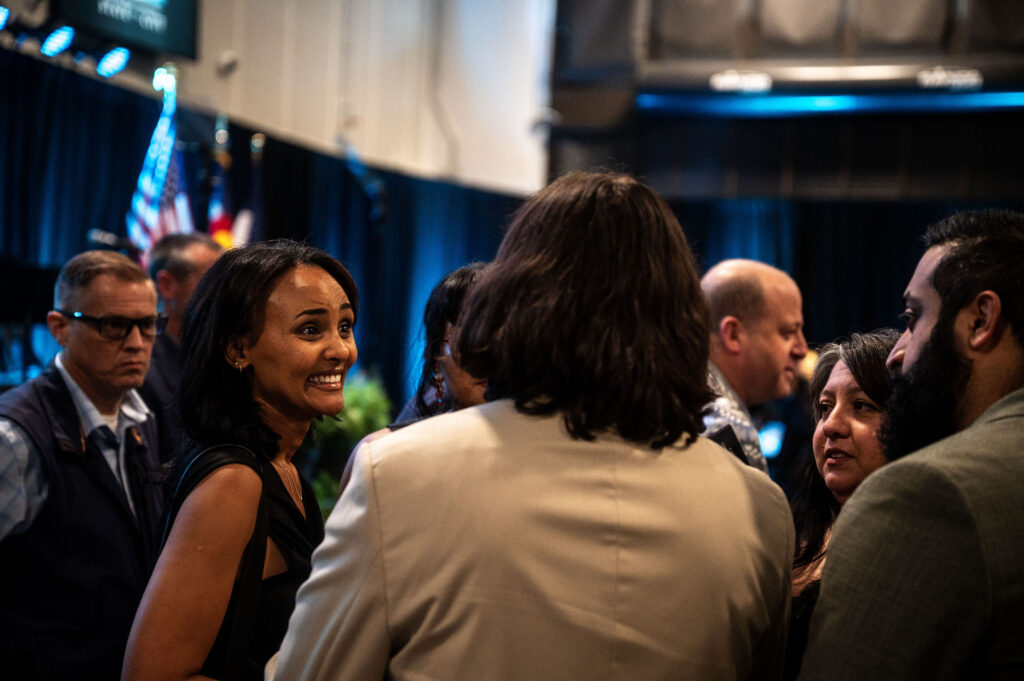
The main message at Tuesday’s annual post-legislative State of the State event, hosted by the chamber, was that the anti-business, pro-regulation approach is failing the business community.
Chamber members discussed Colorado’s economic challenges and legislative impacts. In giving a rundown of bills affecting the business community after the 2025 session, chamber members Rachel Beck and Carly West pointed to CNBC’s annual top states for business rankings. Once a perennial top 10, Colorado was ranked 11th last year and dropped to 16th this year.
This year, key issues plaguing the state included a $1.2 billion budget shortfall, the ongoing issue with AI regulations, a controversial bill on how tipped employees are paid and a union-fee bill.
Beck said with a full tab of regulations, wages, supplies, inflation and tariffs all trending upward, “it’s no wonder we’ve fallen in every economic ranking that we know of for cost of living and cost of doing business.”
“This is a trend that we must all work together to reverse,” Beck told the hundreds in attendance, including the business community and state lawmakers. “The only way that we’re going to do that is by tackling the root causes of problems, and that’s going to take all of us thinking more creatively than we ever have.”
The chamber criticized the legislative process and policies for not promoting competitiveness, innovation or affordability. However, they applauded the state legislature for passing the tax incentive bill to bring the Sundance Film Festival to Boulder.
Beck and West said lawmakers should just “Sundance it” when considering regulations and the business community.
One area the chamber said it would like to see lawmakers “Sundance it” is in artificial intelligence.
Beck said instead of bragging about Colorado being one of the first in the nation to pass a problematic bill to regulate AI, the state should be more willing to embrace its capabilities, highlighting technology being utilized to analyze fire and weather patterns and monitor areas where the human eye won’t see a spark until it’s too late.
“New technologies allow us to solve previously unsolvable problems and to do it better, faster, cheaper,” she said. “That’s why, rather than leading the country by rushing to hamper technology, we ought to be leading the country by embracing it and all of its exciting potential.”
The governor has hinted that he may call a special session to address the 2024 AI regulations bill that was supposed to be fixed through legislation that did not pan out in 2025.
Chamber President J.J. Ament said it has been a challenging few years for Colorado businesses.
“After we’ve worked so hard for generations to build Colorado back from what was the nation’s worst economy in the 1990s to a perennial top 10, to see it so quickly diminished by choices we’re making today can be discouraging,” Ament said.
Ament said the sheer volume of legislation being passed “is remarkable in not such a great way.” Since January, Ament said, the state legislature has passed 500 new laws and regulations.
At an average of four bills per day, Ament said, the trend matches numbers from last year. However, Ament said the problem is that the bills being passed do not necessarily make Colorado more competitive, affordable, simpler to navigate, and better able to achieve economic empowerment.
Instead, as he travels the country to promote Colorado and recruit businesses to come here, Ament said it’s tough because the state is now average, more “middle of the pack,” with the selling point that at least it’s still better than California and Oregon.
The chamber emphasized lawmakers’ positive efforts on affordable housing in 2025, most notably through passing the construction defects bill that will now allow more condos to be built. In speaking briefly during the luncheon, Gov. Jared Polis said he was pleased the legislature took his challenge at the start of the session and made progress making housing more affordable.
Ament said he appreciated Polis’s leadership throughout the 2025 session but noted that one major decision remains regarding the business community.
Despite a lack of compromise between the business industry and the union, state Democrats still passed controversial Senate Bill 005. Ament said while proponents of the measure call it a Worker Protection Act, it boils down to forcing union fees on employees who opt out and firing them if they don’t want to pay.
The bill now awaits the governor’s signature or veto. While Polis did not mention the measure on Tuesday, he has indicated he will likely veto it.


The hidden politics of time: How clocks, calendars — and now-contentious time zones — came to be
The Associated Press
the-associated-press@coloradopolitics.com
Updated 15 minutes ago
NEW YORK (AP) — It flies. It heals all wounds. It can be of the essence, and it can be money. We thrill in the best of it, lament the worst. We’re warned not to waste it, since we can’t...

Colorado, like America, past due for generational change in politics | Miller Hudson
Miller Hudson
miller-hudson@coloradopolitics.com
Updated 18 hours ago
I was 27 before I ever voted for president. At 19, in 1964, the Constitution had not yet been amended establishing 18-year-old voting eligibility. In 1968, I was serving overseas with the U.S. Navy at a time when there was...

Farmers and ranchers win on NIETC cancellation | Rachel Gabel
Rachel Gabel
rachel-gabel@coloradopolitics.com
Updated 18 hours ago
The Department of Energy rolled into Lamar last week and Office of Electricity Assistant Secretary Katie Jereza stood in her neat, green suit in front of a room filled with farmers, ranchers and landowners. The crowd was filled with straw...

Lake Mead hits historic low water level as Colorado River struggles | OUT WEST ROUNDUP
The Associated Press
the-associated-press@coloradopolitics.com
Updated 5 days ago
NEVADA Lake Mead hits new low BOULDER CITY — Lake Mead, the largest reservoir in the United States, has plummeted to its lowest water level since it was filled some 90 years ago, another sign of the crisis plaguing the...

Going after the wrong butts | Jon Caldara
Jon Caldara
jon-caldara@coloradopolitics.com
Updated 4 days ago
Mayor Mike Johnston proclaimed, “It is past time Big Tobacco cleaned up the big mess it’s created.” Yep. Denver is suing tobacco companies for the cigarette butts littering the city. Because Denver’s Big Mess couldn’t possibly be the fault of...

Colorado Politics Calendar Aug. 17-23
Rachael Wright, Special to Colorado Politics
rachael.wright@coloradopolitics.com
Updated 5 days ago
CoPo’s weekly political calendar will help you find political and public-policy events throughout Colorado. It includes candidate and issue campaign events, public policy meetings, court hearings, state and local party conventions, assemblies, debates, rallies, parades, speaking engagements, traveling dignitary appearances,...
Democrats and their big roll of the dice | SONDERMANN
Eric Sondermann
eric-sondermann@coloradopolitics.com
Updated 5 days ago
For Republicans on the ballot this fall, the hand they are forced to play is rather set. Even if so many of them had not so meekly submitted to President Donald Trump’s agenda, they would still be largely tethered to...

Reagan’s PATCO Showdown ignited Colorado labor backlash | A LOOK BACK
Rachael Wright, Special to Colorado Politics
rachael.wright@coloradopolitics.com
Updated 4 days ago
Forty-five years ago this week: “It’s the old Nixon reaction as far as I’m concerned. He thinks he’s the Great God Almighty and can do no wrong … in the eyes of the public,” said Zelda Bransted, spokesman of the...
Federal judge green-lights excessive force, retaliation claims for trial against Fort Collins officers
Michael Karlik
michael.karlik@coloradopolitics.com
Updated 2 days ago
A federal judge green-lit a jury trial last week against multiple Fort Collins police officers on claims that they used excessive force on one man who was standing unarmed in his underwear, and retaliated against another man for exercising his...

Jeff Crank, Jessica Killin set to face off in 2 debates in Colorado’s 5th Congressional District
Ernest Luning
ernest.luning@coloradopolitics.com
Updated 3 days ago
Republican U.S. Rep. Jeff Crank and Jessica Killin, his Democratic challenger, have agreed to debate twice in the weeks leading up to the general election in Colorado’s 5th Congressional District, their campaigns have said. Crank is seeking a second term...