

Michael Bennet’s run for Colorado governor sparks a quieter race, for his Senate seat | TRAIL MIX
Colorado’s 2026 election could wind up filling both of the state’s U.S. Senate seats, though if that’s what happens, the second instance would be the result of a political bank shot.
Only one seat will be on next year’s ballot, as Colorado’s junior senator, Democrat John Hickenlooper, seeks reelection to a second term. At the same time the state’s senior senator, Democrat Michael Bennet, is running for governor — and could have the opportunity to name his own replacement if he’s elected.
That’s because Colorado law gives governors the authority to fill Senate vacancies — the same as in 44 other states; the other five states require a special election — and, like most states, Colorado gives the governor free rein, without any restrictions other than that the appointee satisfy constitutional requirements for the office. Bennet, whose third full term isn’t up for another two years, has confirmed that’s what he intends to do, if elected governor.
Bennet became a senator by appointment in early 2009, when then-Gov. Bill Ritter surprised nearly everyone by bypassing a field of high-profile politicians to tap the much less well known Denver Public Schools superintendent to finish fellow Democrat Ken Salazar’s term after Salazar joined newly elected President Barack Obama’s cabinet as secretary of the interior.
A former lawyer at the Justice Department and Hickenlooper’s first chief of staff, after the brewpub owner was elected mayor of Denver in 2003, Bennet — an East Coast transplant who had never before run for office — may have been a pick out of left field but proved to be an adept candidate, winning full terms three times since, in 2010, 2016 and most recently in 2022. He’s the first senator from Colorado elected to a third term since the mid-1960s.
The prospect of Bennet possibly anointing his successor caused a stir when Bennet joined the primary race last month, with journalists asking whether he would resign his Senate seat early if he wins, before being sworn in as governor, so that outgoing Democratic Gov. Jared Polis could fill the vacancy. Bennet, however, has made clear he plans to stay in the Senate through the election and, given the chance, hopes to choose who fills his seat.
“I was appointed, as you know, to this seat, and it matters a lot to me who’s in it,” Bennet told 9News anchor Kyle Clark. “And the thing that I believe is that we have an unbelievable amount of talent in Colorado, an unbelievable amount of political leadership, and I’m looking forward to thinking about that, but not thinking about it, you know, until this election is done.”
Bennet added that he can appreciate arguments for either appointing a caretaker senator — who wouldn’t seek a full term — as some governors have done, or naming a senator who’s in it for the long haul, like Bennet was when he got the job.
Replacement scenarios only come into play if Bennet wins both next year’s primary and general election, and while his name ID, fundraising prowess and longstanding political strength give him the edge in a state that hasn’t elected a Republican governor in nearly 24 years, that result is by no means a certainty.
First, Bennet will first have to get past Democratic Attorney General Phil Weiser, who is term-limited and launched his gubernatorial campaign in January. Boasting a long list of endorsers, Weiser raised nearly $2 million in the first three months of the year and gave no indication he was the least bit cowed by Bennet’s entry in the primary last month. To the contrary, Weiser welcomed his rival to the race by suggesting that Bennet is preparing to abandon his commitment to the state, saying voters “sent Sen. Bennet back to D.C. because we believed he would be there for us no matter what — especially in historically dangerous moments like the one we currently face.”
Bennet rejected the notion, insisting that his potential move from the Senate to the governor’s office is a considered approach to safeguarding democracy.
“I think every single one of us in this moment needs to think about what our obligation is, to our democracy, to our state and to our country,” Bennet told reporters after his announcement. “This is where I believe I can make the biggest difference to our state at this moment, when there’s red alert flashing with respect to our democracy and respect to our economy.”
A third Democratic heavyweight, Salazar — the former senator Bennet replaced, returned to Colorado earlier this year after serving as President Joe Biden’s ambassador to Mexico for the last four years — hasn’t ruled out joining the primary.
Already, the jockeying to fill a Senate potential vacancy has begun, if mostly quietly and behind the scenes. Expect Bennet to be confronted with variations on the question throughout his run.
In conversations with experienced Democratic strategists, none of whom have likely Bennet successors as clients, something approaching a loose consensus emerged. According to the strategists, there are a handful of clear frontrunners and some longer shots, but no one should presume to know what either the field of potential Bennet replacements or the political landscape will look like 20 months from now, if Bennet is faced with the decision. Bennet could also go the dark-horse route, like Ritter did when he selected Bennet.
Top prospects out of the gate include U.S. Reps. Joe Neguse and Jason Crow, each in their fourth term, and Brittany Pettersen, in her second term, who have all indicated they’d be open to an appointment if that’s how things play out. All three are in their 40s, marking a potential handoff to the next generation by the 60-year-old Bennet, and all three have national profiles.
Of the three, Neguse and Crow were both considering running for governor but instead endorsed Bennet and appeared alongside him at his gubernatorial announcement. Pettersen, for her part, hasn’t taken sides in the primary, though her husband, political consultant Ian Silverii, has a key role on Weiser’s campaign.
The state’s fourth Democratic House member, 15-term U.S. Rep. Diana DeGette didn’t land on lists of potential picks, largely due to her Denver address. it’s exceedingly unlikely that Bennet would tap a Denver resident, since that would ensure that the capitol city was home to the top three elected positions in Colorado, governor and both senators — or top four, if the category includes the city’s mayor. That equation also rules out Mike Johnston, who ran for the Senate in 2020 but withdrew after Hickenlooper got in the primary following two terms as governor and a brief presidential run.
Multiple factors could give one of the three House members a leg up, if Bennet doesn’t go the caretaker route or pick a dark horse, including the likelihoods of keeping to their seats in the Democratic column — Crow and Pettersen represent districts that could be up for grabs without incumbents to defend them — and the historic nature of the appointments. Colorado hasn’t ever had a woman senator or a Black senator, possibly tilting the field toward Petetersen or Neguse, who is Black.
'Don't f--- with moms': Brittany Pettersen pushes proxy voting for new parents in US House | TRAIL MIX
Ken Salazar returns to Colorado, issues call to embrace diversity, celebrate inclusion | TRAIL MIX
'There's no secret to this': House Democrats' recruiter Jason Crow outlines way to win | TRAIL MIX


The hidden politics of time: How clocks, calendars — and now-contentious time zones — came to be
The Associated Press
the-associated-press@coloradopolitics.com
Updated 1 hour ago
NEW YORK (AP) — It flies. It heals all wounds. It can be of the essence, and it can be money. We thrill in the best of it, lament the worst. We’re warned not to waste it, since we can’t...
Colorado, like America, past due for generational change in politics | Miller Hudson
Miller Hudson
miller-hudson@coloradopolitics.com
Updated 20 hours ago
I was 27 before I ever voted for president. At 19, in 1964, the Constitution had not yet been amended establishing 18-year-old voting eligibility. In 1968, I was serving overseas with the U.S. Navy at a time when there was...

Farmers and ranchers win on NIETC cancellation | Rachel Gabel
Rachel Gabel
rachel-gabel@coloradopolitics.com
Updated 19 hours ago
The Department of Energy rolled into Lamar last week and Office of Electricity Assistant Secretary Katie Jereza stood in her neat, green suit in front of a room filled with farmers, ranchers and landowners. The crowd was filled with straw...

Lake Mead hits historic low water level as Colorado River struggles | OUT WEST ROUNDUP
The Associated Press
the-associated-press@coloradopolitics.com
Updated 5 days ago
NEVADA Lake Mead hits new low BOULDER CITY — Lake Mead, the largest reservoir in the United States, has plummeted to its lowest water level since it was filled some 90 years ago, another sign of the crisis plaguing the...

Going after the wrong butts | Jon Caldara
Jon Caldara
jon-caldara@coloradopolitics.com
Updated 4 days ago
Mayor Mike Johnston proclaimed, “It is past time Big Tobacco cleaned up the big mess it’s created.” Yep. Denver is suing tobacco companies for the cigarette butts littering the city. Because Denver’s Big Mess couldn’t possibly be the fault of...

Colorado Politics Calendar Aug. 17-23
Rachael Wright, Special to Colorado Politics
rachael.wright@coloradopolitics.com
Updated 5 days ago
CoPo’s weekly political calendar will help you find political and public-policy events throughout Colorado. It includes candidate and issue campaign events, public policy meetings, court hearings, state and local party conventions, assemblies, debates, rallies, parades, speaking engagements, traveling dignitary appearances,...
Democrats and their big roll of the dice | SONDERMANN
Eric Sondermann
eric-sondermann@coloradopolitics.com
Updated 5 days ago
For Republicans on the ballot this fall, the hand they are forced to play is rather set. Even if so many of them had not so meekly submitted to President Donald Trump’s agenda, they would still be largely tethered to...

Reagan’s PATCO Showdown ignited Colorado labor backlash | A LOOK BACK
Rachael Wright, Special to Colorado Politics
rachael.wright@coloradopolitics.com
Updated 4 days ago
Forty-five years ago this week: “It’s the old Nixon reaction as far as I’m concerned. He thinks he’s the Great God Almighty and can do no wrong … in the eyes of the public,” said Zelda Bransted, spokesman of the...
Federal judge green-lights excessive force, retaliation claims for trial against Fort Collins officers
Michael Karlik
michael.karlik@coloradopolitics.com
Updated 2 days ago
A federal judge green-lit a jury trial last week against multiple Fort Collins police officers on claims that they used excessive force on one man who was standing unarmed in his underwear, and retaliated against another man for exercising his...
Jeff Crank, Jessica Killin set to face off in 2 debates in Colorado’s 5th Congressional District
Ernest Luning
ernest.luning@coloradopolitics.com
Updated 3 days ago
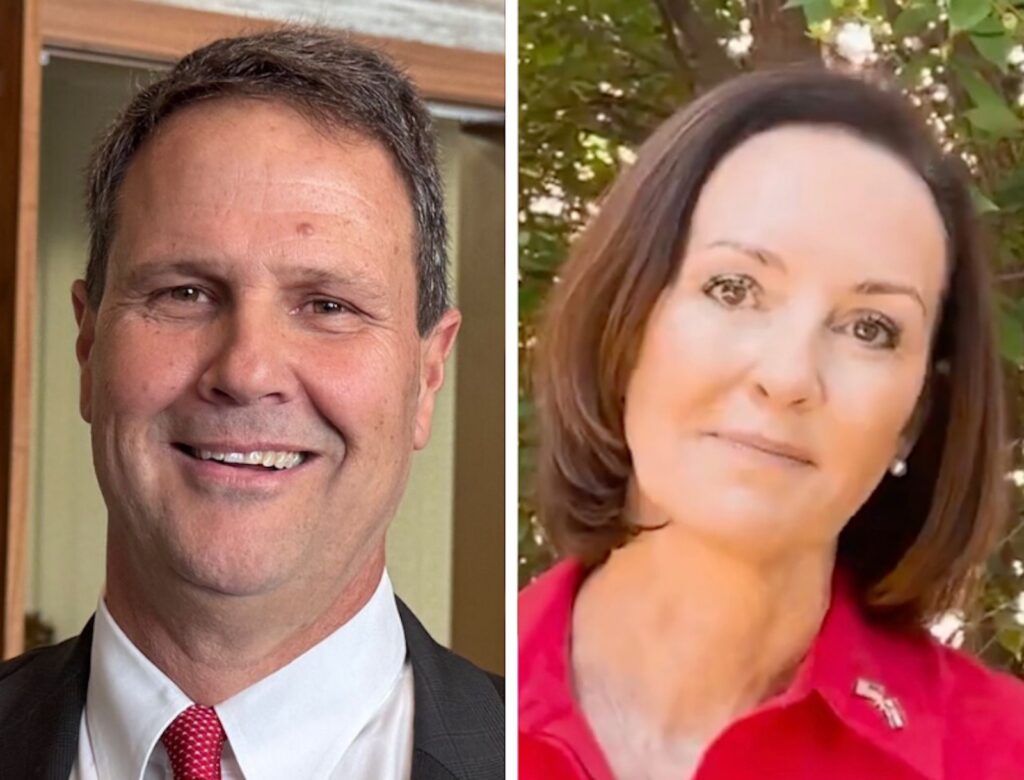
Republican U.S. Rep. Jeff Crank and Jessica Killin, his Democratic challenger, have agreed to debate twice in the weeks leading up to the general election in Colorado’s 5th Congressional District, their campaigns have said. Crank is seeking a second term...