

Colorado Supreme Court clarifies path for proving insurers’ unreasonable delay of benefits
The Colorado Supreme Court delivered a decision with mixed benefits to insurance companies and policyholders on Monday, ruling that insurers’ internal evaluations of claims cannot be used to prove how much they owe a plaintiff, but companies also cannot hide behind ambiguity to delay paying certain types of damages.
Under state law, insurers cannot unreasonably delay or deny payment on a claim. The Supreme Court, in a 2018 decision, previously clarified that auto insurers have an obligation to expeditiously pay the “undisputed portions” of an injured party’s claim even if there are other parts in dispute.
In the case of Marcus A. Fear, who was rear-ended by a driver, a trial judge concluded GEICO had no reason to withhold money for Fear’s noneconomic damages — like pain and suffering — when its own analysis showed a minimum and maximum amount the claim was worth. GEICO had used the minimum figure when attempting to negotiate a settlement with Fear.
However, in a Dec. 23 opinion, the Supreme Court concluded GEICO’s internal figures could not be used to prove the undisputed amount Fear was owed. Simultaneously, wrote Justice Richard L. Gabriel, an insurance company cannot refuse to pay noneconomic damages to injured policyholders if at least some of the amount is undisputed.

“Although, as GEICO argues, non-economic damages tend to involve greater subjectivity than other types of damages like medical expenses,” Gabriel elaborated, “we decline to conclude, as a matter of law, that such damages (or a portion thereof) can never be undisputed.”
Lawyers for Fear and GEICO did not immediately respond to a request for comment.
The case attracted the attention of outside groups who weighed in to the Supreme Court and took away differing impressions of the opinion.
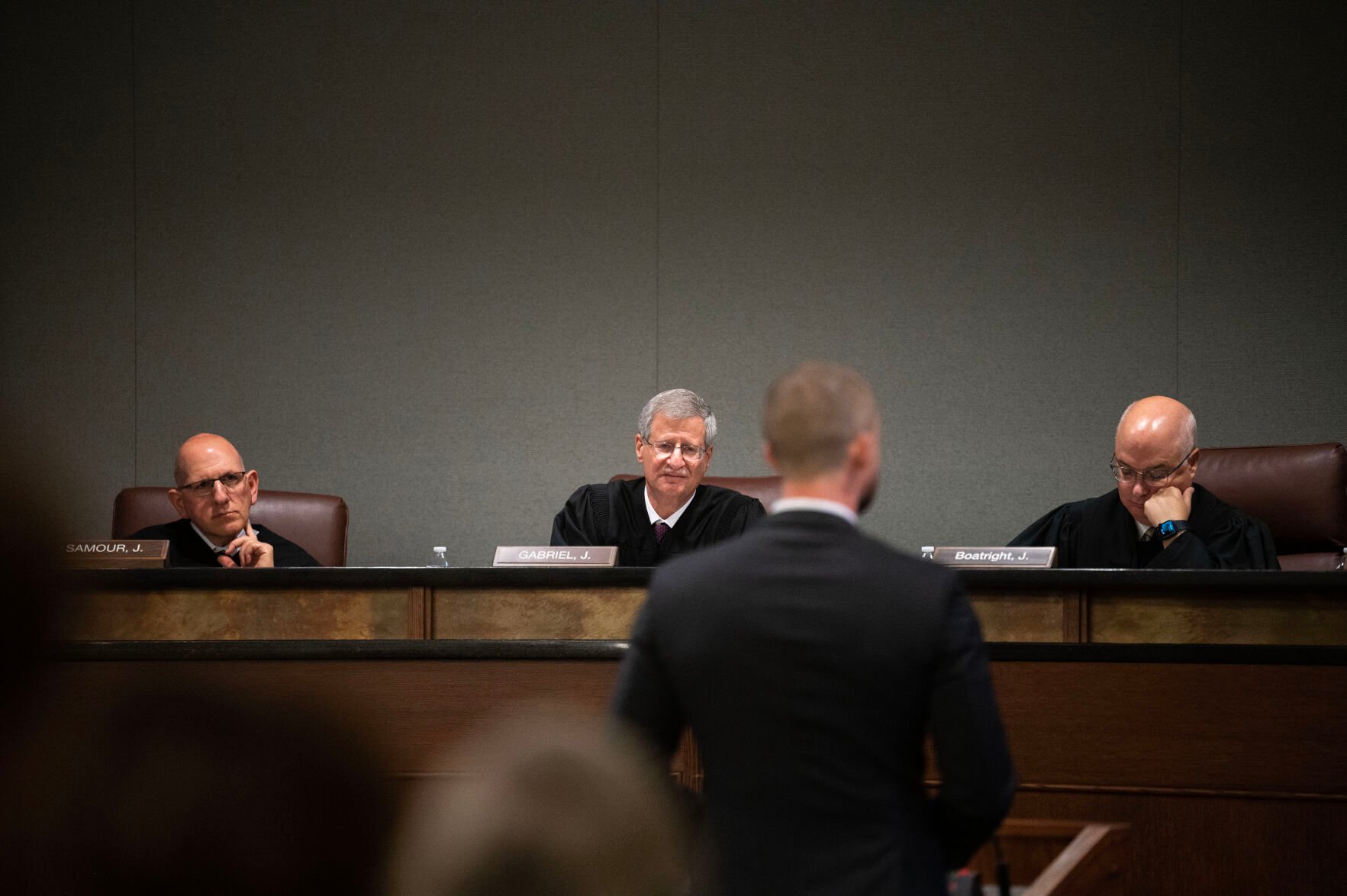
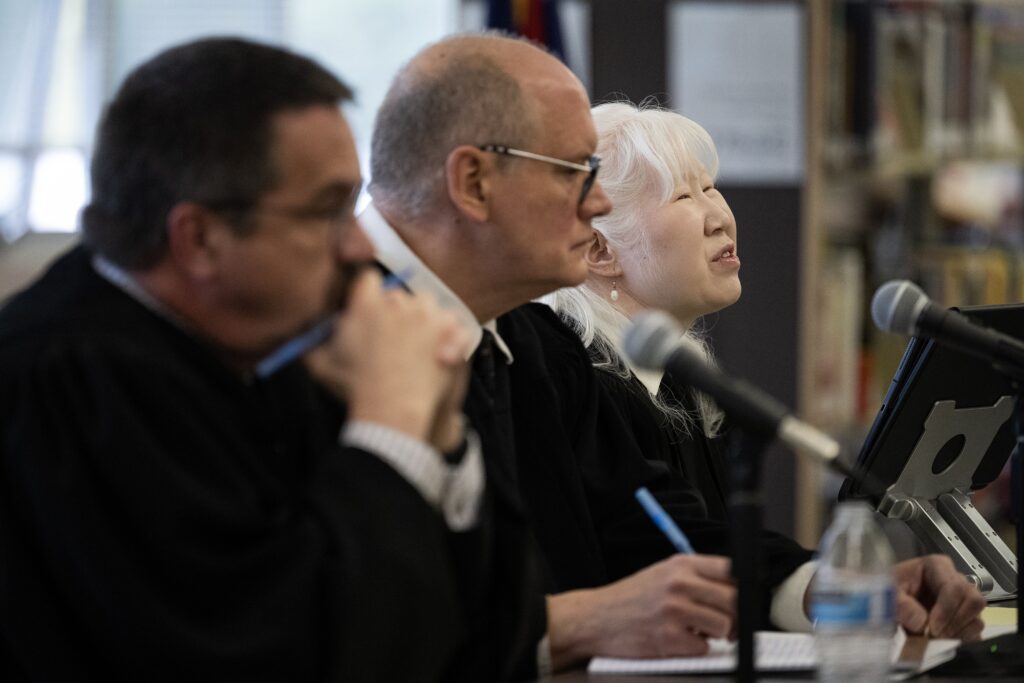
FILE PHOTO: Colorado Supreme Court Justices (from left) Carlos A. Samour Jr., Richard L. Gabriel and Brian D. Boatright listen to arguments from Jake Davis, an attorney in the Nonhuman Rights Project v. Cheyenne Mountain Zoological Society case, as part of Courts in the Community at the Wolf Law building at University of Colorado Boulder on Thursday, Oct. 24, 2024. The semi-annual event entails the Colorado Supreme Court hearing arguments before an audience of students throughout the state. (Stephen Swofford, Denver Gazette)
On the one hand, an attorney for the insurance industry called the decision a rejection of “a cynical attempt” from plaintiffs’ lawyers to etch insurers’ internal estimates in stone.
“In today’s common-sense decision, the Colorado Supreme Court confirmed the overwhelming consensus of prior law that insurers are not required to advance noneconomic damages amounts that are reasonably disputed. And an insurer’s own internal evaluation of such damages is not an ‘undisputed’ amount that must be paid immediately,” said attorney Evan Stephenson, who represented multiple insurance trade associations but spoke on his own behalf.
However, Nelson Waneka, who submitted a brief on behalf of a bar association for plaintiffs’ attorneys, characterized the outcome as “a victory for Colorado insureds.”
“Among other things, the Court recognized that an auto insurer’s evaluation of its insured’s noneconomic damages can be relevant in an insurance bad faith case,” he said.
In Fear’s case, he received neck, back and head injuries from his accident. The responsible driver’s insurance company paid Fear $25,000, pursuant to the policy limits.
Fear then sought additional benefits from his own insurer, GEICO, arguing his injuries exceeded $25,000. Fear did not accept GEICO’s settlement offers or negotiate. Instead, he sued GEICO for unreasonably delaying or denying the payment of benefits.
In 2021, Denver District Court Judge Marie Avery Moses penalized GEICO for failing to pay Fear $3,961 on his claim, which the company’s own evaluation found to represent the minimum amount Fear was owed. She relied on the Supreme Court’s 2018 decision distinguishing between disputed and undisputed portions of claims. Moses also awarded Fear the penalty state law provides for unreasonable delay.
A three-judge panel of the Court of Appeals reversed the penalty, concluding Moses could not rely on the $3,961 figure that was generated internally during GEICO’s efforts to settle Fear’s claim. First, the analysis was “inextricably intertwined” with GEICO’s settlement offer, and such offers are not to be used as evidence. Second, noneconomic damages are “inherently subjective.”
“Internal evaluations like the one that GEICO completed in this case are not intended to confine the fact finder to a particular range of damages, or even to inform its decision-making process,” wrote Judge Matthew D. Grove.
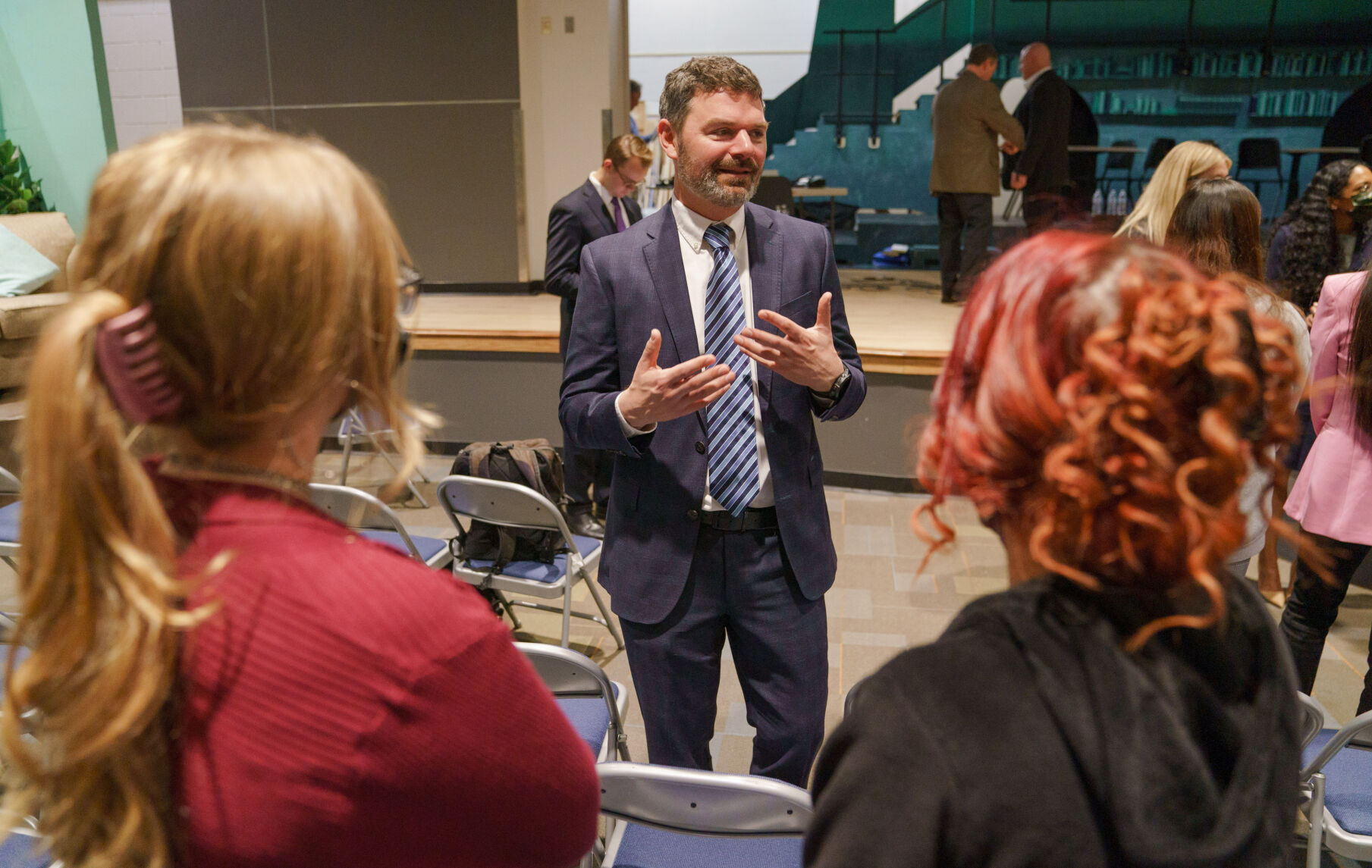
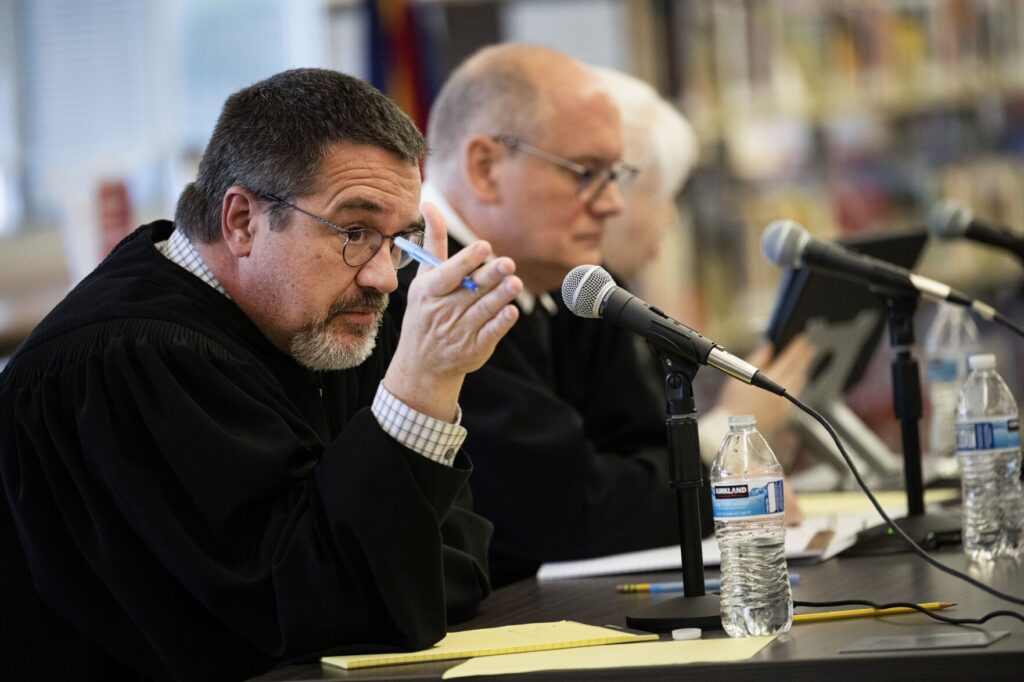
Colorado Court of Appeals Judge Matthew D. Grove speaks with Morgan Rasmussen and Brisais Vargas, 17-year-old juniors. STRIVE Prep — RISE school in Green Valley Ranch hosted a Courts in the Community event, featuring oral arguments before a three-judge panel with the Colorado Court of Appeals on Tuesday, April 19, 2022. Photo by Steve Peterson
During oral arguments in November, the Supreme Court heard about the dynamics of insurance settlements and how a ruling could upend that process. If insurance companies did not immediately pay policyholders the minimum amount shown by their calculations, for example, they could risk a lawsuit for unreasonably delaying “undisputed” damages.
If that were the case, observed Gabriel, “every insurance company would run their number as ‘zero to X.’ And then you’re stuck with, ‘I guess the undisputed number is zero.’ That makes no sense.”
Ultimately, the Supreme Court decided GEICO’s internal estimate of Fear’s damages could not be used in court to show how much he was owed — a win for the insurance industry. But, in a benefit for policyholders and contrary to the Court of Appeals’ belief, the court clarified that undisputed pain-and-suffering portions of a claim must be promptly paid out.
“Accordingly, insurers may not shield themselves from liability simply by disputing the value of a particular benefit; the dispute must have a reasonable basis,” Gabriel added.
The Supreme Court concluded Fear had not proven GEICO unreasonably delayed payment of the undisputed portions of his claim.
The case is Fear v. GEICO Casualty Company.


10th Circuit rules cognitively impaired man’s risk of lobotomy, mistreatment in Mexico not ‘torture’
Michael Karlik
michael.karlik@coloradopolitics.com
Updated 3 hours ago
The Denver-based federal appeals court concluded last month that a man’s risk of mistreatment or forced lobotomy in his native Mexico did not amount to “torture” that should shield him from deportation. A three-judge panel of the U.S. Court of...
Colorado justices side with news organizations for disclosure of high-level child abuse data
Michael Karlik
michael.karlik@coloradopolitics.com
Updated 8 hours ago
The Colorado Supreme Court ruled on Monday that the state must disclose the number of child abuse reports at individual group living facilities in response to an open records request, as the addresses are already in the public domain. The...
Divided Colorado Supreme Court finds Denver detective did not violate defendant’s Miranda rights
Michael Karlik
michael.karlik@coloradopolitics.com
Updated 3 hours ago
The Colorado Supreme Court determined on Monday that a Denver detective did not improperly resume questioning of a defendant in custody after he invoked his right to counsel. By 4-3, the justices reversed a trial judge’s order that found a...

Out-of-state judges address ex-discipline director’s lawsuit, Colorado justices accept federal invitation | COURT CRAWL
Michael Karlik
michael.karlik@coloradopolitics.com
Updated 16 hours ago
Welcome to Court Crawl, Colorado Politics’ roundup of news from the third branch of government. A pair of out-of-state judges got down to business in a lawsuit brought by Colorado’s former judicial discipline director, plus the state Supreme Court has...
Federal judge upholds constitutionality of Colorado campaign contribution limits
Michael Karlik
michael.karlik@coloradopolitics.com
Updated 3 days ago
A federal judge upheld Colorado’s individual campaign contribution limits as constitutional on Thursday, finding that three Republican plaintiffs failed to prove the campaign finance framework violates their First Amendment rights. U.S. District Court Senior Judge John L. Kane recognized that...
Appeals court rejects theory that existing tax revenue undermines need for new fees
Michael Karlik
michael.karlik@coloradopolitics.com
Updated 3 days ago
Colorado’s second-highest court rejected a plaintiff’s claim on Thursday that the tax revenue generated by an existing activity should prevent local governments from imposing new fees aimed at regulating the activity. The question stemmed from Colorado’s unique constraints on taxation...
Appeals court finds no illegal sentence when defendants forfeit time-served credit
Michael Karlik
michael.karlik@coloradopolitics.com
Updated 2 days ago
Colorado’s second-highest court ruled on Thursday that criminal defendants may agree to relinquish the credits they earned while incarcerated pending trial, despite a state law guaranteeing that such time “shall be deducted” from a person’s sentence. Kerry Ellis Endsley pleaded...
Appeals court reinstates Garfield County arson charge
Michael Karlik
michael.karlik@coloradopolitics.com
Updated 1 day ago
Colorado’s second-highest court reinstated a Garfield County defendant’s arson charge on Thursday, concluding a trial judge improperly credited a witness’s claim that she alone was responsible for starting the fire. A sheriff’s deputy responded to a brush fire near Parachute...
Federal judges rebuke ex-Colorado judicial discipline director for conduct in lawsuit
Michael Karlik
michael.karlik@coloradopolitics.com
Updated 4 days ago
A pair of federal judges expressed a desire on Thursday to break the logjam on a lawsuit by Colorado’s former judicial discipline director against the state Supreme Court and related entities, while simultaneously showing little tolerance for the plaintiff’s scorched-earth...

Democratic bill would let recipients of ‘conversion therapy’ sue Colorado providers with no statute of limitations
Marissa Ventrelli
marissa.ventrelli@coloradopolitics.com
Updated 4 days ago
Colorado lawmakers have advanced a proposal that would allow people who underwent conversion therapy to sue licensed providers for damages, moving the measure forward on a party-line vote in the House Judiciary Committee. House Bill 1322, proposed by Democratic Reps....