

Colorado justices skeptical of opening door to resentencing defendants under ‘3 strikes’ law
Members of the Colorado Supreme Court gave an icy reception on Tuesday to the idea that defendants convicted decades ago and serving lengthy sentences under the state’s “three strikes” law should have the opportunity to argue their punishments are grossly disproportionate under current standards.
Although Colorado’s Habitual Criminal Act has undergone changes since its enactment nearly a century ago, the basic framework remains the same: A person convicted of multiple prior felonies will receive a much harsher sentence for a repeat offense than they would otherwise.
Two men convicted in the 1990s are currently asking for the ability to revisit their habitual sentences. To do so requires the Supreme Court to interpret its own decision from less than five years ago.
In 2019, the Supreme Court handed down a major ruling, Wells-Yates v. People, which recognized “grossly disproportionate” sentences are unconstitutional. Therefore, judges must take certain factors into account when they review the proportionality of a defendant’s sentence, including the seriousness of the conduct, the harshness of the penalty and whether changes in law have lessened the penalties for defendants going forward.
The open question, however, was whether Wells-Yates was a purely procedural decision affecting how judges look at sentences, or whether it actually altered the scope of conduct or persons the state can punish. If the latter were true, it would entitle defendants with already-final convictions to a resentencing.
But during oral arguments, the Supreme Court seemed unconvinced.
“It’s always been the case,” said Justice Melissa Hart, “that some sentences are too extreme. Our law has always said that and it continues to say that. This is just a procedure for guaranteeing that.”

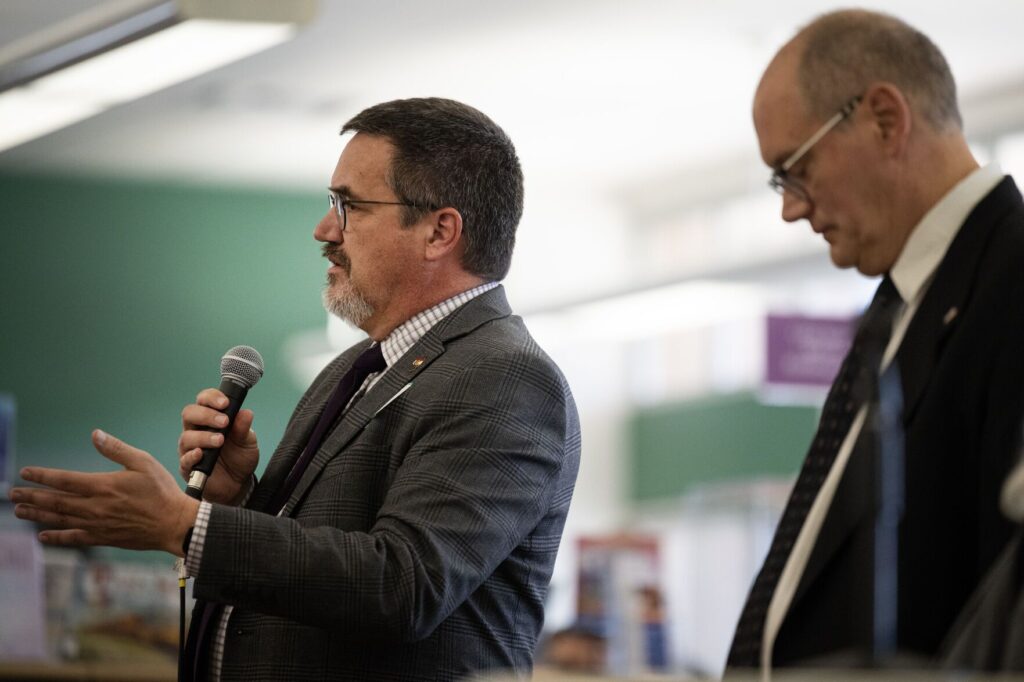
Justice Melissa Hart speaks during oral arguments at the Colorado Supreme Court’s “Courts in the Community” event on May 9, 2024 at Central High School in Pueblo. (Photo by Jerilee Bennett, The Gazette)
Public defender Casey Mark Klekas responded that Wells-Yates‘ focus on legislative changes was new, and rendered the decision more than a procedural tweak. Because the legislature over time has removed some offenses from the scope of the Habitual Criminal Act, he reasoned, three-strikes defendants in the past would not be subject to the law today.
“I didn’t hear any disagreement that, ultimately, there are some people who are no longer punishable under the habitual act when Wells-Yates applies,” said Klekas.
Originally, the Habitual Criminal Act imposed life imprisonment for someone with prior felony convictions. In 1993, the legislature replaced that punishment with a sentence of either three or four times the maximum, depending upon how many prior felonies a person had. The priors are known as “predicate” offenses and the crime that prompts the habitual sentence is the “triggering” offense.
An El Paso County jury convicted Rodney Dewayne McDonald in 1996 of attempted murder, with two prior drug and menacing convictions as the predicate offenses. He received 72 years in prison. Four years earlier, Denver jurors convicted David L. Ward of aggravated robbery. Because he had three prior felonies — and the legislature had not yet amended the Habitual Criminal Act — he received a life sentence.
Although defendants typically have a limited window to seek postconviction relief, that does not apply when there is a new rule of constitutional interpretation that touches on the conduct underlying a person’s conviction. After Wells-Yates, both men petitioned for a review of their sentences’ proportionality, but the Court of Appeals turned them aside.
“Wells-Yates only clarified the methods Colorado courts should use when evaluating whether a habitual sentence is constitutionally disproportionate,” wrote Judge W. Eric Kuhn in McDonald’s appeal, labeling it a procedural change and not a retroactive constitutional rule.

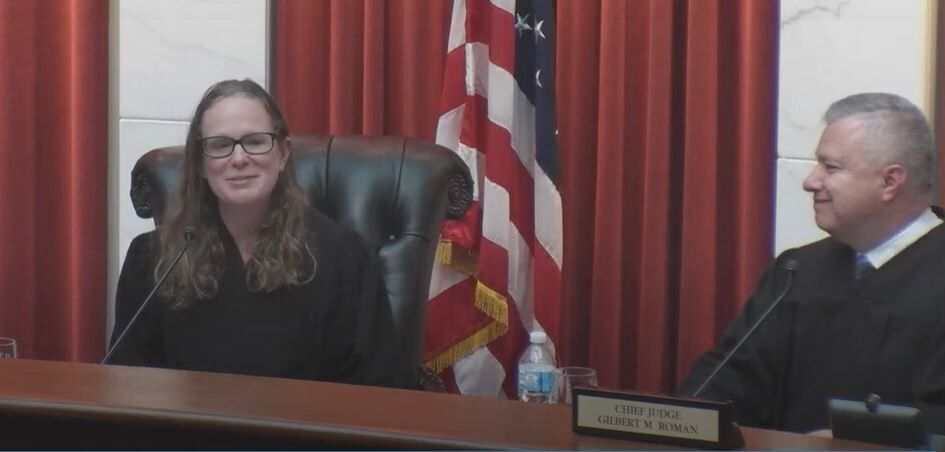
FILE PHOTO: Judge W. Eric Kuhn speaks following his swearing-in ceremony to the Court of Appeals on July 22, 2022. Also pictured, from left to right, are Judges Rebecca R. Freyre, Craig R. Welling and Ted C. Tow III, and Chief Judge Gilbert M. Román.
Turning to the Supreme Court, each defendant took a slightly different approach. McDonald noted both of his predicate offenses from the ’90s would no longer subject him to the Habitual Criminal Act if committed today. The trial judge who reviewed his most recent petition — now-Judge Timothy J. Schutz of the Court of Appeals — conceded there was “something inherently disconcerting” about a person in McDonald’s shoes not being able to challenge his sentence.
“Colorado has substantially revised the Habitual Criminal Act and abandoned the penal philosophy that justified the life-imprisonment provision Mr. Ward was sentenced under,” wrote attorneys for Ward. “As a result, there is a significant risk that outdated punishments like Mr. Ward’s mandatory sentence of lifetime imprisonment are unconstitutional.”
Among other concerns, however, the justices wondered if decades-old sentences would be subject to scrutiny every time lawmakers reduce a penalty.
“That argument suggests there are sentences currently in place that a few years from now will become unconstitutional,” said Hart, who was most critical of the defendants’ positions. “You can’t just go back and revisit sentences because the legislature has changed its perspective. Or can you?”
“The legislature continually changes our criminal laws. Wells-Yates cannot be used as a mechanism for perpetual review of a sentence,” agreed Assistant Solicitor General Jessica E. Ross.

Deputy county attorney Rebecca P. Klymkowsky presents her oral argument to the justices of the Colorado Supreme Court in the County of Jefferson v. Beverly Stickle case during Courts in the Community on Thursday, Oct. 26, 2023, at Gateway High School in Aurora, Colo. (Timothy Hurst/Denver Gazette)
She added that Wells-Yates was ultimately a procedural clarification because it never produced “a class of persons who can say, ‘The Eighth Amendment prohibits my punishment.'”
Still, Justice Richard L. Gabriel returned to the fact that in McDonald’s case, his 72-year sentence would not be imposed today because his predicate offenses no longer render him a habitual criminal.
“It’s never been held to be problematic to sentence people who commit crimes at different times to different sentences,” replied Ross.
Chief Justice Monica M. Márquez asked the government to respond to a brief submitted by law professor Daniel Loehr of the City University of New York. Loehr traced the history of Colorado’s 1929 Habitual Criminal Act to eugenics, and the belief in the early 20th Century that “genetic criminals” should be sterilized or segregated from society.
“I don’t have any reason to doubt that scholarship surrounding the genesis of Colorado’s law,” said Ross. “But it seems obvious to me that Colorado continues to maintain a habitual criminal law today for a rational, but simple, reason: Recidivism is a traditional, if not the most traditional, basis for sentencing courts to increase an offender’s sentence.”
The cases are McDonald v. People and Ward v. People.

Appeals court shuts down path to challenge convictions if lawyer tells jury that defendant is guilty
Michael Karlik
michael.karlik@coloradopolitics.com
Updated 3 hours ago
Colorado’s second-highest court concluded on Wednesday that defendants cannot challenge whether the evidence was sufficient to sustain their convictions if their lawyer argues to the jury that it should find the defendant guilty. The U.S. Supreme Court has provided guidance...

Colorado senator, local officials push for new Colorado Springs federal courthouse
Michael Karlik
michael.karlik@coloradopolitics.com
Updated 4 hours ago
Local officials and one of Colorado’s U.S. senators urged the judiciary earlier this year to explore placing a new federal courthouse and judge’s chambers in Colorado Springs, while the district court is cautioning that Congress must establish new judgeships before...
A year of developments in the CBI forensic lab scandal
Jenny Deam
jenny-deam@coloradopolitics.com
Updated 8 hours ago
As the scandal at the Colorado Bureau of Investigation forensic lab moved through its second year, a series of startling developments and revelations emerged with no clear end in sight and the full toll still unknown. At the heart of a scandal unlike any before in state history,...
Federal judge sides with Douglas County School District in ex-admin’s discrimination lawsuit
Michael Karlik
michael.karlik@coloradopolitics.com
Updated 1 hour ago
A federal judge concluded last week that a former high school administrator had not proven his claims of religious discrimination against the Douglas County School District. Corey McNellis had worked at Ponderosa High School since 2002 and served as the athletic...
Appeals court orders new menacing trial after faulty self-defense instruction
Michael Karlik
michael.karlik@coloradopolitics.com
Updated 1 day ago
Colorado’s second-highest court ordered a new trial last week for an El Paso County defendant convicted of felony menacing, concluding an erroneous self-defense instruction may have influenced the verdict. Under Colorado law, self-defense is an affirmative defense, meaning the prosecution...
Appeals court clarifies framework for parents’ First Amendment rights in child-naming disputes
Michael Karlik
michael.karlik@coloradopolitics.com
Updated 1 day ago
Colorado’s second-highest court overturned a Jefferson County judge’s order last week in a long-running dispute about whether two ex-spouses must call their child by his first name or middle name outside the home. In doing so, a three-judge Court of...
10th Circuit judges recap do’s and don’ts for lawyers
Michael Karlik
michael.karlik@coloradopolitics.com
Updated 1 day ago
Two members of the Denver-based federal appeals court spoke to attorneys on Monday about how to present cases effectively, and when it is helpful for outside entities to weigh in on pending appeals. Judges Robert E. Bacharach of Oklahoma and...
Divided appeals court overturns defendant’s $350,000 restitution obligation
Michael Karlik
michael.karlik@coloradopolitics.com
Updated 1 day ago
Colorado’s second-highest court overturned a defendant’s obligation to pay nearly $350,000 in crime victim restitution last week because an Arapahoe County judge issued the restitution order beyond the legal deadline. The divided decision of a three-judge Court of Appeals panel...
2025 Unfiltered: Colorado Supreme Court vacancy, surge in federal filings and more
Michael Karlik
michael.karlik@coloradopolitics.com
Updated 4 days ago
This year was awash in legal news nationally, with federal courts taking an outsize role in responding to executive branch actions. In Colorado, that effect was evident, but it was not the only factor at play. Here are the top...
$3 million penalty upheld against for-profit college following half-decade of appeals
Michael Karlik
michael.karlik@coloradopolitics.com
Updated 4 days ago
Colorado’s second-highest court upheld a $3 million penalty against a defunct for-profit college on Wednesday, agreeing the state had proven multiple violations of its consumer protection law. The Court of Appeals’ decision against CollegeAmerica followed a trial judge’s order in...