

Why there’s a future in Colorado agriculture, and who to thank | GABEL
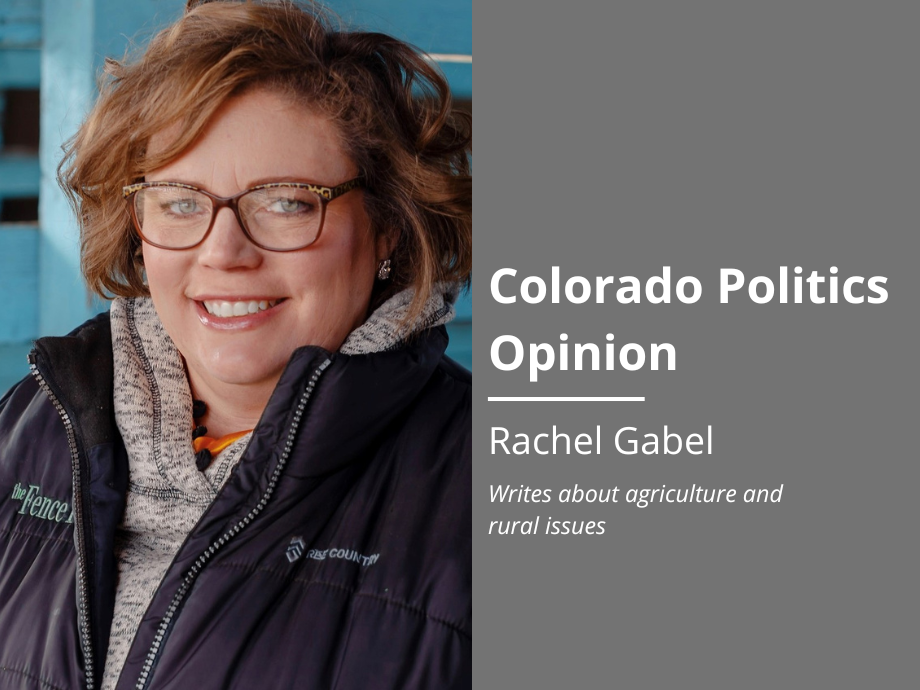
Rachel Gabel

Rachel Gabel
The process of steam-flaking corn makes the business of cattle feeding 10% more efficient and puts more affordable protein on consumers’ plates. In the old days of fattening cattle, pigs ran in pens with cattle to eat, as pigs do, the whole corn left on the ground by the cows either before or after eating it. Chickens came behind the pigs cleaning up the remainder. This was in the days when farmers fed a few fat cattle to sell, and one for their own family. As feeding became a business that had to meet the growing demands and hunger of consumers from coast to coast, cattle needed to reach a consistent endpoint in the feedyard so they could be harvested and makes their way to the plate.
Number 2 field corn is what comes right out of the combine. It’s harvested nearly dry, so as not to mold as a result of moisture. It’s not terribly digestible, which makes the nutrient-dense feedstuff harder for livestock to access. Adding water, cooking the corn and then flattening the kernel into a flake that is still dry enough to store, but far more palatable and digestible, is the ideal method of feeding corn.
The other invention that changed cattle feeding was the advent of the feed-delivery wagon, found today in quite literally every feedyard in the country. Ration ingredients are added to the truck mounted or to a wagon pulled behind a tractor, where they are mixed, and can be delivered to the bunk at exactly the right amount.
Both contributions to the cattle-feeding industry are rooted in Colorado and were invented by Dr. John Matsushima, an alumnus and professor emeritus at Colorado State University. At 103-years old, he is a gem and as sharp as a tack. He is also the subject of the 2025 Colorado Agriculture in the Classroom book, which I had the honor of writing.
Stay up to speed: Sign up for daily opinion in your inbox Monday-Friday
Dr. Matsushima attended CSU during the second World War and as a Japanese American, he wasn’t allowed to enter many businesses in Fort Collins. His livestock judging teammates brought him groceries and after he wore the same pair of shoes for three years, they brought him rubber to tack on the soles.
It was important to me that as elementary students hear his story, they also see him and hear his voice. With the help of his daughter, Nancy Oliver, we filmed content for two videos. One will be a short video featuring Dr. Matsushima talking about the basics of how an order of oatmeal gave him the idea for steam-flaked corn and how watching cows eat cabbage taught him they have no teeth on the top. The second video will be a documentary-style video that will be a legacy piece for the industry, but also appropriate for high school and post-secondary students.
I gathered several of Dr. Matsushima’s former students, many of whom are legends in the cattle-feeding business themselves, and we convened at the CSU campus. Dr. Matsushima visited with each one both on and off camera, shared stories, and laughed with them. He has kept neatly typed lists of every student he taught at the University of Nebraska from 1949 to 1960 and CSU from 1960 to 1992 with their hometown and the grade they earned in his Feeds and Feeding or Feedyard Management classes.
I’m still muddling through an enormous amount of footage to put together both videos with the generous support of several agriculture businesses. When complete next spring, the elementary students who will participate in the free program will hear the book, see the short video, hold steam-flaked corn in their hands and will each get a beef stick from Ram Country Meats at CSU. It’s my hope each student will make the connection between agriculture and people and are more likely to build on that basic knowledge of where their food comes from, especially come election time.
Secondary students will have access to the book, the longer video, and a higher-level telling of Dr. Matsushima’s story in a magazine published by The Fence Post Magazine. The remainder of the content will be centered on careers in agriculture. It’s my hope they will recognize the potential in agriculture careers beyond being a farmer or veterinarian, which are honorable and popular choices, no doubt. There is a future in agriculture, built on the shoulders of giants like Dr. Matsushima and it’s an honor to tell the tale.
Rachel Gabel writes about agriculture and rural issues. She is assistant editor of The Fence Post Magazine, the region’s preeminent agriculture publication. Gabel is a daughter of the state’s oil and gas industry and a member of one of the state’s 12,000 cattle-raising families, and she has authored children’s books used in hundreds of classrooms to teach students about agriculture.

The relevance of Watergate more than a half-century later | SONDERMANN
By Eric Sondermann
by-eric-sondermann@coloradopolitics.com
Updated 3 days ago
It was the scandal for which all other scandals are now named. In June 1972, a small group of Cuban burglars with high-level connections broke into the headquarters of the Democratic National Committee. Those headquarters were located in the Watergate...
Colorado must continue finding common ground on wildfire policy | GUEST COLUMN
Colorado Politics
colorado-politics@coloradopolitics.com
Updated 2 days ago
By John Herrick Colorado has never lacked for opinions about wildfire policy. We debate forest management, climate change, prescribed burns, land use, air quality and budgets. Those debates are familiar territory, but a new discussion is beginning to happen around...
Proposition NN is the best investment for Colorado’s students and schools | GUEST COLUMN
Colorado Politics
colorado-politics@coloradopolitics.com
Updated 2 days ago
By Justin Ogden Colorado families know what it means to make difficult budget decisions. Inflation has driven up the cost of groceries, housing, utilities and just about everything else. Families like mine work hard to stretch every dollar while still...

Were the primaries a preview for consequential general election? | Paula Noonan
Paula Noonan
paula-noonan@coloradopolitics.com
Updated 3 days ago
Colorado’s political future will go the way of this election. Historically, the state has not had both chambers controlled by a supermajority. This election may change that. The primaries suggest how the general election may play out. Democrats had solid...

Disagreement doesn’t have to mean disrespect | GUEST COLUMN
Colorado Politics
colorado-politics@coloradopolitics.com
Updated 3 days ago
By Vincent Atchity These days, it doesn’t take long to feel overwhelmed by politics. Turn on the news, scroll through social media or read the comments on almost any political post and you’ll find anger, outrage and personal attacks. For...

Keeping Colorado’s kids’ trust online | PODIUM
Colorado Politics
colorado-politics@coloradopolitics.com
Updated 4 days ago
By Stuart Jenkins Almost every day, the kids and teens we serve across Colorado are introduced to new generative artificial intelligence and other emerging technology, including conversational AI systems designed to simulate human conversation. These tools are no longer a...

Marx’s ‘through line’ predates Trump, connects to Maes | FEEDBACK
Colorado Politics
colorado-politics@coloradopolitics.com
Updated 4 days ago
Eric Sondermann is of course correct Victor Marx is an unserious, unelectable, embarrassing Republican nominee for governor of Colorado. But I respectfully submit that the “through line,” as Mr. Sondermann describes it, is not from Trump to Marx, despite their...

Cedric Pride’s blueprint for opportunity through the trades | The OpEdge Podcast
Tony Olivero
tony.olivero@gazette.com
Updated 5 days ago
Cedric Pride, CEO of the nonprofit Pride Initiative in Denver, joins The OpEdge with a blueprint for workforce development, skilled trades, and economic opportunity. Pride tells host and investigative columnist Jimmy Sengenberger why he believes the trades offer a path...

Colorado’s No. 1 education ranking should raise our ambition | GUEST COLUMN
Colorado Politics
colorado-politics@coloradopolitics.com
Updated 5 days ago
By Scott Laband Colorado has earned the right to celebrate its new No. 1 ranking in education from U.S. News & World Report. Gov. Jared Polis called it “one of the proudest moments” of his time in office and shared the...

Colorado’s No. 1 education ranking reflects the power of school choice | GUEST COLUMN
Colorado Politics
colorado-politics@coloradopolitics.com
Updated 5 days ago
By Peter Mason Colorado is now the No. 1 state in the nation for education, according to the 2026 U.S. News & World Report Best States rankings. That is a distinction worth celebrating. It is also a distinction worth understanding....