

Grant Sullivan, representing state officials from trial courts to SCOTUS, ceremonially sworn in as appeals judge
For years, Grant T. Sullivan had his name attached to high-profile, high-stakes cases filed against Colorado and its public officials in challenges to the state’s election laws, gun safety policies and its non-discrimination directives.
At his formal swearing-in ceremony as a judge on the state’s Court of Appeals, Sullivan thanked the policymakers he formerly represented.
“I’m grateful for your public service, even if it means you occasionally were sued and had to call me,” he said on Friday.
Gov. Jared Polis appointed Sullivan to the 22-member Court of Appeals last year, and he has been on the court since January. The ceremony, known as an investiture, was intended to formally honor the appointment.

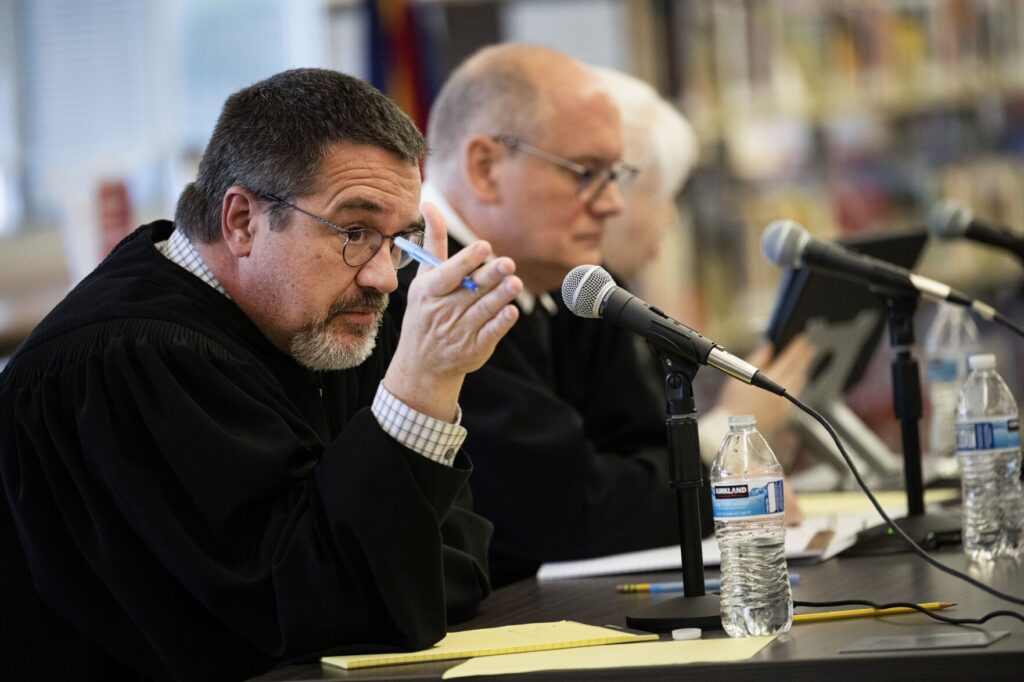
Former Colorado Court of Appeals Judge John R. Webb swears in Grant T. Sullivan to the appellate court during Sullivan’s investiture on June 7, 2024.
Sullivan joined the Colorado Attorney General’s Office in 2011 and worked under two Republican and one Democratic attorneys general. He was part of the office’s public officials unit, where he represented the governor, secretary of state, attorney general, treasurer and various state agencies.
As a lawyer, Sullivan appeared in court to defend the state against challenges to Colorado’s law on campaign spending limits, the “red flag” law governing firearm access for allegedly dangerous individuals, and the COVID-19 vaccine mandate for the University of Colorado’s medical campus.
Sullivan’s judgeship application listed multiple cases he worked on that made it to the U.S. Supreme Court, including Masterpiece Cakeshop v. Colorado Civil Rights Commission, in which the justices sided with a Christian baker who declined to make a wedding cake for a same-sex couple, and Colorado Department of State v. Baca, in which the court approved of state laws regulating “faithless electors” in presidential elections.

Judge Grant T. Sullivan receives assistance from his fiancée, Aubrey Elenis, and his stepdaughter as he puts on his robes on June 7, 2024 during his ceremonial swearing-in to Colorado’s Court of Appeals.
“During my transition, then-Secretary of State Wayne Williams said, ‘Phil, you need to look at this case because it could go all the way to the Supreme Court’,” recalled Attorney General Phil Weiser, who spoke at Sullivan’s investiture, about the faithless electors challenge.
When Colorado lost in the federal appeals court, Sullivan suggested Weiser argue the case before the Supreme Court. Weiser said he was interested in doing so, but others in his department “had some pause.” Ultimately, Weiser argued the case himself and prevailed.
“You would take on the most difficult cases. You didn’t just do that, but you did it with enthusiasm,” he said. “It’s so clear that you were always feeling grateful for the chance to work on these cases. That is precious and that is infectious.”

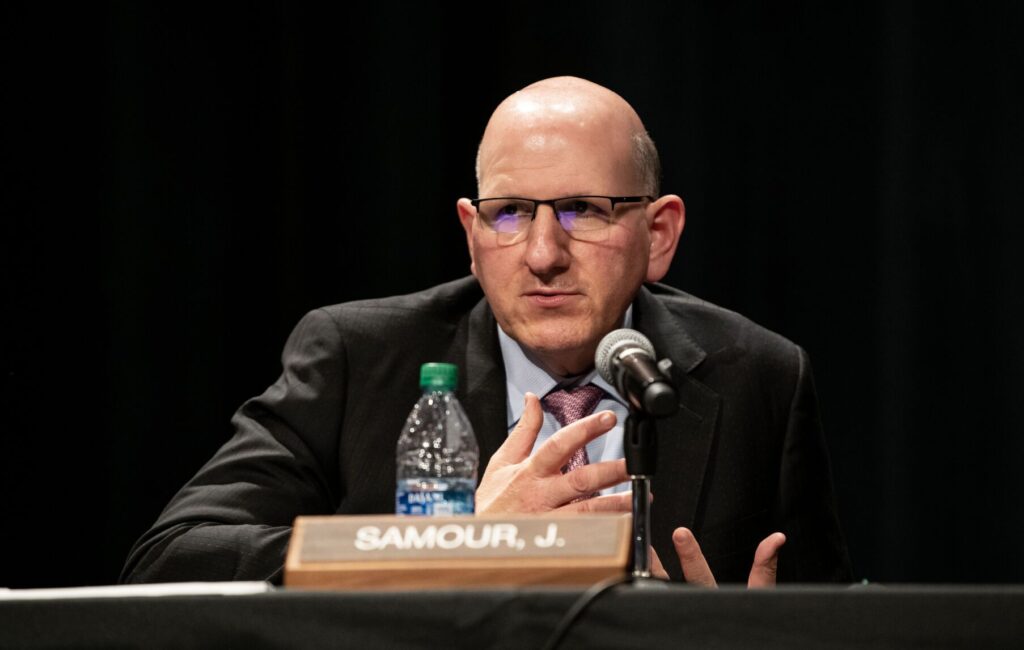
Colorado Attorney General Phil Weiser speaks at the ceremonial swearing-in of Judge Grant T. Sullivan to the Court of Appeals on June 7, 2024.
Sullivan’s appointment to the Court of Appeals occurred days before a trial judge issued her ruling in another unique case of Sullivan’s: representing Secretary of State Jena Griswold in a challenge to Donald Trump’s eligibility to appear on Colorado’s 2024 presidential primary ballot.
“We are not always perfect. I will certainly make mistakes and I’m grateful to the Colorado Supreme Court for telling me when I do,” said Sullivan. “But I will always do my best to earn the public’s trust.”
Sullivan was a clerk for former Court of Appeals Judge John R. Webb and former state Supreme Court Chief Justice Nathan B. Coats. In his judicial application, Sullivan listed his experience with Metro Volunteer Lawyers, providing pro bono services to litigants in family law cases. He also described the event that inspired him to enter government service: when his father, a part-time county counselor in rual Kansas, came out as gay during Sullivan’s childhood.
“He never gave a second thought to the raised eyebrows among his government colleagues. His bravery made the community more accepting and the local government more diverse,” Sullivan wrote.

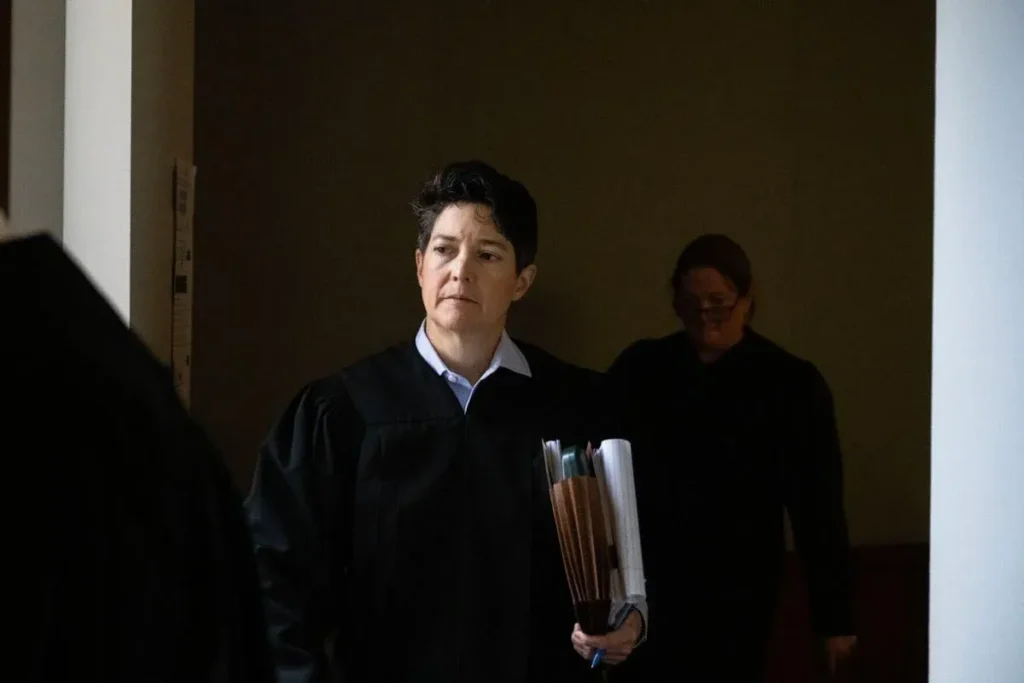
Members of Colorado’s Court of Appeals gather at the ceremonial swearing-in of Judge Grant T. Sullivan on June 7, 2024.
Chief Judge Gilbert M. Román called Sullivan “genuinely one of the nicest people.” He mentioned an unusual experience Sullivan had after three months on the job, participating in the “Courts in the Community” program at Fort Lupton High School when a gun scare prompted a lockout on the campus.
Kara Veitch, Polis’ chief legal counsel, recalled her interaction with Sullivan as she walked with him out of the governor’s residence post-interview. He asked how she was doing and she gave a superficial answer, only for him to respond, “No, how are you doing?”
“In a moment when this is all about him, Judge Sullivan reached out,” Veitch said. “I was going through a really hard time. My daughter had been in the hospital. That kind of empathy that you bring … this is the type of human that we need in public service.”

Kara Veitch, chief legal counsel to Gov. Jared Polis, speaks at the cermonial swearing-in of Judge Grant T. Sullivan to Colorado Court’s of Appeals on June 7, 2024.
With Sullivan’s appointment, Polis has selected half of the Court of Appeals’ membership in just five years. He will appoint a 12th member later this year, when Judge Anthony J. Navarro steps down. In addition to Sullivan, Polis selected Judges Sueanna P. Johnson and W. Eric Kuhn from the ranks of Weiser’s office.
Sullivan also gave a shout-out to his fiancée, Aubrey Elenis, the director of the Colorado Civil Rights Division who herself was involved in a major Supreme Court case out of Colorado last year — 303 Creative v. Elenis, which featured a challenge to the state’s non-discrimination law.
“Let me pause here and answer the question that I just know is gnawing at the judges in the room,” Sullivan added. “Aubrey and I appreciate all of the offers, but we already have someone to officiate the wedding.”


10th Circuit rules cognitively impaired man’s risk of lobotomy, mistreatment in Mexico not ‘torture’
Michael Karlik
michael.karlik@coloradopolitics.com
Updated 1 hour ago
The Denver-based federal appeals court concluded last month that a man’s risk of mistreatment or forced lobotomy in his native Mexico did not amount to “torture” that should shield him from deportation. A three-judge panel of the U.S. Court of...
Colorado justices side with news organizations for disclosure of high-level child abuse data
Michael Karlik
michael.karlik@coloradopolitics.com
Updated 49 minutes ago
The Colorado Supreme Court ruled on Monday that the state must disclose the number of child abuse reports at individual group living facilities in response to an open records request, as the addresses are already in the public domain. The...
Divided Colorado Supreme Court finds Denver detective did not violate defendant’s Miranda rights
Michael Karlik
michael.karlik@coloradopolitics.com
Updated 51 minutes ago
The Colorado Supreme Court determined on Monday that a Denver detective did not improperly resume questioning of a defendant in custody after he invoked his right to counsel. By 4-3, the justices reversed a trial judge’s order that found a...

Out-of-state judges address ex-discipline director’s lawsuit, Colorado justices accept federal invitation | COURT CRAWL
Michael Karlik
michael.karlik@coloradopolitics.com
Updated 8 hours ago
Welcome to Court Crawl, Colorado Politics’ roundup of news from the third branch of government. A pair of out-of-state judges got down to business in a lawsuit brought by Colorado’s former judicial discipline director, plus the state Supreme Court has...
Federal judge upholds constitutionality of Colorado campaign contribution limits
Michael Karlik
michael.karlik@coloradopolitics.com
Updated 3 days ago
A federal judge upheld Colorado’s individual campaign contribution limits as constitutional on Thursday, finding that three Republican plaintiffs failed to prove the campaign finance framework violates their First Amendment rights. U.S. District Court Senior Judge John L. Kane recognized that...

Appeals court rejects theory that existing tax revenue undermines need for new fees
Michael Karlik
michael.karlik@coloradopolitics.com
Updated 3 days ago
Colorado’s second-highest court rejected a plaintiff’s claim on Thursday that the tax revenue generated by an existing activity should prevent local governments from imposing new fees aimed at regulating the activity. The question stemmed from Colorado’s unique constraints on taxation...
Appeals court finds no illegal sentence when defendants forfeit time-served credit
Michael Karlik
michael.karlik@coloradopolitics.com
Updated 2 days ago
Colorado’s second-highest court ruled on Thursday that criminal defendants may agree to relinquish the credits they earned while incarcerated pending trial, despite a state law guaranteeing that such time “shall be deducted” from a person’s sentence. Kerry Ellis Endsley pleaded...
Appeals court reinstates Garfield County arson charge
Michael Karlik
michael.karlik@coloradopolitics.com
Updated 1 day ago
Colorado’s second-highest court reinstated a Garfield County defendant’s arson charge on Thursday, concluding a trial judge improperly credited a witness’s claim that she alone was responsible for starting the fire. A sheriff’s deputy responded to a brush fire near Parachute...
Federal judges rebuke ex-Colorado judicial discipline director for conduct in lawsuit
Michael Karlik
michael.karlik@coloradopolitics.com
Updated 4 days ago
A pair of federal judges expressed a desire on Thursday to break the logjam on a lawsuit by Colorado’s former judicial discipline director against the state Supreme Court and related entities, while simultaneously showing little tolerance for the plaintiff’s scorched-earth...
Democratic bill would let recipients of ‘conversion therapy’ sue Colorado providers with no statute of limitations
Marissa Ventrelli
marissa.ventrelli@coloradopolitics.com
Updated 4 days ago
Colorado lawmakers have advanced a proposal that would allow people who underwent conversion therapy to sue licensed providers for damages, moving the measure forward on a party-line vote in the House Judiciary Committee. House Bill 1322, proposed by Democratic Reps....