

El Paso and Teller counties to see $66 million in grants to address opioid epidemic
El Paso and Teller counties are expected to receive $66 million through 2038 to address the opioid epidemic, a scourge that has claimed hundreds of thousands of lives nationally.
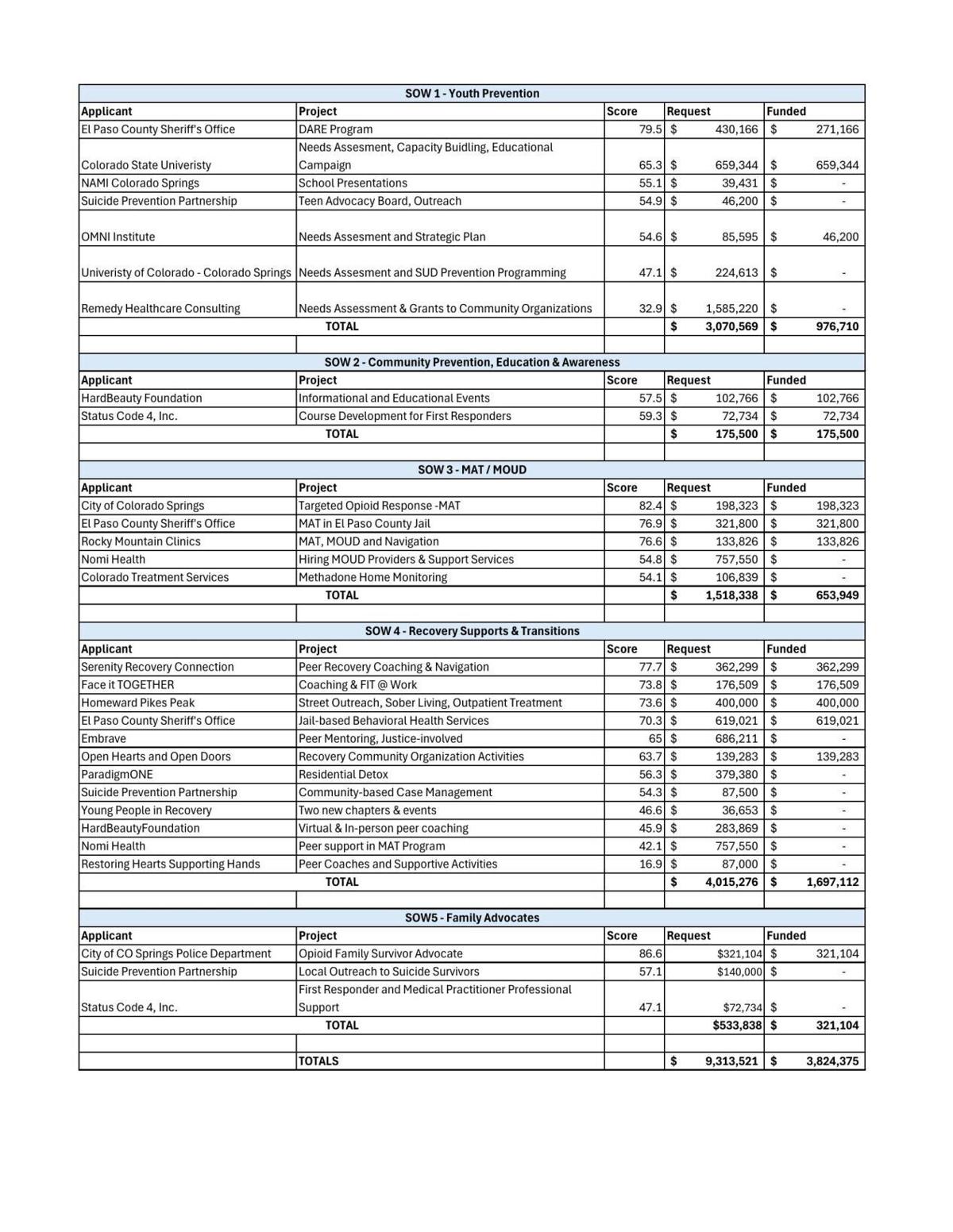
A regional council awarded the first round of that funding, about $3.8 million, in April. The council left about $1.1 million in reserve to fund additional youth prevention programs, said Amanda Grant, an El Paso County finance employee who works with the council. She said the region is currently expected to receive $66 million, although the number will fluctuate depending on settlement outcomes.
The board is composed of 15 officials from El Paso and Teller counties, including county commissioners, city and town council members and law enforcement representatives. At the April meeting, six voting members attended and another five members sent proxies to vote on their behalf to dole out the funds for youth and community prevention, medication assisted treatment and family advocates for those who lost someone to an overdose. The money will also fund recovery support, such as sober living homes.
Fewer US overdose deaths were reported last year, but experts are still cautious
The El Paso County Sheriff’s Office received almost a third of all the grant funding and expects to use it on youth prevention and jail-based programs. Much of the other funding was split across nonprofits working in drug treatment and prevention.
Teller County Commissioner and the council’s vice chair Erik Stone said the epidemic has cut across all races and economic strata and the ongoing funding from federal settlements offers an opportunity for innovation.
“We have a tremendous opportunity to make a difference,” he said.
Last year, El Paso County saw 212 deaths related to drugs, down slightly from 216 the previous year, said Coroner Dr. Leon Kelly, who is also a member of the council.
Fentanyl was involved in 123 deaths last year, up from 115 the pervious year, part of a six-year rise in deaths related to the synthetic opioid. The county saw five fentanyl related deaths in 2017, Kelly said. His office is also detecting new fentanyl analogues of even higher potency.
“The past few years there has clearly been an acceleration of novel and highly potent illicit drugs entering the drug supply chain and I can only expect that will continue,” he said in a written statement.
While $66 million seems like a lot of money, Kelly said, addressing addiction is still a huge challenge given the scope and a relative lack of success over more than 50 years.
He would like to see effective support and treatment for those with addictions, including increased access to medication assisted therapies, work to address the presence of drugs and minimize risk to those in early stages of abuse and and effective youth prevention that provides emotional and intellectual tools, he said. Medication-assisted therapy is typically done in association with counseling and can help stave off withdrawal symptoms.
Effective youth prevention
Nate Riggs, executive director of the CSU Prevention Research Center, expects the large award of about $659,000 his organization received will help fund a prevention needs assessment and help train people already working with youth on effective prevention.
“Working with community partners, so that it is done right, we can save lives and save money,” he said.
Effective prevention helps students learn how to regulate emotions, so they don’t feel the need to use substances, he said. It also helps them build their communication skills.
One-time presentations telling students about the dangers of substance abuse aren’t effective, Riggs said.
Conleys open sober living house in Victor
His organization works with groups, such as the Boys and Girls Club, to help their staff understand how to do prevention so it can be sustainable over time, he said.
One of the challenges in designing youth prevention for El Paso County could be a lack of data through the Healthy Kids Colorado Survey that gauges youth use of substances, such as marijuana, alcohol and pain killers. Not enough students participate in the survey to provide results.
Riggs said his organization will try to identify other sources of data and work with local organizations to identify specific problems in the community.
The El Paso County Sheriff’s Office received the second largest grant in the youth prevention category of about $271,000 to reintroduce the DARE program, or Drug Abuse Resistance Education program, into schools. A presentation provided to the council said Widefield School District 3 and Lewis-Palmer School District 38 have agreed to host the program in the fall.
According to the American Addiction Centers, the DARE program has been reworked in recent years from one-time presentations on the risk of drugs to a series of lessons that teach skills such as coping and decision-making skills.
The Sheriff’s Office declined an interview request about its plans for the grant funding.
Drug recovery
The council designated the most money, $1.7 million, to recovery and support for those dealing with addiction. The El Paso County Sheriff’s Office received $619,000, the largest portion of the money for this work to support jail-based programs.
Slides presented to the council show the jail plans to use the money for its behavioral health services program focused on discharge planning and groups to address relapse prevention. The money will expand services to include additional groups, individualized treatment planning and connections to peer coaches and other community professionals.
The budget includes money for three substance abuse counselors, a program supervisor, a security specialist and a data and funding specialist.
Compassion vs. frustration: Rising angst over problems with homeless population
The council broke out funding for medicated-assisted treatment separately, designating $653,000 to those efforts. Again, the El Paso County Sheriff’s Office was the largest recipient in this category, receiving $321,800 for its medicated assisted treatment program in the jail.
The jail intends to encourage the use of naltrexone instead of suboxone to treat addiction with the grant funding because it will be safer, the council presentation said.
Homeward Pikes Peak received the next highest amount, $400,000, to support its existing outreach to homeless residents and its sober living homes.
While it will not support an expansion of services, CEO Beth Hall Roalstad explained its important because grant support for this kind of work is always shifting. For example, a foundation may support two years of work and then require the nonprofit take a break and find funding elsewhere.
If the opioid settlement dollars could provide Homeward Pikes Peak with stable funding, then it could allow the nonprofit to evaluate the work better and work on expansion.
Across the community, she would like to see the $66 million in settlement dollars build a model to ensure addiction in the community is rare, brief and nonrecurring.
She envisions a model that would ensure “when someone gets addicted there is a really robust safety net of access to treatment and housing and community support to help bolster this person’s choice of sobriety.”
Support for families
The Colorado Springs Police Department expects to start a new assistance program for the families of those who die from an overdose, that will help with referrals to mental health and counseling services and resources, such as crime scene cleanup information and help with funerals.
The Police Department declined an interview request to talk about the program. It was the only agency to receive funding in a category dedicated to family advocacy.
Teller County Commissioner Stone said he expected the program would fill a huge gap for the bereaved.
Over the next decade, the community leader has high hopes for the tens of millions of dollars the region will receive to provide treatment and prevention and he expects that work will be informed by data.
“We want to restore families,” Stone said.


Colorado School of Mines lands major share in Trump’s $100M mining-education plan
Thelma Grimes
thelma.grimes@coloradopolitics.com
Updated 25 minutes ago
President Donald Trump on Friday named the Colorado School of Mines among roughly a dozen institutions that will share in a $100 million commitment “to train the next generation of American miners.” Paul Johnson, the university’s president, said he is...

Local party leaders, incoming judge among members of judicial performance commission that violated law
Michael Karlik
michael.karlik@coloradopolitics.com
Updated 1 hour ago
A local Democratic leader and 2024 presidential elector. A legislative aide and leader in the Young Republicans. An incoming county court judge freshly appointed by the governor. They are among the eight members of the northeastern Colorado judicial performance commission...

Judge dismisses lawsuit seeking records from Colorado Democratic group
Marianne Goodland
marianne.goodland@coloradopolitics.com
Updated 15 minutes ago
A lawsuit seeking to obtain records from Democratic lawmakers affiliated with a caucus has been thrown out by a Denver District Court judge. On July 17, Judge Ericka Englert dismissed the April lawsuit filed by progressive activist Derrick Blanton, who...

US job market stalled in July as employers cut 23,000 jobs, delivering political setback to Trump
The Associated Press
the-associated-press@coloradopolitics.com
Updated 7 hours ago
WASHINGTON (AP) — The U.S. job market stalled unexpectedly last month, delivering a political blow to President Donald Trump three months ahead of midterm elections and complicating decision-making for the inflation fighters at the Federal Reserve. Employers cut 23,000 jobs...

Colorado must continue finding common ground on wildfire policy | GUEST COLUMN
Colorado Politics
colorado-politics@coloradopolitics.com
Updated 24 hours ago
By John Herrick Colorado has never lacked for opinions about wildfire policy. We debate forest management, climate change, prescribed burns, land use, air quality and budgets. Those debates are familiar territory, but a new discussion is beginning to happen around...

Proposition NN is the best investment for Colorado’s students and schools | GUEST COLUMN
Colorado Politics
colorado-politics@coloradopolitics.com
Updated 24 hours ago
By Justin Ogden Colorado families know what it means to make difficult budget decisions. Inflation has driven up the cost of groceries, housing, utilities and just about everything else. Families like mine work hard to stretch every dollar while still...

DOJ official decries ‘nonsense’ in Jeffco schools at fundraising gala
Matt Kyle
matt.kyle@denvergazette.com
Updated 4 hours ago
Amid a legal battle between Jeffco Public Schools and the federal government, a Department of Justice official spoke at a fundraising gala and decried “crazy stuff” and “nonsense” in the school district. The gala was for Jeffco Kids First, an...

Colorado Springs mother Deborah Nicholls’ murder conviction overturned
Nick Smith
nick-smith@coloradopolitics.com
Updated 21 hours ago
A Colorado Springs mother convicted in 2008 of murdering her three children in a house fire might get a new trial after a judge ruled that prosecutors withheld key evidence that could have impacted the jury’s verdict. Deborah Nicholls, whose...

Aurora Community College student journalist accuses college of ‘unconstitutional gag order’
Kyla Pearce
kyla.pearce@gazette.com
Updated 7 hours ago
An Aurora Community College student is accusing the college of putting an “unconstitutional gag order” on his student-run publication, saying the college banned it from publishing until students jumped through “countless bureaucratic hoops.” A college spokesperson said the college is...

Polis administration relaunches Colorado e-bike rebates with $3 million
Scott Weiser
scott.weiser@gazette.com
Updated 1 hour ago
Gov. Jared Polis and the Colorado Energy Office announced Thursday the return of the state’s popular e-bike rebate program, with registration set to open later this month. The office plans to provide point-of-sale rebates totaling $3 million from the Community...