

Colorado Democrat wants voters to strike down constitutional provision banning same-sex marriage
A Democratic senator said she believes it is now time to repeal an amendment in the Colorado Constitution that, on paper, bans same-sex marriage.
Article II, Section 31 of the Colorado Constitution — more popularly known as Amendment 43 — had remained in effect until 2015, when the U.S. Supreme Court declared same-sex marriages constitutional in Obergefell v. Hodges.
Amendment 43, which voters approved in 2006, remains in the state constitution, although it is now deemed unconstitutional as a result of Obergefell.
Sen. Joann Ginal, D-Fort Collins, wants to officially delete the provision via Senate Concurrent Resolution 3.
“It’s important to me because of my community,” Ginal told Colorado Politics on Tuesday, noting she is also a gay and lesbian woman.
She grew up in the late 1950s and 1960s, and people didn’t talk about things like that back then. “It means a lot to people to be able to marry whomever they want to marry,” she said.
Ginal said she was in the legislature when civil unions were passed in the 2013 session, her first year in office, and “how wonderful that was for the LGBTQ community, to have that freedom and not be ashamed of who you loved.” When the U.S. Supreme Court legalized same-sex marriage, “we celebrated,” she said.
“There’s a lot of history that I’ve lived through and lived in my life personally, that it means a lot to run a bill like this and put it on the ballot. We should have that choice,” she said.
Ginal faces two obstacles to get the measure on the November ballot: Securing one Republican to vote for it in the Senate, given that Democrats are a vote short of the 24 they need to get constitutional amendments on the ballot.
The other is more logistical. Lawmakers are allowed only to send six referred measures to the ballot in a two-year session. Three of those six are already spoken for — two from 2023 and the more recent one, on bail exceptions for first-degree murder, which passed on March 28.
There are four ballot measures still in the works for lawmakers to decide on: Ginal’s SCR3; two from Rep. Bob Marshall, D-Highlands Ranch, tied to the vacancy problem; another on property taxes; and, a third from Senate President Steve Fenberg, D-Boulder, on moving election deadlines by one week.
Ginal’s SCR3 will be heard in the Senate State, Veterans and Military Affairs Committee on Thursday.
In 2006, then-Lt. Gov. Jane Norton and her husband, U.S. Attorney Mike Norton, drafted the amendment to the state constitution that said the only marriages recognized in Colorado are those between a man and a woman.
Voters approved the amendment by a vote of 55.02% to 44.98%.
The amendment went into effect upon the signature of Gov. Bill Owens, who signed it on Dec. 31, 2006, just nine days before his term in office ended.
The request to repeal a constitutional amendment is not unprecedented. Voters and courts have repealed amendments in the state constitution several times.
In 2020, voters repealed the Gallagher Amendment, which was sent to the ballot by the General Assembly and approved by voters in 1982. In 2018, voters approved an amendment stripping slavery out of the state constitution as contained in Article II, Section 26.
One other controversial constitutional provision remains on the books. Colorado voters never repealed Amendment 2, which forbade the extension of official protections based on people’s sexual orientation. As a result of its passage at the ballot box in 1992, Colorado earned the nickname “the Hate State,” and national organizations launched boycotts against the state.
The measure was never enacted. Hours before it was slated to be signed into law by Gov. Roy Romer, who actually opposed it, a Denver District Court judge issued a temporary restraining order and a permanent injunction.
The proponents appealed, sending the matter to the Colorado Supreme Court, which ruled in 1994 that the measure was unconstitutional. That ruling was affirmed by the U.S. Supreme Court in 1996 in the decision now known as Romer v. Evans.


Colorado to get $615M from Meta child safety settlement
Thelma Grimes
thelma.grimes@coloradopolitics.com
Updated 2 hours ago
The parent company of Facebook and Instagram will pay hundreds of millions of dollars to Colorado, part of an $18 billion multistate deal, in which the company also agreed to adopt extensive child-safety changes to its operations. The settlement ended...

Colorado’s chief federal judge orders return of wrongfully deported man, second judge to explore ‘series’ of violations
Michael Karlik
michael.karlik@coloradopolitics.com
Updated 5 hours ago
Colorado’s chief federal judge took the extraordinary step of directing the government on Tuesday to do everything it can to return a man it deported in violation of his order. At the same time, Colorado’s chief magistrate judge has set...

Counties warn CPW that new comment limits sideline local governments
Marianne Goodland
marianne.goodland@coloradopolitics.com
Updated 3 hours ago
The September meeting of the Colorado Parks and Wildlife Commission will feature newly revised public‑comment rules — changes introduced by chair Jay Tutchton of Bent County, who announced them without first discussing the revisions publicly with the rest of the...

Controversial two-bag furbearer limit heads to CPW meeting under legal threat
Marianne Goodland
marianne.goodland@coloradopolitics.com
Updated 3 hours ago
Next week’s Colorado Parks and Wildlife Commission meeting in La Junta is likely to open under the cloud of threatened legal action. Safari Club International and the Sportsmen’s Alliance Foundation warned the commission this month that its July vote imposing...

Golden to pay $155,000 to fired city manager
Matt Kyle
matt.kyle@denvergazette.com
Updated 5 hours ago
The Golden City Council on Tuesday approved a roughly $155,000 severance payout to former city manager Scott Vargo, who was fired earlier this month following a “racist incident” at a city fire station. The payout is part of a separation...

Trump says the US doesn’t need Canada. America’s economy says otherwise.
The Associated Press
the-associated-press@coloradopolitics.com
Updated 6 hours ago
TORONTO (AP) — U.S. President Donald Trump says his country does not need Canada. But every day, roughly 4 million barrels of Canadian crude oil flow south, helping fuel American cars, trucks and airplanes and supply U.S. industry. And oil...

USPS ballot rule faces lawsuit from Colorado, other states
Thelma Grimes
thelma.grimes@coloradopolitics.com
Updated 4 hours ago
Colorado, along with 25 other states, filed a lawsuit against the U.S. Postal Service to challenge a new rule that seeks to restrict the mailing of ballots to American citizens in an eligible voters list. Colorado relies heavily on the...

FDA approves landmark pancreatic cancer drug that’s shown to improve survival
The Associated Press
the-associated-press@coloradopolitics.com
Updated 6 hours ago
WASHINGTON (AP) — The Food and Drug Administration on Wednesday approved a groundbreaking new drug for advanced pancreatic cancer, offering U.S. patients a more effective treatment against one of the deadliest types of cancer. FDA officials gave expedited approval to...

Trump defends pause on beef tariffs: Prices are ‘coming down very rapidly’
Naomi Lim
naomi-lim@coloradopolitics.com
Updated 8 hours ago
President Donald Trump defended his decision to pause tariffs on some beef imports, even as Republicans criticize the decision. “Prices are coming down very rapidly, and now beef is starting to come down,” Trump told The Glenn Beck Program on...
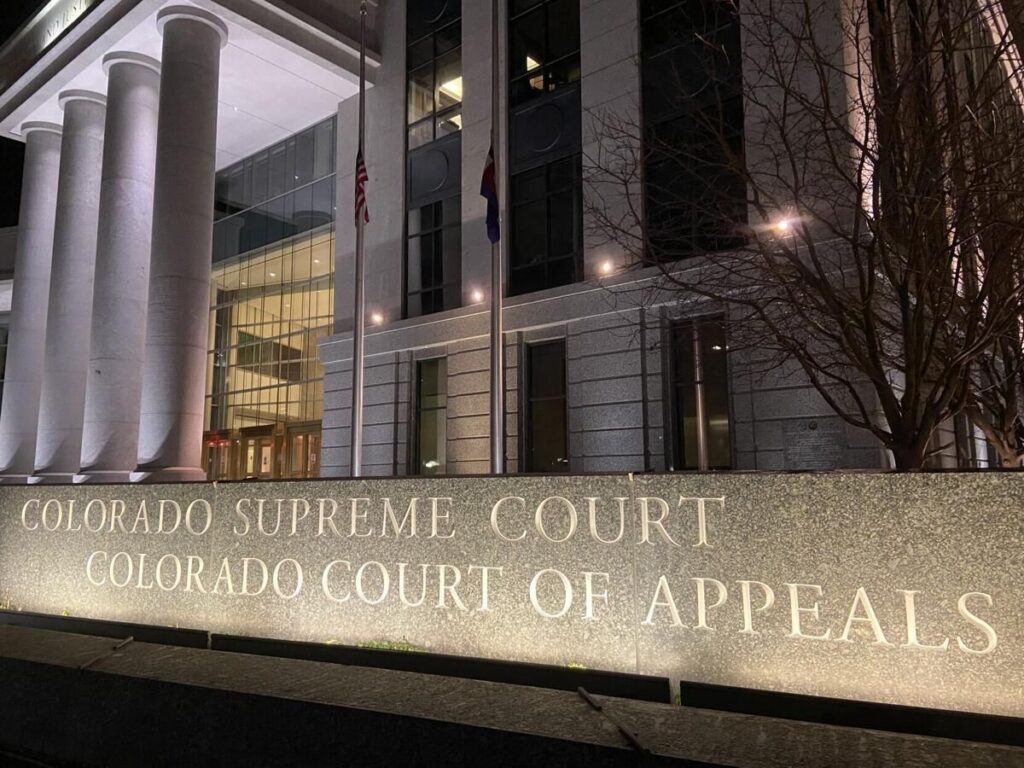
Denver murder, assault convictions reversed due to faulty jury instructions
Michael Karlik
michael.karlik@coloradopolitics.com
Updated 3 hours ago
Colorado’s second-highest court reversed a defendant’s convictions for murder and assault last week after concluding a Denver judge incorrectly omitted key jury instructions that could have affected the verdict and sentencing. Stephen C. Swainson fatally stabbed Israel Casillas in downtown...