

Colorado Springs gets real with border crossers | Colorado Springs Gazette
Those who can’t prepare their homes in time for guests should not invite them. Welcoming people means having enough food and space to accommodate their needs. Encouraging people to congregate in a place ill-equipped to handle them is deceptive, irresponsible and mean.
Denver and Colorado Springs, separated by less than an hour, provide a stark contrast in the midst of the immigration border crisis. In the last two decades, Denver transitioned from “cow town” to a world-class, sophisticated city with some of the highest living costs in the country.
When a city gets expensive, it is a double-sided indicator. It typically means people want to live there, drawn by the city’s ability to support them with career options, an adequate housing supply and a reasonable level of public safety.
Denver appears on the most recent U.S. News & World Report rankings as the 16th most expensive city in the country. Costly cities are typically victims of success. It means heavy demand that outstrips limited public and private resources. When demand quickly intensifies, resources cannot keep up.
Stay up to speed: Sign up for daily opinion in your inbox Monday-Friday
Populations can move from northern Mexico to Denver in less than 10 hours. Yet, we lack the resources and ability to establish adequate shelter — public or private — to keep up with busloads of foreigners arriving in Colorado by the day.
Denver, over the course of the past decade-plus, has virtue signaled compassion for migrants. The city, formally and in writing, mostly refuses to cooperate with federal immigration officials or even let them on city property at times.
Former three-term Denver Mayor Michael Hancock, on routine occasions, let the outside world know that Denver is a “sanctuary city.” Hancock’s successor, Mayor Michael Johnston, has welcomed migrants and refugees by placing them in luxury hotels. He wants to provide as much as possible, which he makes clear by begging the federal government to fund an ill-conceived welcome party.
Colorado Springs, by contrast, never has codified or communicated sanctuary status. Our community has compassion for the domestic homeless, many of whom are veterans. The City Council, mayors present and past, and county commissioners have never rented out hotels for waves of immigrants here illegally.
Colorado Springs has avoided a migrant influx that is crushing Denver socially and economically. It was as simple as being honest about what the city can and will provide.
Most recently, city and county officials in the Springs have made perfectly clear they do not run a “sanctuary” for foreigners in crisis. Telling immigrants we have nothing for them is truly compassionate; relative to inviting strangers, we can’t afford to dilute social services and resources that should help locals.
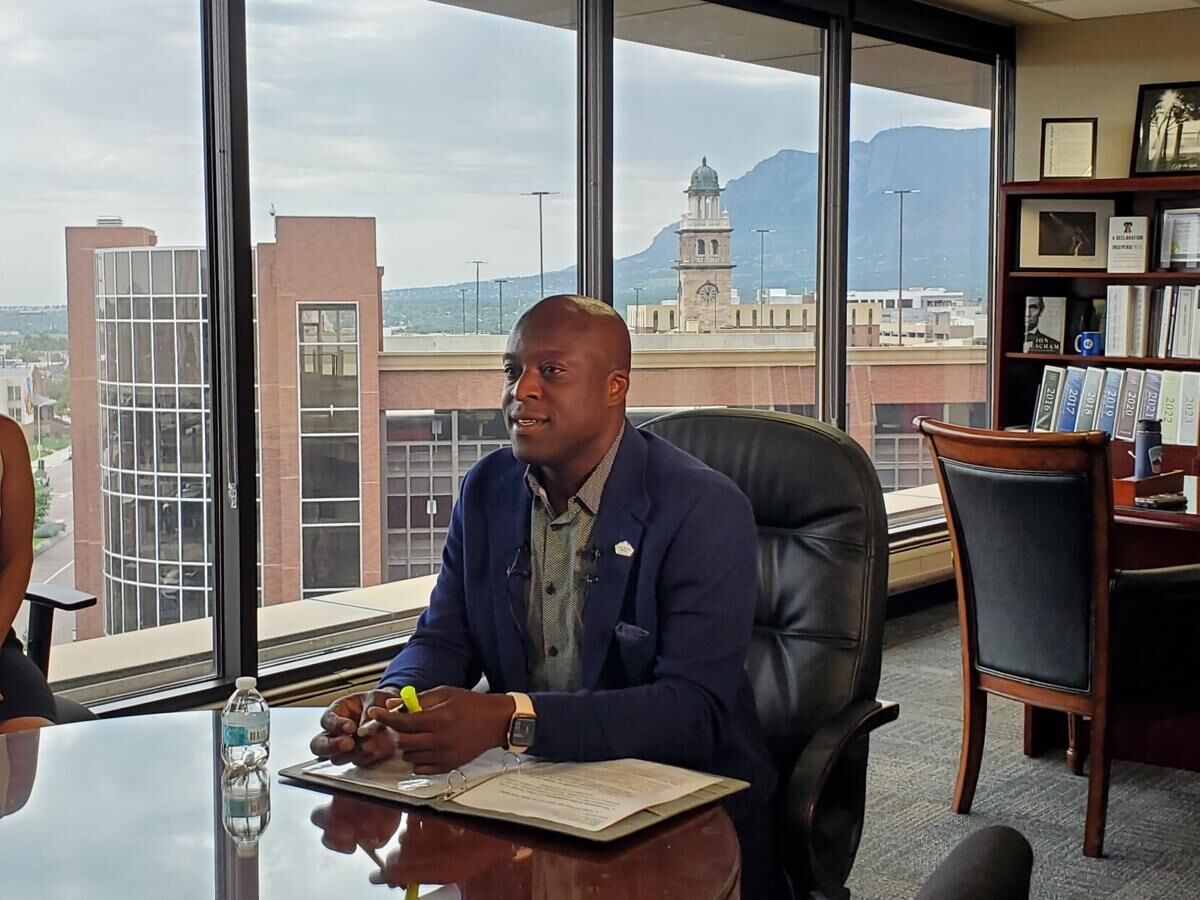
In a conversation with a Gazette editorial board member, Springs Mayor Yemi Mobolade displayed again that he is not an establishment politician. He functions more pragmatically than politically. As such, he refuses to signal compassion his city can afford no more than Denver.
“It’s my job to serve Colorado Springs,” Mobolade said. “We aren’t going to take from residents so we can invite and provide for immigrants. We are not a sanctuary city, and we have no funds to rent out hotels.”
As an immigrant and naturalized citizen from Nigeria, Mobolade has a genuine compassion for immigrants. He is preparing to protect his community from a Denver-style invasion of tens of thousands of newcomers. Other locals are on board, and no one is pushing a sanctuary agenda.
“Allow me to state unequivocally that we will not be designated as a sanctuary county,” said El Paso Board of Commissioners Chair Cami Bremer.
This is genuine compassion. It makes no false promises to desperate foreigners and takes no resources from the low-income individuals and households we have.
Colorado Springs Gazette Editorial Board


Yet again, when rights are in conflict | Hal Bidlack
Hal Bidlack
hal-bidlack@coloradopolitics.com
Updated 3 hours ago
I admit, it is going to take quite a bit of self-control to not have this entire column end up being yet another screed about a certain president who continues to shock the world in his race to the bottom...

Turn blueprint into action with the Outdoors Opportunities Act | OPINION
Kent Thiry
kent-thiry@gazette.com
Updated 3 hours ago
Nearly a year has passed since Gov. Jared Polis, Colorado Parks and Wildlife, the Colorado Department of Natural Resources, Colorado’s Outdoor Recreation Industry Office and other key partners finalized the visionary Colorado Outdoor Strategy, establishing the framework to ensure Colorado’s...

Let Colorado’s communities govern their own neighborhoods | OPINION
Colorado Politics
colorado-politics@coloradopolitics.com
Updated 3 hours ago
By Jeff Bailey and Cindy Bailey Coloradans have always done things their own way. From how we manage our land to how we build our economies, the instinct to govern locally — to trust mayors, councils and commissioners over distant...

Threats inside and out loom for Colorado’s Republicans | Dick Wadhams
Dick Wadhams
dick-wadhams@coloradopolitics.com
Updated 2 days ago
Colorado Republicans made strides in 2024 despite an insidious state chairman who tried to defeat successful Republican candidates. Newly elected U.S. Reps. Gabe Evans, Jeff Hurd and Jeff Crank fought off unethical opposition from their own state party chairman, making...

Is it time for both parties to bail on Colorado’s political nominating system? | Miller Hudson
Miller Hudson
miller-hudson@coloradopolitics.com
Updated 2 days ago
Cracks are beginning to appear in Colorado’s political nominating system. Recently, Mario Nicolais, a formerly Republican-leaning pundit, and Doug Friednash, former Democratic legislator, have opined regarding the imminent demise of the caucus/assembly framework which controls partisan candidate selection. There has...

Recognizing the value of generational work | Rachel Gabel
Rachel Gabel
rachel-gabel@coloradopolitics.com
Updated 2 days ago
The Lesser Prairie Chicken habitat in southeastern Colorado is a swath of prairie that begins in Cheyenne and far-southeastern Lincoln counties and moves south and east into Kiowa, Prowers and Baca counties. This is cattle country where the short grass...

Why the controversy with mail-in ballots? | Cronin & Loevy
Tom Cronin Bob Loevy
tom-cronin-bob-loevy@coloradopolitics.com
Updated 2 days ago
Most Coloradans enjoy the right to vote “by mail” at election time. Most Americans favor this process. But U.S. President Donald Trump is trying to federalize (nationalize) this practice and shift the supervision of voting from county clerks to the...

Who are the kings being crowned here in Colorado? | Jon Caldara
Jon Caldara
jon-caldara@coloradopolitics.com
Updated 4 days ago
Though most of us celebrate “No Kings Day” on July 4, the Trump-deranged got a head start last weekend with rallies around the state. Attendees bravely fought oppression by blocking traffic for people with jobs. Rally-goers demanded freedom from tyranny,...
An April Fool’s Day to remember | Capitol M | Week of April 4, 2026
Marianne Goodland
marianne.goodland@coloradopolitics.com
Updated 12 hours ago
The lighter side of the Capitol, and if light were weight, the Capitol would have lifted off better than the Artemis II rocket on April Fool’s Day. There was a plethora of Fools at the Capitol for April Fool’s Day...

Democrats rebounding without learning necessary lessons | SONDERMANN
Eric Sondermann
eric-sondermann@coloradopolitics.com
Updated 3 days ago
“When we fight, we win!” That, reportedly, was the chant heard over and over again at the Colorado Democratic Assembly a week ago. It suggests that pugilism has been the piece missing from the Democratic toolkit. Perhaps it was just...
PREV
PREVIOUS

A pointless diversion for Denver’s City Council | Denver Gazette
It seems the “Democratic Socialists” who were elected to the Denver City Council just last spring are already bored with their $100K-plus-a-year jobs. The homelessness crisis, the immigration crisis, the affordable-housing crisis — to say nothing of patching potholes and policing the streets — didn’t hold their attention for long. So, now, they want the […]

'Safeguarding our four-legged heroes' | OPINION
Ryan Armagost To address the confusion surrounding HB24-1074, it’s essential to provide clarity on the specifics of what this legislation aims to achieve. Essentially, this bill serves as a continuation of the existing Class 4 Felony for aggravated animal cruelty enacted last year. In simpler terms, it distinguishes and isolates cases of aggravated cruelty, focusing […]