

Colorado justices weigh disbarment of attorney who mishandled client funds
The Colorado Supreme Court considered on Wednesday whether a recently disbarred lawyer in the District of Columbia should avoid the same fate in Colorado under rules the justices adopted two years ago.
In August 2022, the D.C. Court of Appeals found John F. Kennedy intentionally misappropriated his clients’ money and barred him from practicing law. Attorney regulators in Colorado, where Kennedy was also licensed to practice, received notice of the outcome from their counterparts in D.C.
As a result, Colorado’s presiding disciplinary judge similarly disbarred Kennedy under the principle of reciprocal discipline, which prevents attorneys who committed misconduct from simply resuming their practice in another state.
During oral arguments before the Supreme Court, Kennedy argued Colorado’s penalty of disbarment was unfair because he did not realize his conduct in D.C. was wrongful. Therefore, he could not have “intentionally” mishandled client money.
The justices gave that argument a chilly reception.
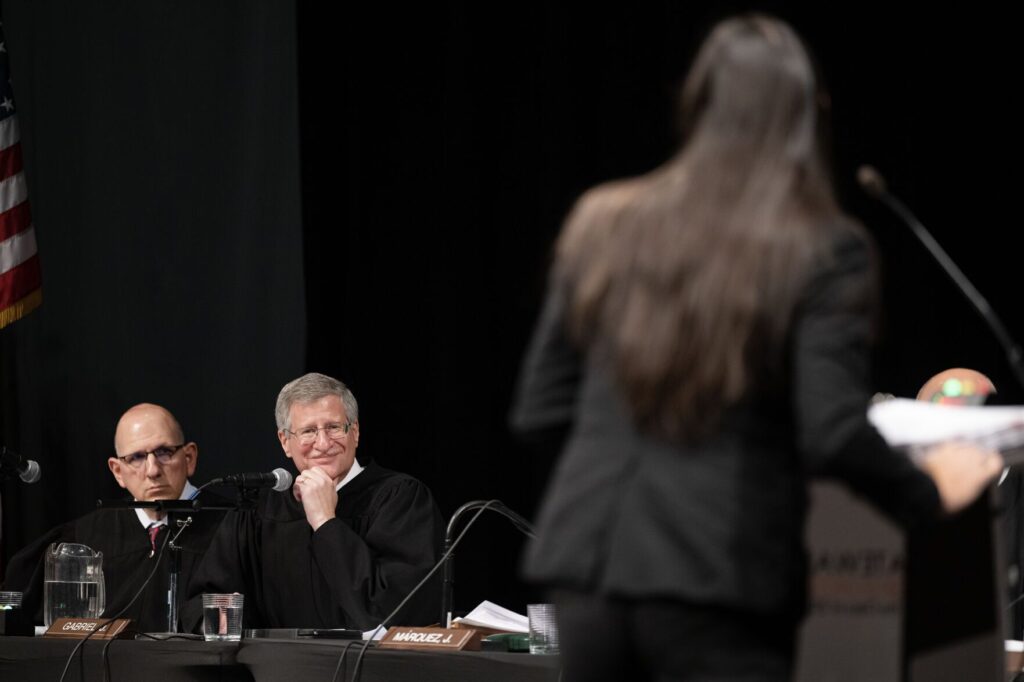
“The word ‘intentional’ in all of the D.C. opinions shows up many, many times,” countered Justice Richard L. Gabriel.
“Everything they talked about was intentional,” added Justice Melissa Hart.
Members of the court, however, appeared more open to Kennedy’s other contention: Recent rules adopted by the justices may mean it is too late to discipline him for the underlying misconduct that happened 15 years ago.
In the early 2000s, Kennedy and his law partner — who was also his wife — began representing a group of employees at a security company who alleged their employer committed wage theft. Eventually, Kennedy settled the case for $310,000 and retained two-thirds of that amount for attorney fees.
At the beginning of 2014, attorney regulators in D.C. notified Kennedy they were investigating his 2008 settlement. A committee recommended disbarment in 2019 and a professional responsibility board upheld that decision. A three-judge panel of the D.C. Court of Appeals provided a final review and agreed with the punishment.
The Court of Appeals concluded Kennedy failed to obtain his clients’ informed consent before settling the case and he concealed the terms of the agreement from them. He also misappropriated the settlement money by taking a portion for attorney fees before his clients’ authorization. The court agreed Kennedy’s actions constituted “intentional misappropriation requiring disbarment.”

Within three months, the Office of Attorney Regulation Counsel sought Kennedy’s disbarment in Colorado based on the outcome of the D.C. proceedings. Although the rules for reciprocal discipline do not allow for a redo of the case, Kennedy was permitted to argue that disbarring him would amount to a “grave injustice.”
Presiding Disciplinary Judge Bryon M. Large rejected as “baseless” Kennedy’s argument that it was unclear whether the D.C. Court of Appeals found he “intentionally” misappropriated client money. Large also disagreed that Kennedy could be disciplined in Colorado no more than five years after the discovery of his misconduct. Instead, Large reasoned the five-year clock began to run when D.C. imposed its discipline, not when it learned about Kennedy’s original misappropriation.
Upon review, the Supreme Court acknowledged its rule lacked a clear directive about how much time Colorado has to react to an attorney’s misconduct elsewhere.
“Who knows what they were thinking … those crazy people,” said Justice William W. Hood III, referring to the current members of the Supreme Court who enacted the rule in 2021.
Nathan Bruggeman, the lawyer for Kennedy, argued the “conduct” triggering the five-year limit is not another jurisdiction’s notification that they have disciplined an attorney, but rather the original misconduct being investigated.
If that were the case, said Gabriel, “probably not in an insignificant number of cases, reciprocal discipline will go away because another jurisdiction’s gonna take too long.”
Justice Monica M. Márquez observed Colorado does not conduct its own reciprocal investigation and largely relies upon the disciplinary proceedings of another state — with no control over how long its investigation takes.
“My understanding of reciprocal discipline is our jurisdiction is going to honor discipline imposed on an attorney we regulate here in Colorado, based on findings that a sister jurisdiction has made,” she said. “It makes me question whether this rule of limitation has any application at all in this context.”
The Office of Attorney Regulation Counsel agreed the time limit likely does not apply, prompting Gabriel to ask if an attorney could be punished in Colorado 10 years after another state imposes discipline.
“That’s an interesting question, but that’s not the facts of this case,” responded Jody M. McGuirk. She noted that attorneys have an obligation to notify regulators when they are disciplined, and in any event, she believed the five-year limit exempts Kennedy’s specific misconduct.
The case is In the Matter of Kennedy.


Fort Carson soldier’s wife could be deported
Carol McKinley
carol-mckinley@coloradopolitics.com
Updated 3 hours ago
As the country’s largest immigration enforcement crackdown continues in Minnesota’s Twin Cities, a Fort Carson sergeant is fighting a personal immigration crisis — one that may implode his family. Sgt. Tyler Garza’s wife, Jennifer Maradiaga Baca, is not a legal...
Elizabeth School District dismisses challenge to book-ban injunction on eve of appellate arguments
Michael Karlik
michael.karlik@coloradopolitics.com
Updated 2 hours ago
An Elbert County school district has dismissed its challenge to a judge’s injunction ordering it to return banned books to library shelves, days before the Denver-based federal appeals court was set to hear oral arguments this week. Although a three-judge...

Colorado Supreme Court to hear cases on insurance coverage for COVID, witness credibility
Michael Karlik
michael.karlik@coloradopolitics.com
Updated 17 hours ago
The Colorado Supreme Court announced on Tuesday that it will decide the degree to which a virus or other hazard must affect a commercial property before it can trigger loss-or-damage coverage under an insurance policy. At least three of the...
Federal judge says prisoner cannot sue for dog-bite injury
Michael Karlik
michael.karlik@coloradopolitics.com
Updated 1 day ago
A federal judge concluded last week that a man cannot sue the government for injuries he sustained when a dog allegedly attacked him while he participated in a prison program. Kenneth M. Chandler, representing himself, was participating in the “FIDOS”...

Federal judge recommends dismissing trans athletics lawsuit by area school districts
Eric Young
eric.young@gazette.com
Updated 1 day ago
A judge has recommended dismissing a federal lawsuit filed by multiple school districts against the Colorado Attorney General’s and Civil Rights Offices over their policies dictating students’ participation in athletics and activities based on their biological sex rather than gender...
Appeals judge asks Colorado Supreme Court to once again clarify magistrate rules
Michael Karlik
michael.karlik@coloradopolitics.com
Updated 2 days ago
A member of Colorado’s second-highest court urged the state Supreme Court last week to revise confusing language in the rules governing magistrates, less than two weeks after an attempted cleanup of the rules took effect. Magistrates are judicial employees who are...
10th Circuit dismisses paralyzed man’s claims against Colorado Springs, officer
Michael Karlik
michael.karlik@coloradopolitics.com
Updated 2 days ago
The Denver-based federal appeals court upheld the dismissal last week of a man’s excessive force claims against the city of Colorado Springs and the officer who tased him, causing him to fall down a sloped surface and break his neck....
Colorado justices weigh overlap between child prostitution offenses
Michael Karlik
michael.karlik@coloradopolitics.com
Updated 2 days ago
Members of the Colorado Supreme Court last week appeared willing to uphold a man’s conviction for an attempted child prostitution offense, which the state’s second-highest court previously found to be a violation of his right to equal protection under the...

State Supreme Court holds oral arguments, 10th Circuit revives dormant initiative | COURT CRAWL
Michael Karlik
michael.karlik@coloradopolitics.com
Updated 3 days ago
Welcome to Court Crawl, Colorado Politics’ roundup of news from the third branch of government. The state Supreme Court heard oral arguments last week in multiple civil and criminal cases, plus the Denver-based federal appeals court is doing something unusual...
Is a pardon for Tina Peters coming? Colorado governor confirms he is weighing options
The Denver Gazette
the-denver-gazette@coloradopolitics.com
Updated 3 days ago
Gov. Jared Polis on Friday strongly indicated he is considering clemency for Tina Peters, the former county clerk convicted of a security breach at her election office. When pressed about the matter, Polis didn’t offer an explicit answer, but he...
PREV
PREVIOUS

Colorado Supreme Court weighs immunity for speeding officer who killed 2
In July 2018, Officer Justin Hice of Olathe was in pursuit of a speeding car, accelerating to more than 100 mph before he accidentally struck a different vehicle and killed its two occupants. Last year, the state’s Court of Appeals concluded Hice was not shielded from liability under the broad immunity Colorado law provides to […]

Colorado Republicans censure state lawmaker for pursuing charges against county GOP leader's husband
The Colorado Republican Party has censured state Sen. Larry Liston, saying the veteran Colorado Springs Republican legislator pursued an “unwarranted” and “inappropriate” criminal complaint against the husband of the chairwoman of the El Paso County GOP over an alleged physical altercation at a party meeting. The state GOP’s executive committee voted on Nov. 9 to […]