

More than a half dozen Colorado judges still haven’t filed financial disclosure

More than a half dozen Colorado judges are still delinquent in updating missing personal financial disclosure statements with state officials, despite a Denver Gazette investigation that flagged them about the problem two weeks ago.
There were 15 judges delinquent as of Thursday – one of them on the Appellate Court bench – but the number more than halved after The Denver Gazette sent each of them an email asking for a comment or explanation why.
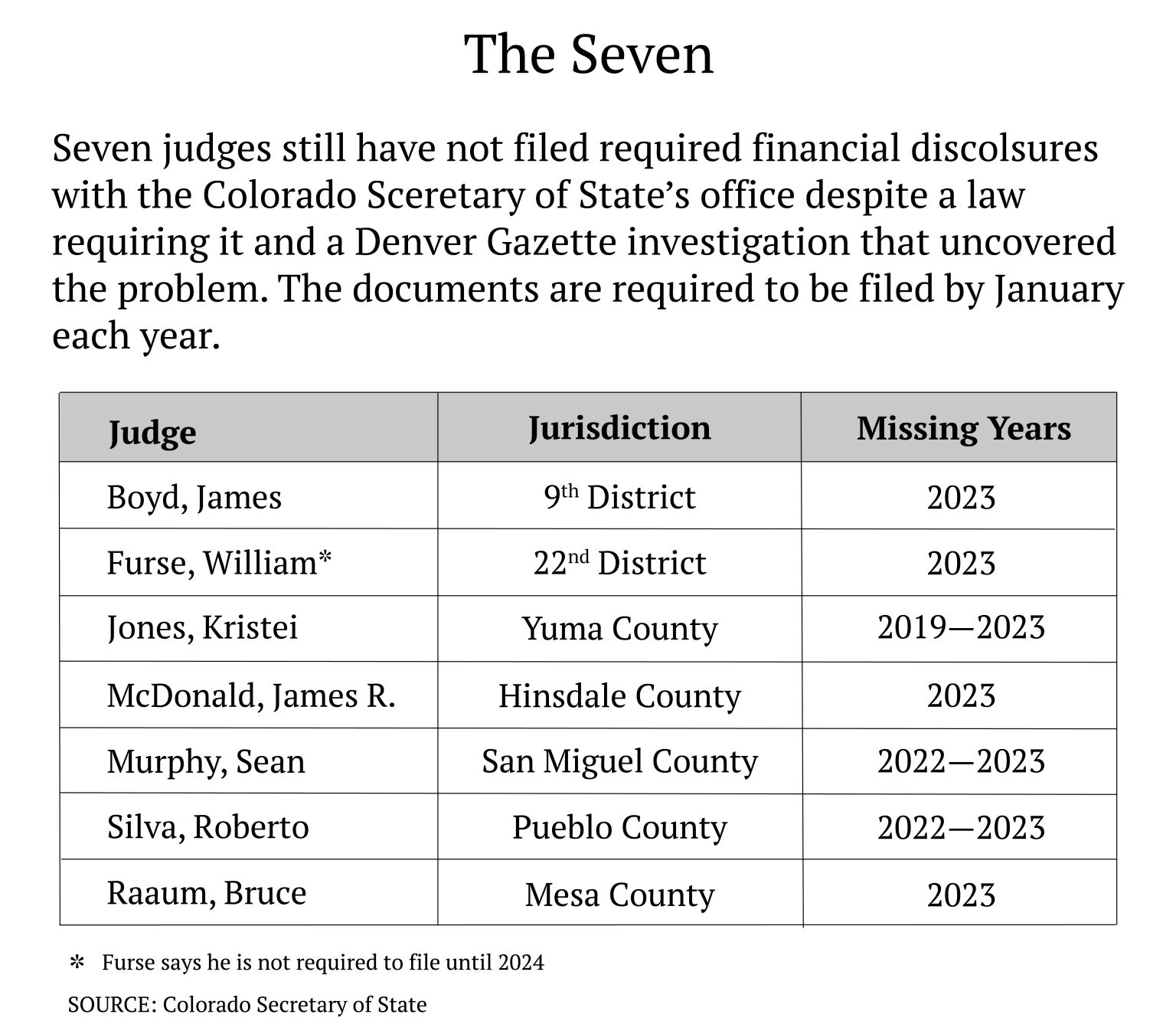
The Secretary of State’s Office said seven judges from a list of nearly 60 did not have financial disclosure forms on file this year – some of them for even longer – following the Denver Gazette’s investigation that ultimately revealed nearly 1 in 6 judges across Colorado had failed to file the document despite a law requiring it.
The disclosures are a financial accounting of a judge’s personal holdings, as well as those of their family. It is a misdemeanor punishable with a fine up to $5,000 to willingly not file. Public officials – from the governor and legislators to county judges and members of certain boards and commissions – are required to file the disclosures with the Secretary of State’s Office each January.
The original list of judges without filings grows even longer when senior judges, those who officially retired but remained on the bench in a limited capacity, are added. Nearly all of the senior judges – there are 50 – hadn’t filed the document with the secretary of state since retiring, some longer than a decade ago, although they do file them with the judicial department as a requirement to be a senior judge. There is no specific exemption that says senior judges are not required to file the document with the secretary of state.
Several judges contacted The Denver Gazette last week to say they had filed the disclosure following the newspaper’s story, some even producing fax logs or copies of the document as proof. A handful pointed to emails sent to The Denver Gazette when the initial story broke in which they said they had taken care of the problem. Many called the missed filings “an oversight.” One said she simply mistyped the email address to make the filing, but did not say whether the email had bounced back undelivered.
A Secretary of State’s Office spokesman said it double-checked its records and could not find disclosures for the seven, but did for the remainder. The office did not immediately say whether senior judges were in compliance. There is no automatic confirmation when a filing is made that shows it’s been accepted.
Yuma County Court Judge Kristei Jones hasn’t filed a disclosure since he was appointed by then-Gov. John Hickenlooper in August 2018, secretary of state records show. The former mayor and city councilman of Wray on Colorado’s Eastern Plains is a rancher with no law degree, other records show. His position is a part-time one and Yuma County is one of the smaller Colorado counties where a county judge need not be a lawyer.
Jones did not respond to emails seeking comment.
When contacted, two judges told The Denver Gazette last week that they were filing the disclosures immediately and offered no explanation why they hadn’t done so until now. A third judge said he ignored the initial story, believing he had properly filed the disclosures previously, only to realize now that he had not.
And Denver District Judge Lisa Arnold emailed The Denver Gazette this week to say her “current disclosure is filed” and that she would “file backdated ones as the info … I need to complete them is sent to me.”
Arnold had not filed any disclosures since she was appointed to the bench in January 2020, The Gazette previously reported.
One of the seven – Mesa County Court Judge Bruce Raaum – insisted he had faxed his disclosures both times The Denver Gazette contacted him, in July and again in August, and provided fax logs to show he had. The Secretary of State’s Office on Friday said it did not have any document from Raaum.
Sedgewick County Court Judge Myka Landry said “although my oversight and the resulting inquiry has caused me much angst,” she was “grateful” to learn that it was an email problem that kept her filing in July from getting to the Secretary of State’s Office. She said the oversight shouldn’t have happened and that she doubted “it will ever happen again.”
As before, several judges again did not respond to Denver Gazette emails seeking comment or explanation, including Appeals Court Judge Elizabeth Harris.
Harris had previously told the newspaper in July that she would check on her two missing disclosures – 2016 and 2020 – but then did not respond to additional emails asking about the outcome of her inquiry. The Secretary of State’s Office said Harris filed the missing disclosures Thursday, a day after The Denver Gazette emailed her again.
One new judge, 22nd Judicial District Judge William Furse in Durango, said he doesn’t think he’s violated any law by not filing. The Denver Gazette had earlier identified him as one of the judges the Secretary of State’s Office said had not filed a disclosure for 2023.
Furse said he believed the statute applies to him only after he was actually sworn in to the job and not before.
Gov. Jared Polis officially appointed Furse on Aug. 31, 2022 to fill a vacancy that was to come with the retirement of District Judge Douglas Walker. But Furse didn’t begin his term until Walker left on Jan. 10, 2023.
The disclosure law only says that judges are required to file by the Jan. 10 “following his or her election, reelection, (or) appointment.”
Furse, who had been the district attorney for the 22nd Judicial District and had previously filed the annual disclosures until he left that office in 2020, told The Denver Gazette he’d file his disclosure as a district court judge next January – a year after he’ll have already been on the bench – and not before.
“I’m of the mind that I’m not required to disclose until later this year or to disclose information that was before the effective date of my appointment,” Furse said in a telephone interview.
Furse added in an email: “Again, it is my intent to fulfill my judicial financial disclosure requirements when this time comes” on Jan. 10, 2024.
The judicial department has said it does not interpret any laws unless it is a matter of litigation, and it does not interpret laws for individual judges. The department sends out a yearly reminder to all judges about their obligation to file the required disclosure forms, even if there are no changes to report.
Rep. Mike Weissman, who chairs the House Judiciary Committee, said the spirit of the law shouldn’t be ambiguous.
“Any judge who is presiding over cases from the bench and deciding Coloradans’ rights under the law should have a financial disclosure on file, regardless of other provisions in the disclosure laws about timing of those filings,” Weissman said. “If there needs to be a legislative change to ensure the law is clear on that point, then we will look at that.”
That some judges still have not filed their disclosures after the newspaper stories troubled Weissman.
“I really hope any judicial officers not yet in compliance with filing requirements will prioritize getting their filings in,” Weissman said.
Following The Denver Gazette story, the Colorado Commission on Judicial Discipline requested extensive information about the entire filing history of more than 100 judges – the 56 identified by the newspaper who are still on the bench and the 50 senior judges – from the Secretary of State’s Office, according to emails obtained through an open records request.
The information provided to the commission showed that some of the judges had a history of missed filings that extended further back than just the years identified by The Denver Gazette, according to the emails.
The commission’s work by law is secret so it’s unclear if it’s launched a full-blown inquiry. Outcomes of official investigations, under the current rules, are public only when a recommendation for discipline is made to the Colorado Supreme Court.
Censures are generally private, which means the public never learns of them except in an annual report that describes them generally without identifying the offending judge.
Voters will be asked in 2024 to change how the state’s judicial discipline system works, including when investigations become public.



Federal judge dismisses developer’s challenge to Denver affordable housing ordinances
Michael Karlik
michael.karlik@coloradopolitics.com
Updated 19 hours ago
A federal judge dismissed a homebuilder’s constitutional challenge on Tuesday to a pair of Denver ordinances that impose obligations on developers related to the affordable housing demands created by new construction. Two related companies, redT Homes and redT Capital Partners,...
10th Circuit distances itself from prior decision making it easier to toss prisoner lawsuits
Michael Karlik
michael.karlik@coloradopolitics.com
Updated 1 day ago
The Denver-based federal appeals court distanced itself on Wednesday from its own recent decision that made it easier for prison officials to end civil lawsuits by transferring incarcerated plaintiffs between facilities. A three-judge panel of the U.S. Court of Appeals...

Appeals court overturns Douglas County vehicular homicide conviction due to faulty jury instructions
Michael Karlik
michael.karlik@coloradopolitics.com
Updated 2 days ago
Colorado’s second-highest court overturned a defendant’s vehicular homicide conviction and 12-year prison sentence on Thursday after determining a Douglas County judge omitted key language from the jury instructions that could have resulted in a different outcome. James Paul McDonald was...
Federal judge dismisses malicious prosecution claim against former Denver prosecutor
Michael Karlik
michael.karlik@coloradopolitics.com
Updated 23 hours ago
A federal judge concluded on Monday that a former Denver prosecutor could not be sued for allegedly causing the arrests of two plaintiffs after they failed to appear for trial on the scheduled date, even though the trial had been...
Judicial discipline commission reports increased transparency, increased submissions
Michael Karlik
michael.karlik@coloradopolitics.com
Updated 2 hours ago
The Colorado Commission on Judicial Discipline received 473 misconduct complaints about judges in 2025, which was nearly 29% higher than in 2024 and substantially greater than any time in the past decade. However, only 31 complaints were referred to the commission...
Colorado Gov. Jared Polis ignites fierce debate after raising clemency questions in Tina Peters case
Marianne Goodland
marianne.goodland@coloradopolitics.com
Updated 3 days ago
Gov. Jared Polis ignited a political firestorm Tuesday night after weighing in on the prison sentences of two former Colorado officials — a Democrat and a Republican — convicted of attempting to influence a public servant. The comments quickly fueled...

Colorado Supreme Court signals intervention in dispute over treatment for trans children
Michael Karlik
michael.karlik@coloradopolitics.com
Updated 4 days ago
The Colorado Supreme Court ordered Children’s Hospital Colorado on Tuesday to explain why it should not direct the organization to resume providing certain types of services to transgender children in compliance with the state’s non-discrimination law. Last month, a Denver...
Judge nixes latest policy requiring 7 days’ notice for Congress members to visit ICE facilities
Michael Kunzelman
michael.kunzelman@associatedpress.com
Updated 4 days ago
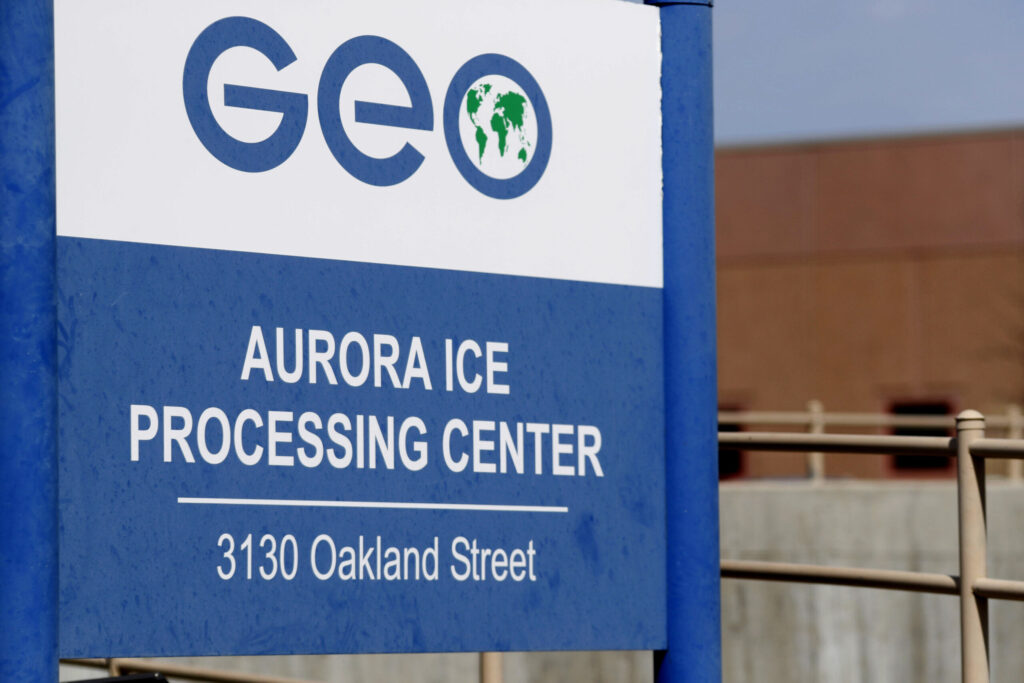
WASHINGTON (AP) — A federal judge agreed on Monday to temporarily suspend the latest version of a Trump administration policy that requires members of Congress to provide a week’s notice before they can visit immigration detention facilities. U.S. District Judge...
Judge nixes latest policy requiring 7 days’ notice for Congress members to visit ICE facilities
Michael Kunzelman
michael.kunzelman@associatedpress.com
Updated 4 days ago
WASHINGTON • A federal judge agreed on Monday to temporarily suspend the latest version of a Trump administration policy that requires members of Congress to provide a week’s notice before they can visit immigration detention facilities. U.S. District Judge Jia...
Colorado Supreme Court clarifies restraining order violations can always support burglary charge
Michael Karlik
michael.karlik@coloradopolitics.com
Updated 3 days ago
The Colorado Supreme Court’s majority ruled on Monday that a violation of a restraining order can also serve as a basis for finding a defendant guilty of burglary. Under state law, a person commits second-degree burglary by unlawfully entering or...
PREV
PREVIOUS

As sexual assaults rise, Air Force Academy needs to stop freshmen hazing, DOD report finds
Following a rise in reported sexual assaults across the military academies, Pentagon staff visited and evaluated all the schools, finding that the Air Force Academy needs to make changes to stop hazing among cadets and that freshman cadets feel the school has a prison-like environment. While military environments need to be stressful to build resilience, […]
Colorado's federal trial court experienced record trial delay, historic acquittal rate in 2022
Colorado’s federal trial court last year saw civil cases take an unprecedented amount of time – more than 43 months since filing, on average – to reach a jury trial, as well as a historically high rate of acquittals in criminal cases. On Aug. 30, U.S. Magistrate Judge Michael E. Hegarty presented a wide-ranging statistical report about […]