

Colorado Supreme Court to answer whether discrimination, retaliation are eviction defenses
Under Colorado law, discrimination and retaliation by landlords are illegal. But are they something that can prevent a landlord from carrying out an eviction?
On Monday, the state Supreme Court agreed to review a case out of Adams County in which a tenant claims her landlord moved to evict her after she rejected his sexual advances. A trial judge decided she could not fend off the legal action by alleging retaliation and sexual harassment were behind the eviction.
“This decision puts Colorado at odds with nearly all state courts who have ruled on this question and have held that discrimination and retaliation under fair housing laws are affirmative defenses to an eviction,” wrote attorney Spencer Bailey on behalf of Claire E. Miller.
A decision in Miller’s favor could have significant effects on eviction filings in Colorado, which stood at 37,000 in 2022.
Miller rented a home from Jesse A. Amos. Amos moved to evict her last year, alleging she failed to abide by their agreement to clean the home in lieu of paying rent. He also accused Miller of being “aggressive” toward him.
In response, Miller alleged Amos was ejecting her because she rebuffed his sexual harassment. The case went to trial in Adams County Court, where a judge concluded the prohibitions on retaliation and discrimination in the Colorado Fair Housing Act could not serve as a defense against eviction.
Miller appealed, and District Court Judge Teri L. Vasquez acknowledged there was no precedent in Colorado to guide her. She noted a landlord’s retaliation based on complaints made about the conditions of a housing unit can bar an eviction. Retaliation rooted in sexual harassment, however, did not qualify.
Vasquez added she was “not indifferent” to the concern that landlords would be free to evict tenants because of sex, race, disability or other protected traits. But the fair housing act “specifically provides an affirmative remedy in the event a landlord engages in such conduct,” she explained, referring to a separate lawsuit.
Miller asked the Supreme Court to hear her case and received the backing of multiple civil rights, legal aid and victim advocacy organizations. They argued a separate housing discrimination lawsuit, brought by a tenant who is already unable to pay rent, is unrealistic and comes too late. The sensible alternative, they contended, is to use a landlord’s retaliation to halt the eviction in the first place.
“To keep a sexual harasser from exploiting the eviction process to further harm victims, tenants must have the ability to assert an affirmative defense in an eviction proceeding,” wrote attorneys for the National Alliance to End Sexual Violence, National Fair Housing Alliance, National Women’s Law Center and other groups.
Miller pointed out that courts in at least 15 states and the District of Columbia have issued rulings that enable tenants to combat an eviction by showing a landlord acted out of discrimination or retaliation. Only two states, she alleged, have taken the opposite path.
In one of the early cases allowing for an affirmative defense to eviction, the Washington Court of Appeals agreed in 2002 that a tenant could invoke disability discrimination by her landlord to try and defeat the eviction attempt.
“Where a tenant does not pay the agreed rent, the tenant’s defense must constitute an excuse,” the court wrote. “While discrimination is extremely unlikely to be such a defense, it is not a logical impossibility.”
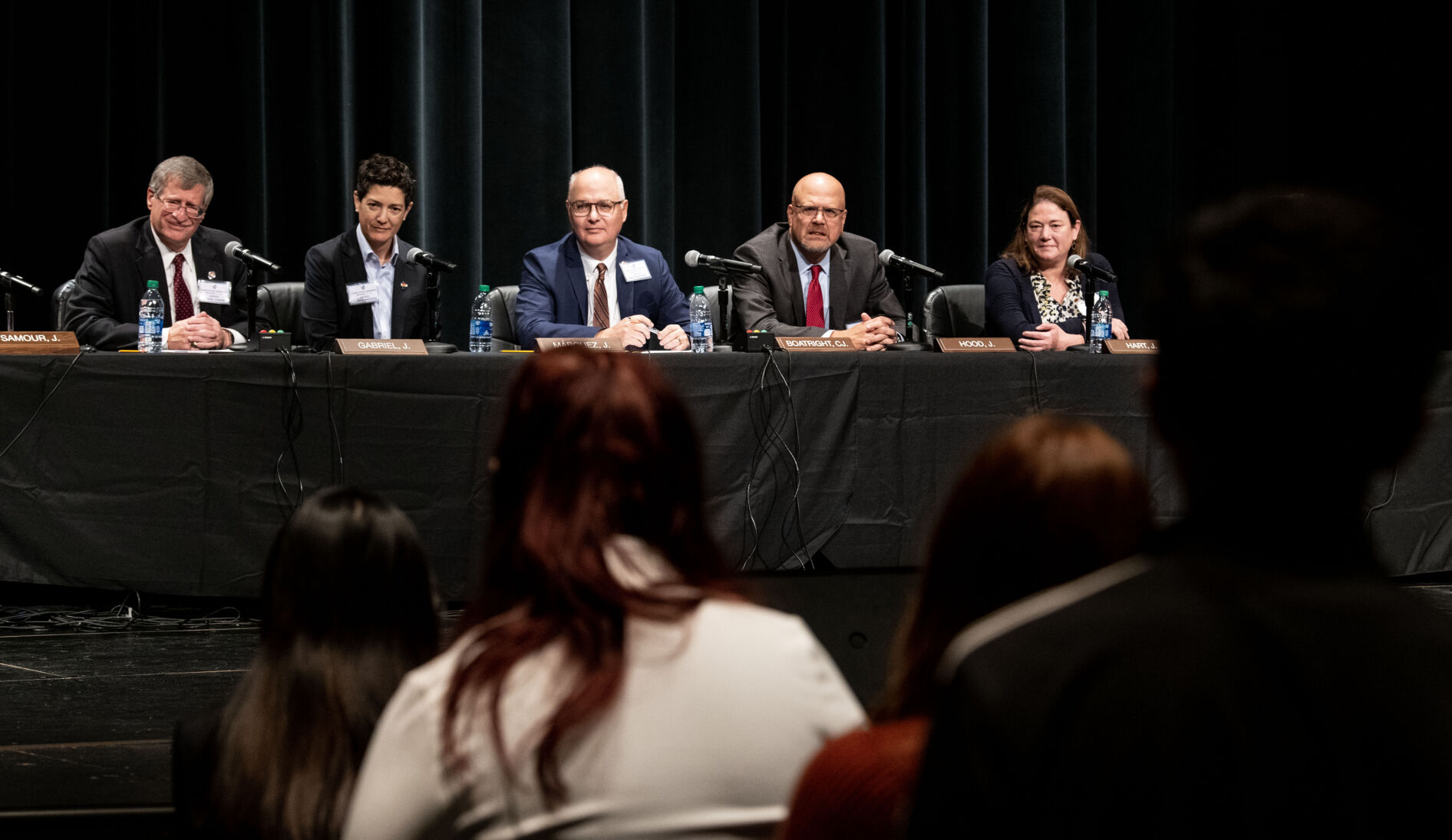
The case is Miller v. Amos. Chief Justice Brian D. Boatright did not participate in the Supreme Court’s decision to hear the appeal.



Colorado Supreme Court’s opinion output drops by two-thirds amid justice’s absence
Michael Karlik
michael.karlik@coloradopolitics.com
Updated 19 hours ago
The Colorado Supreme Court has released significantly fewer new opinions in recent months compared to the previous two years, even as the judicial branch insisted that a member’s open-ended absence is not causing delays. Justice Melissa Hart has been on...

Divided 10th Circuit rules bank customer must arbitrate discrimination-related claims
Michael Karlik
michael.karlik@coloradopolitics.com
Updated 19 hours ago
The Denver-based federal appeals court ruled on Monday that a mandatory arbitration clause in the fine print of a customer’s bank account agreement prohibited her from pursuing claims of racial discrimination in court. Jeanetta Vaughn filed suit against JPMorgan Chase...

Colorado’s federal trial court denies admission to lawyer owing tens of thousands in dues, penalties
Michael Karlik
michael.karlik@coloradopolitics.com
Updated 20 hours ago
Colorado’s U.S. District Court declined last month to allow an attorney to practice before the court due to his failure to pay enrollment fees and penalties to another state’s bar association for years. The federal trial court requires attorneys to...

Federal judge labels appeal ‘frivolous,’ state Supreme Court to hold arguments | COURT CRAWL
Michael Karlik
michael.karlik@coloradopolitics.com
Updated 1 day ago
Welcome to Court Crawl, Colorado Politics’ roundup of news from the third branch of government. A federal judge deemed a government defendant’s appeal “frivolous,” and the state Supreme Court will have an abbreviated oral argument schedule next week. Heard on...

Federal judge rejects Tina Peters’ request for release pending appeal
Michael Karlik
michael.karlik@coloradopolitics.com
Updated 21 hours ago
A federal judge rejected the petition of former Mesa County clerk Tina Peters on Monday to be released from incarceration pending the resolution of her criminal appeal. Chief U.S. Magistrate Judge Scott T. Varholak wrote in a Dec. 8 order...

Colorado justices lay down framework for analyzing defamation lawsuits involving ‘public interest’ issues
Michael Karlik
michael.karlik@coloradopolitics.com
Updated 19 hours ago
The Colorado Supreme Court clarified on Monday how judges should evaluate whether lawsuits arising from a person’s speech — in particular, online consumer reviews — are connected to an “issue of public interest” and merit protection from legal liability. As...
Federal judge rejects DPS’ attempt to obtain 9News sourcing documents in First Amendment case
Michael Karlik
michael.karlik@coloradopolitics.com
Updated 2 days ago
A federal judge rejected Denver Public Schools’ attempt on Monday to obtain documents from 9News related to its interview with a former principal who alleges his termination amounted to a constitutional violation. At the same time, the attorney for plaintiff...

Federal judge declines to order Denver to let police critic apply for review board
Michael Karlik
michael.karlik@coloradopolitics.com
Updated 3 days ago
A federal judge declined on Friday to order that Denver permit a longtime police critic to apply to join the board tasked with reviewing officers’ use of force. Regan Benson sought to become one of the two community members on...

Colorado Supreme Court to hear case on ballot measure disclosure requirements
Marissa Ventrelli
marissa.ventrelli@coloradopolitics.com
Updated 5 days ago
The Colorado Supreme Court has agreed to hear a case challenging whether the state can require ballot measure committees to disclose the names of their registered agents in election communications. The case stems from a complaint filed during the 2020...
Divided 10th Circuit orders pretrial release of defendant facing drug charges
Michael Karlik
michael.karlik@coloradopolitics.com
Updated 5 days ago
The Denver-based federal appeals court overturned a judge’s order keeping a defendant in custody pending trial on Friday, ruling 2-1 that she was entitled to release under the law. Erika Esmeralda Garcia stands accused of two charges related to the...
PREV
PREVIOUS
Victims of Club Q shooting speak on anger and loss at sentencing
Ashtin Gamblin was the self-proclaimed door girl at Club Q, a face familiar to the many patrons of the LGBTQ+ nightclub located in northern Colorado Springs. On Nov. 19, Gamblin’s life – along with the lives of more than 50 others who were at the nightclub that night changed forever. Gamblin spoke at the shooter’s […]

Club Q shooter pleads guilty, gets 5 life sentences and 2,000-plus years in prison
The person who killed five people at a Colorado Springs LGBTQ+ nightclub in November, was sentenced to life in prison on Monday after more than 20 people gave victim statements to the court, lamenting Aldrich as a “coward” and a “monster.” Anderson Aldrich pleaded guilty Monday morning in a packed courtroom to five counts of first-degree […]