

El Paso County Redistricting Commission weighs voter competitiveness, announces future public meeting dates
The El Paso County Redistricting Commission convened for its introductory meeting earlier this week, launching the process of redrawing commissioner districts for the first time since 2017.
The redistricting commission, consisting of the current five members of the El Paso County Board of Commissioners, charged staff with the Clerk and Recorder’s Office and other county officials with creating five preliminary maps using several geographic and cultural factors during its meeting on Monday.
Property tax bill wins Colorado Senate’s approval
Under House Bill 21-1047, passed in 2021, districts must be redrawn by Sept. 30 of the second odd-numbered year after a national census and cannot see more than 5% deviation between the most and least populous districts in a county.
The bill also encourages, as much as possible, preserving “communities of interest – such as urban, rural or trade areas, or other factors like education, environment or water needs – to ensure “fair and effective representation.”
The commissioners, all Republicans, appointed themselves to oversee the process without a citizen advisory committee at a controversial and highly attended regular meeting on April 18, during which dozens of residents argued that such a move would disenfranchise Democratic voters and accused the board of gerrymandering, given that a Democrat has not sat on the board since Stan Johnson’s election in 1970.
The decision was “allowing the fox to guard the henhouse,” one resident said at the April meeting.
Commissioners argued that since all but one of them, Carrie Geitner of District 2, were term-limited, they could not act in self-interest and that several districts were, indeed, competitive in the 2020 presidential and 2022 gubernatorial races.
“Every county seat is held by a Republican, so the argument that the (commissioner districts) are not reflective of a county would be true if we had a treasurer, sheriff, assessor that were split party and (commissioners) were all one party,” Commissioner Longinos Gonzalez said at the time. “That is clearly not the case. I understand the belief system there, but I don’t think it’s necessarily accurate.”
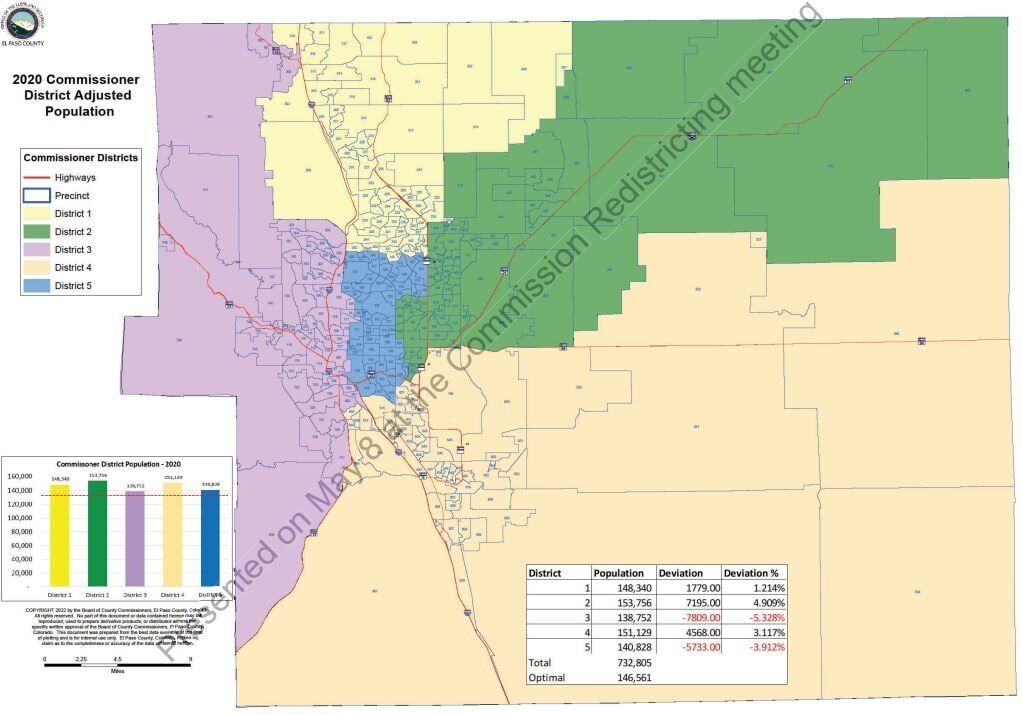
According to a presentation by Clerk and Recorder Steve Schleiker on Monday, each new district should have a population of roughly 146,550 based on 2020 U.S. Census data.
As a result, District 1 needs to lose around 1,800 people, while Districts 2 and 4, the fastest-growing districts, need to lose 7,200 and 4,600, respectively. With growth mostly locked in, Districts 3 and 5 should gain 7,800 and 5,700, respectively.
Government Affairs Department Director Ryan Parsell recommended the commission use the Cook Partisan Voting Index as a standard to gauge election competitiveness among the districts. The index, he said, takes voting results from the past two presidential elections, averages them, and compares them to the nationwide average to determine how strongly Republican, Democrat or unaffiliated a region may be.
The index is considered the “most effective” measurement used by political science experts, he said, and is “very broadly used” by academics, in media coverage and by the Almanac of American Politics.
According to the measurement, Districts 1 and 2 are the most heavily Republican, 4 and 5 are moderately Republican, and 3 is “even,” he said.
While former President Donald Trump carried all five districts in 2016, Districts 3 and 5 narrowly swung blue in 2020. In November, U.S. Sen. Michael Bennet, a Democrat, carried 3 and 5 and Gov. Jared Polis, also a Democrat, carried 3, 4 and 5.
Geitner asked, given the heavy Republican sway in some districts, whether it was possible “mathematically” to make every district equally competitive by carving in blue areas.
“Doing those sorts of surgical lines, while not breaking minority groups or some other communities of interest, could be problematic,” Parsell said. “But never say never.”
Ahead of the next five redistricting meetings, which will each occur in a separate district, commissioners requested its staff draw five preliminary maps as a starting point to be reworked.
Upcoming Redistricting Commission meetings:
? District 1 meeting, June 12: Lewis Palmer High School, 5:30 p.m.
? District 2 meeting, June 21: Mountain View Academy, 5:30 p.m.
? District 4 meeting, July 6: 5:30 p.m., location to be announced
? District 3 meeting, July 10: 5:30 p.m., location to be announced
? District 5 meeting, July 17: 5:30 p.m., location to be announced
July 14 is the last day for the public to submit proposed maps.
Because commissioners representing Districts 2, 3 and 4 are elected on presidential cycles and residents of 1 and 5 elected on gubernatorial cycles, moving voting precincts between districts to achieve equal populations could create “super-voters” who vote again in 2024 or disenfranchise others until 2026.
“People would prefer to miss an election cycle if it meant the end of being disenfranchised for 50 years,” said John Jarrell, a resident and former District 5 commissioner candidate, on Monday.
Still, one requested map will show regulated populations with “minimal changes” in election cycles and another will show a minimum amount of precinct moves.
“There is just absolutely no way to get us to something that’s perfect with all of those different wide varieties of communities of interest,” Commissioner Stan VanderWerf said. “The best approach is to try to do the best that we can based on a large number of types of calculations.”
Gonzalez requested a map keeping Security-Widefield, Hanover and Fountain together as communities of interest, while a fourth would move the Air Force Academy to District 3, keeping the west side of Interstate 25 together as a community of interest with special wildland urban interface needs, thus splitting Monument into two districts.
A fifth map would seek to overpopulate Districts 3 and 5 and underpopulate the rest to account for expected mass growth in coming years.
“I would like to keep them under the deviation so that they have more chance to grow into their numbers,” Commissioner Holly Williams said.
More information on the redistricting process, meeting presentations and legal parameters can be found on the county website.
Residents are encouraged to submit public comments and proposed maps through the website, which can be reviewed at future meetings. According to Schleiker, the county is providing free maps by current district, voter precincts and school districts to assist with future map development.

Colorado justices agree fraud claims belong in corporate dispute
Michael Karlik
michael.karlik@coloradopolitics.com
Updated 30 minutes ago
The Colorado Supreme Court decided on Tuesday that a corporate plaintiff validly pursued fraud claims over conduct that was not covered by a contract or by a set of interrelated business agreements leading up to the contract. Previously, the Court...
Colorado Supreme Court says intimate messages irrelevant to assault case
Michael Karlik
michael.karlik@coloradopolitics.com
Updated 2 hours ago
The Colorado Supreme Court decided on Tuesday that a Douglas County judge acted reasonably by blocking evidence of a defendant’s BDSM-related conversations with the victim in his trial for assault and false imprisonment. While the Court of Appeals believed that...

Postmaster general spars with Senate Democrats over mail-in ballot restrictions
Molly Parks
molly.parks@washingtonexaminer.com
Updated 3 hours ago
Senate Democrats sparred with Postmaster General David Steiner on Wednesday over the U.S. Postal Service’s move to stop delivering mail-in ballots in states that don’t hand over their voter rolls to the federal government. Steiner, who has stayed out of...
Sans seniors, what does Colorado’s uninterested early turnout say about our disengaged electorate? | Paula Noonan
Paula Noonan
paula-noonan@coloradopolitics.com
Updated 20 hours ago
This primary election is poorly attended. Evidence is in the numbers. About 10% of active registered voters are deciding this year’s primaries with seven days to go. If that number triples by June 30, only 30% of voters will decide...
Who gets to decide Colorado’s economic future? | GUEST COLUMN
Colorado Politics
colorado-politics@coloradopolitics.com
Updated 19 hours ago
By Sarah Blackhurst Colorado’s prosperity depends on industries that grow our food, build our future and power our homes. But today, these sectors face an invisible threat from 5,000 miles away: the European Union’s Corporate Sustainability Due Diligence Directive (CS3D)....

Douglas County water plan entering public review phase
Nicholas Fogleman
nicholas.fogleman@denvergazette.com
Updated 21 minutes ago
After more than two years of formal work, Douglas County officials are moving into the public review phase of a countywide water plan they say will help guide future development and water resources through 2050. The Douglas County Water Commission...

Douglas County cracks down on illegal scooter, off-road vehicle use
Nicholas Fogleman
nicholas.fogleman@denvergazette.com
Updated 20 minutes ago
Douglas County joined a growing list of local governments regulating electric scooters and motorcycles, setting standards and penalties for misuse. County commissioners approved an ordinance Tuesday regulating off-highway vehicles and low-powered scooters following broad community support and a presentation from...
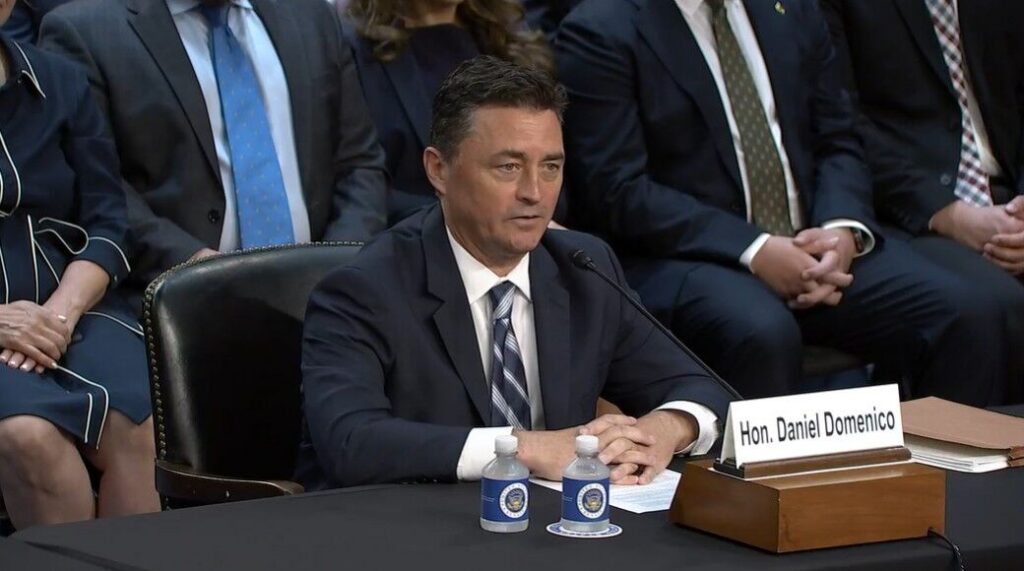
Trump’s 10th Circuit nominee declines to name 2020 election winner, defends immigration decisions
Michael Karlik
michael.karlik@coloradopolitics.com
Updated 3 hours ago
President Donald Trump’s nominee to the Denver-based federal appeals court declined to say who won the 2020 presidential election during his appearance before the U.S. Senate Judiciary Committee on Wednesday, and defended his recent rulings in immigration detention cases. U.S....
Colorado repeals attorney immigration attestation law after one year
Nico Brambila
nico.brambila@denvergazette.com
Updated 19 hours ago
One year and 12 days. That’s how long a Colorado law requiring attorneys to certify they would not use court data for federal immigration enforcement remained on the books before lawmakers repealed it. Gov. Jared Polis signed the initial legislation,...

Monitor says Denver police not sharing information about disciplinary program
Deborah Grigsby
deborah.smith@denvergazette.com
Updated 15 minutes ago
Denver’s civilian public safety oversight system is not receiving information it needs to properly review certain programs within the city’s police department, according to Lisabeth Pérez Castle, Denver’s independent monitor. Pérez Castle, who presented the OIM 2025 annual report to...