

State Supreme Court wades through rules on child testimony in sex assault cases
Out-of-court statements, known as hearsay, are typically not admissible at trial because a defendant cannot cross-examine the person making the comments.
However, Colorado’s legislature has provided an exception for children in sex abuse cases. Their hearsay statements are allowed generally if they are younger than 15 or, in the alternative, whatever age is specifically mentioned “under the statutes that are the subject of the action.”
That sprawling phrase is now under the scrutiny of the state Supreme Court, which heard arguments on Tuesday calling into question the interviews two separate 15-year-old victims provided to forensic interviewers that jurors subsequently heard at trial.
The justices recognized the dual purposes the child hearsay law serves: ensuring prosecutors can have the evidence they need in sex crimes, but also protecting criminal defendants against unreliable testimony. Further, the legislature created a tiered structure with the apparent goal of rendering younger victims less likely to be called into court to testify about their abuse.
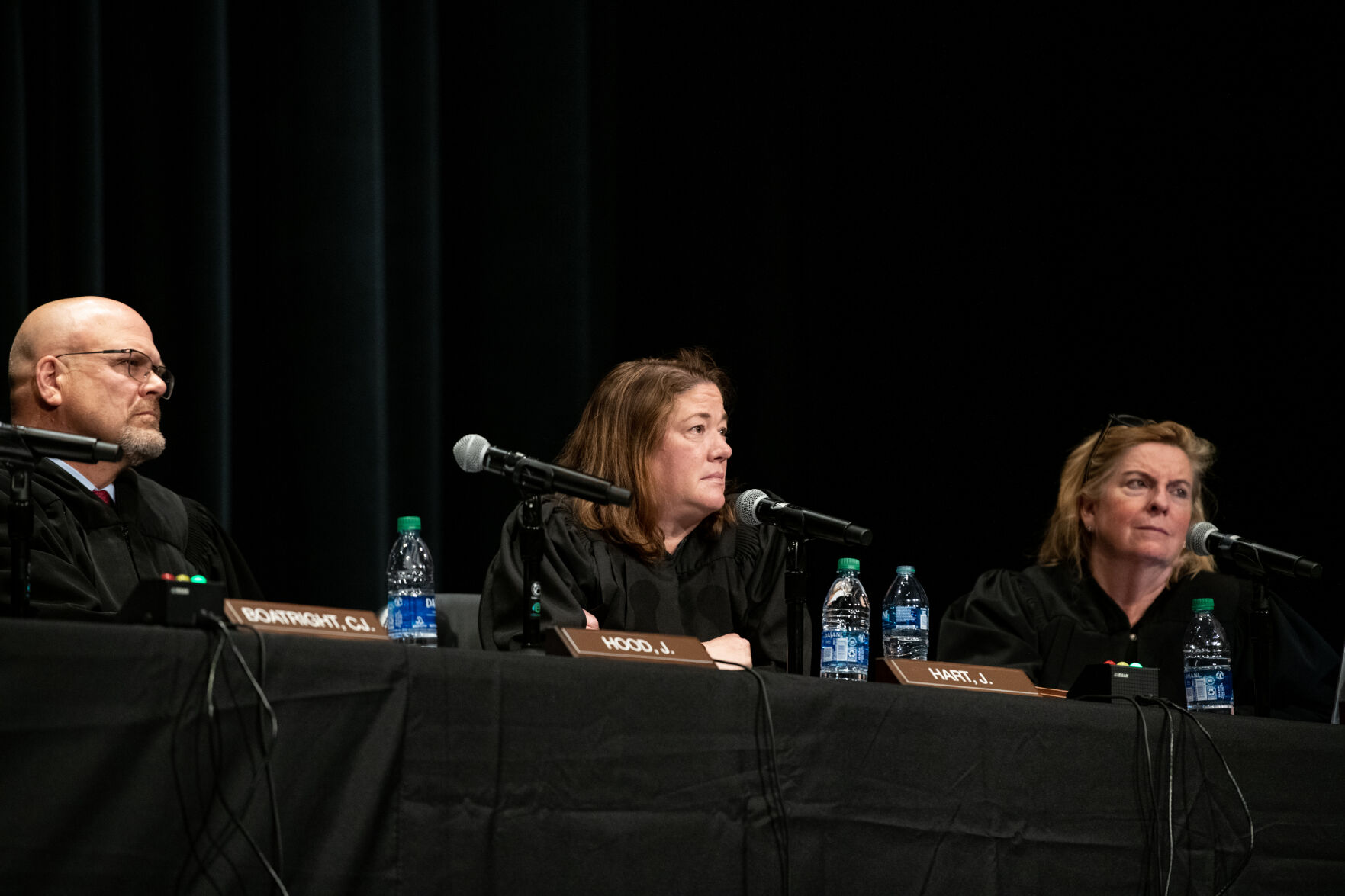
“It seems that the statute is set up in large measure to avoid the potential for re-traumatizing children,” observed Justice William W. Hood III.
But those broad goals have run into the Supreme Court’s prior precedent requiring the child hearsay law to be “strictly construed” in favor of a defendant.
A Denver jury convicted Dennis R. Chirinos-Raudales of sexual assault on a child, sexual assault on a child by someone in a position of trust, and sexual assault as a pattern of abuse. At trial, jurors saw a video of the victim’s interview with a trained professional. Although the sexual abuse took place when the victim was younger than 15, her interview occurred after her fifteenth birthday.
Chirinos-Raudales appealed, arguing the victim’s interview testimony should not have been used at trial. Because the child hearsay law looks to the “subject of the action,” he pointed out that prosecutors charged him specifically with sexually assaulting a child under 15, which meant the victim’s statements could not come in because she was older than 15 when she made them.
In March of last year, the state’s Court of Appeals disagreed. While it was true that part of the law, subsection 2(a), applies to victims younger than 15, the court viewed it merely as a sentence enhancer. The real offense, subsection 1, outlaws sexual assault by someone in a position of trust for victims under 18. Therefore, 18 was the cutoff age for hearsay.
“If we were to accept Chirinos-Raudales’s interpretation,” wrote Judge Ted C. Tow III, “a defendant whose victim turned fifteen before she provided a statement about the abuse would be insulated from the use of such evidence simply because his conduct subjected him to greater consequences.”
The day the Court of Appeals issued its decision, a different panel of the appellate court reached the same conclusion in the case of Jose Leonel Orellana-Leon out of Boulder County, which also involved a victim who provided out-of-court testimony at age 15 about abuse she endured when she was younger than 15.
Both men appealed to the Supreme Court. They argued the sexual assault of someone under 15 is a more serious offense, and defendants should be entitled to greater protection from hearsay evidence. Consequently, the younger age cutoff should apply because the General Assembly has not provided clear instructions and the Supreme Court currently requires a strict interpretation of the hearsay law in favor of defendants.
The prosecution, in turn, offered two rules for the court to adopt. First, a sentence enhancing charge – which, in these cases, set the hearsay cutoff at 15 – does not change the age in the broader law, which remains 18. Alternatively, and more expansively, the court could establish that when multiple charges with multiple ages are in play, every age is fair game.
“It’s maximalist, right? You look at any opportunity to admit child hearsay under the statute and you go to the highest age,” Hood responded. He added that other states with a child hearsay exception, sometimes called a “tender age” exception, generally set the age threshold lower than Colorado’s tiered system.
“If I’m understanding the argument right, the legislature has the prerogative to say, ‘Why not 35’ or whatever,” Hood said. “Does it reach a point when we should say, if it’s ambiguous we should worry about the consequence of admitting a lot of child hearsay that seems to be unnecessary and does pose a risk to the fairness of the trial for the defendant?”
Erin Grundy, representing the Colorado Attorney General’s Office, responded that the legislature “really is trying to reduce trauma on sexual assault victims.”
“Certainly people who are full-grown adults and much older, even 50, would experience trauma by having to revisit some of these events,” Hood countered.
Multiple members of the court dwelled on the child hearsay law’s reference to the “subject of the action.” Justice Melissa Hart noted that subsection 2(a), which applies to victims under 15, not only enhances the defendant’s sentence but increases the offense to a more serious felony.
“Thinking about some of the other cases we’ve had in the past couple of years, we throw around the term ‘sentence enhancer’ pretty casually,” said Hart, who was the author of a major decision in 2020 interpreting whether the state’s felony drunk driving law was a sentence enhancer. “It feels like things are a little out of control.”
Brock J. Swanson, also with the attorney general’s office, warned that prosecutors may choose not to charge a defendant with the more serious offense applicable to victims under 15 if the court rules that the lower age cutoff applies for victims’ out-of-court statements.
“And we’re doing it for procedural reasons rather than for the defendant’s actual, substantive guilt,” he said.
Ultimately, the outcome likely depends on the Supreme Court’s interpretation of the ambiguous phrase “subject of the action,” and whether it refers to the broader crime of sexual assault with an 18-year age cutoff, or the specific offense against someone younger than 15.
“It’s a different felony. It’s not just a more severe sentence,” said Hart.
The cases are Chirinos-Raudales v. People and Orellana-Leon v. People.


Federal judge hears ICE agents’ confusion about law, injunction on warrantless arrests
Michael Karlik
michael.karlik@coloradopolitics.com
Updated 9 minutes ago
A federal judge heard testimony on Tuesday from U.S. Customs and Immigration Enforcement agents in Colorado, who had trouble describing the requirements of his recent injunction and the training they received on making warrantless arrests pursuant to the law. On...

10th Circuit dismisses challenge to Colorado legislature’s decorum rules
Michael Karlik
michael.karlik@coloradopolitics.com
Updated 7 hours ago
The Denver-based federal appeals court concluded on Tuesday that Colorado lawmakers cannot be sued for creating and enforcing rules of decorum that circumscribe the public commentary allowed at legislative committee hearings. A three-judge panel of the U.S. Court of Appeals...
Colorado Supreme Court blocks ballot initiative defining ‘fees’
Michael Karlik
michael.karlik@coloradopolitics.com
Updated 1 day ago
The Colorado Supreme Court blocked a proposed ballot initiative on Monday that would have required voter approval for new fees above a certain threshold, while also enshrining a definition of “fee” into the state constitution for the first time. Chief...
Colorado justices, by 5-2, say Longmont detective did not violate suspect’s Miranda rights
Michael Karlik
michael.karlik@coloradopolitics.com
Updated 1 day ago
The Colorado Supreme Court’s majority ruled on Monday that a Longmont detective did not coerce a suspect into talking by making references to how a judge would look at his character, and by suggesting he may get out of prison...
Colorado justices find Fort Collins police lacked probable cause to arrest suspect in park
Michael Karlik
michael.karlik@coloradopolitics.com
Updated 1 day ago
The Colorado Supreme Court agreed on Monday that Fort Collins police lacked probable cause to arrest a man for a child sex offense based on his presence in a public park around the time they intended to meet with their...

Supreme Court to hold oral arguments, discipline commission releases report | COURT CRAWL
Michael Karlik
michael.karlik@coloradopolitics.com
Updated 1 day ago
Welcome to Court Crawl, Colorado Politics’ roundup of news from the third branch of government. The state Supreme Court is holding oral arguments this week, plus Colorado’s judicial discipline commission released its annual report. Colorado Supreme Court news • The Supreme...
Federal judge dismisses developer’s challenge to Denver affordable housing ordinances
Michael Karlik
michael.karlik@coloradopolitics.com
Updated 4 days ago
A federal judge dismissed a homebuilder’s constitutional challenge on Tuesday to a pair of Denver ordinances that impose obligations on developers related to the affordable housing demands created by new construction. Two related companies, redT Homes and redT Capital Partners,...
10th Circuit distances itself from prior decision making it easier to toss prisoner lawsuits
Michael Karlik
michael.karlik@coloradopolitics.com
Updated 4 days ago
The Denver-based federal appeals court distanced itself on Wednesday from its own recent decision that made it easier for prison officials to end civil lawsuits by transferring incarcerated plaintiffs between facilities. A three-judge panel of the U.S. Court of Appeals...

Appeals court overturns Douglas County vehicular homicide conviction due to faulty jury instructions
Michael Karlik
michael.karlik@coloradopolitics.com
Updated 2 days ago
Colorado’s second-highest court overturned a defendant’s vehicular homicide conviction and 12-year prison sentence on Thursday after determining a Douglas County judge omitted key language from the jury instructions that could have resulted in a different outcome. James Paul McDonald was...
Federal judge dismisses malicious prosecution claim against former Denver prosecutor
Michael Karlik
michael.karlik@coloradopolitics.com
Updated 4 days ago
A federal judge concluded on Monday that a former Denver prosecutor could not be sued for allegedly causing the arrests of two plaintiffs after they failed to appear for trial on the scheduled date, even though the trial had been...
PREV
PREVIOUS

Migrant influx costs Denver $800K; Mayor Hancock issues emergency declaration
Mayor Michael B. Hancock issued an emergency declaration Thursday because of the recent wave of immigrants fleeing Central and South America to Denver – which has to date a price tag for taxpayers of about $800,000. Staffing is one of the main drivers of the cost, Hancock said at a press conference. Other expenses include food, […]

Colorado senators, congressman urge FAA to address noise complaints at Centennial Airport
U.S. Sens. Michael Bennet and John Hickenlooper and U.S. Rep. Jason Crow asked the the Federal Aviation Administration in a letter Wednesday to address noise complaints at the Centennial Airport. In May of 2021, two small planes crashed mid-air over Cherry Creek State Park while attempting to land at the Centennial Airport in Arapahoe County. Though no […]