

State Supreme Court mulls whether right to counsel differs by defendants’ wealth

The U.S. Supreme Court has interpreted the Sixth Amendment to guarantee criminal defendants the right to effective assistance from an attorney and the right to hire the counsel of their choosing if they can afford it. Indigent defendants, by contrast, currently have no right to choose which lawyer is appointed for them.
But now, Colorado’s highest court is considering whether the Sixth Amendment contains one additional protection for poor defendants: the right to keep their preferred public defender for trial, even if a judge tries to force a different defense lawyer to substitute at the last minute.
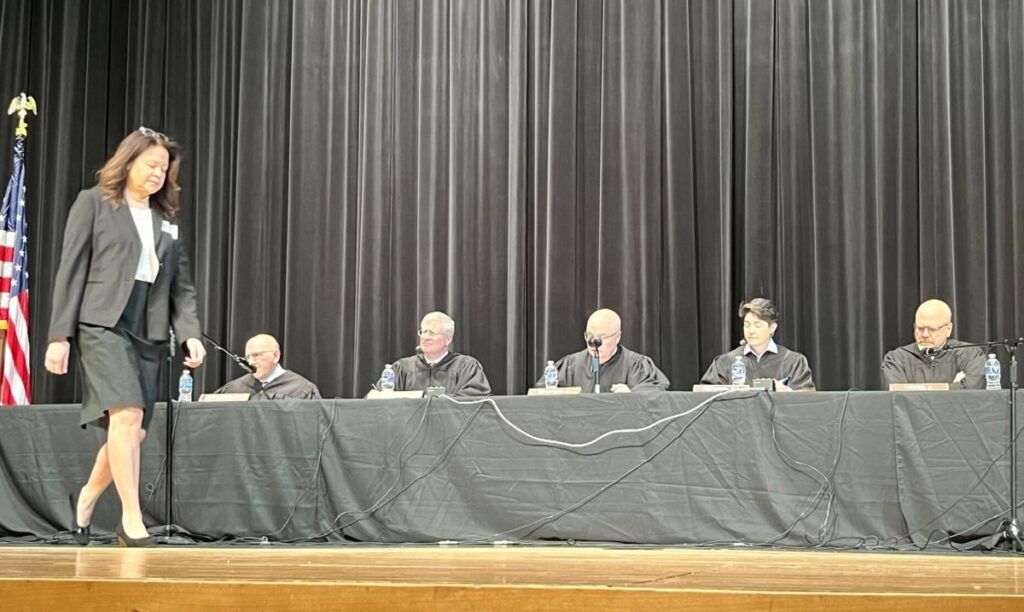
During oral arguments in a pair of cases on Tuesday, members of the Colorado Supreme Court recognized that, if the U.S. Constitution contains no such guarantee for indigent defendants, only the criminally accused who are wealthy will be able to control who continuously represents their interests in the justice system.
“If you have money, you have a Sixth Amendment right to continued counsel. But if you don’t, you don’t?” asked Justice Richard L. Gabriel.
“I recognize how bad that smells in the abstract,” acknowledged Hanna Jane Bustillo of the Colorado Attorney General’s Office.
In People v. Rainey and People v. Davis, the government has appealed two decisions from the state’s Court of Appeals that found trial judges in El Paso and Gilpin counties acted improperly when they refused to postpone the defendants’ trials in order to accommodate the schedules of their public defenders. Instead, the judges held the trials as planned with substitute defense counsel, despite the defendants’ desires to go forward with their original public defenders.
Although the government and the defense both agreed that longstanding court decisions out of Colorado have recognized a defendant’s interest in keeping his public defender is worth “great weight,” the justices were nonetheless puzzled about the origin of that concept.
“Assuming that it’s not the Sixth Amendment,” said Justice Carlos A. Samour Jr., “where does that come from?”
An El Paso County jury convicted Robert James Rainey of kidnapping and criminal mischief in March 2017. The trial had already been postponed four times – once because a storm damaged the courthouse, once because the victim failed to appear, once because a witness was unavailable and once because the court did not call enough jurors.
But on March 3, Rainey’s public defender asked for the first time to postpone the trial, which was set to begin on March 6. Even though he previously said he would be available, he believed at the time the case would be resolved by a plea agreement. The lawyer admitted he would actually be out of town the week of the trial.
District Court Judge Robin Chittum said she “felt terrible for Mr. Rainey,” but denied the motion to continue the trial to another date. The case was not complicated, Chittum elaborated, and Rainey would get another public defender for his trial – “a fine one, too.”
“There is a darn good chance that if we continue this, he gets bumped again. And I can’t do that. I just can’t do that,” she added.
Two other members of the public defender’s office ended up representing Rainey at trial.
A three-judge panel of the Court of Appeals noted indigent defendants do not have the right to choose their appointed attorney. However, once they have established an attorney-client relationship, defendants do have grounds to object to a last-minute substitution. That objection, the panel explained, can occur regardless of whether the substitute defense lawyer handles the case competently.
“And the right to continued representation means that an indigent defendant has a right to proceed with his specific appointed lawyer, not just any appointed lawyer from the public defender’s office,” wrote Judge Elizabeth L. Harris in the March 2021 opinion, citing to a 2002 decision of the state Supreme Court which endorsed that principle.
William Allen Davis faced a similar predicament in Gilpin County. Four days before his trial, Davis’ public defender asked for a postponement because he had a conflict, and Davis wanted him to be his lawyer at trial.
Then-District Court Judge Dennis J. Hall denied the request because “the case law is very clear that there is no right to a particular attorney.” He added that it was “very difficult for us to schedule trials” in Gilpin County and it would “not take any lawyer of any competence any time to prepare this case.”
A jury convicted Davis of three driving-related offenses. One month after the Court of Appeals panel issued its decision in Rainey’s case, a different panel reached the same conclusion in Davis’. The panel returned the case to the trial court, ordering a judge to review whether Hall should have granted the continuance based on the potential harm to Davis, the effect of a postponement on the court’s docket and the inconvenience to witnesses, among other factors.
The government appealed both cases to the Supreme Court, calling into question whether the Sixth Amendment truly contained the principle of continued representation.
“If we recognize a constitutional right, we must be able to locate its constitutional underpinnings,” argued Bustillo of the Attorney General’s Office.
She elaborated that the only relevant constitutional guarantee was the effective assistance of counsel. Because the defendants lacked the right to choose their lawyer in the first place, there was no right to keep their preferred lawyer through trial, Bustillo reasoned.
Weighing in on behalf of the defendants were the Colorado Criminal Defense Bar, the National Association for Public Defense and the Office of Alternate Defense Counsel. The organizations argued that the government’s position would set defense lawyers up to fail, by enabling last-minute substitutions of counsel that would inevitably lead to ineffective representation at trial.
“In the prosecution’s view, trial courts may replace an indigent defendant’s trusted and well-prepared attorney with any warm body that holds a law license if it is expedient to do so,” the groups wrote to the Supreme Court.
During oral arguments, Gabriel was the most vocal critic of the trial judges’ handling of the cases. He was particularly concerned about the events in Rainey’s case, in which Chittum pushed the trial back multiple times at the request of the district attorney’s office, but refused to do so to allow Rainey to keep his public defender.
“The prosecution on the first day of trial says, ‘I want a continuance,’ and the court says, ‘Granted.’ And we didn’t hear about scheduling problems,” Gabriel observed. “Now the court’s docket is a big problem. Isn’t that unfair to you? When you give the (substitute) public defender a weekend to prepare for a felony trial?”
On the other hand, Justice Melissa Hart observed that Rainey’s defense lawyer had, in fact, “lied” when he said he was originally available for trial.
“Only three days before March 6 did he reveal that he had lied. Is that relevant?” she asked.
Gabriel spoke up against “the piling on” of the lawyer, reminding the justices that Chittum had never mentioned the public defender’s misrepresentation in her decision.
The members of the Supreme Court went back and forth to ascertain when a person might form an attorney-client relationship with their public defender that would entitle them to continued representation by that person. River Sedaka, the public defender for Rainey on appeal, believed that an attorney’s minor or preliminary involvement with a case would not trigger any Sixth Amendment right to continued representation.
“The Sixth Amendment does not explicitly state most of the principles we are talking about today. It does not state effective assistance of counsel. It does not state counsel of choice for wealthy defendants. It simply says the right to counsel,” Sedaka said. But “the Supreme Court and the lower courts have concluded that in order for that right to be meaningful, it must include those subsidiary rights.”
Bustillo countered that a defendant’s right to choose his counsel has “never been egalitarian.” In response, Hart raised the hypothetical scenario of a hired defense attorney – “Attorney Smith” – asking to postpone the trial to accommodate a vacation, as Rainey’s public defender had. Would the trial judge have been wrong to deny the continuance and preclude the hired attorney from being present for trial, Hart asked.
“If you’re asking whether this person has a Sixth Amendment right to insist on Attorney Smith,” Bustillo conceded, “the answer is yes.”
Justice William W. Hood III mused that if the members of the court ultimately conclude there is no Sixth Amendment right for continued representation, it would nonetheless be possible to overturn the defendants’ convictions because the trial judges abused their discretion in refusing to continue the trials.
“I wonder if under the (prosecution’s) framework, you should still win,” he said.


Federal judge sides with Mesa County school district in ex-student’s First Amendment claims
Michael Karlik
michael.karlik@coloradopolitics.com
Updated 1 day ago
A federal judge concluded last week that Mesa County Valley School District 51 and three of its administrators did not violate the First Amendment rights of a former student when they imposed minor discipline in response to disruptive behavior. In...

Colorado Supreme Court intervenes in 4 ongoing cases
Michael Karlik
michael.karlik@coloradopolitics.com
Updated 2 days ago
The Colorado Supreme Court recently moved to intervene in four ongoing cases, including two criminal prosecutions, a civil lawsuit, and a child welfare proceeding. At least four of the court’s seven members must agree to hear a case outside of...
Federal judge releases man immediately as consequence for immigration judge disobeying orders
Michael Karlik
michael.karlik@coloradopolitics.com
Updated 2 days ago
A federal judge ordered a man’s immediate release from immigration detention on Thursday after finding an immigration judge disregarded his prior orders requiring a bond hearing. For the past year, Colorado’s federal district court has faced a flood of “habeas corpus”...
Denver judge denies Gov. Polis request to dismiss ICE-related records case
Marianne Goodland
marianne.goodland@coloradopolitics.com
Updated 21 hours ago
A year after blocking the release of state records to federal immigration agents, a Denver judge has now denied Gov. Jared Polis’ effort to end the lawsuit at the center of the dispute. The lawsuit filed against the governor in...
Colorado justices accept appeals on Netflix taxation, children pursuing neglect cases
Michael Karlik
michael.karlik@coloradopolitics.com
Updated 2 days ago
The Colorado Supreme Court announced on Monday that it will decide whether Netflix subscriptions are subject to the state’s sales tax as “tangible personal property.” At least three of the court’s seven members must agree to hear an appeal. The...
Letecia Stauch murder conviction in stepson Gannon’s death overturned by Colorado appeals court
Nick Smith
nick-smith@coloradopolitics.com
Updated 2 days ago
An El Paso County woman convicted of killing her stepson in 2020, shoving his body in a suitcase, then dumping it in Florida, is getting a new trial. The Colorado Court of Appeals published a 52-page ruling on Thursday, stating...
10th Circuit grants rare all-judges’ review of Colorado banking regulation
Michael Karlik
michael.karlik@coloradopolitics.com
Updated 2 days ago
The Denver-based federal appeals court announced on Thursday that it will hold a rare all-judges review of a recent decision that permits Colorado to require out-of-state banks to abide by the state’s maximum interest rates when they lend to in-state...
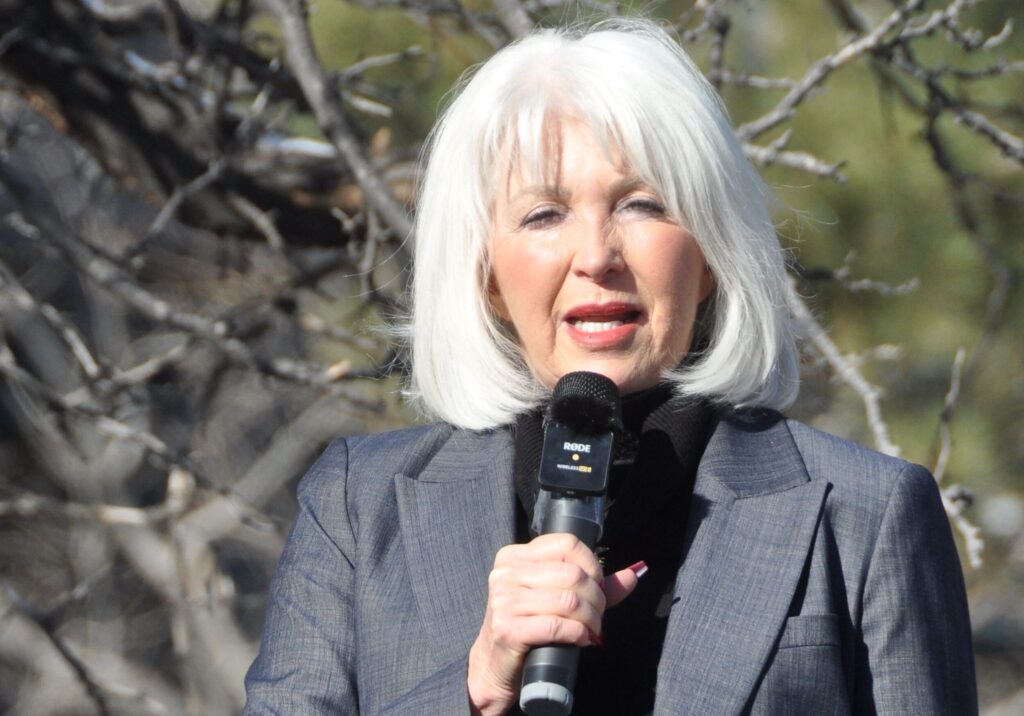
Colorado appeals court orders new sentencing for Tina Peters, upholds convictions
Michael Karlik
michael.karlik@coloradopolitics.com
Updated 3 days ago
Colorado’s second-highest court determined on Thursday that a trial judge improperly sentenced former Mesa County clerk Tina Peters based upon her exercise of protected speech, while at the same time upholding her convictions. The three-judge Court of Appeals panel also...
Judge rules that Colorado law makes it too hard for parties to bar unaffiliated voters from primaries
Ernest Luning
ernest.luning@coloradopolitics.com
Updated 3 days ago
A federal judge ruled in favor of the Colorado Republican Party late Tuesday, saying that a portion of the state law that allows unaffiliated voters to cast ballots in party primaries is unconstitutional because it imposes an unrealistic burden on...
10th Circuit upholds regulator’s methodology for Tri-State exit fees
Michael Karlik
michael.karlik@coloradopolitics.com
Updated 3 days ago
The Denver-based federal appeals court upheld a regulatory agency’s methodology for calculating the fee owed by entities seeking to withdraw from Tri-State Generation and Transmission Association last week. Tri-State is a Westminster-based cooperative that provides and transmits electricity to member...
PREV
PREVIOUS

Colorado Springs Utilities rates could be lower than anticipated this winter
Colorado Springs Utilities expects rates will be lower than previously anticipated this winter. Estimates presented to the Utilities board Wednesday showed an average December bill could be around $340 about $30 lower than originally anticipated, a presentation showed. Colorado Springs Utilities expects bills on par with last winter The cost of electricity and natural gas […]

Gov. Jared Polis refuses to rule out presidential run
Colorado Gov. Jared Polis was pulled into a conversation about his future presidential prospects as he appeared on the HBO political talk show “Real Time with Bill Maher” last week. While criticizing the Democratic Party for purportedly over-prioritizing identity and diversity when it comes to its candidates, Maher suggested Polis’ sexuality – he’s an openly gay man – […]