

Here’s how Colorado’s recent weather may have led to an anthrax outbreak

People are likely to remember the letter-bound anthrax attacks of 2001, which ultimately killed five Americans and sickened 17 others. However, did you know that anthrax can naturally occur in Colorado’s soil?
Animals in at least two northeast Colorado cattle herds have succumbed to anthrax infections in recent days, with two people that were also exposed being put under close surveillance. While the risk to the public is believed to be low, digging into the topic reveals how recent weather conditions may be to blame for the appearance of the deadly infection.
For starters, anthrax is a non-contagious* infection caused by a bacteria called Bacillus anthracis. The infection occurs in four forms (skin, lung, intestinal, and injection), with infections among cattle typically occurring when the animals eat or breathe in spores while they’re grazing a field.
But how does anthrax end up in the soil in the first place?
The CDC says that the bacteria that causes anthrax occurs naturally in soil. At that point, an outbreak or infection may occur if a being comes in contact with the dangerous spores, which then activate once inside the body.
According to research published in an academic journal called Applied and Environmental Microbiology, “outbreaks of anthrax tend to occur in warm weather following rains that are believed to concentrate spores in low-lying areas where runoff collects.”
Once spores that cause anthrax develop, they can lay dormant for up to 50 years or for up to two centuries when found in the bones of an animal that succumbed to the infection.
These dormant spores in the soil can get pushed to the surface when the soil that contains them gets disturbed, including via flooding. Hot temperatures can make pools of stagnant water even more favorable for bacteria to fester. Oddly enough, outbreaks can also be spurred by dry spells and drought.
Given that disturbance effect, the long-present Colorado drought getting hit with big recent rain accompanied by extremely hot temperatures could be contributing factors in why this outbreak is happening now.
While the detection of the spores isn’t necessarily uncommon from a national standpoint, the last confirmed outbreak in Colorado took place in 2012, killing at least 75 animals – also in the northeast Colorado region.
Animals that become infected with anthrax can experience symptoms such as collapse, shortness of breath, and blood dripping from the nose.
According to the CDC, it is very uncommon for a human to be infected with anthrax in the United States, even when conditions may lead to cattle infection. The three main ways that humans can get anthrax are by breathing in spores, eating food or drinking water that is contaminated, or by getting spores in a wound.
*In terms of being contagious, there have been rare cases where person-to-person transmission has been reported with cutaneous anthrax with the infection being passed from discharges from skin lesions. However, the CDC still refers to anthrax as non-contagious.
STAY INFORMED: Sign-up for the daily OutThere Colorado newsletter here

Unsustainable: How Colorado’s Medicaid spending exploded
Nico Brambila
nico.brambila@denvergazette.com
Updated 16 hours ago
The state’s Medicaid program — which covers about one in four Coloradans — is poised for its largest single-year jump in at least two decades, with officials proposing a $2.3 billion increase, even as lawmakers face a $1.5 billion budget...

Colorado hates its disabled citizens | Jon Caldara
Jon Caldara
jon-caldara@coloradopolitics.com
Updated 3 days ago
This is a selfish column. The legislature is about to hurt my disabled son. My son, Chance, has Down syndrome and a few years ago would have been labeled “retarded.” Then “developmentally delayed.” Now the hypersensitive prefer “intellectually disabled.” Whatever...

Phil Weiser wins top spot in Colorado’s Democratic gubernatorial primary at party’s state assembly
Ernest Luning
ernest.luning@coloradopolitics.com
Updated 16 hours ago
Attorney General Phil Weiser’s name will appear first on Colorado’s Democratic gubernatorial primary ballot after his overwhelming win Saturday at the party’s state assembly in Pueblo. Weiser joins U.S. Sen. Michael Bennet in the June 30 primary for the office...
‘No Kings’ protest draws tens of thousands to Colorado state Capitol
Matt Kyle
matt.kyle@denvergazette.com
Updated 16 hours ago
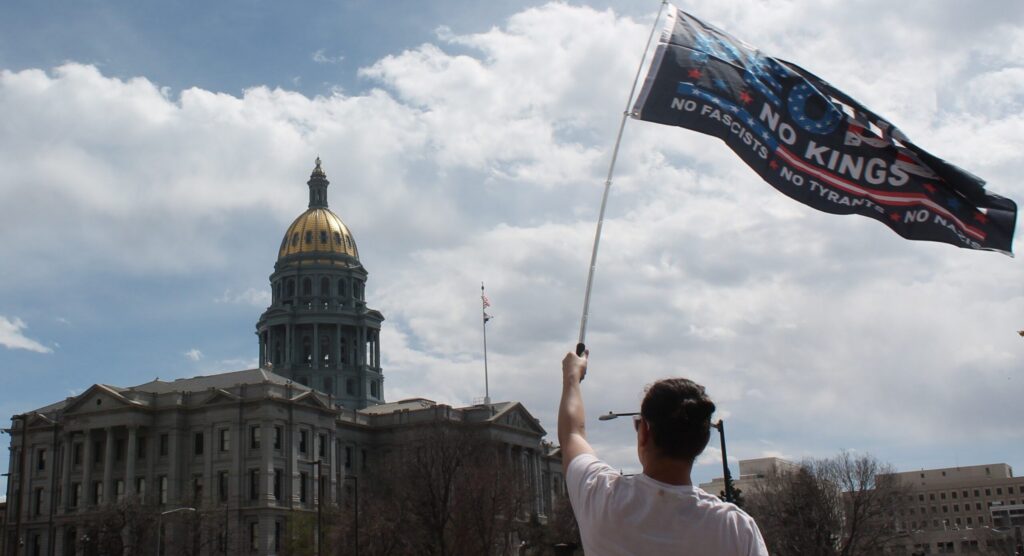
The third round of the national No Kings Day protests hit Denver Saturday, when tens of thousands gathered near the Colorado state Capitol to criticize the Trump administration. Organizers addressing the crowd estimated there were 30,000 present for the Saturday...

Denver Democrat Diana DeGette trails challenger Melat Kiros at assembly as both qualify for primary
Ernest Luning
ernest.luning@coloradopolitics.com
Updated 23 hours ago
U.S. Rep Diana DeGette, a Denver Democrat, qualified for Colorado’s June primary by the skin of her teeth Friday at the party’s district assembly, where the 15-term incumbent received fewer than half as many delegate votes as her challenger, 28-year-old...

Colorado Politics Calendar Mar. 30-Apr. 5
Rachael Wright, Special to Colorado Politics
rachael.wright@coloradopolitics.com
Updated 2 days ago
CoPo’s weekly political calendar will help you find political and public-policy events throughout Colorado. It includes candidate and issue campaign events, public policy meetings, court hearings, state and local party conventions, assemblies, debates, rallies, parades, speaking engagements, traveling dignitary appearances,...
Colorado coal use seen as in decline in 1980s | A LOOK BACK
Rachael Wright, Special to Colorado Politics
rachael.wright@coloradopolitics.com
Updated 2 days ago
Forty-Five Years Ago This Week: “Contrary to popular belief, it appears that growth in Colorado’s coal industry during the 1980s will be surprisingly sluggish,” said the findings in the Colorado Energy Research Institute’s “Focus Series.” The institute’s conclusions on the...
Kwame Spearman warrants plenty of criticism, not cancellation | SONDERMANN
By Eric Sondermann
by-eric-sondermann@coloradopolitics.com
Updated 3 days ago
All of us are flawed humans, some more so than others. This is the tale of Kwame Spearman who burst onto Denver’s business and political scene a handful of years back. His ride has taken a downhill trajectory. Within the...

Federal judge upholds constitutionality of Colorado campaign contribution limits
Michael Karlik
michael.karlik@coloradopolitics.com
Updated 1 day ago
A federal judge upheld Colorado’s individual campaign contribution limits as constitutional on Thursday, finding that three Republican plaintiffs failed to prove the campaign finance framework violates their First Amendment rights. U.S. District Court Senior Judge John L. Kane recognized that...
Appeals court rejects theory that existing tax revenue undermines need for new fees
Michael Karlik
michael.karlik@coloradopolitics.com
Updated 2 days ago
Colorado’s second-highest court rejected a plaintiff’s claim on Thursday that the tax revenue generated by an existing activity should prevent local governments from imposing new fees aimed at regulating the activity. The question stemmed from Colorado’s unique constraints on taxation...