

Judicial branch acknowledges ‘adjustment’ after confusion over judge’s authority

The state’s Judicial Department acknowledged making modifications in the wake of confusion from litigants and from the Court of Appeals, owing to one chief judge’s decision to designate a judicial officer in southern Colorado as an “acting district judge.”
Third Judicial District Chief Judge Leslie J. Gerbracht began assigning Dawn Mann to act as a district court judge in cases beginning on March 18, 2020. Mann is a part-time Huerfano County Court judge, as well as a magistrate. District judges handle a broader array of cases and more serious criminal and civil matters than either county judges or magistrates.
The Court of Appeals first raised its eyebrows at Mann’s status in September 2021, after Mann terminated a mother’s parental rights in Las Animas County during her appointment as acting district judge. Although Colorado’s constitution allows for the assignment of county judges to fill in as district judges, nothing permits magistrates — who are hired by the district courts to perform preliminary criminal and certain civil functions — to exercise the authority of a district judge.
At first, the appellate court voided Mann’s order but reversed itself six months later. After learning more about the timing and the circumstances of the “acting district judge” order, the Court of Appeals concluded Mann was neither practically nor legally handling the case as a district judge. Her termination order was still valid through her status as a magistrate.
But last month, another three-judge panel of the Court of Appeals addressed lingering confusion over Mann’s authority. Mann terminated another mother’s parental rights after Gerbracht issued her “acting district judge” order. The mother’s attorney questioned the “magistrate’s jurisdiction” to hear the case, while Mann countered she was assigned “as a county court judge acting as a district judge.”
In a June 23 opinion, the Court of Appeals reiterated there was no authority to appoint a magistrate to act as a district judge, but this time Gerbracht had made a valid appointment through Mann’s status as a county court judge.
“Mother argues that it is unclear whether the chief judge appointed Judge Mann in her capacity as a county court judge or because she served as a magistrate. Indeed, the order refers to the judicial officer as ‘the Honorable Dawn Mann’,” observed Judge Jerry N. Jones, acknowledging the ambiguity of the descriptor. But “Judge Mann signed the termination order as a ‘county court judge.'”
Jon Sarché, the deputy public information officer for the Judicial Department, did not know how many cases Mann had handled as an “acting district judge,” but conceded that not all of Gerbracht’s initial orders made clear to litigants that Mann’s appointment was through her status as a county court judge.
“Sometimes, it is brought up on the record, especially when Judge Mann is handling a felony,” Sarché said. “However, for the most part, she relies on the written order of assignment and when acting as a district court judge, all orders are signed as ‘acting district court judge’.”
He added that after the Court of Appeals’ initial decision in September, the judicial branch made an “adjustment” to clarify the basis for Mann’s appointment.
“Since then, all appointment orders refer to her as county judge acting as a district judge,” Sarché said.

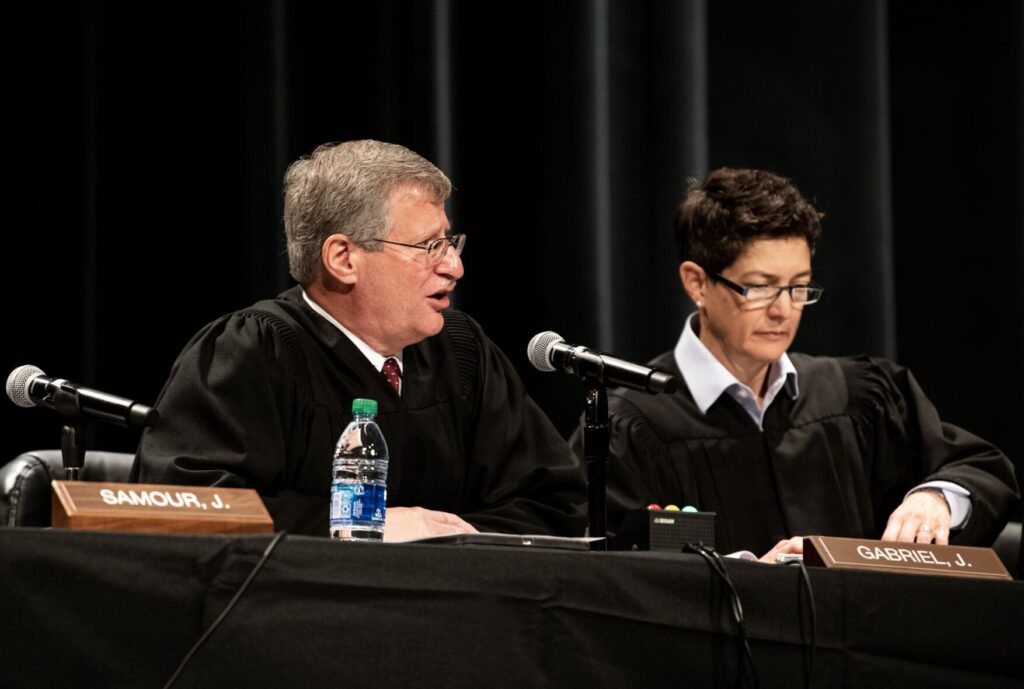
Colorado justices weigh potentially faulty jury instruction in child abuse case
Michael Karlik
michael.karlik@coloradopolitics.com
Updated 58 minutes ago
Members of the Colorado Supreme Court questioned on Tuesday whether a San Miguel County jury convicted a defendant of child abuse resulting in death, even though the instructions potentially allowed jurors to avoid finding that the child abuse resulted in...

Federal judge sanctions Pueblo for destroying evidence in lawsuit
Michael Karlik
michael.karlik@coloradopolitics.com
Updated 17 hours ago
A federal judge imposed sanctions on the city of Pueblo last week after it disposed of a key piece of evidence shortly after the plaintiffs filed suit seeking damages for the destruction of their home. On June 25, 2022, a...
10th Circuit orders lawyer to pay $1,000 for faulty AI citations
Michael Karlik
michael.karlik@coloradopolitics.com
Updated 1 day ago
The Denver-based federal appeals court ordered a lawyer on Monday to pay $1,000 to the opposing side for submitting a legal filing with fake case citations generated by artificial intelligence. A three-judge panel of the U.S. Court of Appeals for...

Supreme Court finalists selected, federal judges slash backlogs | COURT CRAWL
Michael Karlik
michael.karlik@coloradopolitics.com
Updated 2 days ago
Welcome to Court Crawl, Colorado Politics’ roundup of news from the third branch of government. Coloradans learned who the three finalists are for a state Supreme Court vacancy, and new data show that Colorado’s federal trial judges reduced their backlog...
Federal judge blasts government for violating court order, confiscating man’s property
Michael Karlik
michael.karlik@coloradopolitics.com
Updated 3 days ago
A federal judge gave the government three hours on Friday to return the property of a man released from immigration detention, which it allegedly retained in violation of her previous order. “At its most benign, this failure is an unforced...

DA’s withdrawal from veterans treatment court not judge’s problem, ethics panel says
Michael Karlik
michael.karlik@coloradopolitics.com
Updated 5 days ago
There are no ethical concerns from a judge continuing to participate in a specialty veterans treatment court if the district attorney’s office has withdrawn from the program, the Colorado Supreme Court’s ethics committee advised on Wednesday. Colorado law permits chief...
Divided appeals court orders insurance company to pay $35,600 for delayed disclosure of policy
Michael Karlik
michael.karlik@coloradopolitics.com
Updated 5 days ago
Colorado’s second-highest court concluded on Thursday that an insurance company violated state law when it refused to disclose an automobile policy to an injured motorist for nearly one year after she requested it. By 2-1, a three-judge Court of Appeals...

Judge expected to decide Monday whether to accept latest plea agreements for Hallfords
Mackenzie Bodell
mackenzie-bodell@coloradopolitics.com
Updated 5 days ago
An El Paso County judge is expected to decide Monday whether to accept new negotiations that would extend the prison sentence for Jon and Carie Hallford, coming on the heels of the court rejecting the original plea agreements for the...
Who are the 3 finalists for the Colorado Supreme Court?
Michael Karlik
michael.karlik@coloradopolitics.com
Updated 6 days ago
A citizen-led nominating commission has chosen the finalists for a vacancy on the Colorado Supreme Court, the first opening in five years on the seven-member court. The vacancy arose after the unexpected resignation of Justice Melissa Hart, who formally departed...
Christopher Zenisek, trial judge experienced with high-profile cases | SUPREME COURT FINALISTS
Michael Karlik
michael.karlik@coloradopolitics.com
Updated 6 days ago
After the Marshall fire burned through Boulder County in the final days of 2021 and wound up destroying more than 1,000 homes, the sprawling 4,000-plaintiff litigation was assigned to District Court Judge Christopher Zenisek of Jefferson County. Zenisek would go...
PREV
PREVIOUS

Colorado Springs apartment project case headed to Colorado Court of Appeals
The fight over whether apartments should be allowed near the end of Garden of the Gods Road is headed to the state Court of Appeals, in what could be a precedent-setting case. The Colorado Springs City Council refused to rezone property at 2424 Garden of the Gods Road last fall, blocking the construction of 420 […]

U.S. Senate confirms Nina Wang as Colorado's newest federal judge
Nina Y. Wang is Colorado’s newest federal judge, following a U.S. Senate vote on Tuesday of 58-36 to confirm her to the state’s U.S. District Court. Wang will succeed Christine M. Arguello, a 2008 appointee of George W. Bush who took a form of semi-retirement known as senior status effective July 15. The federal trial […]