

TRAIL MIX | Parties have a history of playing in each other’s primaries in Colorado
Some of Colorado’s most prominent Republicans started tearing their hair out last week.
Just as they’d warned, Democrats had stepped into the void left by the GOP’s relatively quiet and low-spending candidates for governor and U.S. senator.
On June 8, the day voters began receiving primary ballots in the mail and just under three weeks before deadline to return them on June 28, voters woke up to a pair of TV ads that seemed to be in heavy rotation on nearly every channel.
At first glance, they appeared to be attack ads, sternly advising voters that gubernatorial candidate Greg Lopez and U.S. Senate candidate Ron Hanks were “too conservative for Colorado” after listing some of their hardline positions, including opposition to abortion and gun control and support for former President Donald Trump’s border wall.
The tell came in the disclaimer at the end of the ads, most obviously in the ad targeting Hanks: “Paid for by Democratic Colorado,” the narrator said.
Lopez, who came in third in the 2018 primary for governor, is running in the GOP primary against Heidi Ganahl, a University of Colorado regent, with the winner facing Gov. Jared Polis in the general election. Hanks and construction company CEO Joe O’Dea, a first-time candidate, are vying for the chance to challenge Democratic U.S. Sen. Michael Bennet.
As details about the massive TV and digital ad buys emerged – in the neighborhood of $1 million a week for each ad campaign – it became clear that Democrats were attempting the political move pioneered by former U.S. Sen. Claire McCaskill, the Missouri Democrat who spent heavily in the 2012 Republican primary for her seat and succeeded in pushing the furthest-right candidate across the finish line.
Amid what could be an ideal environment for the state’s GOP to stage a comeback after nearly two decades on the ropes, Republican strategists are concerned that their most reliable primary voters could sink the party’s hopes of retaking offices lost in the last several cycles, when Democrats won every statewide race and took firm control of both chambers of the General Assembly.
Some Colorado Republicans with long memories fear a replay of the 2010 general election, when the state’s electorate bucked the Republican tsunami that washed over most of the rest of the country in the last Democratic president’s first midterm election.
That year, Democrats spent around $500,000 to hammer the Republican frontrunner for the open governor’s seat, Scott McInnis, a former congressman from the Western Slope, for a burgeoning plagiarism scandal. McInnis barely lost the nomination to political newcomer Dan Maes, a tea party candidate whose own scandals soon engulfed his campaign. It nearly cost Colorado Republicans major-party status in the state when Maes received just 11% of the vote after former U.S. Rep. Tom Tancredo entered the race on a third-party ticket. Then-Denver Mayor John Hickenlooper won the first of two terms as governor against the divided field.
By most measures – fundraising, endorsements, national support – Ganahl and O’Dea have been the leading candidates in their respective primaries this year, though Lopez and Hanks made the ballot by winning the approval of delegates to the Republican state assembly. They have pitched their bids as the party’s grassroots taking on the more moderate, establishment candidates.
It’s an ideal environment for interlopers to push the under-resourced underdogs to the party’s base, who might not otherwise grasp the sharp distinctions between the primary candidates without the help of more advertising than their rivals can afford.
Both parties have attempted the maneuver over the last dozen years in Colorado, though the scale and scope of the Democrats’ intervention in this year’s Republican primaries are unprecedented.
In part, that’s because Ganahl and O’Dea have only been on their air with modest ad buys, if at all, leaving an opening for the Democrats’ ads to dominate.
Also last week, a series of anonymous mailers began landing in mailboxes belonging to likely Republican primary voters purporting to contrast Hanks and O’Dea. The flyers highlight Hanks’ rock-ribbed conservative positions with O’Dea’s less doctrinaire record, including making campaign donations to Democrats – including Bennet – and voicing support for the infrastructure package signed last year by President Joe Biden.
A few days later, ads paid for by the Democrat’s House Majority PAC, a committee aligned with House Speaker Nancy Pelosi, began running similar TV ads tagging Lori Saine, one of four GOP candidates running in the state’s new, 8th Congressional District, as “way too conservative for Colorado.” The ad even touched on the same issues as the ads aimed at Lopez and Hanks: her support for Trump’s border wall and opposition to abortion and gun control.
Like Ganahl and Hanks, Saine’s Republican rivals roundly condemned Democrats’ attempts to push primary voters her way, while the ad’s sponsors counter they are instead taking to the airwaves and cable channels to educate voters on just how conservative the Republicans are.
O’Dea swung back quickly with a 60-second radio ad blasting Democrats for trying to “hijack the Republican nomination for Ron Hanks … because they know they can beat him in the general election.” To bolster its message, the ad included clips from pundits describing Hanks as “absolutely unelectable in a statewide race in Colorado.”
A week after the ads started, O’Dea filed a complaint with the Federal Election Commission over the mailers that compared his record and Hanks’ on hot-button issues. He also sought an injunction in federal court to prohibit further distribution of the flyers and asked prosecutors to consider filing criminal charges over what he maintains are factual errors in the brochures.
The National Republican Senatorial Committee hit the caps-lock key and scolded Democrats for revealing their “historic weakness” by spending big in Colorado’s “REPUBLICAN Senate primary to try and stir up drama.”
Two years earlier, the NRSC did the same thing in Colorado’s Democratic Senate primary, though without causing as much of a stir or successfully advancing their preferred candidates to the general election.
First, early in the race to pick a Democrat to run against Republican Cory Gardner in 2020, the Republicans publicized a billboard it designed that called one of the Democratic Senate candidates, former congressional nominee Stephany Rose Spaulding, “too liberal for Colorado.” The outdoor ad pictured Spaulding alongside progressive hero U.S. Rep. Alexandria Ocasio-Cortez, the New Yorker known as AOC, and her fellow “Squad” member U.S. Rep. Ilhan Omar of Minnesota.
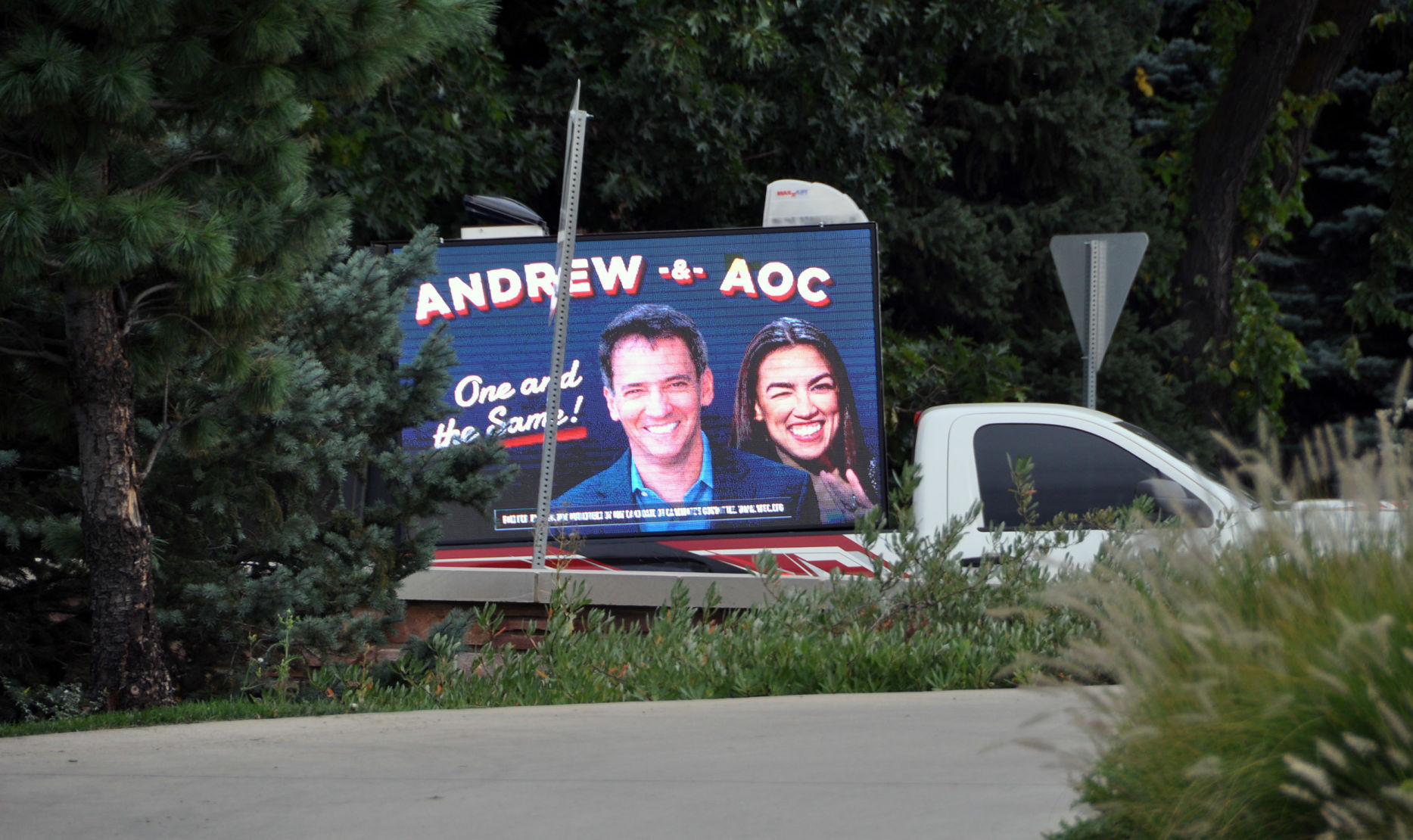
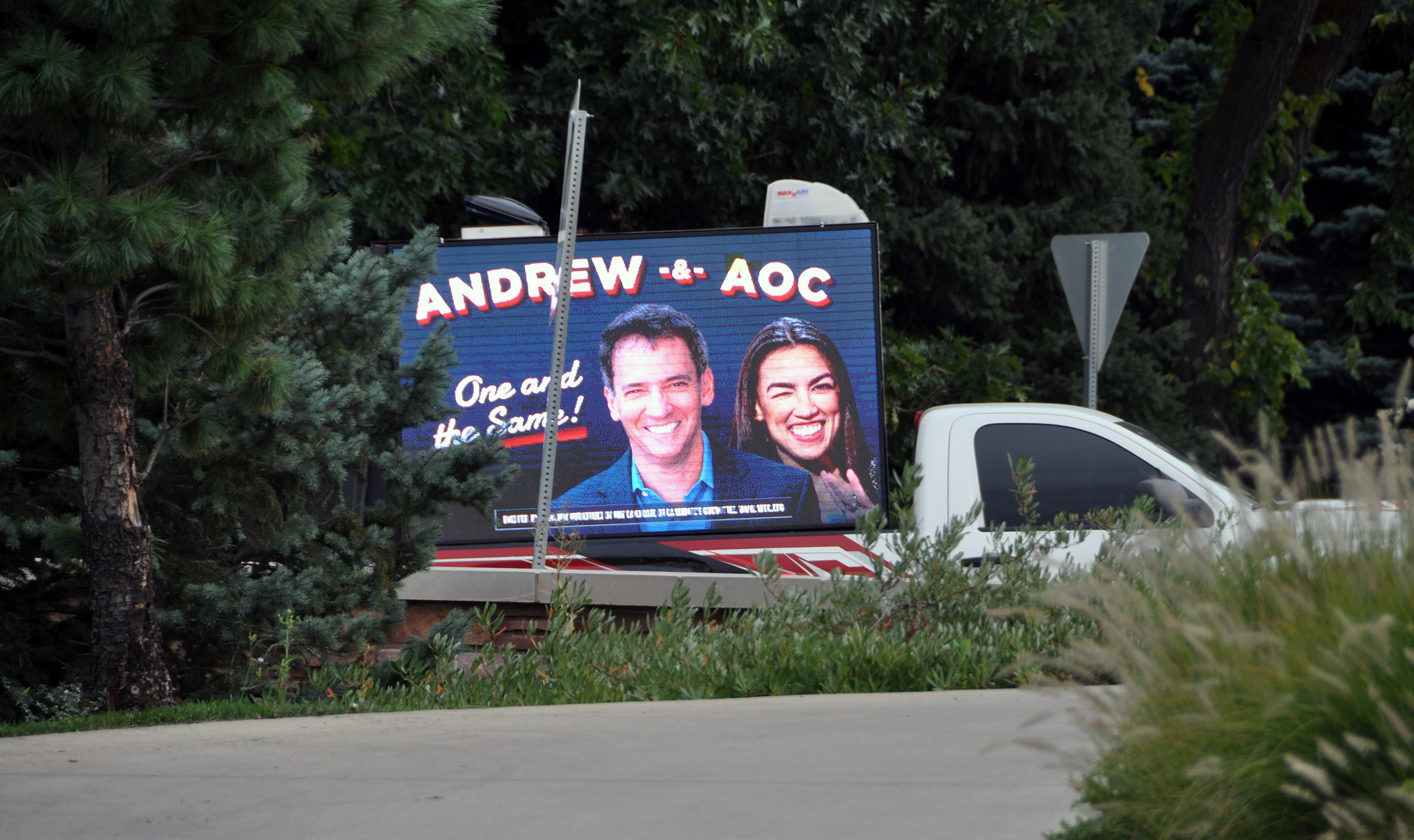
After Hickenlooper ended a brief presidential run and jumped into the crowded Senate race a few months later, the NRSC hired a high-tech mobile billboard to circle the venue where AOC was scheduled to headline the Boulder Democrats’ annual dinner. The Republican’s illuminated, three-sided sign and coordinated, geographically targeted Facebook ads drew attention to similarities between AOC and Andrew Romanoff, one of the more outspoken liberals in the Senate field, declaring “Romanoff & AOC One and the Same!” and “”AOC & Andrew’s Agenda – Medicare for all, Green New Deal, stricter gun control.”
As the 2020 Senate primary neared, the NRSC took the unusual step of airing negative ads attacking Hickenlooper, who was facing Romanoff in the primary. Simply educating the voters about one of Gardner’s potential opponents, the Republicans said.
One ad featured Gardner – who shared the cost of the ad – hammering Hickenlooper over remarks he’d made while still a presidential candidate, expressing his reluctance to run for the Senate. “I don’t think I’m cut out for that,” Hickenlooper said as Gardner frowned.
The other NRSC ad focused on recent findings by Colorado’s Independent Ethics Commission that Hickenlooper had violated a state gift ban by accepting two private plane rides when he was governor. The commission also found him in contempt after he defied a subpoena to testify at a hearing in the matter and fined him $2,750 – the largest fine the commission had issued at that point.
Hickenlooper won the primary weeks later and went on to defeat Gardner in the November election.

Colorado Title Board advances competing redistricting proposals and revised Pinnacol measure as April ballot deadline nears
Marianne Goodland
marianne.goodland@coloradopolitics.com
Updated 7 hours ago
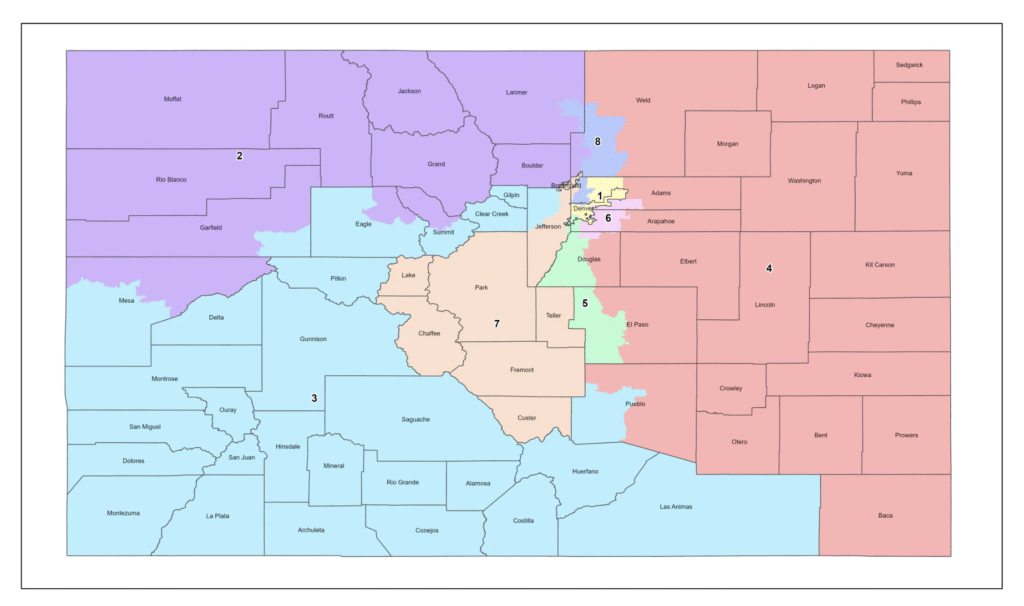
With just two meetings left before an April 15 deadline, the state’s Title Board on Wednesday pushed through a slate of ballot measures — including a revised proposal to privatize Pinnacol Assurance and dueling plans to redraw Colorado’s congressional map...

Democrat Matt Cavanaugh ends campaign in Colorado’s 5th CD, says petition firm came up short
Ernest Luning
ernest.luning@coloradopolitics.com
Updated 5 hours ago
Democratic congressional candidate Matt Cavanaugh said Wednesday that he was ending his bid to challenge Republican U.S. Rep. Jeff Crank in Colorado’s 5th District because the firm his campaign hired to gather petition signatures failed to deliver. Cavanaugh, an Army...
Colorado voters to decide whether to ban gender surgeries for minors
Marissa Ventrelli
marissa.ventrelli@coloradopolitics.com
Updated 4 hours ago
Colorado voters will decide this November whether to prohibit gender surgeries for minors and bar public funding or insurance coverage for procedures that alter children’s biological sex characteristics. The measure qualified for the ballot amid a push by the federal...
DeGette challenger Melat Kiros trounces 15-term Democratic incumbent in Denver delegate vote
Ernest Luning
ernest.luning@coloradopolitics.com
Updated 3 days ago
The 28-year-old, first-time candidate challenging Democratic U.S. Rep. Diana DeGette in this year’s primary soundly defeated the 15-term incumbent in a delegate preference poll conducted Saturday at a county party assembly in Denver. Melat Kiros, the daughter of Ethiopian immigrants...

Army veterans Jessica Killin, Joe Reagan qualify for Democratic primary ballot in Colorado’s 5th CD
Ernest Luning
ernest.luning@coloradopolitics.com
Updated 3 days ago
Democratic congressional candidates Jessica Killin and Joe Reagan secured spots Saturday in Colorado’s June primary to decide who will run against Republican U.S. Rep. Jeff Crank in a district that’s only ever sent GOP lawmakers to Congress. The two Democrats,...

Boebert challenger Eileen Laubacher joins lawsuit aimed at blocking her from Democratic assembly
Ernest Luning
ernest.luning@coloradopolitics.com
Updated 5 days ago
A Denver District Court judge on Thursday permitted Democratic congressional candidate Eileen Laubacher to join a lawsuit filed by one of her primary opponents seeking to prevent Laubacher from participating in the party’s assembly process in a bid to qualify...

Colorado GOP chair Brita Horn says she’ll resign next month, points to ‘divide within our party’
Ernest Luning
ernest.luning@coloradopolitics.com
Updated 6 days ago
Colorado Republican Party Chair Brita Horn said Thursday that she will resign her position next month following the GOP’s state assembly, citing what she described as an “enduring divide” within the party “marked by vitriol and hostility.” Horn’s announcement came...
Senate committee moves forward with Colorado ballot measure to redirect TABOR refunds to schools
Marianne Goodland
marianne.goodland@coloradopolitics.com
Updated 5 days ago
A Senate panel on Thursday voted along party lines to move forward with a bill that would ask voters for permission to eliminate Taxpayer’s Bill of Rights refunds and redirect those dollars to K-12 public education. The 6-3 vote in...

Colorado committee recommends rejecting alcohol, marijuana tax hike to fund mental health care
Marissa Ventrelli
marissa.ventrelli@coloradopolitics.com
Updated 2 days ago
In a rare move, Colorado’s Capital Development Committee unanimously recommended that another legislative committee reject a bill asking voters to approve higher excise taxes on alcohol and marijuana to fund a new mental health hospital in Aurora. Sponsored by Rep....

Republican Jeff Crank, Democrat Jessica Killin qualify by petition for Colorado’s 5th CD primary
Ernest Luning
ernest.luning@coloradopolitics.com
Updated 7 days ago
Republican U.S. Rep. Jeff Crank and Jessica Killin, one of the Democrats challenging the first-term incumbent, have both qualified for the primary ballot in Colorado’s 5th Congressional District after turning in a sufficient number of petition signatures, state election officials...
PREV
PREVIOUS

COLORADO POLITICKING | State Supreme Court ignored subpoena for evidence in scandal inquiry, report says
This week on Colorado Politicking, investigative reporter David Migoya joins host Pat Poblete to discuss his reporting on Colorado’s judicial discipline commission probe into the alleged coverup of misconduct by judges, including the latest revelation that the Judicial Department – and by extension its Supreme Court – has refused to comply with a subpoena from […]

Colorado House Democrats name new chief of staff
House Speaker Alec Garnett, D-Denver named Rebecca Kisner as the next chief of staff for the House Democrats. Kisner has worked for the Colorado House Democrats since 2019, most recently serving as deputy chief of staff. She succeeds Kelly Watkins, who worked for the House Democrats for a decade, including five years as chief of […]