

Biden judicial nominee Nina Wang appears before Senate with long list of endorsements
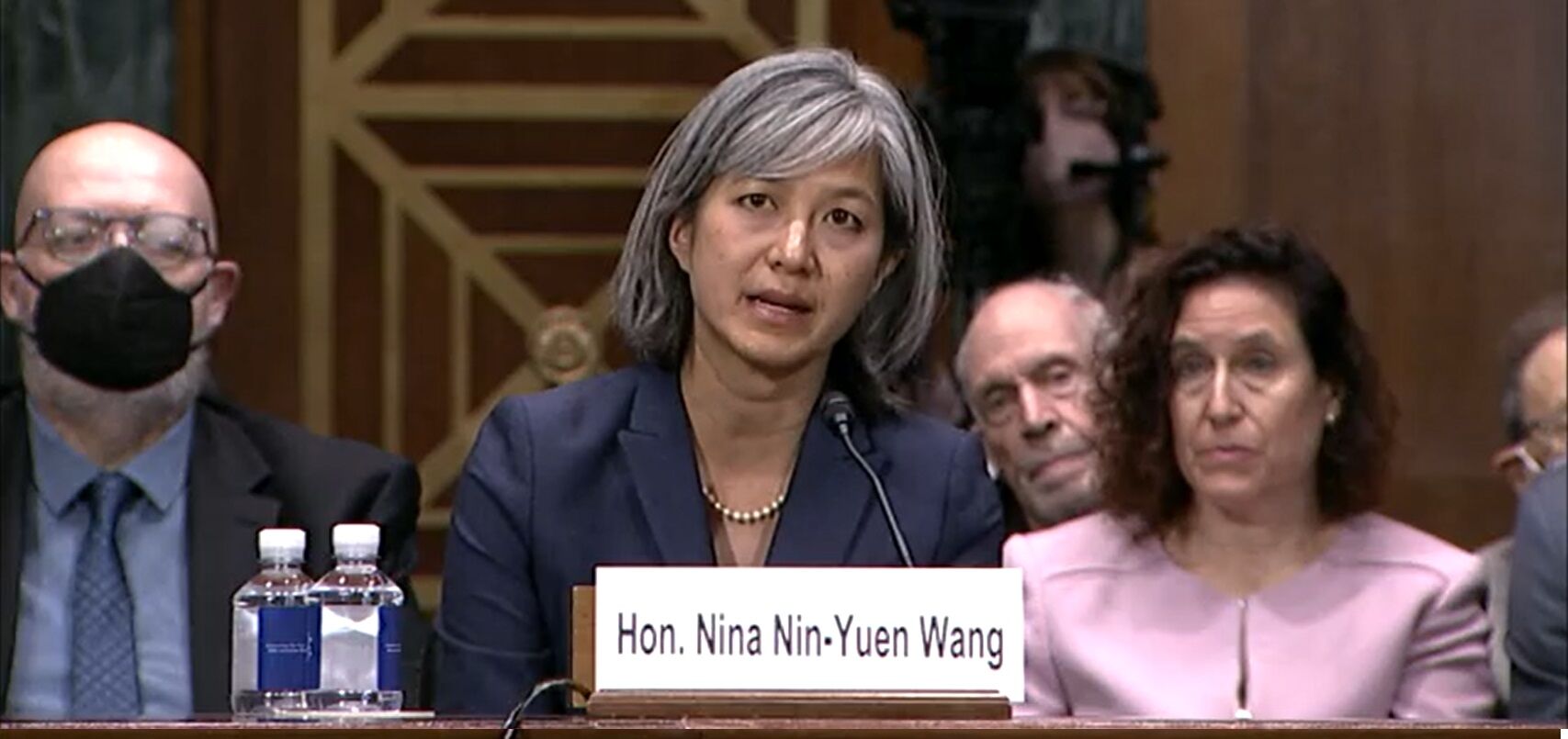
President Joe Biden’s most recent judicial nominee to Colorado’s federal trial court, Nina Y. Wang, appeared before the U.S. Senate Committee on the Judiciary on Wednesday equipped with a lengthy roster of endorsements and a sizeable résumé of handling federal court cases.
The committee’s chair, U.S. Sen. Dick Durbin, D-Ill., alluded to Wang’s experience for the job, having spent seven years in Colorado’s U.S. District Court as a magistrate judge.
“I looked at some of the cases you handled. It’s a wide variety. It was kind of surprising,” Durbin observed.
In January, Biden nominated Wang, 50, to a seat on the state’s seven-member federal trial court. If confirmed, she would succeed Christine M. Arguello, a George W. Bush appointee who is taking a form of semi-retirement known as senior status effective in mid-July.
Wang is the Biden administration’s fourth judicial nominee to the federal bench in Colorado, all of whom have been women. The full Senate confirmed Biden’s previous nominee for Colorado, Charlotte N. Sweeney, at the same time Wang appeared before the judiciary committee on Wednesday.
The number of women Biden has nominated to the U.S. District Court for Colorado in his first year as president is now equal to the number of female judges previously confirmed to the court in its 145-year history since statehood.
Wang’s nomination came at the recommendation of U.S. Sens. Michael Bennet and John Hickenlooper. Speaking to the committee, Bennet said he learned from Wang’s colleagues that she “doesn’t grandstand” and listens to every litigant, regardless of whether they have legal representation. He elaborated on Wang’s upbringing – her family had immigrated to Kansas City from Taiwan.
“They knew English, but people in their Kansas suburb couldn’t always understand them. Some of Nina’s first memories were ordering pizza for the family or speaking to store clerks on behalf of her parents,” Bennet said.
He also described how immigration authorities lost the permanent residency application for Wang’s family. While their case was pending, federal law changed, negatively affecting the family’s pathway to legalization.
“The family spent years in legal limbo, ricocheting from one court to another. So Nina made a promise: If I can stay in America, I’m gonna give back to America,” Bennet said. “It made her cherish America’s legal system, where even noncitizens have their day in court.”
In brief remarks to the committee, Wang thanked then-U.S. Sen. Bob Dole, R-Kan., for his intervention in her immigration case. She also gave thanks to Arguello, saying her “contributions to Colorado’s legal community are truly unparalleled.”
A 1997 graduate of Harvard Law School, Wang spent her early career as a law clerk for a federal judge in Maryland, then moved to Colorado to work in the U.S. Attorney’s Office. She represented the United States in civil cases implicating employment matters, the environment and civil rights.
From 2004 through 2015, she handled intellectual property cases at the firm now known as Faegre Drinker, focusing on patent issues. Wang participated in eight trials, half of which took place in front of a jury.
The judges of the U.S. District Court appointed her to be a magistrate judge in early 2015. Although magistrate judges cannot preside over felony criminal trials or sentencing, they may handle many of the same tasks as their Senate-confirmed counterparts. Their workloads commonly include preliminary matters in criminal cases, making recommendations to district judges on motions, and, if the parties agree, handling civil cases entirely on their own.
The judiciary committee received seven letters backing Wang, signed by dozens of attorneys or organizations familiar with her work. Some of them pointed out that, while magistrate judges have occasionally been nominated in Colorado in the past, Wang would be the first magistrate judge to actually win confirmation.
“Her judicial skills have been honed by efficiently handling a heavy caseload, while writing many detailed and thoughtful opinions on often novel questions of law,” wrote nine men who have served as Colorado’s U.S. attorney, appointed by presidents of both parties dating back to 1981. “It is long past time for such an appointment (of a magistrate judge) to occur and (we) submit that Judge Wang is the ideal candidate to fill that role.”
Wang received the endorsement of a half dozen professional legal groups in Colorado, including the bar associations that represent female, LGBTQ, Black, Hispanic and Asian/Pacific-American attorneys. Five of Wang’s former clerks also registered their support, emphasizing her belief in issuing written decisions for the benefit of litigants and for the development of caselaw in Colorado.
“She very seriously weighs decisions that affect the rights of criminal defendants or civil liberties of underrepresented members of society. For example, we recall many lengthy discussions with her about the importance of the presumption against pretrial detention of criminal defendants,” the clerks wrote. “She has also expressed longstanding interest in issues related to restorative justice and the use of diversionary and alternative sentencing programs.”
Beyond Wang’s work in the courtroom and on the bench, she shared with the judiciary committee her extracurricular activities, not all of which were judicial in nature. For 16 years, she volunteered as a soup maker or server for the “sandwich line” at St. Elizabeth of Hungary Catholic Church in Denver. While at Harvard, she was a student lawyer with the Battered Women’s Advocacy Project, and later represented people for free in their immigration or asylum cases.
In her responses to the judiciary committee’s questionnaire, Wang’s list of her “most significant cases” as a magistrate judge ranged from water pollution and excessive force to trademark infringement. Soon after taking the bench, she inherited a longstanding legal claim against the state of Colorado alleging unacceptable wait times for pretrial detainees to receive mental competency evaluations and related services. Wang found that the state was in violation of a prior settlement and appointed an oversight team to monitor compliance.
Among Wang’s trial experience, she described an eight-day jury trial she presided over in 2018, in which a woman sued Western Slope ranchers whose cow wandered onto a highway and caused an accident resulting in serious injuries. The jury sided with the ranchers, and Wang denied the plaintiff’s request to overturn the verdict.
Only on five occasions, Wang reported, has the federal appeals court based in Denver reversed her decisions. The most recent reversal occurred in October of last year, when the U.S. Court of Appeals for the 10th Circuit disagreed with Wang’s conclusion that a total amount of $31,585 owed to hundreds of call center workers was insignificant.
Currently, the 10th Circuit is reviewing another of Wang’s decisions in a consequential First Amendment case involving the right of bystanders to record police officers.
The most detailed – and personal – attestation to the judiciary committee about Wang’s abilities and background came from Natalie Hanlon Leh, currently the No. 2 official in the Colorado Attorney General’s Office. She wrote that she personally recruited Wang to work on intellectual property litigation in private practice, and emphasized Wang’s ability to learn quickly, maintain her cool and remain professional.
“For example, she consciously tries to make sure that Colorado lawyers who practice outside of Denver perceive her as fair, regardless of what part of the state they are from,” wrote Hanlon Leh.
Wang received few questions from senators during her hearing. She appeared alongside Biden’s nominee to lead the Bureau of Alcohol, Tobacco, Firearms and Explosives, and committee members focused almost exclusively on gun violence in light of another massacre at a Texas school on Tuesday.

Elizabeth School District dismisses challenge to book-ban injunction on eve of appellate arguments
Michael Karlik
michael.karlik@coloradopolitics.com
Updated 10 hours ago
An Elbert County school district has dismissed its challenge to a judge’s injunction ordering it to return banned books to library shelves, days before the Denver-based federal appeals court was set to hear oral arguments this week. Although a three-judge...
Colorado Supreme Court to hear cases on insurance coverage for COVID, witness credibility
Michael Karlik
michael.karlik@coloradopolitics.com
Updated 12 hours ago
The Colorado Supreme Court announced on Tuesday that it will decide the degree to which a virus or other hazard must affect a commercial property before it can trigger loss-or-damage coverage under an insurance policy. At least three of the...
Federal judge says prisoner cannot sue for dog-bite injury
Michael Karlik
michael.karlik@coloradopolitics.com
Updated 22 hours ago
A federal judge concluded last week that a man cannot sue the government for injuries he sustained when a dog allegedly attacked him while he participated in a prison program. Kenneth M. Chandler, representing himself, was participating in the “FIDOS”...
Fort Carson soldier’s wife could be deported
Carol McKinley
carol-mckinley@coloradopolitics.com
Updated 20 hours ago
As the country’s largest immigration enforcement crackdown continues in Minnesota’s Twin Cities, a Fort Carson sergeant is fighting a personal immigration crisis — one that may implode his family. Sgt. Tyler Garza’s wife, Jennifer Maradiaga Baca, is not a legal...

Federal judge recommends dismissing trans athletics lawsuit by area school districts
Eric Young
eric.young@gazette.com
Updated 20 hours ago
A judge has recommended dismissing a federal lawsuit filed by multiple school districts against the Colorado Attorney General’s and Civil Rights Offices over their policies dictating students’ participation in athletics and activities based on their biological sex rather than gender...
Appeals judge asks Colorado Supreme Court to once again clarify magistrate rules
Michael Karlik
michael.karlik@coloradopolitics.com
Updated 2 days ago
A member of Colorado’s second-highest court urged the state Supreme Court last week to revise confusing language in the rules governing magistrates, less than two weeks after an attempted cleanup of the rules took effect. Magistrates are judicial employees who are...
10th Circuit dismisses paralyzed man’s claims against Colorado Springs, officer
Michael Karlik
michael.karlik@coloradopolitics.com
Updated 2 days ago
The Denver-based federal appeals court upheld the dismissal last week of a man’s excessive force claims against the city of Colorado Springs and the officer who tased him, causing him to fall down a sloped surface and break his neck....
Colorado justices weigh overlap between child prostitution offenses
Michael Karlik
michael.karlik@coloradopolitics.com
Updated 2 days ago
Members of the Colorado Supreme Court last week appeared willing to uphold a man’s conviction for an attempted child prostitution offense, which the state’s second-highest court previously found to be a violation of his right to equal protection under the...

State Supreme Court holds oral arguments, 10th Circuit revives dormant initiative | COURT CRAWL
Michael Karlik
michael.karlik@coloradopolitics.com
Updated 3 days ago
Welcome to Court Crawl, Colorado Politics’ roundup of news from the third branch of government. The state Supreme Court heard oral arguments last week in multiple civil and criminal cases, plus the Denver-based federal appeals court is doing something unusual...
Is a pardon for Tina Peters coming? Colorado governor confirms he is weighing options
The Denver Gazette
the-denver-gazette@coloradopolitics.com
Updated 3 days ago
Gov. Jared Polis on Friday strongly indicated he is considering clemency for Tina Peters, the former county clerk convicted of a security breach at her election office. When pressed about the matter, Polis didn’t offer an explicit answer, but he...
PREV
PREVIOUS

Over 60 scholarships approved by state board
The Colorado Opportunity Scholarship Initiative board on Wednesday approved 66 scholarships worth more than $4.9 million. The scholarships will go to 2,900 Colorado students and are part of the board’s matching student scholarship program that assists under-resourced students by matching community scholarship dollars. “These awards represent 54 counties and 12 institutions of higher education around […]

Denver committee approves bill requiring HOAs to notify homeowners of foreclosure rights
Denver’s Safety, Housing, Education & Homelessness Committee on Wednesday gave preliminary approval to a bill that would require homeowners associations to notify homeowners of their foreclosure rights. The bill stemmed from Council President Stacie Gilmore’s district, where at least 50 Green Valley Ranch homes were foreclosed on over unpaid HOA fines. Most homeowners were not […]