

Man who killed wife receives new trial after appeals court finds misunderstanding of Miranda rights
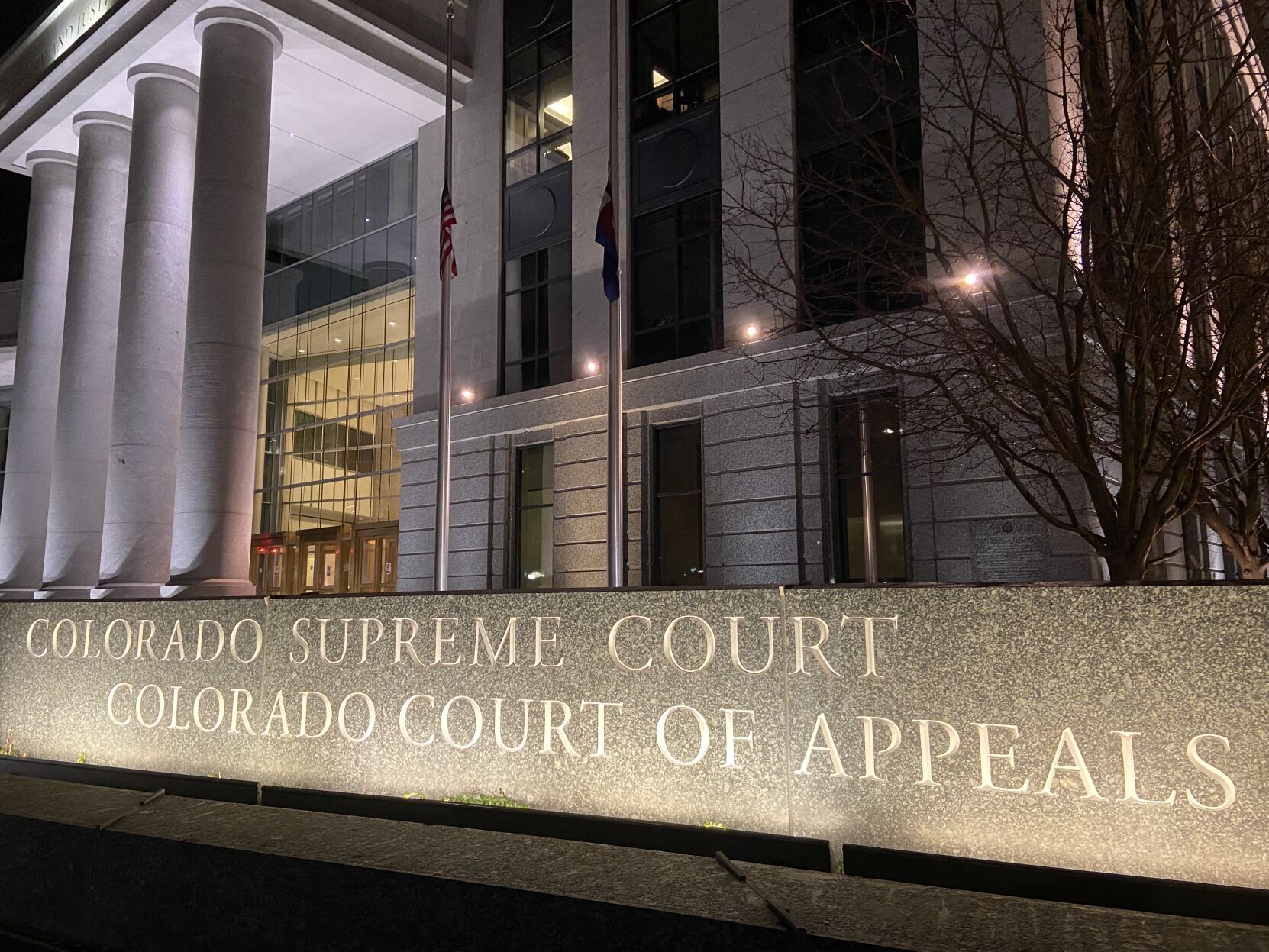
A man serving a life sentence for murder will receive a new trial after the state’s second-highest court determined he failed to understand that he could have an appointed lawyer present during interrogation and Arapahoe County law enforcement did not correct him.
Yury Sudakov appealed his 2018 conviction by arguing he had not knowingly waived his Miranda rights when he made incriminating statements to police. As established in the U.S. Supreme Court’s decision of Miranda v. Arizona, Sudakov had the right to be advised, prior to an in-custody interrogation, that he could talk with a lawyer before and during questioning.
Sudakov, who received his Miranda warning through the translation of a Russian-speaking Arapahoe County sheriff’s deputy, responded by saying, “No, no need. … Why should I pay an attorney $300-400 per hour while I have no money?”
On Thursday, a three-judge panel for the Court of Appeals believed Sudakov had not consented to speak to police without an attorney present because the record showed he misunderstood his constitutional rights. Of the two officers in the room with Sudakov, “neither attempted to correct the misunderstanding,” wrote Judge David J. Richman in the panel’s opinion.
A jury convicted Sudakov of committing first-degree murder in February 2017. Sudakov shot his estranged wife, Svetlana Igolkin, in the head multiple times in their home while their teenage son witnessed the slaying. Sudakov then shot himself. Heavily intoxicated at the time, he apparently did not realize that he had shot and killed Igolkin until police told him at the end of his interrogation.
At trial, there was no dispute that Sudakov had killed Igolkin, only whether he intended to do so after deliberation. The defense instead argued that Sudakov was guilty of manslaughter or second-degree murder.
While Sudakov raised multiple issues on appeal, the Court of Appeals focused on what happened after Sudakov left the hospital and arrived at the interrogation room.
Investigator Niki Bales told sheriff’s Deputy Sergei Volkov that she had a Russian-speaking suspect in custody and asked him to translate. After Bales established that Sudakov spoke English, she introduced the two men and Sudakov expressed a preference for communicating in Russian through Volkov.
Volkov then summarized Sudakov’s Miranda rights and asked him to sign a form that contained the advisement in English. Among the rights listed were Sudakov’s ability to remain silent, the right to a lawyer during questioning and the warning that anything Sudakov said could be used against him in court.
Although the form said that Sudakov had the “right” to a lawyer, the deputy’s oral advisement was that the court could provide a public defender “if you need a lawyer.”
According to an English transcript of the encounter, Sudakov responded to the oral advisement of his rights by saying he had “nothing to hide” and “I believe you (Volkov).” As Volkov affirmed that Sudakov was choosing not to have an attorney present, Sudakov responded: “Why should I pay an attorney $300-$400 per hour while I have no money? I don’t want it.”
As Sudakov initialed the form, Bales asked Volkov what Sudakov had said about waiving his rights.
“He understood everything,” the deputy responded. “He would like to speak with us. He doesn’t like to have a lawyer because it’s very expensive for him and he doesn’t have anything to, kind of, to hide from us.”
On appeal, Sudakov contended that the trial judge was wrong to not suppress the statements he had made during his interrogation because the police had not made him fully aware of his right to an appointed attorney.
“The words ‘need’ and ‘want’ imply that you are incapable somehow,” argued Deputy State Public Defender Lisa Weisz. “Whereas telling someone they have the right to an attorney contemplates that they are a capable person but you have these rights that everybody has. That’s different.”
Majid Yazdi, senior assistant attorney general, acknowledged that there could have been “a more appropriate way” for Volkov to respond to Sudakov’s statements that he could not afford an attorney. However, Yazdi noted repeatedly that Sudakov was “eager from the beginning to talk” to his interrogators.
“You’ve referenced how eager he was probably 12 times,” responded Judge Ted C. Tow III. “If he doesn’t understand his rights, what relevance is his eagerness? If he mistakenly believes that he can only get an attorney with his own money, his eagerness has no bearing, does it?”
Tow added that one of the objectives of a Miranda advisement is to protect suspects from their own “eagerness” while in police custody.
Weisz agreed.
“The courts have said that the most damaging evidence against the defendant is what comes out of his own mouth,” she said.
The panel concluded that Sudakov did not knowingly relinquish his right to speak to an attorney, and that Volkov and Bales neglected to correct his impression that he needed to hire a lawyer himself. Because the prosecution ended up relying extensively on Sudakov’s interrogation at trial to prove he intended to murder his wife, the appellate judges found his statements to police likely affected his conviction.
As a result, Sudakov’s first-degree murder conviction is now reversed. The case is People v. Sudakov.


Federal judge recommends dismissing trans athletics lawsuit by area school districts
Eric Young
eric.young@gazette.com
Updated 15 hours ago
A judge has recommended dismissing a federal lawsuit filed by multiple school districts against the Colorado Attorney General’s and Civil Rights Offices over their policies dictating students’ participation in athletics and activities based on their biological sex rather than gender...
Appeals judge asks Colorado Supreme Court to once again clarify magistrate rules
Michael Karlik
michael.karlik@coloradopolitics.com
Updated 16 hours ago
A member of Colorado’s second-highest court urged the state Supreme Court last week to revise confusing language in the rules governing magistrates, less than two weeks after an attempted cleanup of the rules took effect. Magistrates are judicial employees who are...
10th Circuit dismisses paralyzed man’s claims against Colorado Springs, officer
Michael Karlik
michael.karlik@coloradopolitics.com
Updated 23 hours ago
The Denver-based federal appeals court upheld the dismissal last week of a man’s excessive force claims against the city of Colorado Springs and the officer who tased him, causing him to fall down a sloped surface and break his neck....
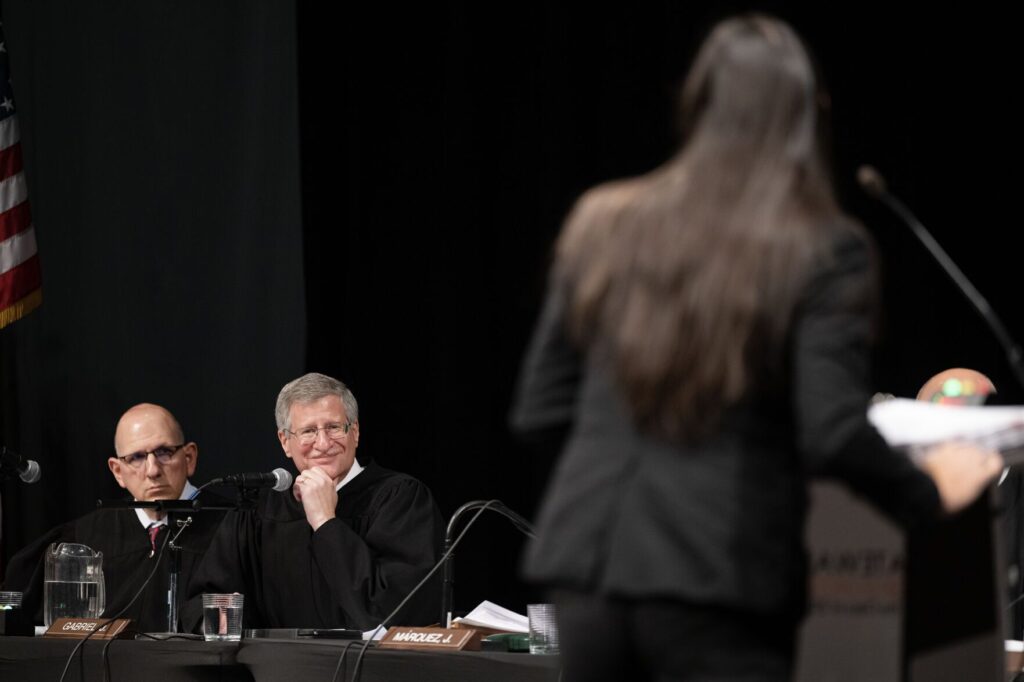
Colorado justices weigh overlap between child prostitution offenses
Michael Karlik
michael.karlik@coloradopolitics.com
Updated 14 hours ago
Members of the Colorado Supreme Court last week appeared willing to uphold a man’s conviction for an attempted child prostitution offense, which the state’s second-highest court previously found to be a violation of his right to equal protection under the...

State Supreme Court holds oral arguments, 10th Circuit revives dormant initiative | COURT CRAWL
Michael Karlik
michael.karlik@coloradopolitics.com
Updated 2 days ago
Welcome to Court Crawl, Colorado Politics’ roundup of news from the third branch of government. The state Supreme Court heard oral arguments last week in multiple civil and criminal cases, plus the Denver-based federal appeals court is doing something unusual...
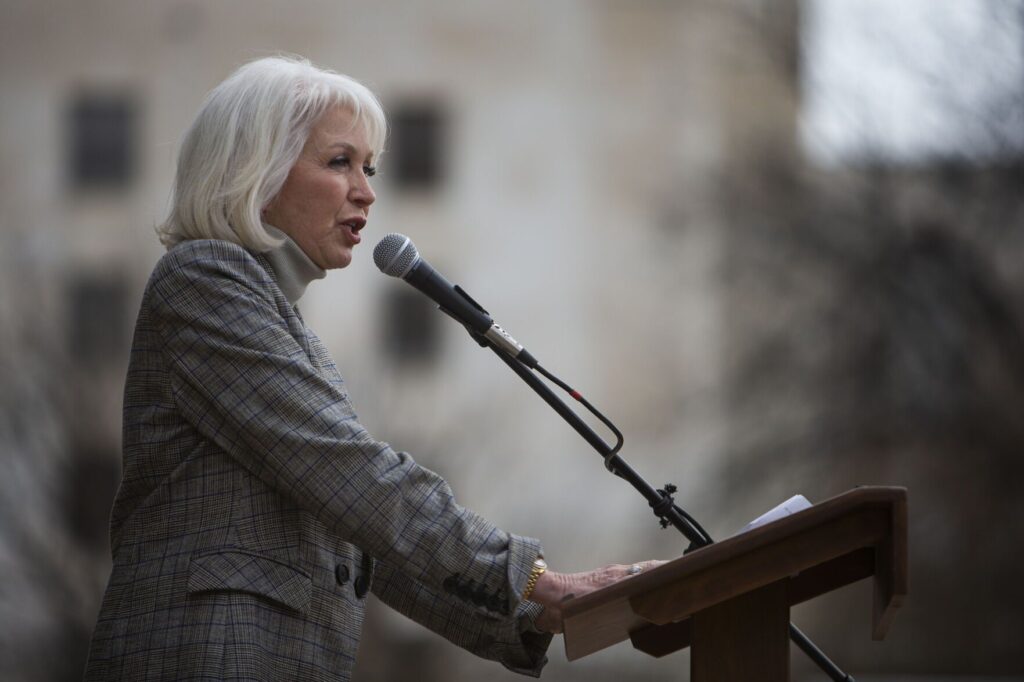
Is a pardon for Tina Peters coming? Colorado governor confirms he is weighing options
The Denver Gazette
the-denver-gazette@coloradopolitics.com
Updated 2 days ago
Gov. Jared Polis on Friday strongly indicated he is considering clemency for Tina Peters, the former county clerk convicted of a security breach at her election office. When pressed about the matter, Polis didn’t offer an explicit answer, but he...
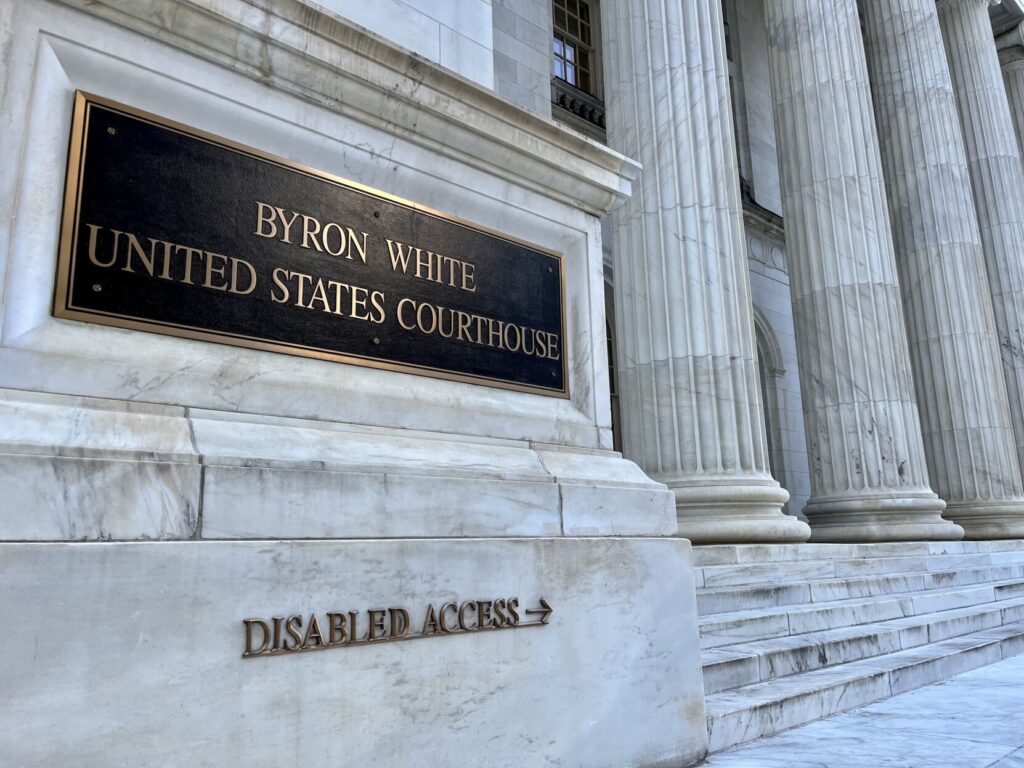
10th Circuit oral arguments to feature trial judges for first time in 12 years
Michael Karlik
michael.karlik@coloradopolitics.com
Updated 5 days ago
When the Denver-based federal appeals court convenes next week to hear oral arguments, six new faces will be staring down from the bench. No, the U.S. Court of Appeals for the 10th Circuit has not added six new members. It...
Federal judge says ICE cannot impose monitoring conditions beyond immigration judge’s order
Michael Karlik
michael.karlik@coloradopolitics.com
Updated 5 days ago
A federal judge told U.S. Immigration and Customs Enforcement on Thursday that it cannot impose additional restrictions or monitoring conditions beyond those ordered by an immigration judge when releasing a person on bond. In November, U.S. District Court Judge Gordon...
Colorado justices weigh constitutionality of student backpack search based on confidential tip
Michael Karlik
michael.karlik@coloradopolitics.com
Updated 4 days ago
The Colorado Supreme Court considered on Wednesday whether a tip submitted through the state’s confidential school safety system provided a Douglas County administrator with reasonable suspicion to search a student’s backpack for drugs. A trial judge blocked evidence from the...
10th Circuit rebuffs Jeffco’s attempt to expand immunity footprint
Michael Karlik
michael.karlik@coloradopolitics.com
Updated 5 days ago
The Denver-based federal appeals court confirmed on Wednesday that it would not treat a judge’s decision to move a civil case forward as the automatic equivalent of denying immunity to governmental officials. The order from the U.S. Court of Appeals...
PREV
PREVIOUS

Colorado Senate passes ban of talking on hand-held cellphones while driving
The Colorado Senate approved legislation Monday seeking to ban adults from talking on cellphones while driving, except when using a hands-free accessory like a Bluetooth headset. Under current law, adult drivers are allowed to use cellphones for calls but they cannot text or browse the internet. If passed, Senate Bill 175 would prohibit all hand-held […]

Colorado Conversation this week: Tackling the fentanyl crisis
The Centers for Disease Control and Prevention announced in December that fentanyl overdoses had become the leading cause of death for 18- to 45-year-olds nationally – since 2020, killing more than COVID-19, car crashes, suicides, cancer and gunshots combined. In response to this raging epidemic, The Gazette in Colorado Springs and KKTV are hosting a […]