

Critics say PUC secrecy hampers public participation in cases hiking Coloradans’ energy bills

Xcel Energy, the state’s largest energy company, recently asked the Colorado Public Utilities Commission for permission to pass on $550 million in excess energy costs to ratepayers – rather than to shareholders – to pay its enormous fuel bills for the four-day February 2021 freeze.
The PUC already approved several requests by other utilities to recover those cold-snap related expenses, and if Colorado’s energy regulators greenlight all pending requests, ratepayers would be on the hook for a total of $677 million.
But ordinary Coloradans have for years been denied access to a swath of information, stamped “confidential” in filings, that could help them understand the legitimacy of the request to hike energy bills during a time of skyrocketing inflation and soaring energy costs that are expected to worsen as the war in Ukraine escalates.
That ordinary Coloradans don’t have the same access to data that energy regulators routinely get has long raised red flags among consumer advocates, who complained the status quo leaves ratepayers in the dark.
In theory, interested persons or groups, if granted formal intervenor status, can see the confidential documents. But even if the request for intervention is granted, which is rare thanks to complex PUC rules, they will have to abide by a confidentially agreement that effectively precludes public scrutiny of the confidential information.
“You don’t get to see the data unless you’re an intervenor and you’re of a certain status,” said Amy Cooke, CEO of the John Locke Foundation in North Carolina and formerly the executive vice president of the Denver-based Independence Institute, where she was also the director of its Energy and Environmental Policy Center. “Then you get to see the data, but you have to sign a confidentiality agreement where you can’t say anything. You can’t show anyone what you’re seeing. So, people have no idea. There is no place for them to go and they can’t even see what goes into this stuff.”
Any consumer can object to a utility’s application for a rate hike through the regular channels, such as by formally filing a position or making a public comment during a hearing. But the complexity of rate cases and PUC rules make it almost impossible for the average resident to stay informed on how and why energy regulators approve increases to their gas and electric bills. That complexity, not to mention time commitment, also makes it doubly difficult for a resident, acting alone, to effectively and consistently press arguments before commissioners.
The secrecy begins with a utility’s application for a rate increase asking regulators to allow it to recover allowable costs, such as capital construction or, in this case, pass on unexpected energy expenses to consumers.
Under this process, a utility submits the paperwork, and PUC staff examines the documents for compliance with PUC rules. The process also allows an energy company or an intervenor to file “confidential” or “highly confidential” documents the submitter claims contain proprietary information, financial documents or other information a utility believes might harm its competitive position or violate some confidentiality requirement.
But critics say that in the last 25 years, the propensity of energy companies to classify documents has expanded radically, and often unnecessarily.
“There is some information that I think can reasonably be considered a competitive secret, such as bids that third parties make,” Charles Griffey, a Texas-based energy consultant, told The Denver Gazette. “Quite frankly, there’s probably too much that’s considered confidential that really isn’t confidential.”
Under the rules, a utility company, when submitting confidential data, is supposed to file different versions of the same document: One version is filed “as part of the public record” – meaning not under seal – with the confidential pages removed or redacted. The other document contains the unredacted information and is labeled “confidential.” Only intervenors or official parties to the case, plus the commissioners and staffers, can access the latter.
But an investigation by The Denver Gazette, which also filed a Colorado Open Records Act request, showed that utilities have not been following the rules and energy regulators have looked the other way. In particular, the companies have not filed the required first page that’s supposed to indicate the “nature of the documents that are filed under seal.”
An examination of the commission’s records found that, in the Xcel rate case, more than 100 of the 830 documents in the PUC database have been marked confidential, with their first pages inaccessible. Many of the document titles fail to describe the nature of the information, and no page numbers of confidential information are displayed, as the rule requires. According to the rule, those documents should have been rejected by PUC staff when they were filed.
When asked about it, Doug Dean, director of the Public Utilities Commission, replied, “The PUC does not generate or revise documents in its record.”
As for complaints that the PUC staff is not properly vetting submissions to determine what should be considered a public record, as the rule requires, Dean said that issue is “not redressable through a request for records under CORA.”
Dean did not admit to any deficiency in his staff’s handling of confidential submissions, but instead referred The Denver Gazette to the administrative law judge who is handling the case.
The commission’s response to The Denver Gazette’s request is not unusual at all, added Cooke, who founded the Coalition of Ratepayers in 2016 at the Independence Institute, a Denver-based think tank, in response to what she describes as the opacity of PUC proceedings that is shutting out the public.
“I found if you actually want to find out what is going on with, for instance, how the utility is charging, or how they actually are figuring out what their new rate case is going to be, you have to get inside what I call their ‘black box,’ and you can’t unless you’re an intervenor,” Cooke said.
The biggest barrier is a rule saying that – unlike industry and large business consumers – residential, agricultural and small business consumers must have a “distinct interest of the consumer (that) is either not adequately represented by the UCA (Utility Consumer Advocate) or inconsistent with other classes of consumers represented by the UCA.”
The UCA, formerly the Office of Consumer Counsel, is tasked with championing the interests of consumers before the PUC. When the name was changed to Utility Consumer Advocate by the Legislature in 2021, it was moved from the state Attorney General’s office to the Department of Regulatory Agencies and is now supervised by the latter’s director.
The Coalition of Ratepayers succeeded in becoming an intervenor in Xcel’s 2016 Electric Resource Plan, among the first forays into crafting a renewable energy path for Xcel. Cooke said Griffey, the coalition’s expert witness, found errors in Xcel’s modeling calculations amounting to an overpricing of Xcel’s rate increase request of between $80 million and $90 million.
“That’s just an error that doesn’t have anything to do with whether or not (the rate increase) was economically viable,” Cooke said of the modeling calculations. “It was just, ‘You guys made a mistake.’ But nobody knows that. How would you know that? Because PUC staff didn’t find it.”
Neither did the Office of the Utility Consumer Advocate.
Nor is intervening in a rate case cheap, which Cooke says creates another barrier to public participation. Cooke said the cost of her group’s effort to intervene in 2016 was at least a half-million dollars. To have any hope of being effective as an intervenor, she added, a party needs to hire attorneys that are experienced in this very small field of public utilities regulation.
“We had to go to the state of Texas because anybody who knew anything about regulatory proceedings and being at the Public Utilities Commission was conflicted out because Xcel had talked to them,” Cooke said. “The attorneys with that kind of knowledge are few and far between.”
That’s not counting her belief that commission rulings are a foregone conclusion.
“At the Public Utilities Commission, by the time you get to the intervening stage, from my experience, the decision’s been made,” Cook said. “Now, they might say, ‘Oh, you bring up a great point,’ and you might get a little bit on the margins, but for the most part, it is stacked against ratepayers, and the Office of Consumer Counsel is no help.”
The governor appoints the three members of the utilities commission. State law says no more than two commissioners can be members of the same political party. The governor also appoints the director of the Utility Consumer Advocate office.
Cooke describes the oversight regime as the fox guarding the hen house, noting PUC itself was created to be the watchdog for the public. She said the “original” public watchdog, the PUC, now has a watchdog, the UCA, and neither is doing much of a job looking out for the interests of the public for safe, reliable and fairly priced energy.
“(Gov. Jared Polis figured he) has two Democrats and one unaffiliated. You literally have to accept what the Public Utilities Commission is saying and what Xcel is saying and what the Office of Consumer Counsel says, and generally they’re all singing from the same sheet music. The Public Utilities Commission was supposed to be the watchdog. And frankly, I found them to be more like a lapdog,” Cooke said.
Cooke also accused the UCA as being more interested in protecting the governor’s political green agenda than ratepayer’s pocketbooks.
“What we found was that the Office of Consumer Council (UCA) didn’t really speak for them (ratepayers). You had the large industrials and commercial users. They’re always intervening, and they have their own (legal) group,” Cooke said. “And then you had the Office of Consumer Council that allegedly represents ratepayers, individual residential ratepayers, and small businesses.”
“But what we found is that they predominantly seem to represent the environmental left,” Cooke continued. “If you’re just an individual ratepayer, and you want to know about what’s going on at the Public Utilities Commission about your electricity bill, a sizable portion of your household budget, you have no real way of knowing how they’re deciding how much you’re going to have to spend. And then you also have no choice but to just pay it.”
In response to a request for comment on the charges leveled by critics, Dean, responding to an email from The Denver Gazette, said: “I do not have comments on the anonymous allegations list in your inquiry. The Colorado Public Utilities Commission abides by rules and statutes under the Administrative Procedures Act (C.R.S 24-72-204) that balance the need for transparency to the public and the need to protect a utility’s sensitive information, including infrastructure, cyber security, and trade secrets.”
A request for comment from the UCA addressing these statements was not returned.
Polis, through his spokesman Conor Cahill, rejected any insinuation that his administration or his appointees are colluding with utilities to raise energy rates. On the contrary, he has consistently acted to reduce the economic burden on constituents, his office said.
“Governor Polis is not beholden to any special interests and the free market shows the best option, and also the most affordable in the long run, is renewable energy like wind and solar to power our homes, businesses, cars, trucks, and industry,” Cahill said.


10th Circuit dismisses paralyzed man’s claims against Colorado Springs, officer
Michael Karlik
michael.karlik@coloradopolitics.com
Updated 11 hours ago
The Denver-based federal appeals court upheld the dismissal last week of a man’s excessive force claims against the city of Colorado Springs and the officer who tased him, causing him to fall down a sloped surface and break his neck....
Powell will attend Supreme Court hearing on Trump power to fire Fed governor
Zach Halaschak, Washington Examiner
zach.halaschak.washington.examiner@gazetteedit.wpenginepowered.com
Updated 11 hours ago
Federal Reserve Chairman Jerome Powell will attend oral arguments at the Supreme Court for a case in which President Donald Trump is testing the bounds of his power by attempting to fire a member of the central bank’s board of...
Pentagon orders 1,500 active-duty troops to prepare for Minnesota deployment
David Zimmermann Washington Examiner
davidzimmermannwashingtonexaminer@wpstage.coloradopolitics.com
Updated 11 hours ago
The Pentagon has ordered roughly 1,500 active-duty troops to remain on standby for a possible deployment to Minnesota, where anti-ICE protests are prevalent after an officer-involved shooting that killed a woman. Tensions between federal and state officials are growing increasingly...

With guidelines expiring, federal agency releases draft plan for Colorado River operations
Marianne Goodland
marianne.goodland@coloradopolitics.com
Updated 11 hours ago
Two months after the seven states of the Colorado River basin failed to reach consensus on managing the waterway, the U.S. Bureau of Reclamation issued a set of proposed alternatives. The alternatives are familiar concepts, including “no action” — an...
Colorado justices weigh overlap between child prostitution offenses
Michael Karlik
michael.karlik@coloradopolitics.com
Updated 14 hours ago
Members of the Colorado Supreme Court last week appeared willing to uphold a man’s conviction for an attempted child prostitution offense, which the state’s second-highest court previously found to be a violation of his right to equal protection under the...

State Supreme Court holds oral arguments, 10th Circuit revives dormant initiative | COURT CRAWL
Michael Karlik
michael.karlik@coloradopolitics.com
Updated 14 hours ago
Welcome to Court Crawl, Colorado Politics’ roundup of news from the third branch of government. The state Supreme Court heard oral arguments last week in multiple civil and criminal cases, plus the Denver-based federal appeals court is doing something unusual...

Denver gas prices surge but diesel mix-up not to blame, expert says
Dan Boniface
dan.boniface@denvergazette.com
Updated 9 hours ago
Denver gas prices surged 16.6 cents per gallon last week, but one expert said the public should not blame the hike on a recent diesel mix-up that damaged hundreds of vehicles and contaminated nearly 50 gas stations. “No, it has...
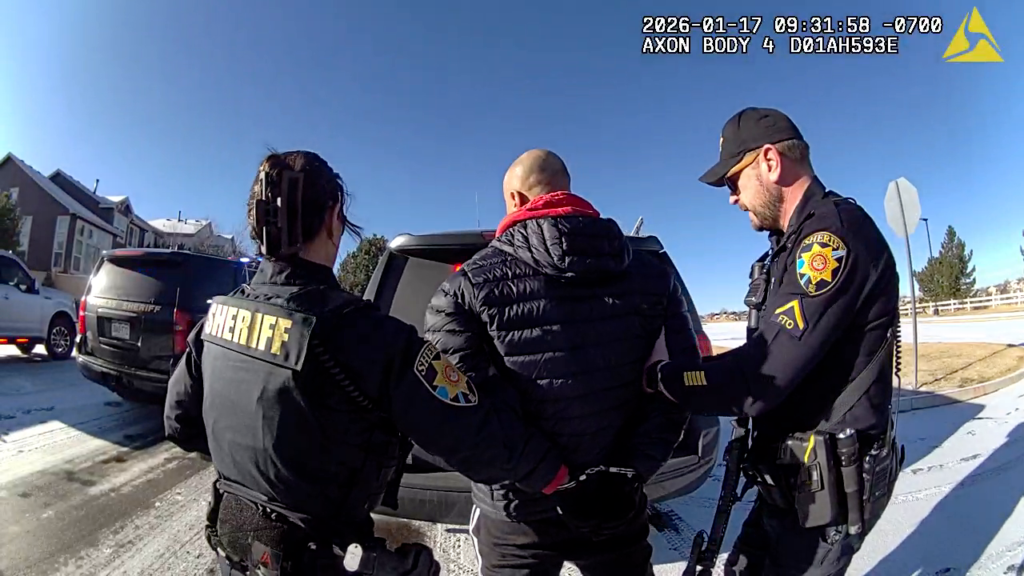
Flock cameras assist in road rage shooting arrest in Douglas County
Dan Boniface
dan.boniface@denvergazette.com
Updated 12 hours ago
Douglas County deputies on Monday said Flock Safety cameras were critical in an investigation that led to the arrest of a road rage shooting suspect. Deputies with the Douglas County Sheriff’s Office said 43-year-old Mitchell Aaron Weber was arrested Saturday...
Colorado governor insists local officers can work with DEA agents amid non-cooperation law
The Denver Gazette
the-denver-gazette@coloradopolitics.com
Updated 10 hours ago
Gov. Jared Polis on Friday insisted that local law enforcement officers in Colorado can — and should — work with federal drug enforcement authorities to go after criminal activity. An official of the U.S. Drug Enforcement Agency earlier said Colorado’s...
Is a pardon for Tina Peters coming? Colorado governor confirms he is weighing options
The Denver Gazette
the-denver-gazette@coloradopolitics.com
Updated 9 hours ago
Gov. Jared Polis on Friday strongly indicated he is considering clemency for Tina Peters, the former county clerk convicted of a security breach at her election office. When pressed about the matter, Polis didn’t offer an explicit answer, but he...
PREV
PREVIOUS

Flavored tobacco ban advances with exemptions for age-restricted stores, more
An effort to ban the sale of flavored tobacco products in Colorado passed its first hurdle Wednesday, receiving approval from a state House panel after several substantial revisions. House Bill 1064 aims to curb youth tobacco and nicotine use by prohibiting the sale of flavored products such as vapes, e-cigarettes, menthol cigarettes and chewing tobacco. […]

Republican US Senate candidate Eli Bremer endorsed by 71 current, former county commissioners
Republican U.S. Senate candidate Eli Bremer has been endorsed by 71 current and former county commissioners representing more than half of the counties in Colorado, his campaign said Thursday. The former El Paso County GOP chairman and 2008 Olympian is one of seven Republicans running for the nomination to challenge U.S. Sen. Michael Bennet, a Democrat […]