

Colorado Senate OKs bill seeking to curb catalytic converter theft

Legislation that intends to address the unprecedented rise in thefts of catalytic converters cleared the Colorado Senate on Wednesday, moving on to the state House of Representatives for consideration.
If enacted, Senate Bill 9 would require auto part recyclers to consult with the national motor vehicle title information system to determine whether a catalytic converter has been stolen and would allow additional law enforcement resources and agencies to investigate the thefts, including the Commodity Metals Theft Task Force.
“In 2019, it was a concern. In 2022, it is a crisis,” said bill sponsor Sen. Joann Ginal, D-Fort Collins. “As it increases, so does the harm to businesses as well as to ordinary citizens that are the victims. These cars become inoperable or noncompliant with emissions laws, meaning people can’t go to work, can’t go to school or do simple errands.”
Catalytic converters are exhaust emission control devices that contain precious metals trading at record prices. Catalytic converter thefts increased by more than 5,000% in Colorado from 2019 to 2021, going from 189 to 9,811 reported thefts annually, according to the Colorado Auto Theft Prevention Authority. In Denver, the thefts rose by 15,000% in the same timeframe – from 15 to 2,359, according to data from the Denver Police Department.
State senators passed the bipartisan bill Wednesday in a 33-1 vote, with only Sen. Jerry Sonnenberg voting “no.” The Sterling Republican said the bill would only increase unnecessary personal data collection.
“It won’t reduce the thefts of catalytic converters,” Sonnenberg said. “The bigger problem that needs to be dealt with is more cars are stolen in Colorado than anywhere else in the country. I opposed previous legislation that forced the taking of personal information and pictures of me doing regular business.”
In 2021, an Uswitch report found that Colorado had the most vehicle thefts per 100,000 vehicle owners at 524.3. However, Ginal said the bill would take away the incentives to steal catalytic converters by cutting off the ability to resell them.
As a result of the national rise in thefts and supply chain issues, it is very difficult to replace catalytic converters, leading to weeks- or months-long wait periods for parts that can cost between $1,000 and $5,000. Sen. Chris Holbert, R-Douglas County, said his son has been waiting seven weeks to replace the catalytic converters stolen out of his pickup truck in January.
“If you had asked me in early January of this year if I thought that having catalytic converters stolen was a significant life event, I would have said no. … I was wrong,” Holbert said. “He’s still making payments on his truck but for seven weeks it’s been sitting in a collision shop in Parker.”
Holbert said the bill is a “step in the right direction,” even if it does not address all aspects of the issue.
A second bill regarding catalytic converter theft, House Bill 1217, would create a grant program to raise awareness of the thefts by funding public information campaigns, theft prevention, victim assistance and catalytic converter identification and tracking efforts. Holbert said he also intends to sponsor his own bill that would increase penalties for catalytic converter theft.


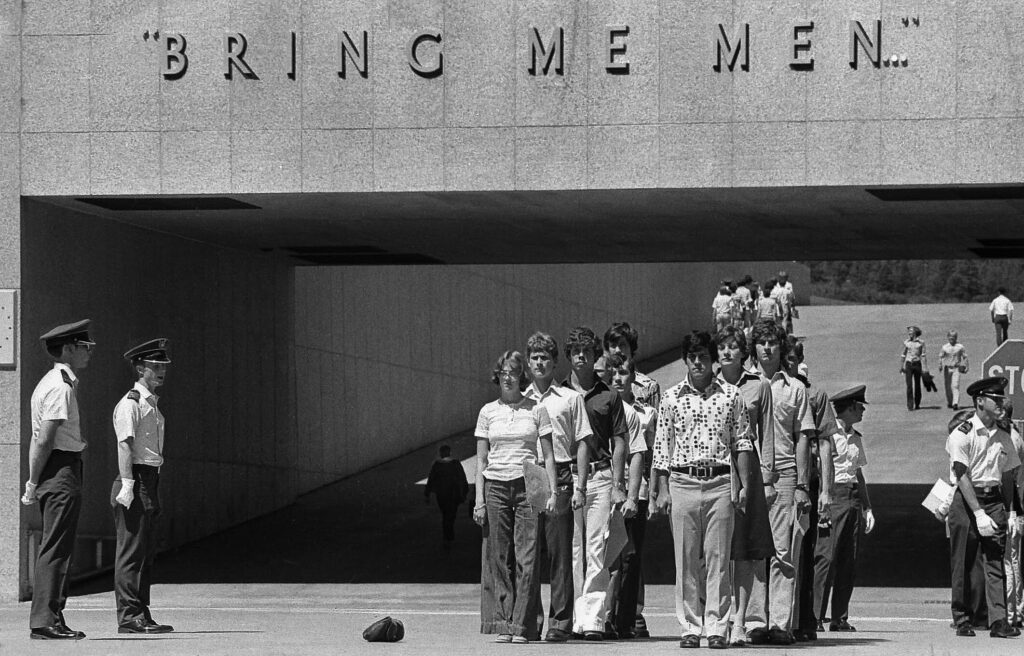
Fifty years later, women reflect on first coed class at the Air Force Academy, struggle for equality
Mary Shinn
mary-shinn@coloradopolitics.com
Updated 1 day ago
When the first female Air Force Academy cadets arrived 50 years ago this summer, they stood in front of an enormous sign on campus that read “Bring me men.” In the shadow of that sign, Kathleen Utley Kornahrens, one of...

As Lake Powell shrinks, marinas are having to adapt to dwindling water levels | OUT WEST ROUNDUP
The Associated Press
the-associated-press@coloradopolitics.com
Updated 4 days ago
ARIZONA Reservoirs near record lows PAGE — The Colorado River’s Lake Powell, the second largest reservoir in the U.S., is shrinking. A record-dry winter and extreme heat — as well as decades of overuse, chronic drought and climate change —...

A new day? Colorado’s troubled guardianship office pursues ‘cultural reset’
Marianne Goodland
marianne.goodland@coloradopolitics.com
Updated 4 days ago
Colorado’s guardianship program, long criticized for mismanagement and high staff attrition, is undergoing a “cultural reset,” as its new director works to repair partnerships and prepare for a major expansion under recent legislation. Created by lawmakers in 2017, the Office...

U.S. Senate OKs funding bill to avoid government shutdown
Wire Services
wire-services@coloradopolitics.com
Updated 2 days ago
Hemp provision became point of contention WASHINGTON • The U.S. Senate in an overnight vote Saturday approved a short-term measure to fund federal agencies into early December and avoid a government shutdown during the middle of campaign season. The late-summer...

The relevance of Watergate more than a half-century later | SONDERMANN
By Eric Sondermann
by-eric-sondermann@coloradopolitics.com
Updated 4 days ago
It was the scandal for which all other scandals are now named. In June 1972, a small group of Cuban burglars with high-level connections broke into the headquarters of the Democratic National Committee. Those headquarters were located in the Watergate...

Wirth downplays Social Security disaster talk | A LOOK BACK
Rachael Wright, Special to Colorado Politics
rachael.wright@coloradopolitics.com
Updated 4 days ago
Forty-five years ago this week: “As time goes on,” said Democratic U.S. Rep. Tim Wirth, of the 2nd Congressional District, “we are finding that the safety net, which was proposed earlier this year, has some very large holes in it,”...
Colorado Politics Calendar Aug. 10-16
Rachael Wright, Special to Colorado Politics
rachael.wright@coloradopolitics.com
Updated 4 days ago
CoPo’s weekly political calendar will help you find political and public-policy events throughout Colorado. It includes candidate and issue campaign events, public policy meetings, court hearings, state and local party conventions, assemblies, debates, rallies, parades, speaking engagements, traveling dignitary appearances,...

Democratic group aims Spanish-language TV ad at Gabe Evans in Colorado’s battleground 8th CD
Ernest Luning
ernest.luning@coloradopolitics.com
Updated 2 days ago
A national group tied to House Democratic leadership launched a six-figure Spanish-language TV ad in Colorado this week targeting Republican U.S. Rep. Gabe Evans and the GOP’s signature budget legislation. The 30-second spot is part of $15 million in new...

Colorado School of Mines lands major share in Trump’s $100M mining-education plan
Thelma Grimes
thelma.grimes@coloradopolitics.com
Updated 2 days ago
President Donald Trump on Friday named the Colorado School of Mines among roughly a dozen institutions that will share in a $100 million commitment “to train the next generation of American miners.” Paul Johnson, the university’s president, said he is...
Local party leaders, incoming judge among members of judicial performance commission that violated law
Michael Karlik
michael.karlik@coloradopolitics.com
Updated 1 day ago
A local Democratic leader and 2024 presidential elector. A legislative aide and leader in the Young Republicans. An incoming county court judge freshly appointed by the governor. They are among the eight members of the northeastern Colorado judicial performance commission...
PREV
PREVIOUS

Colorado legislature approves involuntary inspections of funeral homes, crematories
After multiple cases of malpractice were uncovered in Colorado’s funeral industry, the state legislature passed a bill to allow inspections of funeral homes and crematories without getting an operator’s permission to enter the premises. State senators unanimously approved House Bill 1073 on Wednesday, after the bipartisan bill cleared the House of Representatives in a 53-10 […]

Colorado Senate unanimously passes bill to remedy immigration consequences of guilty pleas
The Colorado Senate unanimously approved legislation Wednesday to allow immigrants who plead guilty to certain crimes a way to remedy resulting adverse consequences to their immigration status. If enacted, Senate Bill 103 would let criminal defendants challenge their guilty pleas for municipal offenses and class 1 or 2 misdemeanors if they had not been advised of the […]