

Judge orders some questions off-limits in Aurora excessive force lawsuit

Two defendants from the Arapahoe County Sheriff’s Office may not ask the man suing them for excessive force about certain topics that could incriminate him in the separate criminal prosecution stemming from the encounter, a federal judge has ordered.
Elijah McKnight has filed a civil claim against deputies Justin Yantiss and Andrew DeVries, alleging they used an unreasonable degree of force against him by throwing him to the ground and tasing him, eventually leading to McKnight’s injection with a substantial amount of the sedative ketamine. Although McKnight also named South Metro Fire Rescue, individual paramedics and Sheriff Tyler Brown as defendants, the parties agreed to dismiss everyone except the two deputies from the lawsuit.
In October, the deputies asked U.S. Magistrate Judge S. Kato Crews to order McKnight to answer their attorneys’ questions. They asserted that McKnight had refused to respond to “virtually all questions” during his deposition, owing to a pending criminal case in Arapahoe County where he stands accused of assaulting Yantiss and DeVries.
McKnight had cited his right, under the Fifth Amendment, not to incriminate himself in the criminal case.
Crews agreed last month that McKnight could not be compelled to answer certain questions that could support his conviction in state court, but declared other topics fair game. Specifically, the magistrate judge ordered McKnight to answer basic background questions, relevant inquiries about past criminal convictions and to speak about his injuries from the police encounter.
“Mr. McKnight cannot use his privilege against self-incrimination as a sword and a shield by claiming $600,000 in damages for ‘impairment of quality of life, emotional distress, anger, outrage, humiliation, disappointment, frustration, fear, anxiety, depression’,” Crews wrote, “but then refuse to provide testimony about the damages he seeks.”
At the same time, Crews declined to compel McKnight to answer questions about his prior substance use and drinking, the actions of paramedics or his intoxication on the day of his arrest.
“Testimony concerning his intoxication associated with the alleged assault presents a real danger of self-incrimination that could support criminal conviction,” Crews noted in his Feb. 17 order. “This is particularly true where the Defendants describe Mr. McKnight as having ‘had dangerously high levels of alcohol in his system on the day of his arrest.'”
According to McKnight’s lawsuit, Yantiss and DeVries contacted him on the night of Aug. 20, 2019, after a caller reported a man lying on the ground and unconscious at a bus stop in Aurora. The deputies roused McKnight and began talking with him, noticing that he was disorientated and intoxicated. McKnight volunteered that he had two outstanding warrants.
The deputies then allegedly arrested McKnight without explanation, bringing him to the ground, tasing him and kneeling on him in a way that reportedly caused severe pain.
“This use of force was excessive and objectively unreasonable. Defendants Yantiss and DeVries had no reasonable belief that Plaintiff possessed a weapon or posed a threat to themselves or any other person,” wrote McKnight’s attorneys.
South Metro Fire Rescue personnel arrived and McKnight allegedly overheard one paramedic say they would not take him to the hospital without sedating him. McKnight objected, but received an injection of 500 milligrams of ketamine and a second, 250 milligram, dose.
As a result, McKnight reportedly ceased breathing on his way to the hospital and required machine assistance to breathe for days afterward.
In response to incidents like McKnight’s and the high-profile death of Elijah McClain, who received a forcible injection of 500 milligrams of ketamine in a separate Aurora police encounter less than a week after McKnight’s, the state legislature enacted restrictions on ketamine use last year.
McKnight first appeared in state court for the charges of assaulting a peace officer and obstructing a peace officer a month after his arrest. Court records show he entered a plea of not guilty as recently as November 2021.
In January, Yantiss and DeVries also asked the federal court to grant them summary judgment, meaning they would prevail in the case if there were no key factual disputes and McKnight had failed to prove his case under the law. Arapahoe County argued that the deputies were entitled to qualified immunity, which shields government employees from civil liability unless they violate a person’s clearly-established legal rights.
Prior court decisions clearly established that officers could tackle and tase a suspect who was resisting arrest and who had struck an officer, Deputy County Attorney Writer Mott wrote to the court, and it was reasonable to restrain McKnight’s legs even after he was handcuffed.
But McKnight’s lawyers disputed the degree of force used, noting there was disagreement about whether, in fact, McKnight had assaulted the deputies.
A jury, responded attorney Igor Raykin in February, “could conclude that Plaintiff’s behavior did not constitute an actual threat, and a rational trier of fact could find that Plaintiff did not punch Defendant Yantiss in the face.”
U.S. District Court Chief Judge Philip A. Brimmer will ultimately decide whether to grant qualified immunity to the defendants.
The case is McKnight v. Brown et al.


Divided Colorado Supreme Court finds Denver detective did not violate defendant’s Miranda rights
Michael Karlik
michael.karlik@coloradopolitics.com
Updated 2 minutes ago
The Colorado Supreme Court determined on Monday that a Denver detective did not improperly resume questioning of a defendant in custody after he invoked his right to counsel. By 4-3, the justices reversed a trial judge’s order that found a...

Out-of-state judges address ex-discipline director’s lawsuit, Colorado justices accept federal invitation | COURT CRAWL
Michael Karlik
michael.karlik@coloradopolitics.com
Updated 4 hours ago
Welcome to Court Crawl, Colorado Politics’ roundup of news from the third branch of government. A pair of out-of-state judges got down to business in a lawsuit brought by Colorado’s former judicial discipline director, plus the state Supreme Court has...
Federal judge upholds constitutionality of Colorado campaign contribution limits
Michael Karlik
michael.karlik@coloradopolitics.com
Updated 3 days ago
A federal judge upheld Colorado’s individual campaign contribution limits as constitutional on Thursday, finding that three Republican plaintiffs failed to prove the campaign finance framework violates their First Amendment rights. U.S. District Court Senior Judge John L. Kane recognized that...
Appeals court rejects theory that existing tax revenue undermines need for new fees
Michael Karlik
michael.karlik@coloradopolitics.com
Updated 3 days ago
Colorado’s second-highest court rejected a plaintiff’s claim on Thursday that the tax revenue generated by an existing activity should prevent local governments from imposing new fees aimed at regulating the activity. The question stemmed from Colorado’s unique constraints on taxation...
Appeals court finds no illegal sentence when defendants forfeit time-served credit
Michael Karlik
michael.karlik@coloradopolitics.com
Updated 2 days ago
Colorado’s second-highest court ruled on Thursday that criminal defendants may agree to relinquish the credits they earned while incarcerated pending trial, despite a state law guaranteeing that such time “shall be deducted” from a person’s sentence. Kerry Ellis Endsley pleaded...
Appeals court reinstates Garfield County arson charge
Michael Karlik
michael.karlik@coloradopolitics.com
Updated 24 hours ago
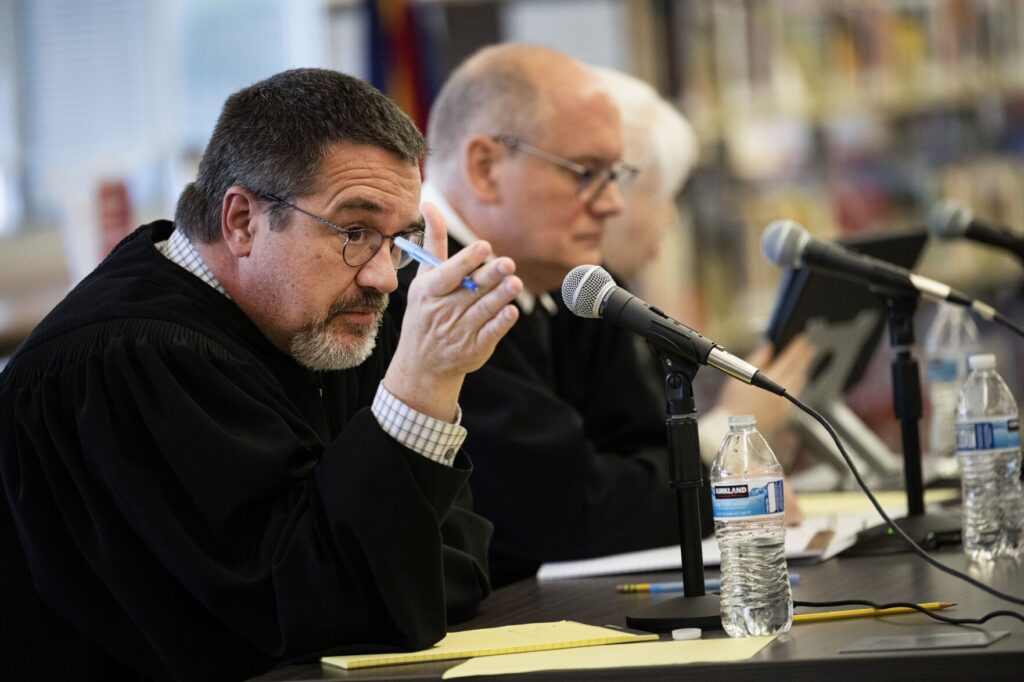
Colorado’s second-highest court reinstated a Garfield County defendant’s arson charge on Thursday, concluding a trial judge improperly credited a witness’s claim that she alone was responsible for starting the fire. A sheriff’s deputy responded to a brush fire near Parachute...
Federal judges rebuke ex-Colorado judicial discipline director for conduct in lawsuit
Michael Karlik
michael.karlik@coloradopolitics.com
Updated 4 days ago
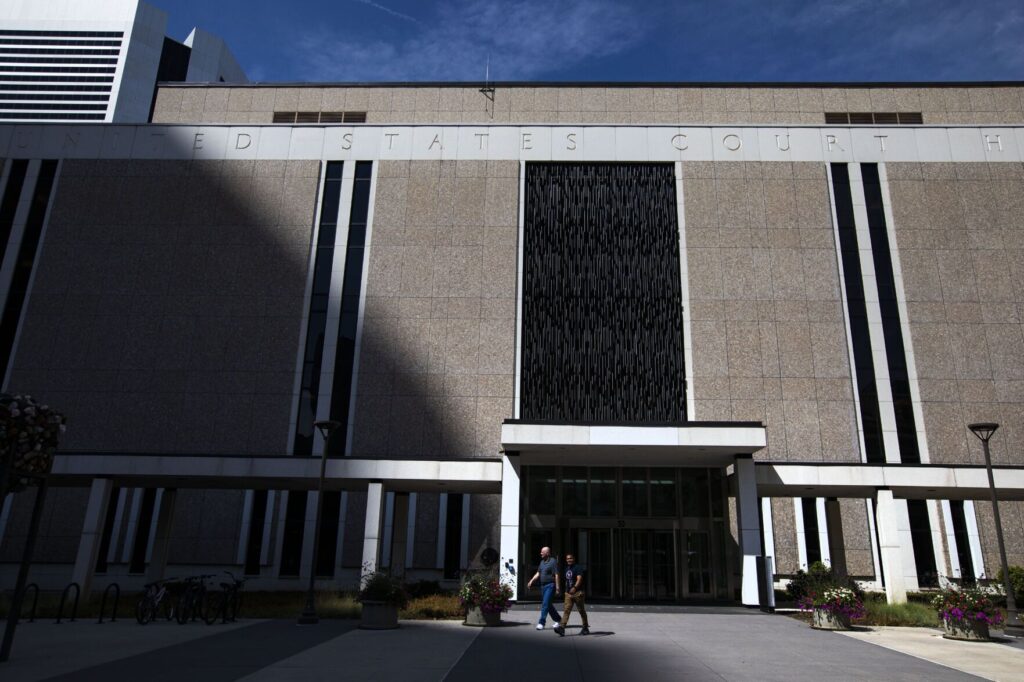
A pair of federal judges expressed a desire on Thursday to break the logjam on a lawsuit by Colorado’s former judicial discipline director against the state Supreme Court and related entities, while simultaneously showing little tolerance for the plaintiff’s scorched-earth...
Democratic bill would let recipients of ‘conversion therapy’ sue Colorado providers with no statute of limitations
Marissa Ventrelli
marissa.ventrelli@coloradopolitics.com
Updated 4 days ago
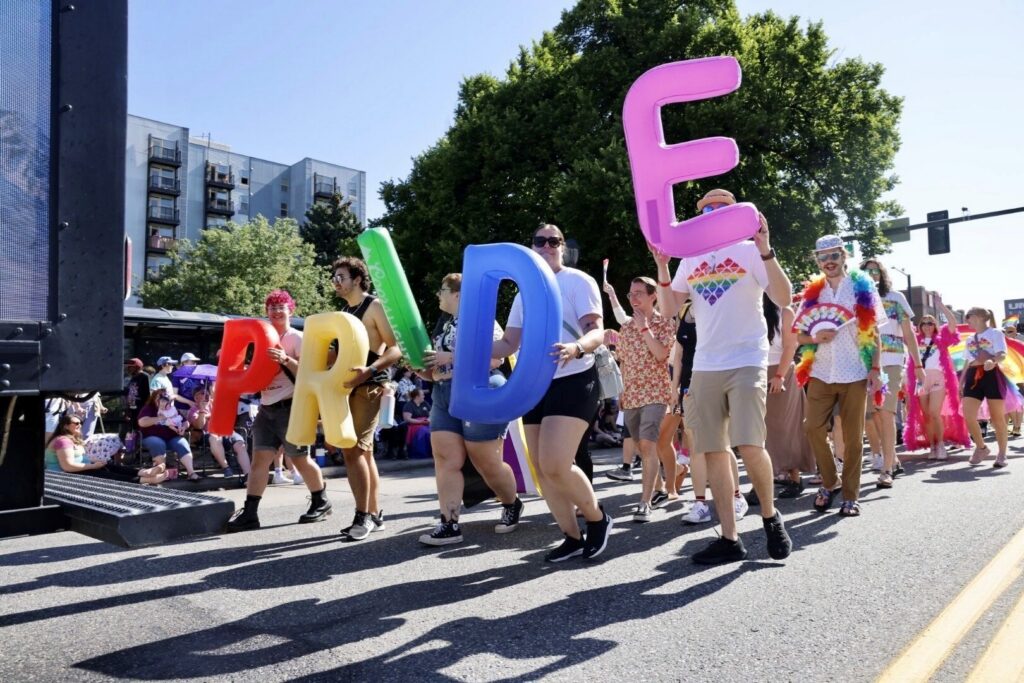
Colorado lawmakers have advanced a proposal that would allow people who underwent conversion therapy to sue licensed providers for damages, moving the measure forward on a party-line vote in the House Judiciary Committee. House Bill 1322, proposed by Democratic Reps....
Federal judge refuses to authorize immediate appeal in World Cup trafficking lawsuit
Michael Karlik
michael.karlik@coloradopolitics.com
Updated 5 days ago
A federal judge declined to authorize an immediate appeal last week of a prior decision allowing companies operating out of Colorado to be sued for allegedly participating in a human trafficking venture involving Filipino laborers who constructed facilities for the...
Federal judge considers second round of sanctions against ex-Colorado judicial discipline director
Michael Karlik
michael.karlik@coloradopolitics.com
Updated 5 days ago
A federal judge ordered Colorado’s former judicial discipline director on Tuesday to explain why she should not sanction him a second time for filing documents for improper purposes, such as harassment or delay. U.S. District Court Senior Judge Kathryn H....
PREV
PREVIOUS

Sand Creek memorial backers restart statue design process
A proposal to place a memorial at the Colorado state Capitol in honor of the 230 Cheyenne and Arapaho massacred at Sand Creek has been tossed out and the proponents have started over, seeking a new design. The original statue, a kneeling Native American woman in Cheyenne dress which was to be created by artist Harvey Pratt, […]

State Senate approves restricting facial recognition technology in Colorado
The Colorado Senate approved legislation Tuesday that seeks to restrict the use of facial recognition technology in the state’s government, law enforcement and schools. Senators passed Senate Bill 113 in a 27-7 vote, moving it to the state House of Representatives for consideration. If enacted, the bill would establish several limitations and regulations for the […]