

COVER STORY | Failure to train: The 7 minutes that cost Boulder $3.41 million
When four women and three men walked into a federal courtroom one Friday afternoon in October, they handed down one of the largest jury awards against the City of Boulder in its history: $3.41 million.
The circumstances in the case involving Boulder police were a bit unusual: There was no excessive force; no one lost a life in the encounter; and, notably, the officers present were not on trial.
Instead, the jury had been asked to connect the dots between Seth Garrett Franco’s 12 days in jail and the city itself. Did Boulder police officers violate Franco’s constitutional rights by arresting him without probable cause? Was this situation typical in Boulder? Was the police department’s training inadequate, and the city indifferent? And, finally, was the city’s inaction responsible for Franco’s unlawful arrest?
On each question, the jury said yes.
“We 100% believed the City of Boulder was liable,” Douglas Idlett, one of the jurors, told Colorado Politics this month.
The city already indicated it will appeal its loss to the U.S. Court of Appeals for the 10th Circuit. Franco’s attorneys have countered that if the city carries through on its promise, then they, too, will appeal the dismissal of Boulder’s officers from the lawsuit.
Franco’s case combined elements that have been a part of longstanding policy discussions about accountability and policing: qualified immunity, body-worn cameras, and, particularly, training for officers. On the one hand, it is a flag to municipalities that their training, or lack of it, may result in significant financial liability for something as mundane as a police contact with a person on probation. In Boulder’s case, there is the added cost of contesting claims through a trial and beyond.
And for plaintiffs, it is a reminder that people seeking to vindicate their rights against law enforcement will go up against not only a handful of officers and their attorneys, but the weight of an entire municipal government.
Indeed, Boulder returned to federal court earlier this month asking a judge to toss the verdict, with lawyers claiming there was no way under the law that the city could be held liable for failing to train its officers. Even if it could, they added, the jury’s $3.41 million award was the result of “passion” that could not stand.
The city’s legal maneuver does not sit well with some of the jurors who learned about the status of the case since the trial.
“I think it’s a smack in the face, and that’s why people feel so poorly about the justice system,” said juror Dixie Sunday, adding that what happened to Franco still bothers her.
The judge who oversaw the lawsuit since its filing in September 2019, U.S. Magistrate Judge Michael E. Hegarty, has conceded that the case will extend far beyond the weeklong trial.
“No matter which way I come down, it’s gonna get appealed,” he said at a Valentine’s Day hearing, “and three people on the circuit court will disagree with what I do.”
Wherever the appeal ends up, Franco, the original plaintiff, will not see a penny from the judgment. He died by suicide in March 2020, six months into the litigation. His brother, Sage B. Franco, has since taken his place.
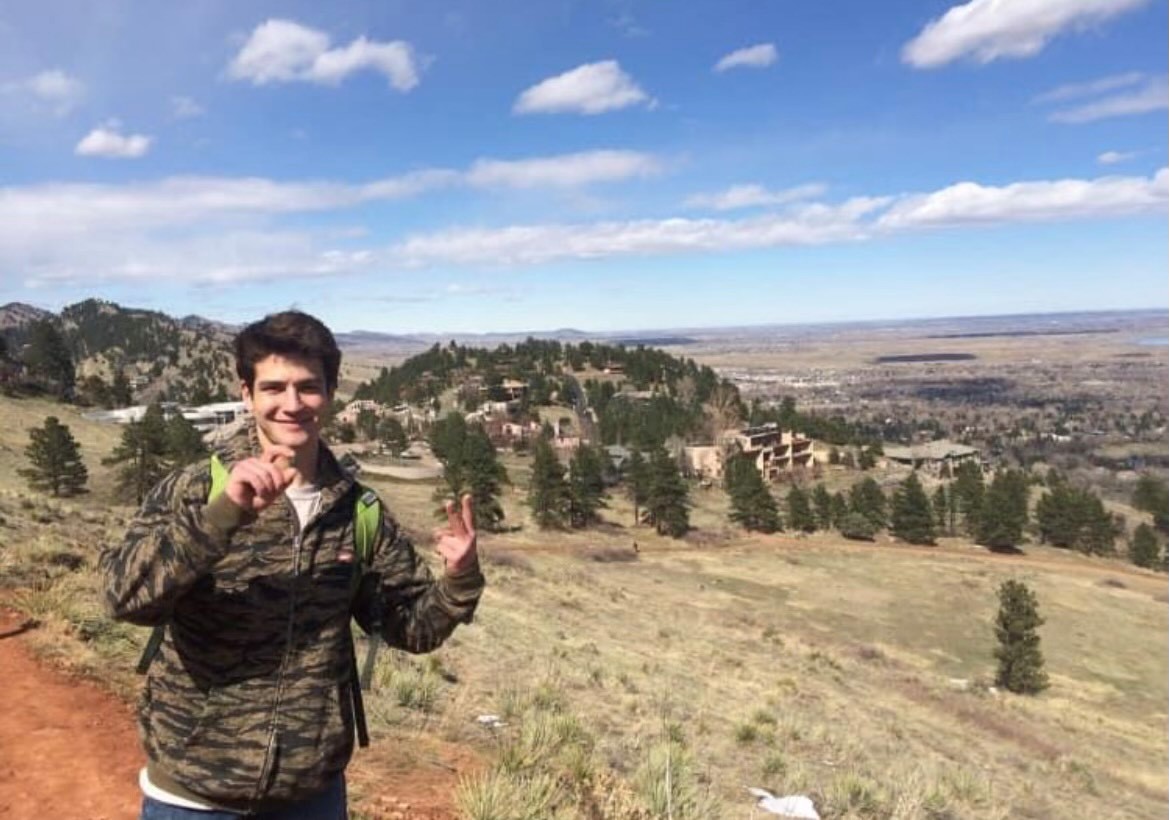
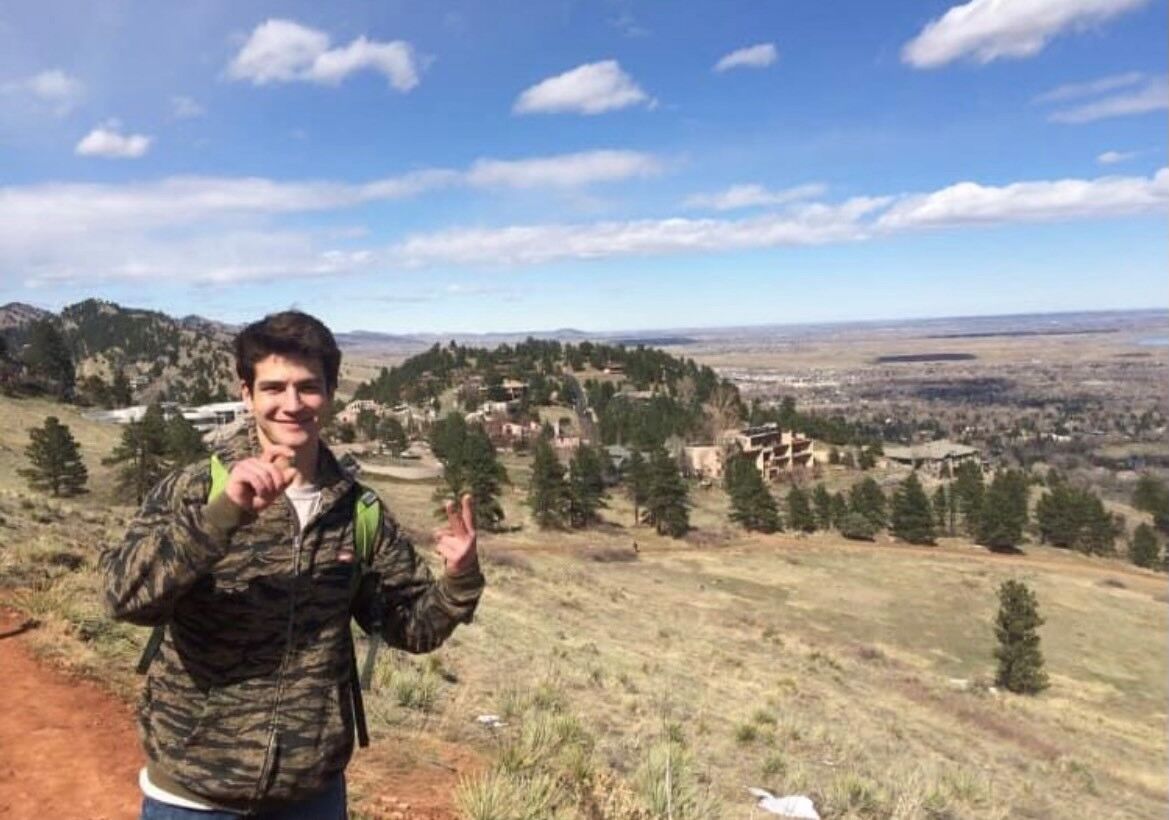
Seth Franco’s life was troubled well before his encounter with Boulder police. At age 16, he was the victim of an assault that put him in a coma. He began having seizures. After moving from Florida to Boulder a few years later, he fell on the Flatirons, again landing in the hospital.
“He got really depressed, like just didn’t want to leave his apartment,” his older sister, Jessica Cirino, testified about Franco’s health after the Flatirons fall. “He was having more seizures. Just really – just very different.”
“He functions like a 12-year-old, very impulsive, poor insight, lack of responsibility,” Franco’s public defender would later observe.
Nevertheless, Franco found a job – at the Boulder Dushanbe Teahouse on 13th Street – and a hobby: wire wrapping. Franco enjoyed working with his hands, and jewelry-making was therapeutic for him. Boulder police even found crystals on him when they arrested Franco. At trial, the jury passed around his custom jewelry.
“The guy was talented. He was a talented artist,” said Dan Corrales, another one of the jurors. “One of the lady jurors was very familiar with it (wire wrapping) and said, ‘You know, these can sell for as high as $1,000.'”
Things took a turn for the worse after Franco was charged in 2016 with assaulting a police officer. Without that encounter, the federal jury likely would not have heard the matter ultimately placed in its hands: Who was responsible for Boulder police arresting Franco in fall 2017 without evidence of a crime, when they were supposed to be checking on his welfare?
‘He’s gonna go to the hospital’
Seth Franco’s court appearance on Sept. 22, 2017, went well for him, even though he did not believe it. Franco received a sentence in Boulder County District Court to three years of probation for assaulting Officer Michael Marquez the prior year. Marquez had been trying to arrest Franco for an open container violation when Franco squeezed the officer’s testicle. Marquez hit Franco so hard he broke his hand, and bystander video captured the sound of Franco’s screams upon being tased.
Marquez, as the victim, had come to Franco’s court hearings. He was present on the day of sentencing, and wanted to see Franco go to prison.
“He would sit in the front, and he would glare,” testified public defender Jennifer Engelmann about Marquez. “It was such an upsetting, just like, like glaring daggers at Seth, at me, and it was like palpable. And it was enough that it made me feel extremely uncomfortable, and I don’t – I don’t get uncomfortable easily.”
Marquez would later testify that he looked at Franco “with intent.”
That night, Franco’s probation officer contacted dispatch. She asked for a welfare check on Franco, saying his girlfriend had reported Franco making suicide threats. Shortly after 9 p.m., police arrived at a mobile home park in North Boulder. Franco had left 10 to 15 minutes prior.
“He talked about how he feels like he really got screwed over and even though he’s got this three-year probation, the cop who pressed charges against him is gonna try to get him to violate (probation) so he goes to jail,” Franco’s girlfriend, Rowen Bautts, told police outside her home. “He’s tired of fighting. He’s just exhausted. He just said, ‘My soul is too tired to go on’ and it was time to meet his dad in heaven.”
“You represent what he really, really hates right now,” her father added to the officers present at the mobile home park.
The police learned that Franco had taken his prescriptions with him: muscle relaxers, epilepsy medication, depression medication, ibuprofen. Officers who took Bautts’ statement never asked about whether Franco had any weapons.
Marquez was also on duty that night. Around the same time, he walked up to a group of officers gathered in North Boulder. Because Marquez had been in court with Franco, he knew what the judge had attached as a condition of Franco’s probation: no alcohol.
“It’s critical about the drug aspect, or any alcohol. Like, if she says that, ‘Yeah, he was drunk or he took drugs’ – violation,'” Marquez told the officers. The city would later maintain that everything its officers did that night was in order to keep themselves, the public and Franco himself safe.
Just before 9:45 p.m., there was another call to police from the Dushanbe Teahouse, where an employee reported that Franco was there making suicidal comments.
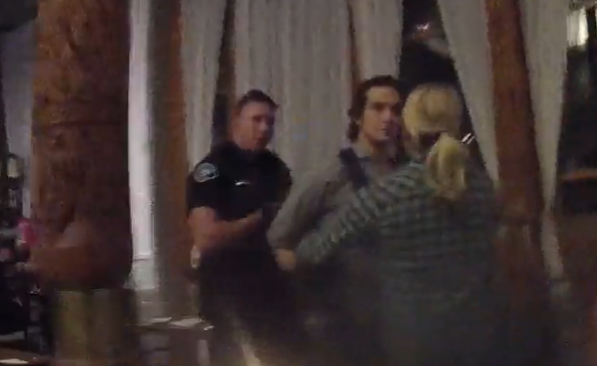
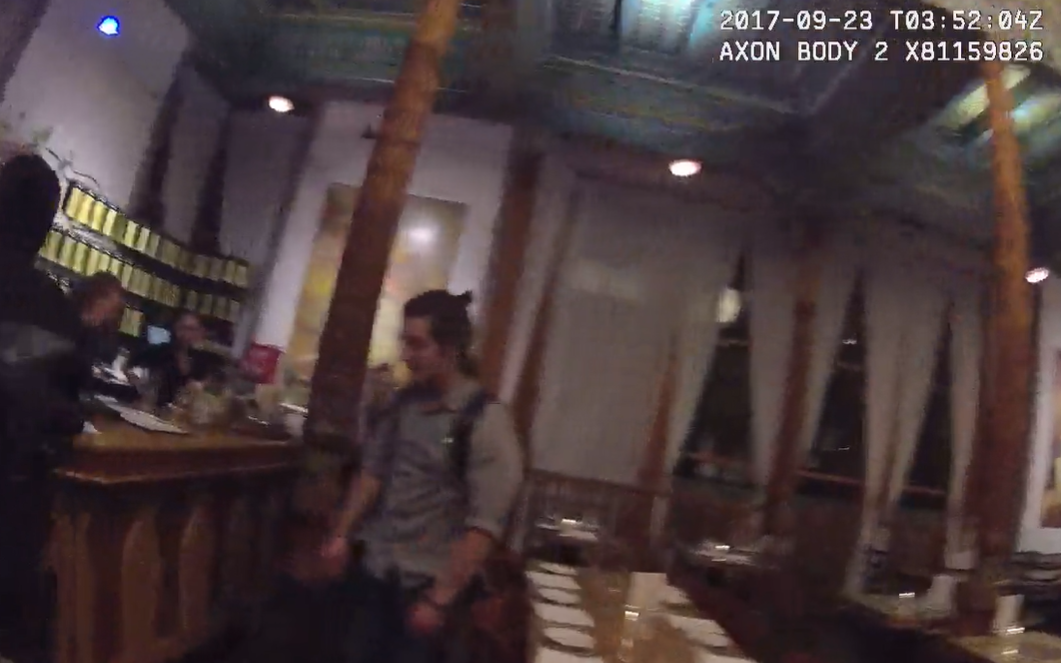
Officer Dillon Garretson, Detective Ashley Flynn and Sgt. Kristi Peterson were the first to walk into the teahouse’s dining room. Franco saw Garretson – Marquez’s partner who arrested Franco in 2016 – and slowly turned around. Within 10 seconds, Garretson had grabbed Franco and quickly placed him in handcuffs. Two more officers joined almost immediately.
“Do I need to get you an ambulance?” Flynn asked him.
“You guys have just hurt me so much. You’ve turn my soul apart. I don’t know what more you guys want from me,” Franco responded, beginning to cry. He did not resist, and appeared defeated and deflated.
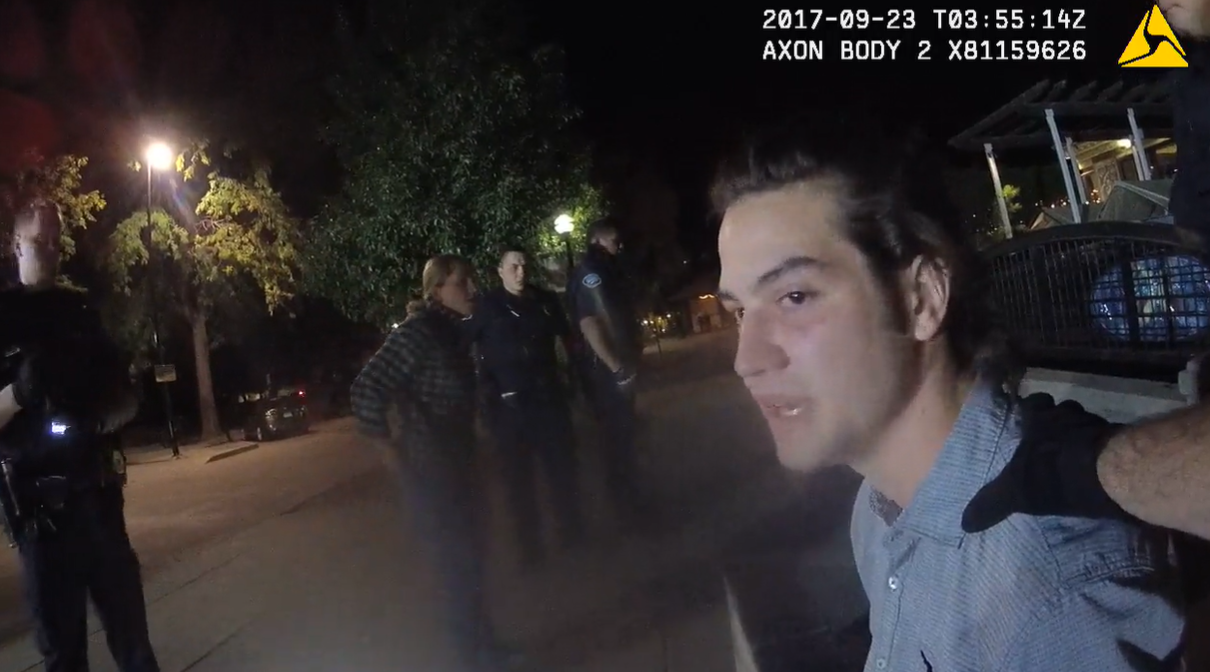
Police encountered Seth Garrett Franco at a restaurant in Boulder in September 2017. Franco sued the city of Boulder alleging their welfare check was an unlawful arrest based on a probation violation, which is not a crime. A jury later awarded Franco, who has since died, $3.41 million. The city is appealing the ruling.
Flynn asked how much alcohol Franco had drunk. “I can smell it on you,” she added. Officers cut off Franco’s backpack because with his handcuffs on, they could not remove it any other way.
“You guys have tased me,” Franco began to say.
“That was a long time ago,” Flynn interjected. She again accused Franco of lying to her about not taking drugs. The officers then marched Franco, handcuffed, out of the restaurant to waiting medical responders. On his way out, Garretson turned around to find a crying teahouse employee.
“I just wanna know if he’s gonna be OK,” the employee said through tears. “Where are you taking him?”
“He’s gonna go to the hospital because he’s taken all his prescription pills and obviously drank alcohol,” Garretson responded.
“He did?” she asked incredulously. “He didn’t drink anything here. We only gave him tea.”
“He’ll be going to one hospital or the other,” Garretson assured her.
The arrest
Police sat Franco down on a bench next to the road. At least six officers hung around. In all, 16 officers would respond that night to the welfare check on Franco – more than half of the personnel on duty.
“This is all Marquez’s fault,” Franco complained as he sat down. A fire truck pulled up and one firefighter approached. Franco began to explain his encounter with Marquez the year prior and briefly began to weep when talking about the nightmares he had from it.
“I don’t know why he’s out to get me. I don’t know why he hates me so bad,” Franco continued before the firefighter redirected him toward talking about his medications.
In the background, Garretson was searching Franco’s backpack. He found pill bottles and an unopened can of beer.
“Well, there goes his protection order,” Garretson said out loud, possibly believing that the judge had issued a criminal protection order with a no-alcohol condition to Franco. He also found a bag of psilocybin mushrooms.
Franco told the first responders he did not want to go to the hospital. He grudgingly agreed to walk to a waiting ambulance. He was reluctant to get inside, asking if he would be free to “walk out after it’s all done.”
“So, Seth, I’m gonna tell you: you do need to get up there,” Officer Stephen Coon told Franco.
“Against my will?”
“Yep,” Coon responded.
When Franco emerged from the ambulance several minutes later, Coon placed him directly into his patrol car. Marquez, who was purposefully hanging back from the encounter with Franco, was captured on body-worn camera footage giving a thumbs up. Coon subsequently drove Franco to the county jail, not to a medical facility.
“I didn’t pass directly by the hospital, but I could have made a turn to get to the hospital,” Coon later testified. The two charges listed for Franco on the arrest affidavit were possession of a controlled substance (the mushrooms) and violating probation.
Franco spent 12 days in jail. Boulder County prosecutors would dismiss the criminal case against him the following year, and a judge would find the search of Franco’s backpack to be unlawful.
On Sept. 16, 2019, Franco filed suit against Boulder, as well as Garretson, Flynn, Peterson and Coon. He claimed a violation of the Fourth Amendment, which prohibits arrests without probable cause of a crime.
“Rather than conducting a welfare check,” his attorneys wrote, “responding officers decided to arrest Mr. Franco, despite the fact that there was no information or evidence to suggest he had committed any crime.”
Hegarty, the judge in the case, dismissed Franco’s claims against the officers. He found they were entitled to qualified immunity because their actions had not amounted to a violation of Franco’s clearly-established rights. However, he declined to drop the claim against the city: namely, that it had failed to train its officers on proper arrest procedures.
In Colorado, violating the terms of one’s probation is not a crime. If Franco could prove that the officers were investigating him for a nonexistent crime instead of conducting a welfare check, “a jury might find that inadequate training resulted in his arrest,” Hegarty wrote.
A failure to train
Legally, an attempt to hold a local government liable for its officers’ actions is known as a “Monell” claim, named after the U.S. Supreme Court’s decision in Monell v. Department of Social Services of the City of New York. Municipalities have liability when a plaintiff establishes that a violation of his or her constitutional rights was rooted in an official policy or custom.
The court clarified in 1989 that a municipality’s failure to train its employees on how to avoid constitutional infringements is itself a policy if the lack of action reflects a deliberate or conscious choice. That is the heart of Franco’s claim – that untrained Boulder police believed they could arrest people for probation violations alone. And, in Franco’s case, they allegedly did.
Boulder’s attorneys argued there was no indication the city should have been on notice that wrongful arrests of probationers was a predictable or obvious consequence of the lack of training. They even suggested that rogue officers could have violated Franco’s rights even if they had been properly trained.
“If those officers were hellbent on finding something to arrest Mr. Franco for, they would have found it. It wouldn’t have mattered what kind of training or how much or anything like that,” explained attorney Michael Lowe during closing arguments.
Within the jurisdiction of the 10th Circuit, which is the federal appeals court covering Colorado and five neighboring states, a panel of three judges nearly two decades ago faced a similar case – whether Davis County, Utah, could face liability for failing to train jail officers on obsessive-compulsive disorder.

A police officer had arrested a man at a shopping mall after the man’s credit card was declined and a store clerk called for security. On the way to jail, and then again in jail, the man had a panic attack from his OCD. Booking officials also took away his OCD medication.
By a 2-1 decision in December 2002, the panel of judges saw sufficient facts to establish that Davis County was deliberately indifferent in failing to train booking officers to recognize OCD and handle people with the condition accordingly. As part of its decision, the panel noted that the condition is relatively common, affecting about 2% of the general population.
During Franco’s case, the jury learned that roughly 1,800 adults and 200 children are on probation annually in Boulder County. The vast majority struggle with technical violations of their probation, such as alcohol use.
Given that Boulder police serve a population of just over 100,000, having 2,000 probationers would mean the percentage of people affected by unconstitutional arrests could also reach 2%.
The trial
The five-day trial began on Monday, Oct. 18, 2021. The lawyers for plaintiff Sage Franco – Seth’s brother – quickly resorted to proving the heart of the case: Boulder officers had no idea they could not arrest probation violators.
“As a City of Boulder law enforcement officer, you believe you can arrest someone for a probation violation without an arrest warrant for the crime of failure to comply with probation?” attorney Gwyneth Whalen asked Flynn, the detective.
“Correct,” she responded.
At one point, Christian Griffin, another attorney for Franco, brought up the concept of a detainer. When a probation officer issues a detainer for a suspected probation violation, it allows law enforcement to arrest a person. However, the detainer process also ensures that the person arrested goes before a judge at the next possible time – something that did not happen for Seth Franco.
“When Seth Franco was surrounded, handcuffed, and searched, and walked outside, no officer had a detainer for him at the tea house, correct?” Griffin asked Peterson, the highest-ranking officer who responded to Franco’s welfare check.
“Had a detainer for him?” she responded.
“Yeah. Do you know what I mean?”
“I don’t,” she answered.
“You don’t even know what I mean by that word, do you?” Griffin said.
“I don’t know what that is to you,” Peterson replied.
One of the plaintiff’s witnesses was Katherine McEldowney, the recently-retired training commander for the Boulder Police Department. She acknowledged that, during a deposition, she could not point to any specific training Boulder had provided its officers about the circumstances under which they could arrest someone without a warrant for violating probation.
Calling into question the officers’ representation that Franco was drunk inside the teahouse, a coworker of Franco’s, trained to serve alcohol, indicated Franco exhibited no signs of drunkenness that night.
Sunday, one of the jurors, saw fairly early in the encounter that police had moved on from a welfare check to an arrest.
“The tape showed me that: ‘We’re getting him for something else. Let’s put on the backburner that he may have ingested (medications). We need to find whatever it is and get him into custody,'” she recalled.
Not everything went smoothly for Franco’s side. On the first day, over Boulder’s objection, the lawyers played the bystander video from 2016 of Franco being tased, screaming in pain and yelling, “I have seizures and you’re hitting my head! I have seizures and you’re beating me up!” Hegarty reminded the jury that Franco was not seeking damages for that incident.
But when the plaintiff’s lawyers played the same video without warning later in the trial, Hegarty immediately ordered the jury out of the room and upbraided the attorneys.
“You cannot play that video for purposes of inflaming the jury … and I believe that’s what you’re doing. So, unless you want me to react in a very negative way in front of this jury, I warned you ahead of time,” Hegarty chastised. “It’s akin to in a murder case continually flashing the dead body.”
The second-to-last day of the trial, after the jury had left for the day, the city made a motion under Rule 50, which would have allowed the case to end if the plaintiff had presented insufficient evidence to prove his or her claim under the law. Hegarty acknowledged that the initial handcuffing inside the teahouse was permissible under the police’s need to establish safety. But at some point, he believed the jury could find the stop had transformed into an arrest.
“He remains handcuffed for a perp walk through the Dushanbe Teahouse. He remains handcuffed outside at all times. There is no threat of him hurting himself or others surrounded by seven police officers with no possible weapon or drugs,” the judge observed. “Why hasn’t the continued deprivation of liberty been potentially excessive at that point?”
Griffin agreed, noting that seven minutes elapsed between officers initially handcuffing Franco and Garretson finding the illegal mushrooms in his backpack. Given that there was no threat from Franco, the only justification for keeping him restrained was because of a wrongful perception that he had committed a crime.
“The whole reason they did that to him, the reason they felt comfortable putting handcuffs on him right out of the gate and arresting him for this probation violation, is because Boulder never said to them, ‘You can’t do this,'” he said.
Hegarty ultimately agreed, denying the city’s motion and letting the jury deliberate the case. When he sent the jury off, he provided no technical direction for how to calculate the monetary award to Franco if jurors found Boulder liable for a training failure. He told them they may consider out-of-pocket losses, loss of liberty, lost sense of security or dignity, and mental anguish.
They also heard of the plaintiff’s requested amount of $2.1 million.
“Difficulty or uncertainty in determining the precise amount of any damages does not prevent you from deciding an amount. You must use your best judgment,” Hegarty added.
The city’s protest
On Feb. 14, the parties returned to Hegarty’s courtroom to again address the city’s Rule 50 request for a judgment in its favor. Alternatively, the city asked the magistrate judge to grant a new trial, or at least to reduce the jury’s dollar award.
Hegarty indicated his decision would come down to the question of how obvious the need for officer training on arrests was, given the likelihood that Boulder police will encounter people who are in technical violation of their probation.
“Where I agree with you,” he told the city, is “we heard no evidence of another encounter between police and a probation violator.”
Griffin, the attorney for Franco, quoted the 10th Circuit’s 2002 decision in the Utah lawsuit involving obsessive-compulsive disorder. The three factors that allowed a jury to decide that case were the insufficient procedures for handling the issue, the individual officers’ ignorance of what to do, and the frequency with which they encountered persons having OCD.
Hegarty believed the two cases were similar enough to draw parallels. If it is likely that an untrained officer handling a suspect with OCD might violate his or her constitutional rights, it stands to reason that the same is true of an officer handling a suspected probation violator.
Two days later, Hegarty issued his ruling. He defended his decision to send the case to the jury, he wrote, because there was an unquestionable need to train patrol officers on what to do when encountering people with probation violations.
“Boulder has given its police officers a badge, a gun, and authority to take the life or liberty of the persons police encounter,” he concluded, “so the need for a policy and to train under that policy here is sufficiently obvious, and the utter failure to train potentially deliberately indifferent, that it created a question of fact for the jury.”

Although he doubted that the verdict resulted from the jury’s “passion and prejudice,” Hegarty agreed the dollar amount was excessive. He would either reduce it to the $2.1 million that the plaintiff asked for or hold a new trial on damages alone. On Feb. 22, Franco’s attorneys accepted the reduction.
Going to the Supreme Court?
A spokesperson for Boulder confirmed to Colorado Politics that the police department is now taking action to prevent unlawful, probation-related arrests.
“The department’s legal and training teams are currently collaborating on the creation of a specialized training related to technical probation violations,” said Sarah Huntley, director of communication and engagement.
The city’s lawyers have continued to assert that it cannot be liable for “gaps” in training, and also that Boulder’s training was not to blame even if some officers “mistakenly believed” they could arrest someone for probation violations.
Idlett, one of the jurors, recalled that Franco’s jury concluded the Boulder officers were simply not equipped to handle the situation they were presented with on Sept. 22, 2017.
“One of the points they (the city) were trying to make was they went in and tried to arrest because he was a danger to himself, when the video showed he was not in that moment,” Idlett said. “I just felt like this was one person that has not exhibited violence except toward that one officer the summer prior. The whole thing just felt off.”
He described the way in which the jury arrived at the $3.41 million award to Franco – they all agreed to accept the outcome of each juror writing his or her desired amount, and used the average number.
Idlett disagreed with the city’s argument that passions were inflamed, but he acknowledged he considered Seth Franco’s death in choosing his number. (Franco died of suicide at age 27 in a halfway house, where he was serving a sentence not linked to the teahouse arrest.)
“The way that he spoke in the body cam footage, he seemed totally just broken,” Idlett said.
Corrales, another one of the jurors, remembered choosing the requested $2.1 million as his amount for damages, meaning other jurors must have selected significantly larger awards for the result to be $3.41 million. He now sees no issue with the judge using his authority to lower the amount of the verdict to what the plaintiff originally asked for. Like Idlett, Corrales believed the police’s response to Franco was excessive, and the officers appeared to have determined that Franco would go to jail, no matter how the welfare check went.
“I was hung up on the fact that they did what they were supposed to. And that was the whole issue,” he said. “They weren’t properly trained.”
After jury deliberations, Hegarty came to speak with the jurors. The judge reportedly mentioned the case could drag on through appeals, and there was a “slight possibility” it could end up before the Supreme Court.
During the Feb. 14 hearing, Hegarty told the parties that Boulder’s attempt to overturn the verdict would depend on him, but also on the three judges at the 10th Circuit who would look at any appeal. He referenced his prior decision to grant qualified immunity to the officers, and mused that the 10th Circuit might review and find that it is a clear constitutional violation, after all, to arrest someone solely for a probation issue.
“So, maybe it’s a case that needs to be appealed,” he added.


10th Circuit rules cognitively impaired man’s risk of lobotomy, mistreatment in Mexico not ‘torture’
Michael Karlik
michael.karlik@coloradopolitics.com
Updated 6 hours ago
The Denver-based federal appeals court concluded last month that a man’s risk of mistreatment or forced lobotomy in his native Mexico did not amount to “torture” that should shield him from deportation. A three-judge panel of the U.S. Court of...
Colorado justices side with news organizations for disclosure of high-level child abuse data
Michael Karlik
michael.karlik@coloradopolitics.com
Updated 10 hours ago
The Colorado Supreme Court ruled on Monday that the state must disclose the number of child abuse reports at individual group living facilities in response to an open records request, as the addresses are already in the public domain. The...
Divided Colorado Supreme Court finds Denver detective did not violate defendant’s Miranda rights
Michael Karlik
michael.karlik@coloradopolitics.com
Updated 6 hours ago
The Colorado Supreme Court determined on Monday that a Denver detective did not improperly resume questioning of a defendant in custody after he invoked his right to counsel. By 4-3, the justices reversed a trial judge’s order that found a...

Out-of-state judges address ex-discipline director’s lawsuit, Colorado justices accept federal invitation | COURT CRAWL
Michael Karlik
michael.karlik@coloradopolitics.com
Updated 18 hours ago
Welcome to Court Crawl, Colorado Politics’ roundup of news from the third branch of government. A pair of out-of-state judges got down to business in a lawsuit brought by Colorado’s former judicial discipline director, plus the state Supreme Court has...
Federal judge upholds constitutionality of Colorado campaign contribution limits
Michael Karlik
michael.karlik@coloradopolitics.com
Updated 3 days ago
A federal judge upheld Colorado’s individual campaign contribution limits as constitutional on Thursday, finding that three Republican plaintiffs failed to prove the campaign finance framework violates their First Amendment rights. U.S. District Court Senior Judge John L. Kane recognized that...

Appeals court rejects theory that existing tax revenue undermines need for new fees
Michael Karlik
michael.karlik@coloradopolitics.com
Updated 3 days ago
Colorado’s second-highest court rejected a plaintiff’s claim on Thursday that the tax revenue generated by an existing activity should prevent local governments from imposing new fees aimed at regulating the activity. The question stemmed from Colorado’s unique constraints on taxation...
Appeals court finds no illegal sentence when defendants forfeit time-served credit
Michael Karlik
michael.karlik@coloradopolitics.com
Updated 2 days ago
Colorado’s second-highest court ruled on Thursday that criminal defendants may agree to relinquish the credits they earned while incarcerated pending trial, despite a state law guaranteeing that such time “shall be deducted” from a person’s sentence. Kerry Ellis Endsley pleaded...
Appeals court reinstates Garfield County arson charge
Michael Karlik
michael.karlik@coloradopolitics.com
Updated 2 days ago
Colorado’s second-highest court reinstated a Garfield County defendant’s arson charge on Thursday, concluding a trial judge improperly credited a witness’s claim that she alone was responsible for starting the fire. A sheriff’s deputy responded to a brush fire near Parachute...
Federal judges rebuke ex-Colorado judicial discipline director for conduct in lawsuit
Michael Karlik
michael.karlik@coloradopolitics.com
Updated 4 days ago
A pair of federal judges expressed a desire on Thursday to break the logjam on a lawsuit by Colorado’s former judicial discipline director against the state Supreme Court and related entities, while simultaneously showing little tolerance for the plaintiff’s scorched-earth...

Democratic bill would let recipients of ‘conversion therapy’ sue Colorado providers with no statute of limitations
Marissa Ventrelli
marissa.ventrelli@coloradopolitics.com
Updated 4 days ago
Colorado lawmakers have advanced a proposal that would allow people who underwent conversion therapy to sue licensed providers for damages, moving the measure forward on a party-line vote in the House Judiciary Committee. House Bill 1322, proposed by Democratic Reps....
PREV
PREVIOUS

Election forecaster nudges Colorado's US Senate seat from 'solid' to 'likely' Democrat
While the election forecasters at Cook Political Report aren’t yet ready to say Colorado’s U.S. Senate race will be competitive this fall, they bumped the contest one notch in that direction on Friday, suggesting that a a more difficult national environment for Democrats could put U.S. Sen. Michael Bennet’s bid for a third term in […]

Capitol M: Departing Senate President edition | Week of Feb. 26, 2022
The lighter side of the state Capitol, usually. The state Senate was a wistful place on Tuesday, when Senate President Leroy Garcia banged the gavel for the last time, as he departs for a job with the Biden administration. (Please don’t ask me to repeat the unbelievably LONG job title again.) After senators unanimously elected […]