

A LOOK BACK | State ag dustup explodes, wheat leader resigns

Sixty Years Ago This Week: State Agriculture Commissioner Paul Swisher’s criticism of Tim Thornton, director of the Colorado Wheat Administrative Committee, led to Thornton’s resignation.
This followed the CWAC’s 4-4 tie vote on the committee’s movement of no confidence in his leadership.
Pushing back, state Rep. Forest Burns, D-Lamar, commented on the vote.
“It’s too bad the Commission on Agriculture didn’t accept Paul Swisher’s resignation when he wrote it out a couple of years ago,” said Burns, a member of the House Agriculture Committee.
Swisher had spearheaded the push for Thornton’s resignation, armed with a poll taken from 21 of 270 elevator operators who were unhappy when Thornton had criticized wheat being shipped internationally.
“The poll took no account of what the individual operators said,” Burns said. “Swisher told me Friday all copies of the report had been destroyed … He didn’t leave a copy with the committee. Now nobody is responsible to anybody for what has been done.”
Burns told The Democrat the State Board of Agriculture and the governor’s office were duty bound to look into the matter.
“I don’t see why Swisher had to go to the elevator operators. Operation of the Wheat Administrative Committee is the wheat farmers’ business. The producer pays for it all the way,” he added.
Thornton told The Democrat that he resigned to “put a stop to letting a handful of people prevent every move made to benefit the wheat producer.”
In the following days, Thornton said that he would submit a report to the Colorado Wheat Administrative Committee and to the federal secretary of agriculture.
“Cooperation from the majority of members has been wonderful,” Thornton said. “Opposition has come from only a handful, who fear some of the programs might put into jeopardy storage of federal grain.”
Thirty-Five Years Ago: Though he had a fully up-and-running reelection campaign in place, Republican State Chairman Bo Callaway told The Colorado Statesman that he wouldn’t be seeking reelection and would instead lead GOPAC, a political action committee designed to elect Republicans to the U.S. House.
U.S. Rep. Newt Gingrich, R-Ga., was the chairman of the organization and had raised more than $4 million the year previous.
Callaway said the offer was one he couldn’t refuse.
“GOPAC has the potential to do in all fifty states what we have done so successfully here in Colorado,” Callaway said. “GOPAC has a mission to build the systems and organizations to insure Republican control of the U.S. House of Representatives by 1992. I really think this can be done.”
But a Denver Post story by Carl Miller hinted that Callaway had bowed out, not because of the new job, but because he was facing a tough challenge from Bruce Benson and was at an increasingly likely risk of losing.
Callaway rejected the notion.
“There’s no truth that Bruce’s strength had anything to do with my decision. Everyone was dismayed that I’d abandoned the race… The story that should have been written is this: I have the opportunity to do something real important politically. This is really exciting. This is a big deal.”
“Carl [the reporter] hangs around the legislature,” Callaway said. “He naturally picks things up from the lawmakers. I’m the first to concede that my strength among legislators has never been strong and many of them were supporting Benson in the race.”
Callaway said he’d already received congratulatory calls from former President Gerald Ford, whose presidential campaign he’d managed in 1976, and Frank Fahrenkrog, chairman of the Republican National Committee.
Rachael Wright is the author of the Captain Savva Mystery series, with degrees in Political Science and History from Colorado Mesa University, and is a contributing writer to Colorado Politics and The Gazette.


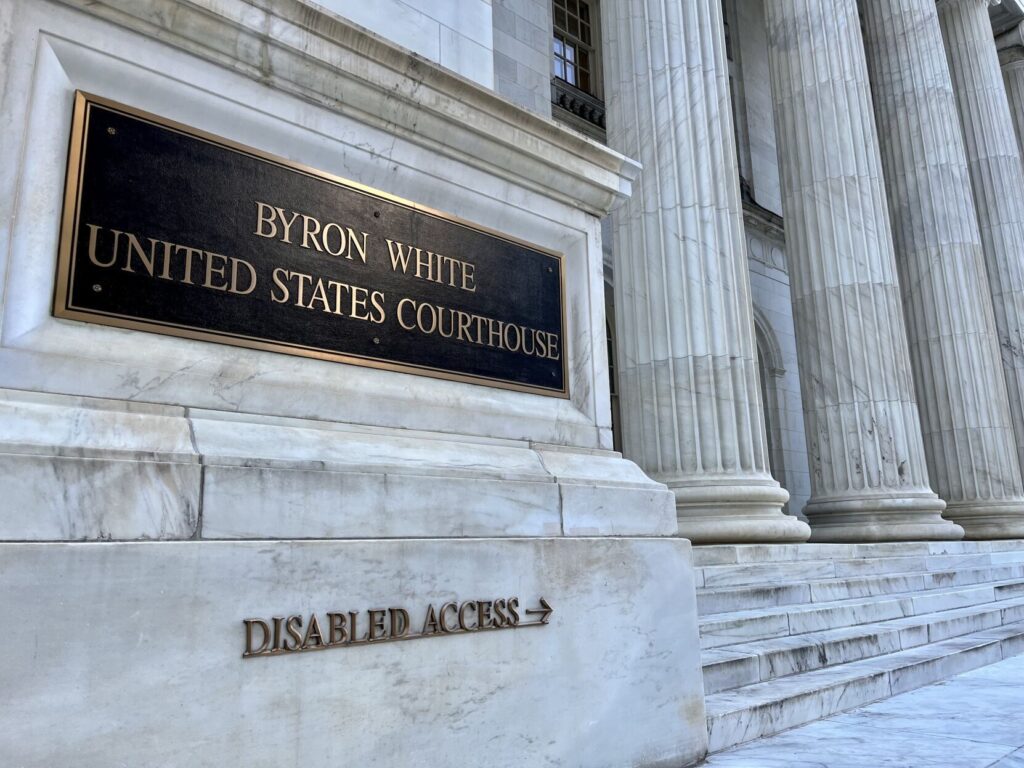
Elizabeth School District dismisses challenge to book-ban injunction on eve of appellate arguments
Michael Karlik
michael.karlik@coloradopolitics.com
Updated 3 hours ago
An Elbert County school district has dismissed its challenge to a judge’s injunction ordering it to return banned books to library shelves, days before the Denver-based federal appeals court was set to hear oral arguments this week. Although a three-judge...

Colorado farmers warn U.S. Sen. John Hickenlooper tariffs and research cuts endanger agriculture
Marianne Goodland
marianne.goodland@coloradopolitics.com
Updated 4 hours ago
Northern Colorado farmers told U.S. Sen. John Hickenlooper this week that tariffs and President Donald Trump’s decision to import $40 billion worth of beef from Argentina have hurt Colorado’s agricultural industry. But the administration’s cuts to scientific research are almost...

‘Doesn’t do enough’: House Democrats reject GOP deal on cutting ICE funding
Rachel Schilke, Washington Examiner
rachel.schilke.washington.examiner@gazetteedit.wpenginepowered.com
Updated 4 hours ago
House Democratic leaders are planning to oppose a bipartisan homeland security funding bill set for a vote this week, even after Republicans agreed to cut funding for Immigration and Customs Enforcement. A source familiar with House Minority Leader Hakeem Jeffries’s...

Vance heading to Minneapolis amid Trump’s ICE crackdown
Christian Datoc, Washington Examiner
christian.datoc.washington.examiner@gazetteedit.wpenginepowered.com
Updated 8 hours ago
Vice President JD Vance will deliver remarks and visit with ICE agents in Minneapolis Thursday, as President Donald Trump continues his immigration crackdown in the state. The vice president has been a critical messenger for the administration combating public opposition...

Gov. Polis, Democratic lawmakers introduce trio of housing affordability bills
Marissa Ventrelli
marissa.ventrelli@coloradopolitics.com
Updated 4 hours ago
Democratic lawmakers were joined by housing advocates and Gov. Jared Polis at the Capitol on Wednesday to announce a trio of bills they say will increase affordable housing in Colorado. “This session, Colorado Democrats are focused on lowering costs, and...

Colorado Supreme Court to hear cases on insurance coverage for COVID, witness credibility
Michael Karlik
michael.karlik@coloradopolitics.com
Updated 4 hours ago
The Colorado Supreme Court announced on Tuesday that it will decide the degree to which a virus or other hazard must affect a commercial property before it can trigger loss-or-damage coverage under an insurance policy. At least three of the...

Colorado halts wolf releases for 2026 as federal pressure mounts
Marianne Goodland
marianne.goodland@coloradopolitics.com
Updated 6 hours ago
Colorado Parks and Wildlife, facing mounting criticism from the Trump administration over its management of the wolf reintroduction program, announced Wednesday they will not bring in any new wolves to the state for the 2026 winter season. CPW was turned...

Colorado wildlife officials report first wolf death of 2026 as mortality count reaches 13
Marianne Goodland
marianne.goodland@coloradopolitics.com
Updated 6 hours ago
Colorado Parks and Wildlife announced late Monday that another British Columbia female gray wolf, known as 2504-BC, was found dead in northwest Colorado on Friday. No cause of death nor an exact location of where the wolf was found was...

Trump’s threats challenge Europe’s security and prosperity, EU chief says ahead of summit
Lorne Cook
lorne.cook@associatedpress.com
Updated 13 hours ago
BRUSSELS (AP) — U.S. President Donald Trump’s threats to annex Greenland and impose tariffs on its backers pose a challenge to Europe’s security, principles and prosperity, European Council President António Costa said on Wednesday. “All these three dimensions are being...
Federal judge says prisoner cannot sue for dog-bite injury
Michael Karlik
michael.karlik@coloradopolitics.com
Updated 14 hours ago
A federal judge concluded last week that a man cannot sue the government for injuries he sustained when a dog allegedly attacked him while he participated in a prison program. Kenneth M. Chandler, representing himself, was participating in the “FIDOS”...
PREV
PREVIOUS

Marshall Fire shows gaps in emergency alert systems
As the Marshall Fire roared into heavily populated areas of Boulder County, some residents report, the only way they knew things were getting dangerous was by watching people run out of nearby Target and Costco stores into hazy parking lots. At ground zero on Dec. 30, where Boulder Sheriff’s Office says the fire originated, some […]

'Lies, lies and damn lies': Boebert's GOP challenger swings back at ads alleging hemp scheme
The gloves came off quickly in the Republican primary for the Colorado congressional seat held by U.S. Rep. Lauren Boebert. Boebert’s campaign announced on Thursday that it was launching a barrage of attack ads aimed at state Sen. Don Coram, the Montrose Republican who made it official last week that he’s challenging the incumbent. The […]