

OUT WEST ROUNDUP | Yellowstone halts winter vehicle study; Noem wants to block critical race theory
MONTANA
Yellowstone opens roads to oversnow travel
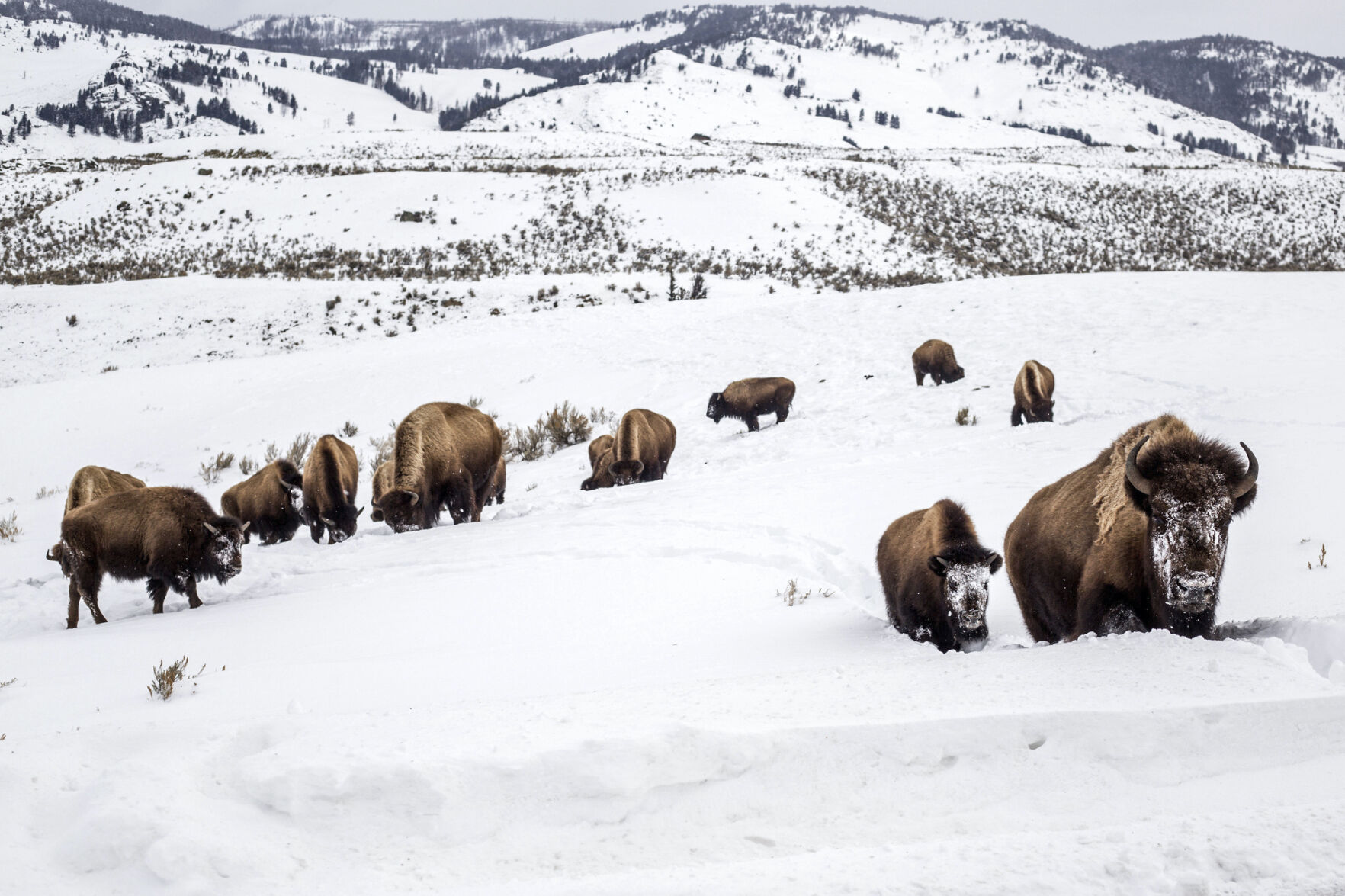
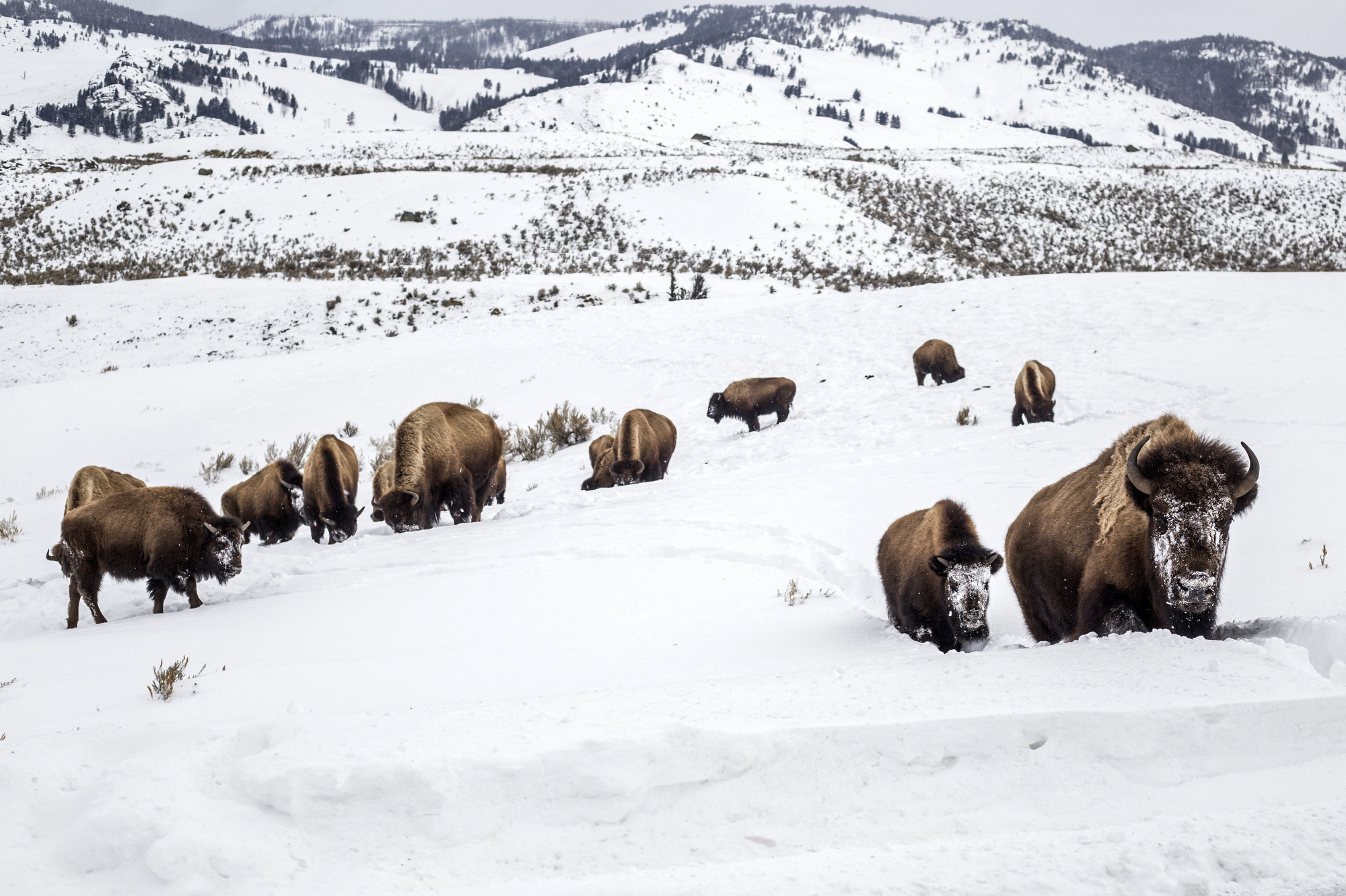
BILLINGS – Yellowstone National Park opened its roads to oversnow vehicles for the winter season on Dec. 15 and has suspended a wildlife monitoring program that found snowmobiles and other such machines were having minimal effects on animals.
The monitoring program for wildlife along road corridors used by snowmobiles and larger, multi-passenger snow coaches began after Yellowstone adopted a plan in 2013 that restricted the number of winter vehicles allowed in the park.
The plan followed years of legal disputes and temporary restrictions on the types and number of vehicles allowed, fueled by concerns that too many snowmobiles were harming air quality and disrupting the park’s bison and other wildlife.
Wildlife workers observed more than 1,100 groups of animals over seven years with the restrictions in place. They found that 95% of bison and 81% of trumpeter swans had either no response to nearby oversnow vehicles, or the animals would look up and then resume what they had been doing.
The park also evaluated air quality and found that pollution levels dropped significantly after cleaner-burning snowmobiles were introduced in 2003.
While the monitoring program is suspended, rules governing winter vehicle use in the park remain unchanged.
Snowmobiles first appeared in Yellowstone in 1963, according to the park. They became increasingly popular in the following decades as a way to access remote areas.
Under the rules put in place in 2013, the park requires winter visitors to travel in groups and allows up to 110 groups daily.
Guided snowcoach and snowmobile tours and up to four non-guided snowmobile groups daily are allowed, beginning typically in mid-December and continuing through mid-March.
Company seeks to restore oil lease on land sacred to tribes
BILLINGS – Attorneys for a Louisiana oil and gas company have asked a federal judge to reinstate a drilling lease it held on land considered sacred to Native American tribes in the U.S. and Canada.
The long-disputed energy lease in the Badger-Two Medicine area of northwestern Montana near the Blackfeet Reservation was cancelled in 2016 under then-U.S. Interior Secretary Sally Jewell. That decision was upheld by a federal appeals court in 2020.
Now Solenex LLC – the company that held the lease – is making another run at getting a court to restore its drilling rights. In court documents filed on Dec. 23 in a lawsuit against the Interior Department, its attorneys argued that Jewell exceeded her authority and the lease should be reinstated.
Solenex founder Sidney Longwell, who died last year, bought the 10-square-mile lease in 1982 but never drilled on the site. Instead, Longwell confronted major bureaucratic delays within the U.S. departments of Interior and Agriculture that prompted the company to sue in 2013.
The Badger-Two-Medicine area near Glacier National Park is the site of the creation story of the Blackfoot tribes of southern Canada and Montana’s Blackfeet Nation. There have been efforts to declare it a national monument or make it a cultural heritage area, and tribal leaders have bitterly opposed Solenex’s drilling aspirations.
The Blackfeet have intervened in the case on the side of the government. Blackfeet Nation historic preservation officer John Murray said tribal officials were confident in the case against drilling.
Solenex attorneys said the government unlawfully “outsourced” its decisions by deferring to the tribe’s wishes to block drilling.
Solenex’s lawsuit is being waged by the Mountain States Legal Foundation, a Colorado-based firm that pursues cases involving property rights, guns and other conservative causes.
An Interior Department spokesperson declined to comment on the case.
SOUTH DAKOTA
Governor pens bill to block race theory in schools, colleges
SIOUX FALLS – Republican Gov. Kristi Noem has drafted a bill that would block teaching critical race theory in South Dakota schools, public universities and technical colleges.
Noem announced the legislation on Dec. 20, the Sioux Falls Argus Leader reported.
Critical race theory is an academic concept that originated in the 1970s. It focuses on how racism is embedded in legal systems in the United States.
South Dakota education officials say critical race theory isn’t part of state curriculum in schools or colleges. But Noem said the theory teaches a false and divisive message.
Her bill would prohibit teaching that any race, religion, sex or ethnicity is inherently superior or inferior; that anyone should feel guilt, anguish or distress because of their race, religion, sex or ethnicity; or that people are inherently responsible for past actions because of their race, sex, religion or ethnicity.
The ACLU of South Dakota said it opposes the bill, saying it could censor U.S. history discussions and local school districts should decide their own curriculums.
North Dakota has blocked critical race theory teachings.
NEW MEXICO
Suspect arrested in Arizona bear killing with bow and arrow
ALBUQUERQUE – A suspect has been arrested in the shooting of a bear with a bow and arrow near Taos in October.
The Albuquerque Journal reported on Dec. 24 a man was charged in Taos Magistrate Court with unlawful killing of big game by shooting from the road and failing to tag the bear, both misdemeanors.
The New Mexico Department of Game and Fish said earlier that it was investigating the Oct. 29 incident in Arroyo Seco.
Bears are a protected species in New Mexico, but bear hunting was allowed in that area at the time of killing, officials said previously.
But the newspaper reported that court documents state a Taos area man shot the bear in a tree with a bow and arrow, then shot it a second time after a bystander told him to “shoot it again” so it wouldn’t suffer.
The man then “left the area where the bear was killed and made no attempt to retrieve the bear,” authorities allege.
The next day the Taos Volunteer Fire Department removed the bear from the tree with a ladder truck.
OKLAHOMA
Sixth-grader praised for heroism twice in one day
MUSKOGEE – An Oklahoma sixth-grader was honored by law enforcement and school officials for his heroic actions not just once, but twice in the same day.
Earlier in December, Davyon Johnson used the Heimlich maneuver on a classmate who was choking on a bottle cap at his school in Muskogee. Later that same day, he helped a woman escape from a burning house, the Muskogee Phoenix reported.
Davyon was named an honorary member of the police and sheriff’s departments at the Muskogee Board of Education meeting, the newspaper reported.
Principal Latricia Dawkins called Davyon a “dual hero” and a “kind soul,” adding that the recognition couldn’t have happened to a better person.
Dawkins recalled the incident that earned Davyon the honor. She said a student was trying to fill his water bottle and loosen the cap with his mouth. The cap slipped into his throat, she said.
“Davyon immediately sprinted over and did the Heimlich maneuver,” Dawkins said. “From the account of the witnesses, when he did it the bottle cap popped out.”
Davyon demonstrated how he got behind the choking student, wrapped his arms around the student and “burped him, kind of.”
Davyon helped a woman evacuate her burning house later that day.
He said he learned to do the Heimlich maneuver on YouTube and said it is a valuable procedure to learn.
Davyon’s mother, LaToya Johnson, said she’s a “proud mom” and wasn’t surprised her son behaved the way he did. She said her brother, Wendell Johnson, is an emergency medical technician.

Grand Canyon flooding threatens economy that’s still recovering from a fire | OUT WEST ROUNDUP
Ernest Luning
ernest.luning@coloradopolitics.com
Updated 3 days ago
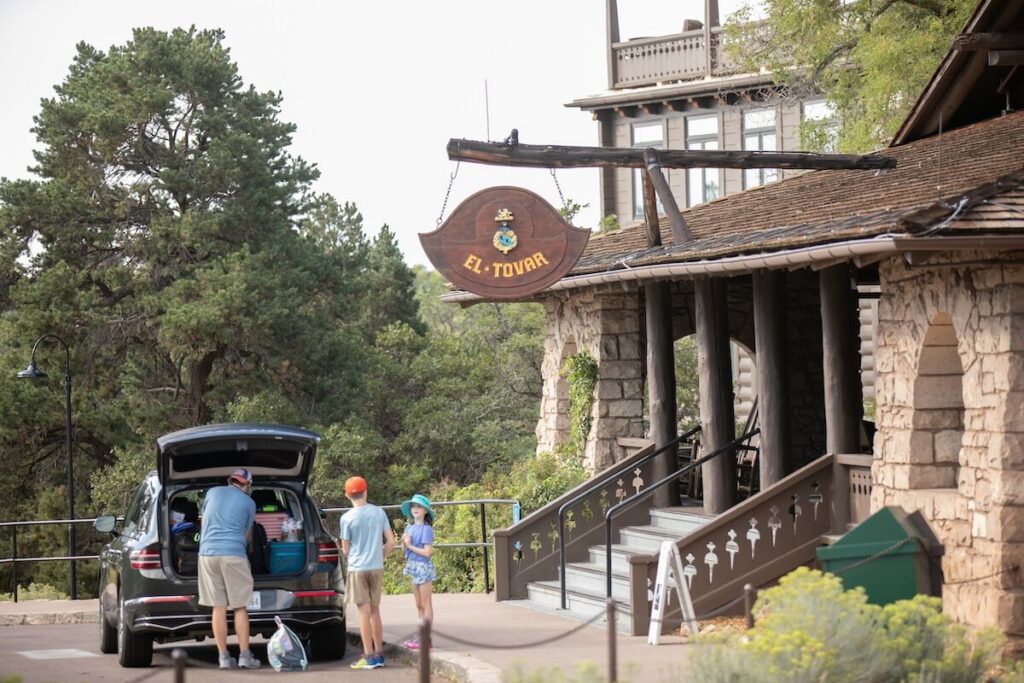
ARIZONA Flooding slams park’s economy Deadly flooding at the Grand Canyon is damaging the area’s economy, with a washed-out pipeline severing the South Rim’s water supply and shutting down lodging at the popular tourist vista for an indefinite period. The...

Immigration reporting measure fuels debate over Colorado’s role with ICE
Marissa Ventrelli
marissa.ventrelli@coloradopolitics.com
Updated 9 hours ago
A coalition of advocacy groups and several district attorneys rallied outside the Colorado Capitol on Thursday to oppose a ballot measure that, if approved by voters in November, would require state and local law enforcement to cooperate with federal immigration...
Colorado Politics Calendar Sept. 14-20
Rachael Wright, Special to Colorado Politics
rachael.wright@coloradopolitics.com
Updated 4 days ago
CoPo’s weekly political calendar will help you find political and public-policy events throughout Colorado. It includes candidate and issue campaign events, public policy meetings, court hearings, state and local party conventions, assemblies, debates, rallies, parades, speaking engagements, traveling dignitary appearances,...
The African roots of three Colorado leaders | SONDERMANN
Eric Sondermann
eric-sondermann@coloradopolitics.com
Updated 3 days ago
Colorado’s political transformation is measured in many ways. A once reliably red state (with asterisks) became purple and is now a rather deep blue. For better or worse, probably the latter, power is ever more consolidated along the Front Range...
Federal judge green-lights civil trial against ex-Fort Collins DUI officer
Michael Karlik
michael.karlik@coloradopolitics.com
Updated 2 days ago
A federal judge ruled on Thursday that Fort Collins’ former “DUI officer” will face a civil trial for allegedly investigating a motorist for impaired driving without any reasonable suspicion to do so. In recent years, several people arrested by Officer...

Denver police reopen 13 sex assault cases after retesting Missy Woods’ CBI work
Jenny Deam
jenny.deam@gazette.com
Updated 9 hours ago
Thirteen previously closed Denver sexual assault cases have been reopened after the city’s crime lab retested DNA evidence once analyzed by former Colorado Bureau of Investigation forensic analyst Yvonne Woods. A police spokesperson told The Denver Gazette the once-closed cases...

Ballot measure aims to shift Colorado sporting goods tax revenue to land, water and wildfire projects
Marissa Ventrelli
marissa.ventrelli@coloradopolitics.com
Updated 1 day ago
Colorado voters this November will decide whether to direct a share of sales tax revenue from sporting goods — including bicycles and skiing equipment — toward land and water conservation, wildfire prevention and expanding outdoor recreation. Supporters say the measure...

Colorado Supreme Court suspends Mesa County judge pending misconduct investigation
Michael Karlik
michael.karlik@coloradopolitics.com
Updated 1 day ago
The Colorado Supreme Court suspended Mesa County Court Judge Michael J. Grattan on Thursday amid a misconduct investigation. The court’s Sept. 10 order gave Grattan 21 days to explain why his paid suspension should not continue through the end of...

Trump honors the fallen of the 9/11 terrorist attacks during Pentagon speech
Mabinty Quarshie
mabinty-quarshie@coloradopolitics.com
Updated 2 days ago
President Donald Trump and first lady Melania Trump honored the roughly 3,000 Americans killed during the Sept. 11, 2001, terrorist attacks during a ceremony at the Pentagon. The event marking the 25th anniversary of the deadliest attack on American soil...
Colorado Supreme Court changes course, dismisses case about special district bonds
Michael Karlik
michael.karlik@coloradopolitics.com
Updated 1 day ago
The Colorado Supreme Court declined on Friday to decide a dispute between a large-scale Commerce City development and the various districts financing it, after initially showing interest in the ongoing case. Colorado has roughly 2,800 special districts, which are local...
PREV
PREVIOUS

SONDERMANN | It’s a tradition: Eight more exemplars
Eric Sondermann “Tradition, tradition.” No one sings it like Tevye in the classic musical, “Fiddler on the Roof.” In that spirit, though lacking even a remote bit of that vocal talent, let me denote this annual calendar reset by recognizing eight more Coloradans who are making a difference through their endeavors and their values. Two […]
Year in review: The year COVID didn't end
It’s strange to think back to 12 months ago. Vaccines had started to trickle in. The fever of the November 2020 surge had broken. Not many people were saying it out loud yet, but the long-rumored light at the end of the tunnel looked like it might just be getting closer. In the early days […]