

Denver considers massage business licenses to address illicit massage parlors

In an attempt to address illicit massage parlors in Denver, the City Council is considering requiring licenses for massage businesses. The council’s safety committee approved the proposal Wednesday, moving it to the full council.
Illicit massage businesses are businesses that provide sexual services while disguised as legitimate massage parlors. Senior Deputy District Attorney Lara Mullin said these businesses are often staffed by sex trafficking victims who were brought the U.S. under promises of different work.
“We’ve encountered workers inside of these businesses who are being forced or coerced to provide sexual services,” Mullin said. “We’ve also seen buyers who are going to these businesses to get a massage and are then provided sexual services and report it as a sexual assault.”
Mullin said sex traffickers hide behind illicit massage businesses and loopholes to exploit the workers. The workers are often foreign-born women who are forced to work illegal hours and often live inside the businesses in substandard conditions with building, fire code and public health violations.
This is a common practice in Denver and around the country, according to the district attorney’s office. In the U.S., there are an estimated 9,000 illicit massage businesses that generate approximately $2.5 billion in annual revenue.
“The current tools that we have in place are simply inadequate to hold accountable those who are exploiting the workers inside of these businesses,” Mullin said.
Arrested sex workers in Denver may be done with sexually transmitted infection tests
If the proposal is approved, massage businesses would need to apply for specific business licenses. The applications would require the owners to pass a criminal background check, provide contact information, disclose any previous licensure disciplinary action and provide proof of possession of the business location.
License applications could be denied for a number of reasons, including if the owner has been convicted of a felony (or released from prison because of a felony conviction) within the last five years or if the owner has ever been convicted of a sex crime.
In addition to preventing certain felons from operating these businesses, the licenses would also create more transparency regarding business ownership to help hold the owners accountable when businesses are found to be illicit.
Division Chief Joseph Montoya with the Denver Police Department called the license plan a “victim-centered” approach to addressing illicit massage businesses, protecting the workers from being victimized and exploited instead of punishing them.
“Our usual response was to go in some sort of undercover operation, and generally that resulted in charges against the workers for prostitution,” Montoya said. “Our only recourse against the business was through the nuisance abatement program and we had about a 25% success rate in taking any through that process.”
If a massage business is issued a license, it would have to adhere to regular record keeping requirements with the city, including providing a valid copy of massage therapist licenses, contact information, dates of birth and employment start and end dates for all employees and contractors.
Under the proposal, it would also be illegal for anyone who owns or works for a licensed massage business to perform sexual acts in the business, live within the business or operate between the hours of 11 p.m. and 5 a.m.
Businesses that are exempt and do not need this license are accredited massage schools, government-owned facilities, athletic training rooms, health care offices and clinics, barber shops, beauty salons, events with temporary massage services and solo practitioner massage therapists.
Any of these exempt businesses may be required to apply for a license if found to be engaging in a pattern of criminal conduct.
The council safety committee unanimously approved the proposal, with some members expressing that they wished it had happened sooner.
“It’s been a two-year slog to get this done, which has been a bit frustrating,” Councilman Paul Kashmann said. “I understand the complexities of moving something like this forward … I would’ve hoped, because of the seriousness of the matter, that we could’ve done it sooner.”
If approved, the license applications would come with a one-time, non-refundable $500 fee to cover the processing costs. Licensed businesses would have to pay an annual $250 licensing fee to renew the license.
The proposal will now have to pass two full council votes before being implemented.


Colorado House Democrats focus on rising prison costs amid declining crime rates during budget discussion
Marissa Ventrelli
marissa.ventrelli@coloradopolitics.com
Updated 17 hours ago
Colorado’s House Democrats pressed budget writers Tuesday over a nearly $70 million increase for the Department of Corrections, questioning why the state plans to add 941 prison beds and explore new prison capacity at a time when crime rates are...

Federal judge warns of increasingly inadequate immigration bond hearings
Michael Karlik
michael.karlik@coloradopolitics.com
Updated 14 hours ago
A federal judge ordered the immediate release of a man in immigration custody last week and, seemingly for the first time in Colorado, warned that the government is increasingly conducting inadequate bond hearings for detainees. Colorado’s federal trial court is facing...

Inside the GOP caucus: Colorado legislator explains why a bigger budget still means cuts
Marianne Goodland
marianne.goodland@coloradopolitics.com
Updated 16 hours ago
Tasked with explaining a budget driven by rising caseloads, shifting federal dollars and a $1.5 billion shortfall, Joint Budget Committee member Rep. Rick Taggart spent Tuesday’s Republican caucus meeting detailing why the 2026–27 spending plan appears larger on paper, even...

10th Circuit upholds dismissal of Barry Morphew’s civil lawsuit against prosecutors, investigators
Michael Karlik
michael.karlik@coloradopolitics.com
Updated 14 hours ago
The Denver-based federal appeals court agreed on Monday that Barry Morphew, who now stands accused for a second time of murdering his wife, failed to state viable claims against the government officials involved in his first, unsuccessful prosecution. Morphew was...

Johnson won’t reopen DHS until Thune makes good on megabill promise
Lauren Green, Washington Examiner
lauren.green.washington.examiner@gazetteedit.wpenginepowered.com
Updated 19 hours ago
Speaker Mike Johnson (R-LA) is unlikely to move legislation ending a partial shutdown of the Department of Homeland Security until Senate Majority Leader John Thune (R-SD) kickstarts the party-line budget reconciliation process to pass another megabill. A source familiar told...
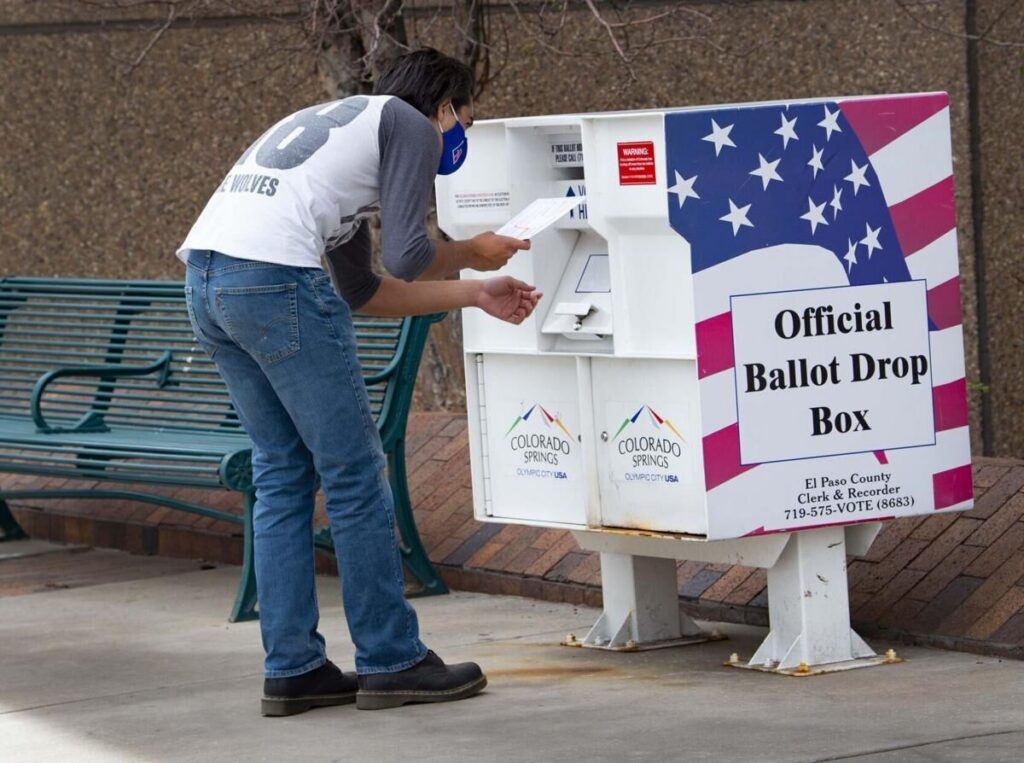
Trump’s mail-in ballot executive order reveals why DOJ is pushing for state voter data
Kaelan Deese, Washington Examiner
kaelan.deese.washington.examiner@gazetteedit.wpenginepowered.com
Updated 20 hours ago
President Donald Trump’s new executive order on mail-in voting is offering the clearest explanation yet for why the Justice Department has spent months aggressively seeking access to state voter rolls, while also triggering a sweeping legal challenge from Democrat-led states....

Trump quietly drops steel and aluminum tariffs for bikes, e-bikes, and frames
Christian Datoc, Washington Examiner
christian.datoc.washington.examiner@gazetteedit.wpenginepowered.com
Updated 20 hours ago
EXCLUSIVE — The Trump administration has quietly backed off from President Donald Trump’s threat to impose 50% steel and aluminum tariffs on imported bicycles, e-bikes, and bicycle frames. In August 2025, the administration added e-bikes to the list of products covered...

Trump warns Iran’s ‘whole civilization will die tonight’ unless deal is struck with US
Hailey Bullis, Washington Examiner
hailey.bullis.washington.examiner@gazetteedit.wpenginepowered.com
Updated 20 hours ago
President Donald Trump issued a bleak warning ahead of his Tuesday night deadline for Iran to reach a peace deal with the United States, saying “a whole civilization will die” unless Iranian leadership yields. “A whole civilization will die tonight,...

Senate-passed farmworkers overtime bill easily clears Colorado House committee
Marianne Goodland
marianne.goodland@coloradopolitics.com
Updated 16 hours ago
A proposal to ease Colorado’s overtime requirements for agricultural employers cleared a key House committee Monday, setting up a broader fight over whether the state should scale back a labor policy adopted just five years ago. The House Agriculture, Water...

Federal judge blocks evidence from Aurora police’s unconstitutional search
Michael Karlik
michael.karlik@coloradopolitics.com
Updated 14 hours ago
A federal judge ruled last month that prosecutors cannot use firearm evidence against a defendant because Aurora police searched him without having any reasonable basis to believe he was armed and dangerous. In evaluating the constitutionality of the search, U.S....
PREV
PREVIOUS

Oil and gas industry supporters ask Polis to veto climate bill
The Colorado Oil and Gas Association and other business interests formally took a shot at getting Gov. Jared Polis to veto climate-change legislation, House Bill 1266. The trade association made the request in a letter noting the bill, previously focused on a community disproportionately impacted by environmental issues, to include elements of Senate Bill 200, […]

Arrested sex workers in Denver may be done with sexually transmitted infection tests
A proposal passed by the Denver City Council safety committee Wednesday would remove the city’s requirement that arrested sex workers receive testing for sexually transmitted infections. This proposal will be sent to the full council for final votes. Kevin Kelly with the Denver Department of Public Health and Environment said Denver’s testing requirement is drastically […]