

Justices decide lower court overreached in answering Miranda warning question
A trial court properly admitted a man’s false answer to an officer’s question about his identity, which he gave before being advised of his right to stay silent, the Colorado Supreme Court ruled on Monday.
However, the justices also determined the Court of Appeals went too far in concluding statements that amount to a new crime are admissible regardless of whether an interrogation is constitutional.
Although such a “new crime exception” already implicates people who commit another offense following an unconstitutional stop by police, the Supreme Court clawed back the appellate court’s application of that rule to interrogations.
According to court documents, Vincent Joseph Compos was subject to a protection order on his ex-girlfriend, but nonetheless he arrived uninvited at her home in January 2016, where the two began arguing. Compos pointed a gun at the woman and her son, threatening to kill them. The victim called 9-1-1 and fled, telling police Compos was in her house.
When Pueblo officers arrived at the house, he denied being “Vincent” and invited them to shoot him. Instead, an officer tased and incapacitated Compos. When an officer subsequently asked for Compos’s name, he responded, “John Rocha.” Based on that false name, prosecutors charged Compos with criminal impersonation in addition to violating the protection order.
He pleaded guilty to the protection order violation, and a Pueblo County jury convicted him of criminal impersonation.
Compos appealed, arguing his statements to police while in custody, including the false name, should have been suppressed in the absence of a Miranda warning. Although the U.S. Supreme Court established in 1966 that a suspect’s statements are inadmissible if they do not receive a proper advisement about their rights, routine booking questions, like the suspect’s name, do not require a Miranda warning.
Compos claimed to the state Supreme Court that he was not going through the booking process at the time of questioning and was, in fact, being investigated for a crime related to his identity. If he gave his real name, he would implicate himself in violating a protection order; if he lied, he would commit a separate crime; and officers had not yet advised him of his right to remain silent. Therefore, the officer “should have known that asking Mr. Compos for his name was likely to elicit an incriminating response.”
The government countered that “police do not interrogate people hoping that they will commit new crimes in their presence,” and requiring a Miranda warning before any questions are asked of a suspect would amount to needless red tape.
A three-judge panel of the Court of Appeals agreed that Compos’s statements were admissible, but came up with a fresh justification. If a suspect commits a new crime during questioning, as did Compos, there is no constitutional protection for such statements, the panel concluded.
By sidestepping the issue of routine booking questions, Compos’s attorney criticized the appellate court for taking up an issue that neither side broached.
“The United States Supreme Court emphasized that our justice system hinges on the premise that the parties frame the issues and the court — a neutral arbiter — decides the issues as presented,” wrote deputy state public defender Julia Chamberlin, describing what is known as the party presentation principle.
Upon further review from the Supreme Court, the justices agreed with the ultimate outcome. If an officer asks for a defendant’s name for administrative reasons, and not as part of the investigation, such a query does not violate Miranda protections, even if the suspect incriminates himself when giving his biographical information.
“This is not to say, however, that identity-related questions are always permissible,” cautioned Justice Richard L. Gabriel, writing for the court. He provided the example of an officer asking questions for the purpose of establishing a crime related to a suspect’s immigration status.
As to the appellate panel’s adoption of a new rule governing crimes committed during interrogations, the Supreme Court walked back the lower court’s ruling and nullified that portion of its decision.
The justices acknowledged that in adopting the new crime exception on its own, the appeals judges “violated the party presentation principle,” Gabriel noted.
Criminal defense attorneys observed the Supreme Court’s opinion provided the rubric for judging whether a question involves a routine booking matter that does not require a Miranda advisement. Future courts should consider the facts of the case and the context of the biographical question.
“The ‘new crime exception’ would have created a much brighter line rule where anytime a response to a question was itself a crime, it would not be excluded, no exceptions,” said Colleen Kelley, a partner at Wolf Law in Denver. “So the Court is saying, although in this case asking the defendant his name did not violate Miranda under the routine booking question exception, there are circumstances in which it may violate Miranda, and a fact- and context specific-inquiry must be made in each case to determine this.”
Sarah Schielke, a defender in Loveland, emphasized that nothing prevents police from issuing a Miranda warning prior to asking even basic, non-investigatory questions.
“Now, here, what was the worst thing that would happen if Campos’s statement had been properly suppressed? Prosecutors wouldn’t have been able to charge him with the new false reporting crime in addition to his other crimes. That’s it,” she said. “What’s the worst thing that will happen if the courts keep endeavoring to create more broad and undefined exceptions to Miranda?”
Police, Shiielke contended, may believe the rules do not apply to them.
“The second outcome sure feels a lot worse to me,” she said.
Justice Monica M. Márquez did not participate in the case. The case is Compos v. People.


Colorado justices agree to review insurance question that has divided federal judges
Michael Karlik
michael.karlik@coloradopolitics.com
Updated 39 minutes ago
The Colorado Supreme Court granted a federal judge’s request on Friday to address an issue that has produced conflicting answers in policyholders’ lawsuits against insurance companies over unpaid benefits. “Parties (and judges) regularly spend undue time and money fighting in...
Federal judge dismisses background screeners’ challenge to Colorado law
Michael Karlik
michael.karlik@coloradopolitics.com
Updated 21 hours ago
A federal judge dismissed a challenge on Friday to a portion of Colorado law that prohibits certain information from being included in consumer reports, in what seemed to be a conflict with federal law. Congress originally enacted the Fair Credit...
10th Circuit rejects ‘penalty’ for children of naturalized citizens seeking visas
Michael Karlik
michael.karlik@coloradopolitics.com
Updated 14 hours ago
The Denver-based federal appeals court joined three of its peers earlier this month and determined the child of a newly naturalized U.S. citizen is not moved to a longer visa line as a result of his parent gaining citizenship, and...
Appeals court recognizes longer window to sue insurers for withholding policy details
Michael Karlik
michael.karlik@coloradopolitics.com
Updated 1 day ago
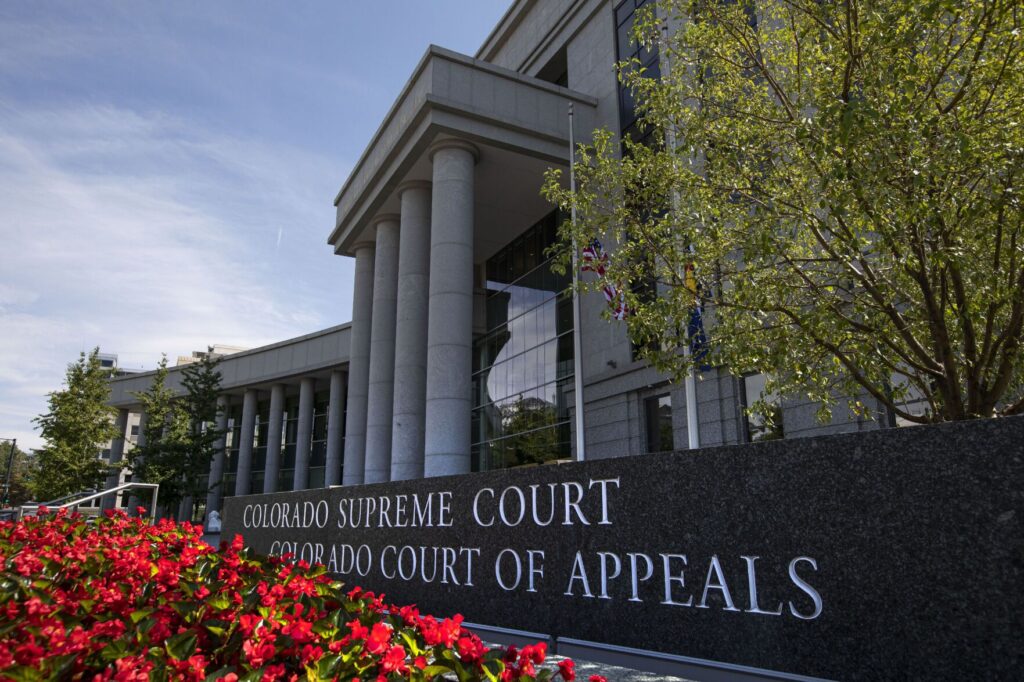
Colorado’s second-highest court split with its own prior decision earlier this month and concluded injured motorists have two years, not one, to sue insurance companies for withholding relevant information about an at-fault driver’s policy. In 2019, Colorado lawmakers enacted a measure to...

Appeals court decides free speech cases, error-prone judge reversed again | COURT CRAWL
Michael Karlik
michael.karlik@coloradopolitics.com
Updated 2 days ago
Welcome to Court Crawl, Colorado Politics’ roundup of news from the third branch of government. The state’s Court of Appeals decided multiple cases implicating free speech rights, plus Colorado’s most error-prone judge was reversed on appeal yet again. Heard on...
Federal judge dismisses claims against medical contractor for Eagle County jail suicide
Michael Karlik
michael.karlik@coloradopolitics.com
Updated 5 days ago
A federal judge dismissed the claims against a medical contractor for the Eagle County jail and its employees earlier this month, concluding there were insufficient allegations that they violated the constitutional rights of a man who died by suicide in...
Federal judge advances lawsuit seeking overtime compensation for Aurora firefighter trainees
Michael Karlik
michael.karlik@coloradopolitics.com
Updated 2 days ago
A federal judge gave preliminary approval earlier this month to a class of Aurora firefighter trainees who may sue the city over allegations that they were denied overtime pay in violation of federal law. Joseph Elias, who attended Aurora’s fire...
Appeals court says jury not obligated to apply discounts to determine value of stolen merch
Michael Karlik
michael.karlik@coloradopolitics.com
Updated 2 days ago
Colorado’s second-highest court concluded on Thursday that it was up to a Douglas County jury to determine the value of stolen merchandise at a defendant’s theft trial, after both sides presented different estimates of the items’ value. Under state law,...
Public figures have limited path to sue over accusations of criminality, says appeals court
Michael Karlik
michael.karlik@coloradopolitics.com
Updated 5 days ago
Colorado’s second-highest court ruled last week that a public figure cannot sue for defamation solely because a person publicly accuses them of committing a crime, as the statement may be constitutionally protected opinion. A three-judge Court of Appeals panel narrowed...
Federal judge to consider sanctioning ex-Colorado judicial discipline director
Michael Karlik
michael.karlik@coloradopolitics.com
Updated 6 days ago
A federal judge ordered Colorado’s former head of judicial discipline on Wednesday to explain why she should not sanction him for making inaccurate statements about the defendants in his lawsuit against the Colorado Supreme Court and related entities. U.S. District...
PREV
PREVIOUS

Nothing wrong with officer's body-language testimony, justices rule 6-1
A school resource officer’s interpretation of a boy’s body language was an acceptable piece of testimony in the trial of the boy’s relative, the Colorado Supreme Court decided by 6-1 on Monday, reversing a lower court’s finding that the officer inappropriately relied on his professional expertise to characterize the non-verbal response. “Certain types of body […]

State Supreme Court to consider definition of kidnapping, Vail Resorts' tax bill
The state Supreme Court has agreed to hear appeals about the definition of “kidnapping” and also the calculation of a luxury mountain resort’s property tax bill. In case announcements released on Monday, the justices indicated they would review whether a trial court judge correctly described kidnapping as an offense that occurs when someone is seized […]