

Scathing audit of RTD shows low employee morale tied to poor supervisory practices
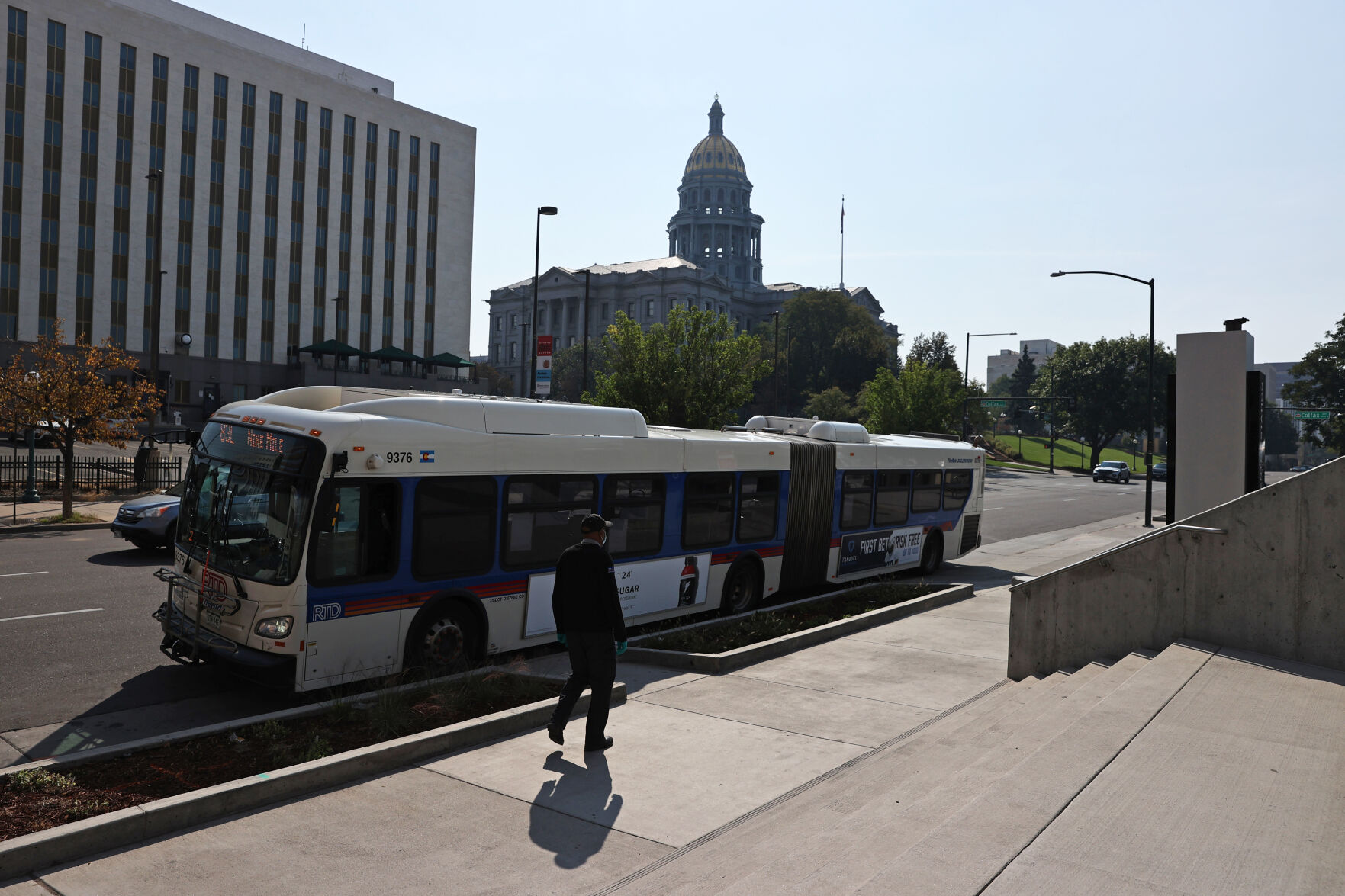
A performance audit of the Regional Transportation District found a myriad of problems in how the transit agency manages its driver workforce, with findings that left state lawmakers on the Legislative Audit Committee aghast.
The scathing audit, presented Thursday by State Auditor Dianne Ray and her staff, detailed issues with lack of union contract-required rest breaks and fatigue that may have played a role in more than 500 preventable RTD accidents in 2019; and high turnover among operators with less than two years on the job due to the poor quality of the work experience.
On the hot seat: RTD general manager Debra Johnson, who has been in the job for just two months.
The audit covered a five-year period from January 2015 to May 2020. Auditors surveyed 207 of the 1,344 bus and rail operators last May and June “to better understand RTD operations pre-pandemic and during the pandemic, and their experiences working at RTD.”
The results were not good.
The audit stated that during the audit period, the agency “experienced a prolonged shortage of bus and rail operators, with a significant number of them leaving RTD each year, resulting in planned services not being provided to the public. Despite steps taken by RTD to improve operator retention, they continue to experience discontentment and/or low morale.”
During the audit period, two-thirds of those hired quit within the first two years on the job. From 2016 to 2019, RTD saw average annual turnover rates of 26% for bus drivers and 43% for rail operators.
Key problems identified :
- Lack of meaningful performance feedback from supervisors. The audit said drivers often only get feedback when there’s a problem, not when they’re doing a good job, and that leads to poor morale.
- lack of rest breaks, as mandated in the union contract
- fatigue among newer drivers due to working six and seven days a week and uneven scheduling
- no exit interview process that would tell RTD why people quit
RTD pointed out that it established an employee recognition program in February 2020 to recognize operators for various milestones, such as going long periods of time without accidents. Despite those programs, the audit said, drivers surveyed by the state auditors said that recognition is inconsistent, untimely or impersonal.
For example, customer compliments took as long as three months to reach the operators, according to the audit. Awards handed out to drivers were put in their company mailboxes rather than being presented by supervisors.
The audit reported that there is no RTD policy or process for supervisors to give regular performance feedback to operators, other than going through the disciplinary process.
RTD’s explanation is that the lack of recognition is tied to the union contract, which does not set up a process for traditional performance evaluations. The contract does not allow performance evaluations to be used to determine operator pay, the audit said.
RTD managers also told auditors that there are not enough supervisors to provide feedback to the large number of operators. As of May 2020, there was one bus supervisor for every 16 bus operators and one rail supervisor for every eight rail operators, the audit said.
However, the problem appears to be more systemic. The audit noted that RTD’s supervisor training does not provide bus and rail supervisors guidance on how to provide operators with effective performance feedback on areas they are doing well or can improve.
The contract requires operators be given a rest break equivalent to 10% of the round-trip time. For a trip that takes two hours, for example, a rest break of 12 minutes would be required, allowing the driver to go to the bathroom or clean the bus. The audit reported that RTD doesn’t appear to have a way to figure out how to make those breaks happen. The result is that drivers will be on routes from 4-12 hours without a break, and operators often won’t drink enough fluids because they know they won’t get a chance to go to the bathroom.
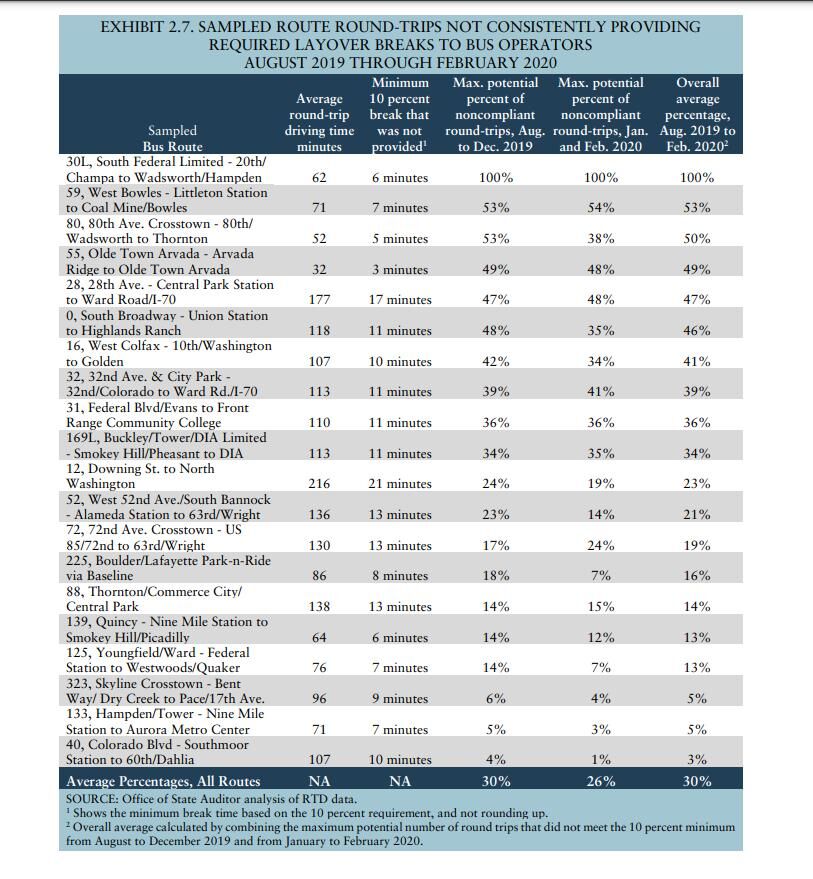
One union rep told auditors that “some operators have kidney issues because operators do not have sufficient time to use the bathroom and do not want to make a bus late by taking a break, because they have a duty to stay on schedule for customers.” Hypertension is also a factor when drivers don’t get sufficient rest breaks, according to the audit.
RTD claimed the lack of rest breaks often is a situation beyond their control because of traffic congestion, construction or other route issues, for example, but the audit pointed out that RTD lacks a plan to mitigate the impact of those circumstances. When the routes were adjusted in January 2020, RTD did not adjust the rest breaks, since they have no way to analyze actual break times between round-trips.
“RTD staff only review the scheduled layover break time for each route to check if it appears close to the 10% minimum required in the agreement,” the audit said.
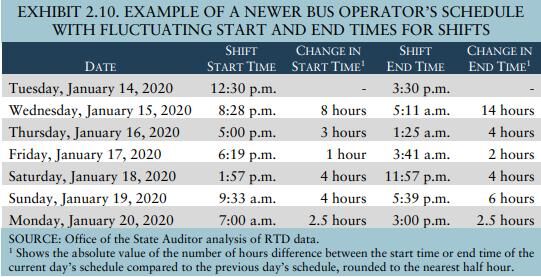
Newer operators also suffer from fatigue due to substantial variations in their work schedules or from working six or seven days a week.
The lack of breaks and fatigue are safety risks, the audit said. In 2019, 529 of the 1,670 bus accidents were classified by RTD as preventable. While there may be factors other than driver fatigue, 474 of those 529 accidents occurred when a driver was on duty between four and 12 hours. “We could not determine how many of the operators with accidents did not receive their breaks due to a lack of available data from RTD,” the audit said.
The audit noted that some of the scheduling issues are tied to the union contract, which allows senior drivers to get choice routes. RTD General Manager Debra Johnson told the committee that newly hired operators receive routes that are less desirable, or have to work late-night shifts. She also pointed to a lack of supervisory support.
The lack of exit interviews among those who quit – two-thirds of new drivers quit in the first two years – was a red flag for several lawmakers on the committee. Rep. Colin Larson, R-Littleton, who last year was one of the sponsors of a bill to reform some of RTD’s compliance issues with the Americans with Disabilities Act, noted that “when half of your staff is leaving, it seems you might want to ask why.”
Johnson replied that they are implementing an exit interview strategy.
Sen. Jim Smallwood, R-Parker, wanted to know if RTD knows if those who quit were good drivers, or “it was a good thing they quit.”
“We should have invested more time in their success in the organization,” Johnson replied. She also told lawmakers that RTD is working on training supervisors on recognizing fatigue, including taking advantage of federal training programs.
But she also said that some newer operators prefer those longer hours, akin to a substitute teacher. “It’s a greater opportunity to get a more desirable day shift,” she said. But Johnson also pledged to work with the union on this issue.
Rep. Rod Bockenfeld, R-Watkins, had issues with allowing RTD to have an entire year to fix the problems. “I would hope we can get some of these timelines modified to prioritize” fixes, he said.
He also asked for another audit. “Given the current circumstances, does it make sense to have a look-see on how they’re meeting these challenges in the next year or two?” he asked Ray. She suggested another look in two to three years to see what the new leadership has done.
Bockenfeld and Larson, also, are both interested in issues that didn’t come up in the audit. For Larson, that’s if RTD’s use of outside consultants and “very generous” contracts for communications and management strategy.
“If you’re spending as much money as you are, and layering on tens of millions [in] outside contracts, and the outcomes are this poor, who’s in charge? Do we get value for our dollar? I would have liked a dive into their contracting practices and deliverables,” he said.
The other major issue is the “total disaster” that is ADA compliance, he said. “You talk to anyone in the disability community about Access a Ride, it’s heartbreaking and not reliable, with chronic driver shortages.” That makes holding down a job nearly impossible when you don’t have reliable transportation that is often hours late.
Larson told RTD management Thursday that he doesn’t want to lay too much responsibility for the problems of the past on the new management. “I’m cautiously optimistic that the new board and leadership is taking a new direction.”
He later told Colorado Politics that the majority of the RTD board – nine out of its 15 members – have been on the board during this period of “incompetence.” He’s encouraged that they have a new executive director.
“She’s saying all the right things, such as, ‘Yes, we have a culture problem; we need to fix these issues,’ ” Larson said, adding that he wants to give Johnson the time to make those changes.
But RTD also has a litany of broken promises and a failure to deliver, Larson said.
“COVID has [allowed RTD] to paper over some of this, but these were horrible issues,” long before the pandemic. “I want to give them time to do the right thing, but the period for a lot of grace has come and gone. The legislature is justified in being skeptical about what RTD says and promises.”
Had RTD not brought in a new director, the audit committee would have been looking for someone’s head, Larson indicated.
Read the audit:
State auditor report on RTD, January 2021


Aurora mental health nonprofit cuts 100-plus jobs after Colorado agency reduces reimbursement rate
Marianne Goodland
marianne.goodland@coloradopolitics.com
Updated 6 hours ago
A nonprofit that provides services through 11 mental health centers in Aurora announced Thursday that it is eliminating 111 jobs effective June 30, the result of federal and state budget reductions. Aurora Mental Health & Recovery said the positions being...

Colorado space startup secures $650 million for expansion
alex-edwards
alex.edwards@gazette.com
Updated 9 hours ago
The window to deliver space superiority for the U.S. is open but shrinking rapidly, according to defense startup True Anomaly. The Centennial-based company hit a milestone in its pursuit to help deliver that, announcing Tuesday that it raised $650 million...

Colorado bill prohibits credit card companies from charging ‘swipe fees’ on sales taxes
Marianne Goodland
marianne.goodland@coloradopolitics.com
Updated 8 hours ago
Colorado senators on Wednesday voted to advance a proposal to eliminate credit card “swipe fees” on sales taxes. Proponents say the move would save businesses tens of thousands of dollars annually, while critics have countered those fees are needed to...
First ever disciplinary trial of a Colorado judge scheduled under new system
Michael Karlik
michael.karlik@coloradopolitics.com
Updated 11 hours ago
A disciplinary panel on Thursday scheduled a mid-August hearing to adjudicate the alleged misconduct of Montezuma County Court Judge Ian J. MacLaren. Following voters’ passage of constitutional Amendment H in November 2024, adjudication of serious judicial misconduct allegations is open to public...
Colorado eyes licensure, new oversight body for autism therapy providers
Marissa Ventrelli
marissa.ventrelli@coloradopolitics.com
Updated 6 hours ago
A panel of Colorado legislators on Wednesday approved a bill establishing a new regulatory body and licensure requirements for professionals who provide therapy for children on the autism spectrum, as well as for the facilities in which they work. House...
Appeals court recognizes weekend, holiday rule applies to judicial review deadline
Michael Karlik
michael.karlik@coloradopolitics.com
Updated 13 hours ago
Colorado’s second-highest court clarified for the first time on Thursday that the rule extending deadlines in civil cases when the final day falls on a weekend or holiday also applies to litigants seeking review of governmental decisions. Nicholas A. Rigato...
SCOTUS arguments, varied workload: 6 Colorado solicitors general talk about job
Michael Karlik
michael.karlik@coloradopolitics.com
Updated 15 hours ago
Six current and former solicitors general of Colorado, including two who have since become members of the bench, spoke to attorneys on Wednesday about how the role has changed over time, what the workload entails, and their experiences arguing at...

Denver public safety power shut-offs ‘a last resort,’ Xcel says
Deborah Grigsby
deborah.smith@denvergazette.com
Updated 17 hours ago
Although Denver has not yet experienced a public safety power shut-off, the Mile High City came close in December, according to Xcel Energy officials who briefed the city’s Transportation and Infrastructure committee Wednesday. Representatives from the utility company briefed members...

12 finalists selected to interview for Aurora Colfax revitalization board
Kyla Pearce
kyla.pearce@gazette.com
Updated 17 hours ago
Twelve finalists, including several area business owners, will interview for Aurora’s Downtown Development Authority Board in early May to form the oversight body for a project to revitalize Colfax Avenue. Aurora officials received 38 applications for the six board positions,...
Federal judge declines to end Denver sheriff employee’s sex discrimination suit
Michael Karlik
michael.karlik@coloradopolitics.com
Updated 17 hours ago
A federal judge tentatively green-lit a former Denver Sheriff Department sergeant’s sex discrimination lawsuit for trial last month, based upon allegations that three female employees were promoted ahead of him despite his qualifications. U.S. District Court Judge Nina Y. Wang...
PREV
PREVIOUS

Larimer County approved for disaster recovery programs over Cameron Peak Fire
Larimer County has been partially approved for a Federal Emergency Management Agency major disaster declaration for the Cameron Peak wildfire, allowing for funding for some recovery programs. So far, programs for fixing public infrastructure damages have been approved, including public roads, bridges, water infrastructure and debris removal. These programs also include hazardous tree removal on […]

Southern Ute Tribal Ranger was justified in shooting, U.S. Attorney's Office of Colorado says
A Southern Ute Trial Ranger who fatally shot a wanted man last November while responding to a potential trespassing incident on the Southern Ute Indian Reservation was justified, the U.S. Attorney’s Office of Colorado announced Thursday. The attorney’s office reviewed the results of an investigation performed by the FBI that included witness accounts, recorded radio […]