

Pair of 4-3 Supreme Court decisions kicks El Paso DA’s office off case, keeps Lake County’s on
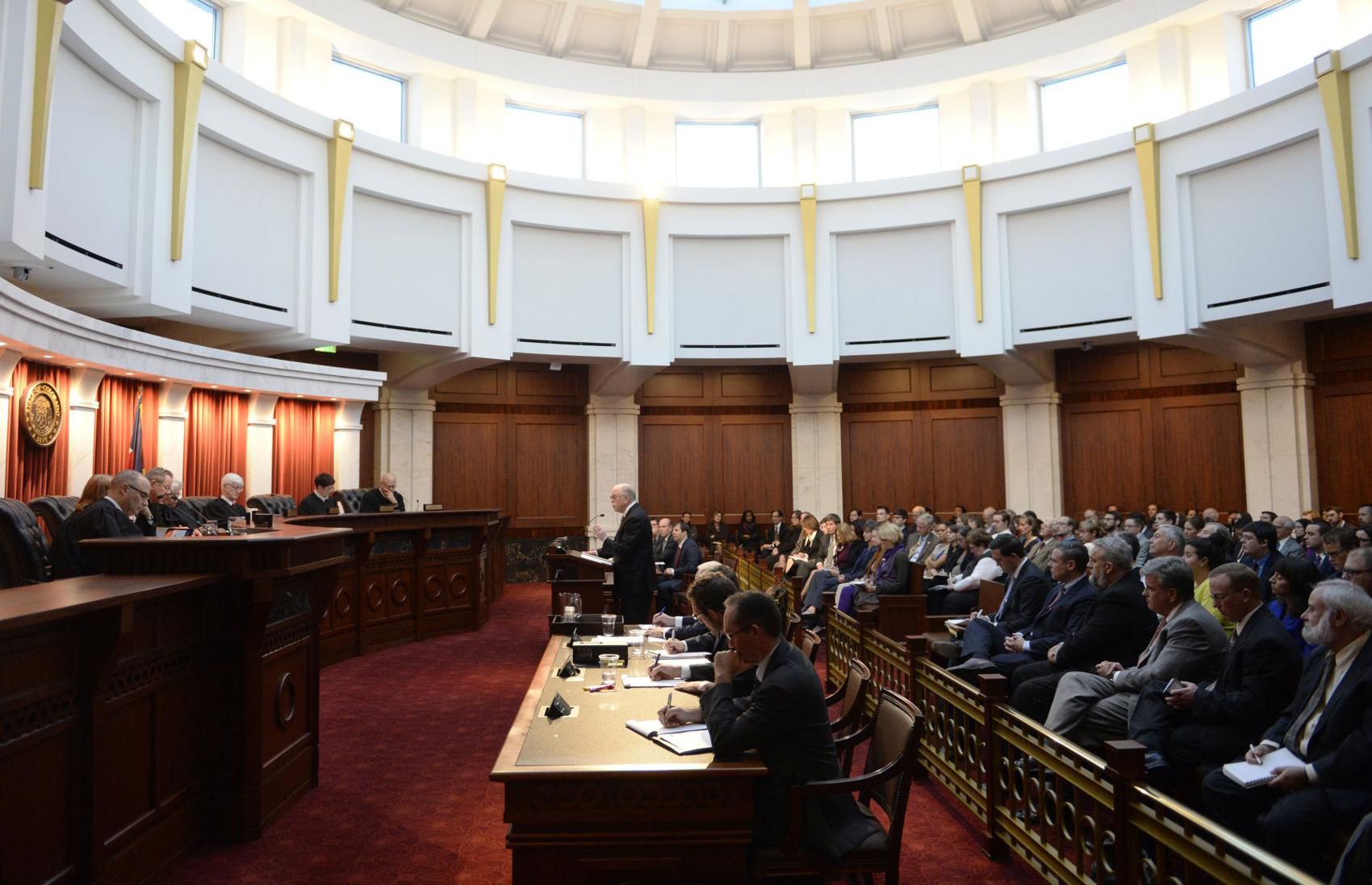
In an unusual pairing of decisions, the Colorado Supreme Court on Monday decided by 4-3 that an El Paso County judge was correct to disqualify the district attorney’s office from prosecuting a case, while simultaneously holding that a Lake County judge was wrong to issue the same order.
“Our court goes one for two in today’s doubleheader,” observed Justice Carlos A. Samour Jr. “A .500 performance is great for any hitter in baseball; not so much for an appellate court.”
Both appeals were filed to the Supreme Court while criminal proceedings were ongoing, with the defendants alleging they could not receive fair trials due to special circumstances involving their respective district attorney’s office. Requesting the disqualification of an entire office is a “drastic remedy,” the court has noted in the past.
Prosecutors in the Fourth Judicial District have accused Erica Renee Arellano of second degree murder in the shooting death of her boyfriend in Colorado Springs in January of this year. Arellano indicated the victim was assaulting her with his fists and objects at the time, and self-defense will be a factor in her trial defense.
An unnamed employee of the district attorney’s office was married to, but separated from, the murder victim at the time. The same employee may be a crucial witness in Arellano’s trial because she has provided information to prosecutors that undermined Arellano’s self-defense claim.
Specifically, the employee told a detective that the defendant’s “game” would be to cast the victim as a domestic abuser, and that any such claims were false, in her experience. She further speculated that Arellano planned the entire incident.
Arellano asked El Paso County District Court Judge Marcus Henson to disqualify the district attorney’s office from the case. Henson agreed, finding the unique circumstances made it unlikely Arellano could receive a fair trial. Among other factors, Henson decided an “open and honest discussion of possible resolution of the case” could be problematic given the conflict.
Prosecutors acknowledged that disqualification is necessary when an attorney of the office will appear as a witness with sufficiently consequential testimony, but then turned directly to the Supreme Court for a ruling.
Writing for the majority, Justice Richard L. Gabriel agreed with Henson’s logic, including the district judge’s observation that the district attorney’s office had a financial interest in the outcome of the case because the employee sought victim compensation.
“On these unique facts, all of which were supported by the record, and given that the district court correctly recited and applied the pertinent legal principles to such facts,” Gabriel wrote, “we cannot say that the court’s decision to disqualify the district attorney’s office here was manifestly arbitrary, unreasonable, or unfair, so as to constitute an abuse of the broad discretion afforded district courts in cases like this one.”
Samour authored the dissent on behalf of himself, Chief Justice Nathan B. Coats and Justice Brian D. Boatright. Samour dismissed as “mere speculation” any worries about the employee’s effect on Arellano’s trial, and believed the disqualification of the office required extreme circumstances.
“In attempting to rescue the district court’s ruling, the majority generously describes the court’s reflections as ‘extensive findings,’ ” Samour wrote. “However, the majority strains to identify any actual pertinent findings, never mind extensive ones. There are none.”
Further, the dissenting justices doubted that the employee’s “speculative, foundationless, irrelevant information stands a chance of coming into evidence at trial.”
In the second case, Fifth Judicial District, District Attorney Bruce I. Brown brought charges against Coroner Shannon L. Kent for perjury and second degree official misconduct. Following a complaint from the Lake County Sheriff that Kent sent his wife to respond to a coroner call, a grand jury indicted him for misconduct by letting his wife act as a deputy coroner without formal authorization.
According to court records, Kent allegedly made threatening comments at Brown and to a third party directed at Brown. A second grand jury subsequently recommended a perjury charge for the coroner for providing false testimony about his wife’s official work during the original grand jury proceeding.
The coroner claimed that multiple circumstances merited the disqualification of Brown’s office, including anticipated testimony at Kent’s trial from a district attorney investigator and a complaint Brown filed against Kent with the state’s Department of Regulatory Agencies.
Lake County District Court Judge Catherine J. Cheroutes determined that none of the circumstances by themselves merited removal of the district attorney’s office from the case, but that taken together, disqualification was necessary.
“There is something personal about the case. Mr. Brown is both seeking a conviction of Mr. Kent and his removal from his position,” she concluded. “This pattern raises grave concerns about the ability of the defendant to receive a fair trial with Mr. Brown and his office prosecuting the case.”
Samour, who authored the majority opinion in this instance, picked up on Cheroutes’s concern about Brown’s motivations. Nevertheless, the majority decided the judge exceeded her discretion.
Declining to order Brown off the case, Samour wrote how “circumstances that may lead a court to harbor suspicions about a district attorney’s motives and strategies do not warrant disqualification if they don’t render it unlikely that the defendant would receive a fair trial.”
Justice William W. Hood III wrote the dissenting opinion, with Gabriel and Justice Melissa Hart joining him. While not endorsing Kent’s behavior or disparaging Brown’s handling of the case, Hood concluded the court “should hesitate to find an abuse of discretion when the evidence of unfairness, though scattershot, plausibly suggests that the district attorney can’t prosecute a defendant objectively due to a palpable, personal animus.”
Brown, who is leaving office due to term limits, said in a statement that prosecutors understand their community and the needs of local law enforcement, and as such it is beneficial that they are familiar with witnesses and parties to cases.
“We are gratified that the Court upheld the important principle that the elected prosecutor should represent their District whenever justice can be served by maintaining this responsibility in local hands,” said Brown.
Stanley L. Garnett, formerly the district attorney for Boulder County, said the court’s rulings present an argument for the General Assembly to intervene and clarify the law over district attorney disqualification.
“I also think district attorneys should be pretty proactive in disqualifying themselves when they think there is the slightest hint of an appearance of impropriety,” he said.
Garnett added that in his office, his policy required employees to notify him if they or any relative were charged in a criminal case. He once recused himself from the felony prosecution of former U.S. Sen. Mark Udall’s son because he was political friend of the senator.
The cases are People v. Arellano and People v. Kent. Justice Monica M. Márquez was in the majority for both cases, with the remaining justices maintaining their coalitions.

Colorado Supreme Court weighs trans rights case involving Children’s Hospital and federal threats
Michael Karlik
michael.karlik@coloradopolitics.com
Updated 11 hours ago
Some members of the Colorado Supreme Court expressed discomfort on Tuesday with having to decide whether to order Children’s Hospital Colorado to resume providing certain services to transgender children, which could trigger a “death sentence” if the federal government imposes...
Colorado justices weigh constitutionality of unique disclosure requirement for ballot measures
Michael Karlik
michael.karlik@coloradopolitics.com
Updated 19 hours ago
Members of the Colorado Supreme Court considered on Tuesday whether a unique feature of the state’s campaign finance system categorically violates the First Amendment by requiring the disclosure of a ballot measure committee’s legal representative on advertisements. No on EE...
Appeals court shuts down Boasberg contempt inquiry into Trump administration over El Salvador deportations
Kaelan Deese, Washington Examiner
kaelan.deese.washington.examiner@gazetteedit.wpenginepowered.com
Updated 19 hours ago
A federal appeals court on Tuesday ordered an end to U.S. District Judge James Boasberg’s criminal contempt inquiry into Trump administration officials over last year’s deportations of Venezuelans to El Salvador, delivering a second major rebuke to Boasberg and foreclosing...

Colorado marijuana regulators pledge crackdown on intoxicating hemp
Christopher Osher
chris.osher@gazette.com
Updated 20 hours ago
Citing potential tax avoidance, ‘serious risk to public safety,’ Marijuana Enforcement Division warns companies about swapping illegal chemically converted hemp for marijuana This article was produced for ProPublica’s Local Reporting Network in partnership with The Denver Gazette. Colorado regulators announced...

Polis pushes back after Trump administration again denies federal disaster aid
Marissa Ventrelli
marissa.ventrelli@coloradopolitics.com
Updated 13 hours ago
A dispute over federal disaster aid escalated Monday as Colorado Gov. Jared Polis faulted the Trump administration for rejecting the state’s appeals for assistance following last fall’s fires and flooding. The state initially filed for a Major Disaster Declaration for...

Colorado justices block injured plaintiff from suing, despite alleged concealment by Manitou Springs
Michael Karlik
michael.karlik@coloradopolitics.com
Updated 1 day ago
The Colorado Supreme Court ruled on Monday that a woman injured on a Manitou Springs sidewalk could not sue the allegedly responsible entity, the city of Colorado Springs, even though she did not learn until too late of an agreement...

Rep. Eric Swalwell of California says he will resign after sexual misconduct allegations
Kevin Freking
kevin.freking@associatedpress.com
Updated 2 days ago
WASHINGTON (AP) — Democratic Rep. Eric Swalwell of California announced Monday he will resign from Congress following sexual assault and misconduct allegations that prompted loud bipartisan calls for him to step down. The decision caps a swift political fall for...
Denver continues to explore moving to a biennial budget
Deborah Grigsby
deborah.smith@denvergazette.com
Updated 22 hours ago
There’s continued momentum to shift the city of Denver to a biennial budget cycle, and if approved by the City Council, the measure would be sent to voters on the November 2026 ballot. The idea, first put forth in December,...

Colorado saw job losses for the first time since pandemic
Bernadette Berdychowski
bernadette.berdychowski@denvergazette.com
Updated 19 hours ago
Colorado’s job market last year appears to have been dimmer than it was originally believed to have been, new state data revisions show. The labor market wasn’t slowly growing, but rather it contracted in 2025. The state saw job losses...

Whistleblower contacted Democrats before filing Trump complaint that led to first impeachment, records show
Kaelan Deese, Washington Examiner
kaelan.deese.washington.examiner@gazetteedit.wpenginepowered.com
Updated 2 days ago
Newly declassified transcripts from the Intelligence Community’s then-inspector general show that the whistleblower whose complaint triggered President Donald Trump’s first impeachment had prior contact with congressional Democrats before filing the allegation, a newly-surfaced and damning detail that was not disclosed...
PREV
PREVIOUS

Specialty courts work, but fairness of access questioned
District attorneys tout specialty courts and diversion programs, designed to rehabilitate rather than incarcerate, as a success story. The worth of these programs is a rare topic both Republican and Democratic district attorneys often agree on. In Colorado, specialty courts – also known as problem-solving courts – include drug courts, mental health courts, veterans’ treatment […]

Denver judge, advocate for diversity to retire
Gary M. Jackson, a Denver County Court judge and a public advocate for judicial diversity, is retiring after seven years on the bench. “It has been an honor to enter into my 50 year as an attorney and judge,” Jackson said. “It is my hope that I have been the type of role model as […]