

SLOAN | Curbing late-term abortion makes sense


Since Colorado has adopted a habit of legislating important questions by plebiscite, there are, as ever, several important questions on the ballot. For reasons that should seem apparent, Proposition 115, the prohibition on late-term abortions, edges out most of the others in scope of importance.
Abortion is among those issues which generates a great deal of passion on both sides. Arguments overloaded with passion tend to polarize those combatants who are already engaged and encourage the unengaged to tune out. There is plenty of room for dispassionate analysis in the abortion argument.
A dispassionate examination of 115 argues strongly in its favor. The measure represents a reasonable approach to the issue, offering a prohibition of abortions only after the 22nd week of pregnancy — the gestational age at which a fetus can live outside the womb — with an exception for those performed to preserve the life of the mother.
It is true that the number of late-term and partial-birth abortions is, blessedly, not very high, prompting the question of why so much thunder and fire is generated against their restriction. The passionate zeal for maintaining the facility of the baby guillotine until birth has spun off a fair bit of histrionic inaccuracy concerning the proposition, pretty much all of which is disposed of by reading the measure.
There is, for instance, the worn claim that 115 would endanger the lives of women; this despite the measure asking, verbatim, whether it ought to be “a misdemeanor punishable by a fine to perform or attempt to perform a prohibited abortion, except when the abortion is immediately required to save the life of the pregnant woman when her life is physically threatened.” If that was an insufficiently clear rebuttal, there is the allegation that 115 would criminalize women who receive those specified abortions; the ballot language specifically states that the new law would include definitions “specifying that a woman on whom an abortion is performed may not be charged with a crime in relation to a prohibited abortion.”
Being categorically denied valid arguments against the specifics of the proposition, the abortionists rely on an alleged belief that prohibiting late-term abortions would somehow emasculate Roe v. Wade. This is nonsense. The case in which the Supreme Court authorized abortions in general made provision for certain reasonable restrictions to be adopted by the states — a provision Colorado has never taken up, making it one of only a very few states that permit abortion up to birth. If 115 is passed, Colorado’s abortion laws would still be more liberal than such bastions of progressivism as New York and California, and would in no way dilute, much less vitiate, Roe.
It seems rather macabre to reduce the issue to the coldness of arithmetic calculations, but for those inclined to such speculative endeavors one good measure by which to judge prospective policy is to ask how many will be harmed or helped; ergo, in the month after enactment, how many mothers would die for the inability to kill their pre-born babies? Answer: none. Conversely, in the same time frame, how many Coloradans would be allowed to emerge safely from their mother’s womb who would not otherwise?
Polling on banning late-term and partial-birth abortion fares rather well, better than more doctrinaire policies such as, say, defining life scientifically — i.e. the moment of conception — and conferring related constitutional protections at that point, largely because the fetus that is closer to birth takes on a more relatable feel: the baby kicks the mother’s stomach; ultrasound images reveal a being with features and reactions not dissimilar to our own; a sensitive nervous system has developed, indicated by reactions to pain, like the prick of an instrument, that are also not unlike what we would do. It is not much of a leap to therefore support a policy which would spare those close to birth the pain inflicted by an abortionist’s knives.
I am reminded of the story of the professor who posed the following question to his students: You behold a family — the father is suffering from syphilis, the mother from consumption; two children are dying from disease, a third was stillborn. The mother is pregnant again — what do you recommend? The class answers, unanimously, abortion. “Congratulations”, says the professor, “you just aborted Beethoven.”
The fate of 115 may rest upon the realization that all of us, every single one, were at one time among those the proposed law would seek to protect; and contemplation of what, fundamentally, is the difference between a body one minute after and one minute before birth.


The public health hazards in sports betting | PODIUM
Colorado Politics
colorado-politics@coloradopolitics.com
Updated 10 hours ago
By Brandon Zelasko As Colorado lawmakers revisit sports betting policy this session, the state has an opportunity to widen the lens. Beyond revenue projections and regulatory frameworks lies a critical question: Are we fully reckoning with the human effect of...

Colorado’s public lands are not for sale | OPINION
Colorado Politics
colorado-politics@coloradopolitics.com
Updated 10 hours ago
By Jonathan Houck Our state is defined by its public land. It shapes our communities, our economy and our Colorado way of life. Just driving through Gunnison County, where I have lived for more than 30 years, sometimes I can’t...

The real impact of regulations on businesses, employees and Colorado’s way of life | OPINION
Colorado Politics
colorado-politics@coloradopolitics.com
Updated 1 day ago
By Loren Furman and Steve Swinney Every day in Colorado, business owners are faced with decisions most people never see, shaped by rising costs and a regulatory environment that has grown more complex over time. Those choices eventually reveal themselves...

Should we have recall votes for all Colorado elected officials? | Hal Bidlack
Hal Bidlack
hal-bidlack@coloradopolitics.com
Updated 1 day ago
As I write this on the Sunday before you read it, we’ve just learned of the first American casualties of our, what — war? conflict? attack? — on Iran. The Supreme Leader of Iran, for the past 36 years or...

Colorado legislature should not reverse lottery modernization | OPINION
Colorado Politics
colorado-politics@coloradopolitics.com
Updated 1 day ago
By Bill Clayton Four years ago, the Colorado General Assembly passed bipartisan legislation to modernize the state’s lottery system and strengthen funding for Colorado’s outdoor projects and open spaces. Lawmakers recognized a simple reality: consumer behavior has evolved. Most Coloradans...

Could Weiser or Bennet as governor each be an improvement over Polis? | Miller Hudson
Miller Hudson
miller-hudson@coloradopolitics.com
Updated 3 days ago
The weekend before last was a forerunner to numerous forums and debates where U.S. Sen. Michael Bennet and Attorney General Phil Weiser will jostle for position in the Democratic primary for governor. The victor seems certain to be headed to...

Poison, poultry and prostitution — the Colorado legislature marches on | Rachel Gabel
Rachel Gabel
rachel-gabel@coloradopolitics.com
Updated 3 days ago
Many weeks my search history is odd but the past two weeks might worry our county sheriff if he didn’t know me as well as he does. This week has been the week of poison, poultry and prostitution. Not to...

Thoughts on President Trump’s State of the Union address | Cronin & Loevy
Tom Cronin Bob Loevy
tom-cronin-bob-loevy@coloradopolitics.com
Updated 3 days ago
The U.S. Constitution’s Article Two states “He (the president) shall from time to time give to the Congress Information of the State of the Union, and recommend to their Consideration such Measures as he shall judge necessary and expedient….” On...

Are Colorado businesses leaving or evacuating? | Jon Caldara
Jon Caldara
jon-caldara@coloradopolitics.com
Updated 6 days ago
At this point, if you hear beeping downtown, it’s not a construction crew. It’s a company backing out. And look, I get it. Businesses relocate for all sorts of reasons: taxes, regulations, labor costs, office space, crime, commute times, the...
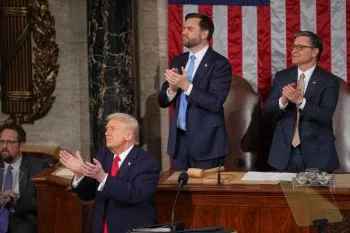
Additional thoughts on State of the Union address/rally | Cronin and Loevy
Tom Cronin Bob Loevy
tom-cronin-bob-loevy@coloradopolitics.com
Updated 4 days ago
The U.S. Constitution’s Article II states that “He (the president) shall from time to time give to the Congress Information of the State of the Union, and recommend to their Consideration such Measures as he shall judge necessary and expedient...
PREV
PREVIOUS

NOONAN | Who wins a water war? Ask the judge
Paula Noonan Colorado’s former Gov. Dick Lamm, an early prognosticator on the “devil’s in the details” of economic growth, was the featured speaker in a podcast sponsored by the Center for the Advancement of a Steady State Economy. The premise of the Center is that an ever-growing world economy is unsustainable for earth’s environment. Lamm has long been […]

A simpler sales tax will buoy small businesses
Kevin Van Winkle These days there is no shortage of political spin, campaign rhetoric and breaking news. In fact, the election season combined with the pandemic and economic chaos has transformed 2020 into an unprecedented year of turmoil and challenge. This is especially true for small businesses. From restaurants to day care centers to neighborhood […]