

Unemployment claims top half a million in Colorado
For the seventh week in a row, new unemployment claims have fallen, even as the total number of Coloradans who have applied for benefits since the COVID-19 pandemic hit the state exceeds half a million people.
In the week ending May 30, 12,149 people filed claims for traditional unemployment benefits, while more than 6,400 people sought compensation through the federal government’s expansion of the program to those who were self-employed, working part-time, or independent contractors. All told, 517,414 Coloradans in the past 11 weeks have been approved for some form of unemployment compensation.
Cher Haavind, deputy executive director for the Colorado Department of Labor and Employment, said that there have been 1,200 reports of employees refusing to return to work, of which 220 resulted in a denial of continued benefits.
“Most of the reasons being cited for denial of benefits include the claimant was not able to demonstrate that they were either a member of a vulnerable population, caring for a dependent or living with somebody who was a member of a vulnerable population,” she said. There were also instances where employers had demonstrated that they enacted safe workplace conditions per COVID-19 guidance.
The department has reinstituted work search requirements, and claimants must certify that they are able, available and actively looking to return to work. Haavind reported that some claimants were confused about the need to attest to those conditions in an ongoing manner to receive payment.
“Unfortunately, if they don’t continue to certify, their claim is closed because it makes our system think they have returned to work,” she explained.
Accommodation, food services and retail continued to be the industries whose workers have been hardest hit. From the $2.2 trillion CARES Act, which Congress passed in March to provide an array of economic relief measures, unemployed workers are receiving a temporary increase of $600 per week in their benefits. In Colorado, those payouts have reached $1 billion.
Excluding the federally-funded expansion of benefits, the state has paid out three-and-a-half times more in May than it did during the peak of the last decade’s recession, in May 2009. The COVID-19 Eviction Defense Project, started in March, predicts that when federal funding expires in July, there could be a wave of evictions in Colorado as incomes drop.
Jeff Fitzgerald, CDLE’s Division of Insurance director, said that the department is looking for legislation to expand the work-share program, which allows companies to reduce employees’ hours without laying them off and enables those employees to then receive partial unemployment benefits. In the most recent week of data, there were just under 3,700 ongoing claims from people participating in the work-share arrangement.
Ryan Gedney, senior economist at CDLE, announced that if payouts continue to hover around $90 million per week, the unemployment insurance trust fund would become insolvent in late July or early August. A solvency surcharge would begin in January 2021 on employers, while the state would receive zero-interest loans from the federal government to continue to pay claims. The last time the trust fund ran out of money was in the prior recession, and the surcharge from that round of borrowing ended in May 2017.
Altogether, 370,491 Coloradans, or 12% of the state’s workforce as of February, have received some kind of unemployment payment since the onset of the pandemic.


Healthcare freefall: UNC’s new medical school aims to tackle Colorado’s rural doctor shortage
Hap Fry, Special to The Gazette
hap-fry@gazette.com
Updated 1 day ago
Editor’s Note: Colorado’s healthcare system is entering a period of accelerating instability — a “tsunami,” as multiple leaders describe it — driven by collapsing hospital finances, shrinking Medicaid reimbursements, disappearing services and a political fight over who is responsible for...

Healthcare freefall: Economic ripple effects grow as Colorado hospitals face financial strain
Thelma Grimes
thelma.grimes@coloradopolitics.com
Updated 1 day ago
Colorado’s hospital systems aren’t just a network of clinics and emergency rooms — they are also one of the state’s largest economic engines. So some 10 hospitals identified at any given time as vulnerable to closure, the alarm extends far...

Gubernatorial candidates Phil Weiser, Greg Lopez spar, as Marx skips debate
Deborah Grigsby
deborah.smith@denvergazette.com
Updated 11 hours ago
Two of the candidates for Colorado governor squared off in a televised debate on Thursday night, when Attorney General Phil Weiser, the Democratic nominee, and former U.S. Rep. Greg Lopez, an unaffiliated candidate, delved into issues of affordability, data center...
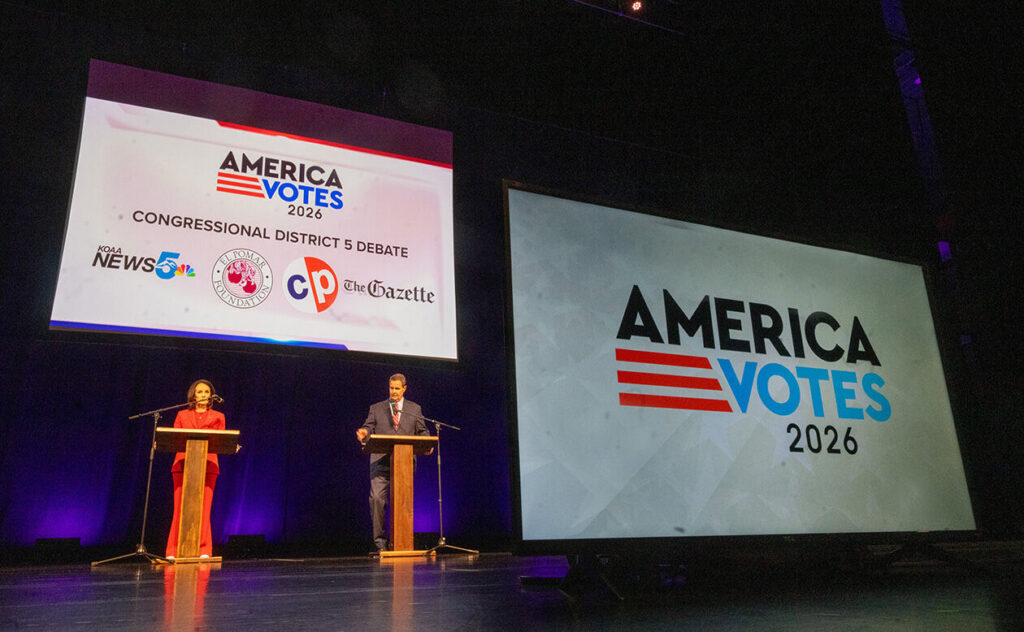
Troops, taxes, war dominate Colorado’s 5th CD debate between Jeff Crank, Jessica Killin
Deborah Grigsby
deborah.smith@denvergazette.com
Updated 12 hours ago
Republican U.S. Rep. Jeff Crank and Democratic challenger Jessica Killin on Thursday night clashed over the war in Iran, the federal budget and healthcare when they took the stage in Colorado Springs for a sold-out debate in the race to...

WATCH: Colorado gubernatorial candidates Phil Weiser, Greg Lopez face off Thursday in televised debate
Ernest Luning
ernest.luning@coloradopolitics.com
Updated 13 hours ago
Two of the candidates for governor of Colorado are set to square off in a televised debate for the first time Thursday night, when Attorney General Phil Weiser, the Democratic nominee, and former U.S. Rep. Greg Lopez, an unaffiliated candidate,...

WATCH: Republican US Rep. Jeff Crank, Democratic challenger Jessica Killin debate in Colorado’s 5th CD
Ernest Luning
ernest.luning@coloradopolitics.com
Updated 14 hours ago
Republican U.S. Rep. Jeff Crank and Jessica Killin, his Democratic challenger, are scheduled to meet for a televised debate in the race to represent Colorado’s 5th Congressional District on Thursday night. The candidates are set to take the stage at...

Colorado officials warn of e-bike safety amid increase in serious youth injuries
Matt Kyle
matt.kyle@denvergazette.com
Updated 10 hours ago
Serious injuries involving e-bikes, e-scooters and children have risen significantly in Colorado over the past year and a half. Traumatic injuries involving e-bikes have risen 184%, according to Alicia Melven, Colorado injury prevention and outreach specialist for Children’s Hospital Colorado’s...

Colorado State Fair youth golf tournament celebrates 11 years
Marianne Goodland
marianne.goodland@coloradopolitics.com
Updated 16 hours ago
Twenty-eight teams tee off Friday at Walking Stick Golf Course in Pueblo for a tournament supporting 4-H, Future Farmers of America and capital improvements at the Colorado State Fair. Now in its 11th year, the Partners of Youth in Ag...

Controversial two-bag furbearer limit heads to CPW meeting under legal threat
Marianne Goodland
marianne.goodland@coloradopolitics.com
Updated 17 hours ago
Next week’s Colorado Parks and Wildlife Commission meeting in La Junta is likely to open under the cloud of threatened legal action. Safari Club International and the Sportsmen’s Alliance Foundation warned the commission this month that its July vote imposing...

Democratic-aligned poll shows big majority of swing-seat voters support routine childhood vaccines
Ernest Luning
ernest.luning@coloradopolitics.com
Updated 19 hours ago
A new poll conducted by Democratic-aligned groups found that voters in competitive U.S. House districts — including a battleground seat in Colorado — support routine childhood vaccinations by a wide margin and oppose a recent order by President Donald Trump...
PREV
PREVIOUS

DU class's UN white paper on corporate human rights abuses has shocking finds
More than half of worldwide human rights abuses from corporations are physical in nature – such as forced labor, trafficking and abduction – and environmental, concluded a white paper prepared in part by two University of Denver classes in business and international studies. Students analyzed a database of 1,007 alleged human rights abuses by corporate entities in […]

Colorado businesses ask Polis to back Big Tech
Small businesses in Colorado, fearful of a growing tsunami of federal probes into Big Tech, are asking Gov. Jared Polis to help them rein in any potential disruptions to digital technology platforms during the ongoing COVID-19 pandemic. In a letter to Polis spearheaded by the nonprofit Connected Commerce Council and signed by 154 Colorado businesses, the group, also […]