

Economists: Colorado budget improves slightly, but deficits still loom

State economists reported a stronger-than-expected bump in general fund revenue driven largely by higher individual income tax collections, yet warned that Colorado remains on track to begin the next fiscal year with a sizable shortfall.
State economists upgraded “significantly” the amount of general fund revenue the state is taking in this year from their March estimates, according to Greg Sobetski, chief economist for the legislative council.
That’s due to new information that wasn’t available in March, Sobetski told the Joint Budget Committee on June 18.
That new information? The impact of the federal Trump budget bill, signed a year ago, was not as significant on individual income taxes as once feared. The difference: $498 million more than was expected in March. The June forecast also accounted for legislative changes made during the 2026 session, primarily reflecting lower expectations for cash-fund revenue.
There’s still an expectation for lower corporate income tax revenue, which Sobetski called a “significant” decrease.
Sobetski said the impact on individual income taxes was much smaller than expected, and the impact on corporate income taxes was larger, resulting in revenue decreases.
Individual income taxes are a much larger part of the general fund revenue, Sobetski explained.
Instead of the larger impact expected from the Trump budget bill, Sobetski said the cause is likely that the economy is supporting more revenue, offsetting some of the expected revenue losses from the Trump bill.
The June forecast, however, didn’t change the outlook for TABOR refunds. There won’t be any TABOR surplus, which pays for those refunds, in 2025-26; it will be payable in the following year.
In addition, because of a bill passed in the 2026 session — House Bill 26-1419 — the refund obligation will be reduced by more than $300 million over the two years following.
“You should feel that the forecast, despite being prepared 12 days before the end of the fiscal year, has less certainty than it ought to about conditions for the current fiscal year,” Sobetski told the committee.
The bottom line, according to economists, is that the state budget for 2025-26 and 2026-27 is balanced, with a small surplus in each year. That’s also based on a 13% general fund reserve, rather than the 15% that has been in place in the past.
For the state budget in 2027-28, which budget writers will start tackling in November, there’s $873 million more to spend or save, but that’s without taking into consideration inflation or caseload growth. When those are factored in, the budget writers will start with a $315 million general fund deficit. They will also have to pay back the 2% taken from the general fund reserve, since the law adopted during the 2026 session only temporarily allowed lawmakers to reduce the reserve and that reduction ended with the 2026-27 fiscal year. That’s another $341 million.
In March, Sobetski explained, the Legislative Council forecast showed that budget writers had a $1.44 billion hole to fill for the 2026-27 budget. The JBC instead used the forecast from the governor’s Office of State Planning and Budgeting, which reduced the deficit to around $1.1 billion.
As to HB 1419, Sobetski said it will reduce refund obligations only if revenue is below the TABOR limit, which he expects. It also means the general fund revenue will have to pay for the property tax exemptions for homestead, primary residence, senior and disabled veterans.
Lawmakers will also have a decision to make once they return in January related to the Healthy School Meals for All program. Voters last year approved the state keeping more of the revenue from that program, which is based on higher taxes on high-income earners.
By next year, however, that higher approved cap will be back before lawmakers. That’s because the amount of revenue coming in is still higher than what’s allowed under the law, to the tune of about $41 million, according to Sobetski. Lawmakers can choose to refund that money to the taxpayers or refer a ballot measure to voters to ask to keep more of the money coming in.
The governor’s economists told the JBC that economic growth is expected to be “resilient,” but consumer spending is also expected to be weaker due to inflation. The labor market also looks weaker, according to Bryce Cooke of OSPB.
“We do expect consumption and investments to remain relatively solid in the current year,” Cooke said. “However, as we turn the table to 2027, we do think there will be some level of consumer exhaustion, which will lead to negative real consumer growth, which has a drag on GDP growth in the out year. That’s an impact at all income levels, even for the highest wage earners.”
He told the committee that those who have just graduated from high school or college are having much more difficulty finding work than they did a couple of years ago. That’s combined with other people who have just stopped looking for work. And that will put downward pressure on individual wage growth, Cooke said.
OSPB confirmed that their revenue numbers were also better in the June forecast than in March, up by about $200 million, for the same reasons: higher individual income tax revenue and lower corporate income tax revenue, both attributed to the federal budget.
The main reason for those better revenue expectations, according to OSPB, is lower-than-expected refunds and better cash from filed returns.
But blaming the federal budget prompted some annoyance from Rep. Rick Taggart, R-Grand Junction, who said placing the revenue shortfall from corporate income taxes on H.R. 1 is a “misrepresentation.”
“Corporate America has also seen, and Colorado, significant increases in regulations,” Taggart said.
Taggart added, “It bears the brunt of inflation when it tries to absorb those inflationary costs and it absorbs, in many cases, increases in tariffs. So, I understand the statement that our taxable dollars have gone down as it relates to corporate taxes, but to place it all on H.R. 1, I don’t believe is accurate at all.”
Cooke told Taggart his office is still “formulating” the final impacts of the federal budget.


Democratic-aligned poll shows big majority of swing-seat voters support routine childhood vaccines
Ernest Luning
ernest.luning@coloradopolitics.com
Updated 2 hours ago
A new poll conducted by Democratic-aligned groups found that voters in competitive U.S. House districts — including a battleground seat in Colorado — support routine childhood vaccinations by a wide margin and oppose a recent order by President Donald Trump...

Colorado gubernatorial candidates Phil Weiser, Greg Lopez to face off Thursday in televised debate
Ernest Luning
ernest.luning@coloradopolitics.com
Updated 4 hours ago
Two of the candidates for governor of Colorado are set to square off in a televised debate for the first time Thursday night, when Attorney General Phil Weiser, the Democratic nominee, and former U.S. Rep. Greg Lopez, an unaffiliated candidate,...
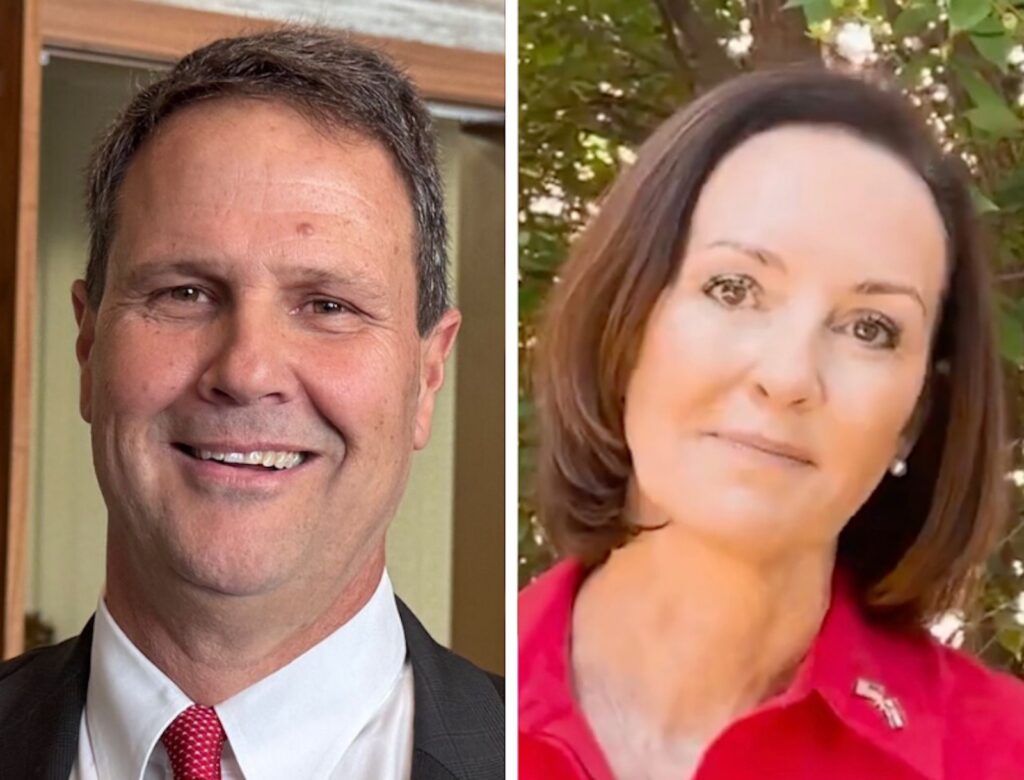
Republican US Rep. Jeff Crank, Democratic challenger Jessica Killin set to debate in Colorado’s 5th CD
Ernest Luning
ernest.luning@coloradopolitics.com
Updated 5 hours ago
Republican U.S. Rep. Jeff Crank and Jessica Killin, his Democratic challenger, are scheduled to meet for a televised debate in the race to represent Colorado’s 5th Congressional District on Thursday night. The candidates are set to take the stage at...
Wrongfully deported man to be returned to U.S., Colorado federal judge orders
Michael Karlik
michael.karlik@coloradopolitics.com
Updated 6 hours ago
Colorado’s chief federal judge took the extraordinary step of directing the government on Tuesday to do everything it can to return a man it deported in violation of his order. At the same time, Colorado’s chief magistrate judge has set...

Colorado to get $615M from Meta child safety settlement
Thelma Grimes
thelma.grimes@coloradopolitics.com
Updated 4 hours ago
The parent company of Facebook and Instagram will pay hundreds of millions of dollars to Colorado, part of an $18 billion multistate deal, in which the company also agreed to adopt extensive child-safety changes to its operations. The settlement ended...

Aurora police warn businesses of 5 shoplifters involved in 139 crimes
Kyla Pearce
kyla.pearce@gazette.com
Updated 5 hours ago
Aurora police are warning business owners to look out for five shoplifters involved in 139 crimes with some $60,000 in stolen merchandise. Four of the five shoplifters are wanted on active Aurora Police Department warrants, according to a news release...

Counties warn CPW that new comment limits sideline local governments
Marianne Goodland
marianne.goodland@coloradopolitics.com
Updated 20 hours ago
The September meeting of the Colorado Parks and Wildlife Commission will feature newly revised public‑comment rules — changes introduced by chair Jay Tutchton of Bent County, who announced them without first discussing the revisions publicly with the rest of the...

Controversial two-bag furbearer limit heads to CPW meeting under legal threat
Marianne Goodland
marianne.goodland@coloradopolitics.com
Updated 20 hours ago
Next week’s Colorado Parks and Wildlife Commission meeting in La Junta is likely to open under the cloud of threatened legal action. Safari Club International and the Sportsmen’s Alliance Foundation warned the commission this month that its July vote imposing...

Federal science agency gives CU Boulder $37.5M to supercharge its quantum studies
Bernadette Berdychowski
bernadette.berdychowski@denvergazette.com
Updated 5 hours ago
The University of Colorado Boulder was awarded $37.5 million from a federal research agency to propel its quantum research, the U.S. National Science Foundation announced Tuesday. The school was one of eight academic institutions to receive a total of $290...

Golden to pay $155,000 to fired city manager
Matt Kyle
matt.kyle@denvergazette.com
Updated 22 hours ago
The Golden City Council on Tuesday approved a roughly $155,000 severance payout to former city manager Scott Vargo, who was fired earlier this month following a “racist incident” at a city fire station. The payout is part of a separation...
PREV
PREVIOUS

Colorado law allowing lawsuits against 'conversion therapy' providers takes effect July 1
With a new law taking effect July 1, Colorado is creating a legal pathway for people to sue licensed providers of “conversion therapy,” even as debate over the practice’s constitutionality continues in the wake of a recent U.S. Supreme Court ruling. Under House Bill 1322, individuals can bring a cause of action for claims of […]

Colorado's 'right to natural gas' measure submits signatures to qualify for November ballot
A natural-gas rights initiative backed by Advance Colorado is likely headed to the November ballot, triggering a parallel campaign by environmental groups seeking to impose new liabilities on oil and gas operators. Petitions for Initiative No. 177 were turned in to the Secretary of State’s Office on Tuesday for review, totaling 200,000 signatures. To make […]