

House and Senate fight over remote voting by lawmakers
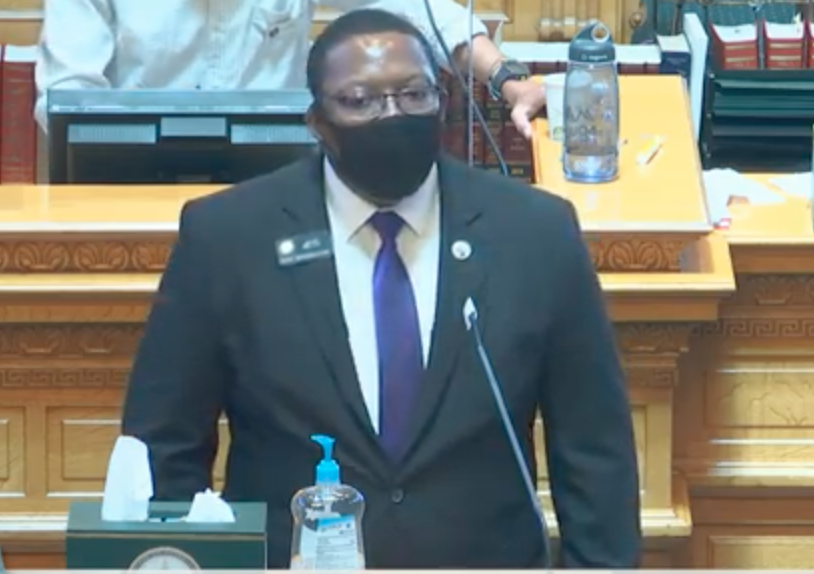
After more than two hours of debate, both chambers of the Colorado General Assembly Wednesday approved resolutions to allow lawmakers to vote remotely when they are unable to be at the state Capitol, but it was with largely Democratic majority votes and Republican opposition.
In the House, Majority Leader Alec Garnett of Denver described a resolution that would allow lawmakers to vote on second reading and third reading, the initial debate and the final vote on a measure.
“We’ve taken great efforts to make the chamber as safe as possible,” washing hands, wearing masks, social distancing, but for some lawmakers in this body, the risk from COVID-19 is still too great, Garnett said. They worked during the recess to find a way for lawmakers to participate remotely, he explained.
There are many rarely utilized statutes and rules the General Assembly leans on during these unprecedented times. The resolution is a “limited, temporary change that allows our colleagues to represent their districts, cast votes and make sure constituents are not voiceless.”
The resolution does not apply to committee hearings, Garnett noted.
Rep. Dave Williams, a Colorado Springs Republican, objected to the resolution on procedural grounds, noting that House rules require a two-thirds vote. However, the House amended the rules at the beginning of the session to allow for a simple majority vote, which Williams called a dangerous precedent. These rules are the only reason the minority has a voice, he added.
“I believe that if you want to participate you have to show up,” Williams said.
Rep Richard Holtorf, an Akron Republican, called the absent lawmakers AWOL, absent without leave. “We can’t serve our state from home.”
That prompted an angry response from Rep. Leslie Herod, a Denver Democrat.
Among those who have not been able to come to the Capitol for health reasons: Democratic Reps. Janet Buckner, Dominique Jackson and Jovan Melton, all of Aurora. Melton is recovering from acute heart failure, Herod said.
“You want him to come here and die?” Herod shouted at the Republican caucus. “We need our members to live during this pandemic so we can fight for our communities that have been disproportionately impacted by this virus,” she said angrily. “We respect our members who cannot be here because of health conditions.”
That prompted Williams to infer that Herod was calling his caucus racist.
Members of the Black Caucus are talking about how this virus impacts their communities, Herod replied, and a discussion about race is not the same as calling someone racist.
Both parties brought up the example of the late Rep. Kimmi Lewis of Kim, who died last December from breast cancer. Lewis continued to serve in the House while being treated for breast cancer. “If she had asked to stay home, would you have said no to her?” asked Rep. Barbara McLachlan, a Durango Democrat. “We have members who are just as susceptible as Kimmi Lewis, and cannot make it here. We do not want them to die because of a rule change.”
Rep. Larry Liston, a Colorado Springs Republican, pointed out that the late Sen. John McCain came off his deathbed to fly across the country to cast a critical vote in the U.S. Senate.
And in a surprise appearance, Melton came to the Capitol to participate in the debate. “To be compared to a person who went AWOL, or a soldier who wasn’t willing to do their duty, that hurt,” he said.
He said he drove to the Capitol against doctor’s orders “to speak up and ask for compassion,” not just for himself but for Buckner and Jackson, too.
Melton said he was diagnosed with pneumonia last December and spent five days in the hospital, waiting for blood clots to dissipate. He’s had a tank of oxygen in his office since the first day of the session, he said.
“We want to serve. We want to be here.”
But just after the General Assembly adjourned in March, Melton was diagnosed with acute heart failure, he said. “I should not be here … but the nonsense I’m hearing in this chamber, I can’t help but go to work.”
Do the right thing, Melton asked his colleagues. “Give my constituents a voice and a vote in this chamber.”
A similar resolution in the Senate got the same level of opposition.
“We are at a place where this is incredibly unprecedented across the world – 100,000 Americans have died from the coronavirus,” Senate Majority Leader Steve Fenberg of Boulder said. “This is something (where) we need to put our politics aside and just decide what is right in this exact moment.
“This is something that will not feel right after this moment so it won’t be allowed to be used.”
He said it would allow people from across the state to have a voice at the Capitol, just as they participate in other kinds of meetings.
“This is not something I think will become a norm,” Fenberg said. “This is not something I think is in the DNA of the Colorado Senate, by any means, but it is something that I think we absolutely have to do to take care of colleagues, our families and the people of Colorado to ensure we’re not adding to the crisis.”
Senate Minority Leader Chris Holbert of Parker said Republicans opposed the proposal.
“There is a responsibility for those of us elected to represent people to be here in this environment so the people can see and hear what we have to say,” he said.
While the public has been allowed to testify remotely to committees for years, many of those sites are closed to discourage gatherings.
“The last two months have been a learning experience for me,” conceded Holbert, who said he had never been on a Zoom call before the March 14 adjournment.
Sen. Bob Gardner, a Republican from Colorado Springs who was wearing a mask in the speaker’s well, said he was “somewhat amazed that there are those in perfectly good health who are unwilling to encounter the risk of being present here.”
He said some lawmakers might find it safer to participate from Cabo San Lucas. “I challenge you to deny me, because I’m in the at-risk category,” Gardner said, adding, “I can Bob it from there … The way I read the rules, you can Bob it from everywhere.”
Sen. Jim Smallwood, a Parker Republican, added that “if this place is so deadly and so toxic, why are we here?
“I’m not scolding. I’m begging. Let me do my job. Let my constituents be heard,” Smallwood said.
Smallwood tested positive for the virus in March and was quarantined in California for two weeks.
Sen. Rob Woodward, a Republican from Loveland, said the vote was reflective of how the emergency has been handled the past few months.
“This body is impotent,” he said. “We have given all power to the governor. He spends our money. He passes laws. He decides what laws to enforce. He decides which laws to ignore, so why even be here? Let’s go home. Let’s all of us just do remote testimony. Let’s continue to collect our paychecks, let’s continue to get our insurance.
“Let the little people who are working in our grocery stores and restaurants, driving trucks, working in hospitals, let them go to work. Let them take risks. We’re important,” Woodward said.
But Sen. Kerry Donovan, a Vail Democrat, replied that rule changes are designed to accommodate people with health issues. “These are not flippant reasons to not be on the Senate floor,” she said.
Fenberg said toward the debate’s conclusion that Republicans might have a point, in the context of the remote participation debate, about senators going a bit soft. He says of previous generations: “Yes, they might’ve been a little tougher than us in some ways. They also had higher infant mortality rates. They also died of dysentery.”
Both resolutions passed in their respective chambers on party-line votes.


10th Circuit rules cognitively impaired man’s risk of lobotomy, mistreatment in Mexico not ‘torture’
Michael Karlik
michael.karlik@coloradopolitics.com
Updated 3 hours ago
The Denver-based federal appeals court concluded last month that a man’s risk of mistreatment or forced lobotomy in his native Mexico did not amount to “torture” that should shield him from deportation. A three-judge panel of the U.S. Court of...
Colorado justices side with news organizations for disclosure of high-level child abuse data
Michael Karlik
michael.karlik@coloradopolitics.com
Updated 2 hours ago
The Colorado Supreme Court ruled on Monday that the state must disclose the number of child abuse reports at individual group living facilities in response to an open records request, as the addresses are already in the public domain. The...
Divided Colorado Supreme Court finds Denver detective did not violate defendant’s Miranda rights
Michael Karlik
michael.karlik@coloradopolitics.com
Updated 2 hours ago
The Colorado Supreme Court determined on Monday that a Denver detective did not improperly resume questioning of a defendant in custody after he invoked his right to counsel. By 4-3, the justices reversed a trial judge’s order that found a...

Colorado Gov. Polis signs social media warrant bill after last year’s veto
Marissa Ventrelli
marissa.ventrelli@coloradopolitics.com
Updated 2 hours ago
Colorado law enforcement will soon have faster access to digital evidence after Gov. Jared Polis signed a pared‑down bill requiring social media companies to acknowledge and respond to search warrants on a tight timeline, a shift from a broader proposal...
Under fire from legislators and critics, Colorado’s top Medicaid official resigns
Marianne Goodland
marianne.goodland@coloradopolitics.com
Updated 2 hours ago
Colorado’s top Medicaid official stepped down on Monday, just as a bipartisan bloc of state senators prepared to formally urge Gov. Jared Polis to remove her over what they called years of mismanagement, waste and costly errors inside the state’s...

Usha Vance launches story time podcast in latest second lady venture
Asher Notheis, Washington Examiner
asher.notheis.washington.examiner@gazetteedit.wpenginepowered.com
Updated 8 hours ago
Second lady Usha Vance unveiled her new story time podcast of reading children’s stories on Monday. The podcast, Storytime with the Second Lady, features either her reading books or inviting a special guest to read, and is part of her...

Out-of-state judges address ex-discipline director’s lawsuit, Colorado justices accept federal invitation | COURT CRAWL
Michael Karlik
michael.karlik@coloradopolitics.com
Updated 9 hours ago
Welcome to Court Crawl, Colorado Politics’ roundup of news from the third branch of government. A pair of out-of-state judges got down to business in a lawsuit brought by Colorado’s former judicial discipline director, plus the state Supreme Court has...
Power grid shutdowns in Colorado bring protection — and problems
Scott Weiser
scott.weiser@gazette.com
Updated 10 hours ago
A downed power line in Sunshine Canyon in the mountains west of Boulder in December posed an electrocution risk to firefighters and bystanders after Xcel Energy re-energized it without repairing it, despite being notified of the break the day before....
Aurora wildland fire contained at Buckley Space Force Base
Nicholas Fogleman
nicholas.fogleman@denvergazette.com
Updated 10 hours ago
A wildland fire burned Sunday morning on the southwest end of Buckley Space Force Base in Aurora, authorities said. The fire no longer posed a threat and crews were clearing the scene as of 10:53 a.m., according to Aurora Fire...

Unsustainable: How Colorado’s Medicaid spending exploded
Nico Brambila
nico.brambila@denvergazette.com
Updated 11 hours ago
The state’s Medicaid program — which covers about one in four Coloradans — is poised for its largest single-year jump in at least two decades, with officials proposing a $2.3 billion increase, even as lawmakers face a $1.5 billion budget...
PREV
PREVIOUS

Lawmakers lay out plan for pandemic paid leave
The legislation had been left for the buzzards when the Colorado General Assembly broke for the pandemic on March 14, but paid leave will be back before lawmakers as they respond to the pandemic. Citing the ongoing health crisis, Democrats are proposing a bill to provide every worker at least 48 hours of leave to […]

CDE offers initial guidance on school reopenings
The Colorado Department of Education has begun the process of creating timelines and checklists for school districts planning to reopen for in-person instruction in the fall, while warning that a statewide or local public health order could change plans just as quickly in the spring semester. “We are doing everything we can to make sure […]