

Homeless advocacy groups file lawsuit against state urging better shelter
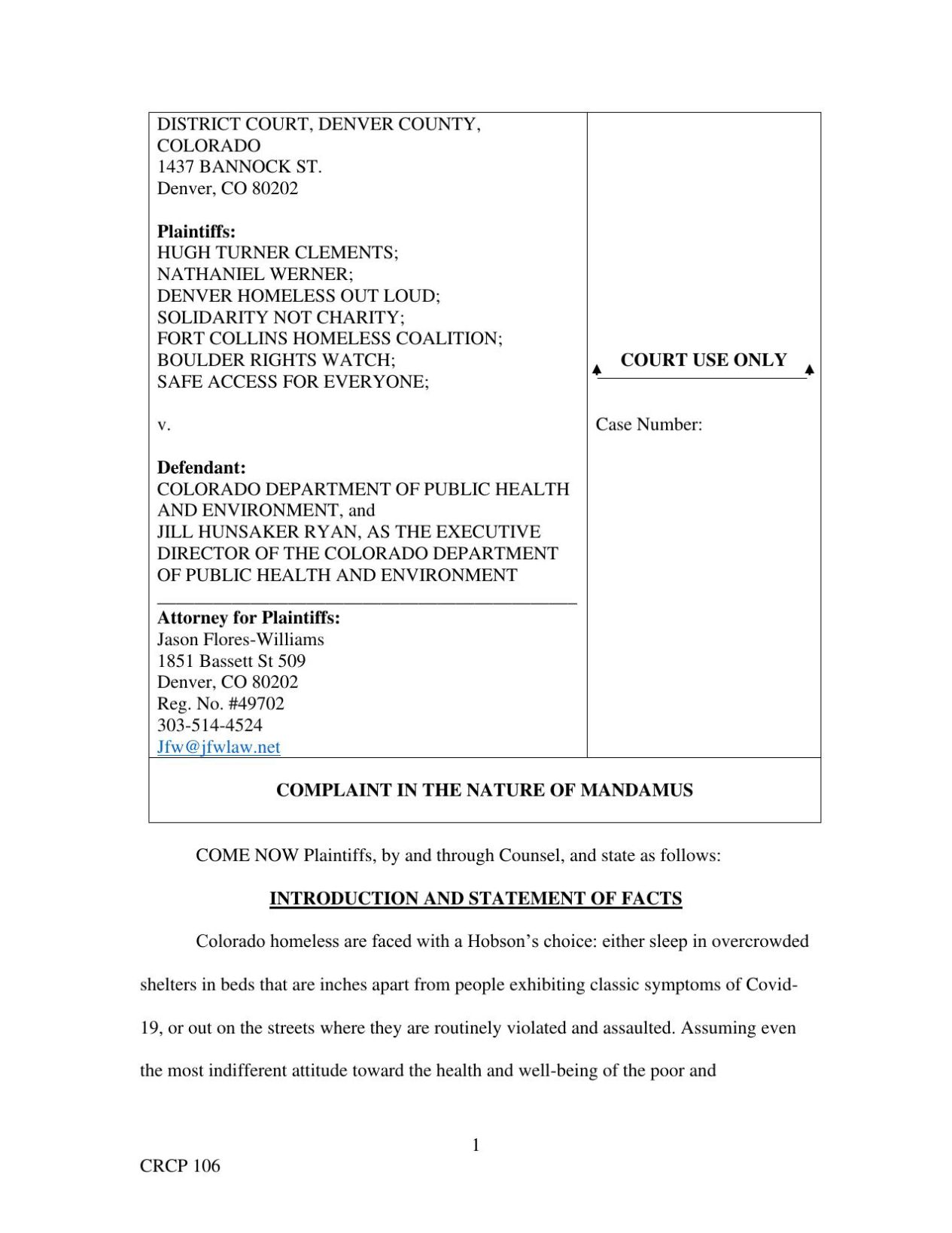
Calling the traditional setup of homeless shelters inadequate and dangerous during a pandemic, several groups filed a lawsuit in state court asking the Department of Public Health and Environment to provide safe and sanitary housing to Colorado’s homeless community.
“Plaintiffs take pains here not to cast a negative light on the efforts of those managing the shelters in our state during this crisis, but conditions are uniformly deficient throughout Colorado shelters,” the complaint reads.
There were over 9,600 people experiencing homelessness in Colorado during a 2019 census, over half of whom were in the Denver metro area. The plaintiffs, which include Denver Homeless Out Loud, Solidarity Not Charity, the Fort Collins Homeless Coalition, Boulder Rights Watch and Safe Access for Everyone, alleged that existing shelters could not accommodate the distancing needed to prevent COVID-19 transmission.
“Conditions in the two Boulder shelters are overcrowded,” the complaint reads, with “people sleeping in bunk beds with only a few feet in between each bunk, making the shelters ideal hotspots for this highly infectious disease.”
Among the exacerbating factors, the plaintiffs allege that beds and sleeping mats are usually fewer than three feet apart, bathrooms are shared, and food service occurs in congregated settings. The groups suing the state, which work with the homeless communities of Grand Junction, Denver, Fort Collins and Boulder, acknowledged that the CDPHE is likely doing the best job that it can under the circumstances, but that it should enforce the state’s public health orders related to quarantines and isolation on behalf of homeless individuals as well.
A CDPHE spokesperson said that the department could not comment on pending litigation.
Rep. Jovan Melton, D-Aurora, agreed with the plaintiffs’ argument and felt that asking people without a home to abide by the statewide stay-at-home order was a “complete contradiction.”
“In my home city of Aurora, efforts are being made to purchase vacant motels to separate homeless individuals infected with COVID-19. I believe similar actions can and should be taken on a state level,” he said. In previous legislative sessions, Melton was a sponsor of the “right to rest” proposal to give homeless individuals the ability to lawfully occupy public spaces.
The lawsuit asks the state to work with localities to provide housing and to do more to prevent COVID-19 transmission among the homeless community. As of its filing, 10 homeless individuals had tested positive for COVID-19. Multiple cities, including Austin, San Francisco and the District of Columbia have taken steps toward placing people in hotel rooms as an alternative to street homelessness.
In the absence of a remedy, the Colorado plaintiffs wrote, those experiencing homelessness face an unappealing choice: “shelters in beds that are inches apart from people exhibiting classic symptoms of Covid-19, or out on the streets where they are routinely violated and assaulted.”
Homelessness advocates’ lawsuit against CDPHE

Heat, wind and drought conditions spark wildfires across US West | OUT WEST ROUNDUP
Ernest Luning
ernest.luning@coloradopolitics.com
Updated 2 hours ago
Heat, drought spark wildfires Extreme heat and dry, windy conditions fueled several wildfires in the West on June 21, including an uncontained blaze in Utah that forced the evacuation of a small town southwest of Salt Lake City. The Iron...
Crank challenger Jessica Killin signs on to new centrist Democratic group’s ‘Promise to America’
Ernest Luning
ernest.luning@coloradopolitics.com
Updated 13 hours ago
Jessica Killin, one of the Democrats running in Tuesday’s primary for the chance to challenge U.S. Rep. Jeff Crank in Colorado’s 5th Congressional District, joined with more than a dozen incumbent Democratic lawmakers and candidates this week signing on to...

Colorado Politics Calendar June 29-July 5
Rachael Wright, Special to Colorado Politics
rachael.wright@coloradopolitics.com
Updated 4 days ago
CoPo’s weekly political calendar will help you find political and public-policy events throughout Colorado. It includes candidate and issue campaign events, public policy meetings, court hearings, state and local party conventions, assemblies, debates, rallies, parades, speaking engagements, traveling dignitary appearances,...
Gov. Lamm’s GOP challenger gives insights into his campaign | A LOOK BACK
Rachael Wright, Special to Colorado Politics
rachael.wright@coloradopolitics.com
Updated 4 days ago
Forty-five years ago this week: “I see Gov. (Richard) Lamm is fairly popular in general,” said gubernatorial candidate and state Sen. Bill Hughes, R-Colorado Springs. “ … And he’ll be hard to beat.” Hughes was on a whirlwind campaign trail...

Giving credit to Polis where credit is due | SONDERMANN
Eric Sondermann
eric-sondermann@coloradopolitics.com
Updated 4 days ago
It is an understatement to suggest that Gov. Jared Polis has had a tough couple of months. The bloom was already off the rose and Coloradans were paying far more attention to the choice of his replacement than they were...

Bennet, Hickenlooper to vote against Trump’s 10th Circuit nominee from Colorado
Michael Karlik
michael.karlik@coloradopolitics.com
Updated 1 day ago
Colorado’s two Democratic senators will not vote to confirm President Donald Trump’s nominee to a vacancy on the Denver-based federal appeals court. Trump has selected U.S. District Court Chief Judge Daniel D. Domenico, who he appointed as a federal trial...
Who’s spending in Colorado to get your vote?
Marianne Goodland
marianne.goodland@coloradopolitics.com
Updated 1 day ago
Groups that raise unlimited amounts of money have spent about $20 million in May and June to try and influence Colorado voters’ choices in the upcoming June 30 primaries. By law, these groups cannot coordinate with the candidates they support....
U.S. government declines to oppose multiple challenges to immigration detention in Colorado
Michael Karlik
michael.karlik@coloradopolitics.com
Updated 2 days ago
Multiple federal judges in Colorado granted petitions from people challenging the lawfulness of their immigration detention this week after the government took the unusual step of declining to submit arguments in opposition. Colorado’s federal trial court is facing a flood of...
Tina Peters tells supporters to ‘stand up and fight back’ at Castle Rock event
Marissa Ventrelli
marissa.ventrelli@coloradopolitics.com
Updated 2 days ago
Tina Peters, the former Mesa County clerk recently released from prison, warned supporters that what happened to her could happen to them, too, if they did not “stand up and fight back” at an event at the Douglas County Fairgrounds....

Iran strikes cargo ship in Strait of Hormuz, endangering Trump’s peace
Christian Datoc
christian-datoc@coloradopolitics.com
Updated 2 days ago
Iran attacked a cargo ship traveling through the Strait of Hormuz on Thursday, possibly upending President Donald Trump‘s diplomatic end to the war with Iran. A U.S. official confirmed to the Washington Examiner that the Islamic Revolutionary Guard Corps “struck...
PREV
PREVIOUS

RTD to receive $232 million through federal relief as workers demand protective equipment
The Regional Transportation District will receive more than $232 million through the CARES Act, the $2.2 trillion relief package Congress passed amid a wave of COVID-19-related unemployment, while its transit union is demanding that the agency purchase protective equipment for operators. “Since the coronavirus pandemic began, RTD bus drivers have put themselves in harm’s way […]

Denver files lawsuit against e-cig companies, including JUUL
Denver on Wednesday filed a lawsuit in U.S. District Court against electronic cigarette companies on grounds that they wrongfully marketed to young people. The 207-page lawsuit comes at a time when Colorado has the highest youth vaping rate in the country. “As we battle COVID-19, pulmonary health has never been more important,” Denver City […]