

Jeffco man on mission to abolish vacancy committees
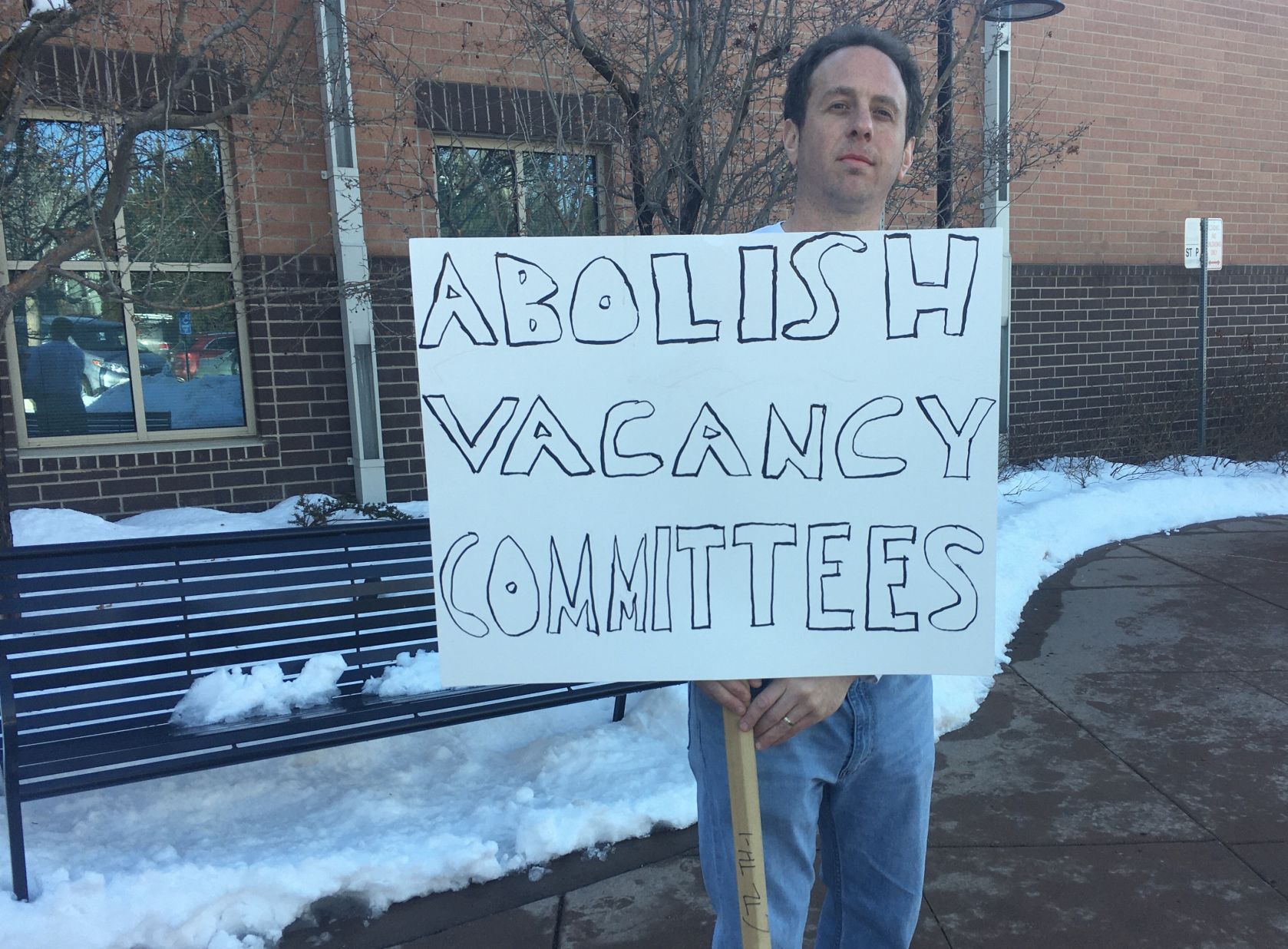
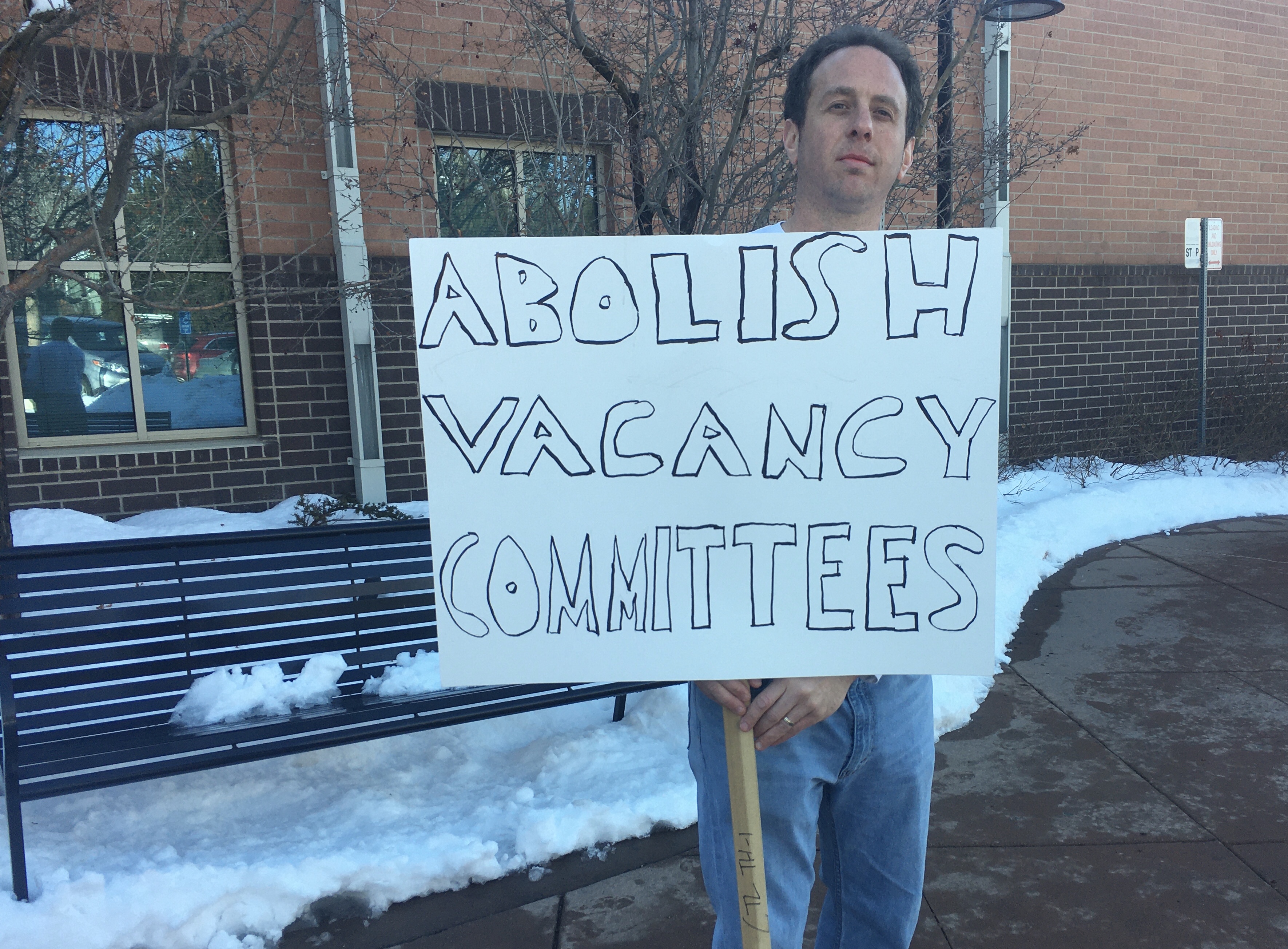
Inside Littleton’s Douglas H. Buck Community Center on Saturday, 55 Republican vacancy committee members were meeting to fill the unexpired term of Rep. Susan Beckman, who resigned on Jan. 17. Outside, Russell Weisfield stood on the sidewalk with a homemade sign, scrawled in permanent marker with block letters:
“Abolish Vacancy Committees.”
“It all just seems wrong to me that a small group of people, insiders, are the ones who get to choose,” he said. Colorado is one of 25 states that uses a method other than special elections to address vacancies in the legislature. Vacancy committees derived from each party’s central committee fill the unexpired term, with the party of the departing legislator receiving the privilege. Weisfield feels that process is too exclusive.
“If you can’t show up to caucus night because you have to work? Guess what, you don’t get a say in the vacancy committee. Because that’s where the precinct leaders and precinct committee people come from,” he said. “Working people get stiffed on being able to decide who represents them.
Weisfield said that he first thought about the issue when his senator, Evie Hudak, resigned in 2013 under a recall threat. But since December 2019, with four vacancy appointments in three months, he has protested outside most of them.
“One of my biggest problems is we elect individuals and not parties,” he said. “I vote for a person and not a party. It just seems wrong to me.”
Colorado Politics found that since the November 2018 election, 12% of the General Assembly’s membership consists of legislators who were not elected to the districts they now serve. That appointment rate was the highest in the nation. Originally, Colorado required special elections, but a 1951 change instituted the current process.
Inside the House District 38 vacancy committee, Martin Bolt, the chair, tried to emphasize the serious responsibility to the party activists.
“It is an election. You’re not nominating somebody for a primary. You’re actually electing them to this office,” he said.
Afterward, Bolt added, “I used to talk and think that way,” referring to the notion of abolishing vacancy committees. “But once you get involved you begin to appreciate why these laws were made. Your representation is gone when the person is gone and you have got to replace them as fast as possible. And so it does serve a purpose, a fair purpose.”
Garry Kirkland, a House District 38 vacancy committee member from Littleton, said that he “could probably see both sides of that issue. I think this obviously is expeditious. This particular election will only last as long as this particular session, which has two or so months left in it.”
The circumstances triggering the past four vacancy committee have been unique: death, illness, moving from the House to the Senate, and, in Beckman’s case, taking a new day job.
“Susan didn’t give us any notice,” Kirkland said. “She resigned in January. The legislative session is only about 120 days long. What are you gonna do? We need to get somebody in the legislature voting for HD38, and to have an election would pretty much chew up the rest of the legislative session.”
That justification – expediency – is a nonstarter for Weisfield.
“Yes, they have to run for reelection in November,” he said. “But you can do a lot of damage as a legislator in that time.”
Dorothy Gotlieb, the chair of the Arapahoe County Republicans, was noncommittal on Weisfield’s idea, saying she would “have to think about it. I can see pros and cons.”
Marc Kamin, chair of the Democratic Party of Denver, where the last two vacancy committees took place, previously told Colorado Politics that “I don’t think it’s a perfect system, but it’s the system we have and so you make it work.”
There are four or five other people, Weisfield said, who are interested in the crusade to ban vacancy committees. During this year’s caucuses, Weisfield will attempt to insert a plank in as many county party platforms as possible to call for special elections. Among the metro Denver party officials to whom he has spoken, he has found an unreceptive audience.
“I wouldn’t say it’s a complete ‘buzz off.’ But it’s like, ‘Okay. That’s nice. Thank you for your opinion,'” he recalled. “I don’t think the parties themselves want to see it changed.”
This story has been updated to correct the spelling of Garry Kirkland’s first name.

Homeless recruits of ‘The Program’ say they were told to sign NDAs amid investigations in Colorado
David Migoya
david.migoya@gazette.com
Updated 50 minutes ago
Several formerly homeless people — each drawn into an Aurora-based enterprise known as “The Program” that promised free housing and cash in return for letting a home-health business administer prescriptions they were given — said they were pressed into signing...
Homeless recruits of ‘The Program’ say they were told to sign NDAs amid investigations in Colorado
David Migoya
david.migoya@gazette.com
Updated 50 minutes ago
Several formerly homeless people — each drawn into an Aurora-based enterprise known as “The Program” that promised free housing and cash in return for letting a home-health business administer prescriptions they were given — said they were pressed into signing...
Trump’s 10th Circuit nominee declines to name 2020 election winner, defends immigration decisions
Michael Karlik
michael.karlik@coloradopolitics.com
Updated 44 minutes ago
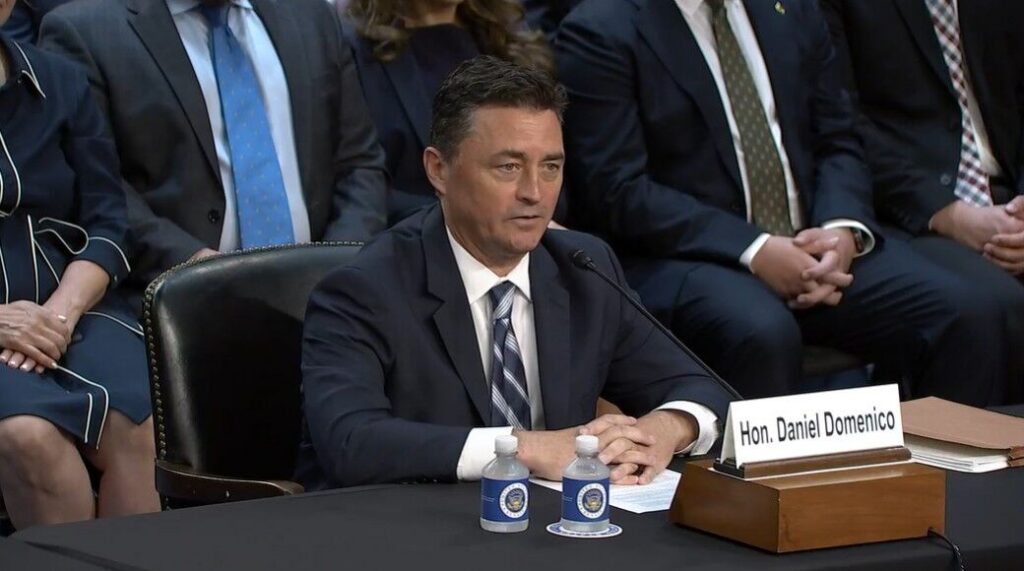
President Donald Trump’s nominee to the Denver-based federal appeals court declined to say who won the 2020 presidential election during his appearance before the U.S. Senate Judiciary Committee on Wednesday, and defended his recent rulings in immigration detention cases. U.S....
Colorado repeals attorney immigration attestation law after one year
Nico Brambila
nico.brambila@denvergazette.com
Updated 4 minutes ago
One year and 12 days. That’s how long a Colorado law requiring attorneys to certify they would not use court data for federal immigration enforcement remained on the books before lawmakers repealed it. Gov. Jared Polis signed the initial legislation,...
Colorado’s ‘right to natural gas’ measure submits signatures to qualify for November ballot
Marissa Ventrelli
marissa.ventrelli@coloradopolitics.com
Updated 3 hours ago
A natural-gas rights initiative backed by Advance Colorado is likely headed to the November ballot, triggering a parallel campaign by environmental groups seeking to impose new liabilities on oil and gas operators. Petitions for Initiative No. 177 were turned in...

Economists: Colorado budget improves slightly, but deficits still loom
Marianne Goodland
marianne.goodland@coloradopolitics.com
Updated 3 hours ago
State economists reported a stronger-than-expected bump in general fund revenue driven largely by higher individual income tax collections, yet warned that Colorado remains on track to begin the next fiscal year with a sizable shortfall. State economists upgraded “significantly” the...

Colorado law allowing lawsuits against ‘conversion therapy’ providers takes effect July 1
Marissa Ventrelli
marissa.ventrelli@coloradopolitics.com
Updated 3 hours ago
With a new law taking effect July 1, Colorado is creating a legal pathway for people to sue licensed providers of “conversion therapy,” even as debate over the practice’s constitutionality continues in the wake of a recent U.S. Supreme Court...
Colorado justices expand ability for civil defendants to avoid participating, win after trial
Michael Karlik
michael.karlik@coloradopolitics.com
Updated 6 hours ago
The Colorado Supreme Court decided on Tuesday that a civil defendant, whose non-participation in the case meant that he legally admitted to the sexual assault allegations against him, could nonetheless prevail after he showed up to testify at trial. A...
Trump heads to Senate as GOP grows more willing to challenge White House
Naomi Lim
naomi-lim@coloradopolitics.com
Updated 6 hours ago
President Donald Trump normally summons congressional Republicans to the White House, but on Wednesday, he is making a rare trip to Capitol Hill to have lunch with GOP senators. And at least publicly, there is one agenda item. “We’re just...

Trump blasts oil companies for not lowering prices to consumers, accuses them of price gouging
Washington Examiner Staff
washington-examiner-staff@coloradopolitics.com
Updated 6 hours ago
President Donald Trump criticized “big oil companies” for not lowering prices for consumers, even though oil purchase costs have dropped. He accused oil companies of price gouging consumers, ordered the Department of Justice to investigate current practices, and demanded that...
PREV
PREVIOUS

House gives first approval to hair anti-discrimination bill
The Colorado House gave a thumbs up in the first of two required votes on a bill to protect hair rights in the workplace. House Bill 1048, called the Crown Act, prohibits discrimination against hairstyles historically associated with race, such as dreadlocks. Rep. Dave Williams, a Republican from Colorado Springs, opposed the bill in committee. […]
Colorado House gives initial OK to short-term rental law
The Colorado House gave preliminary approval to legislation Monday that empower county governments to regulate short-term rentals. The question is a big issue outside Colorado’s resort towns and mountain enclaves, where letting out a space can lead to a fuss in the neighborhood. House Bill 1093 passed on a voice voice but still faces a roll-call […]