

DECLARING INDEPENDENCE | Trapped between two parties? Try ranked-choice voting


I had great hopes for the Libertarian Party in the 2018 elections.
The old parties had been shrinking for years and becoming shrill in their death throes: the Republicans were increasingly the party of Donald Trump, and the Democrats were morphing into the party of Bernie Sanders. The rising share of independents proved that they no longer met the needs of a great many voters.
On Nov. 6, my hopes were dashed. The LP did not have a good day, including with the “bellwether” candidates who were running real and full-time races.
What happened?
It turns out that the bitter state of American politics, which we Libertarians thought would put us in the unexpected position of being the adults in the room, hurt us. In an atmosphere of hyper-partisanship, tactical voting – voting against a particularly distasteful outcome – dominates, even among unaffiliateds (who, despite their name, usually lean one direction or the other).
So, from the standpoint of the 57% of Americans who tell Gallup they want a viable third party (a great many of whom are independents), we appear to be in a death loop: The old parties shrink and become more partisan. This disgusts a large number of voters, many of whom become independent. But at voting time, partisanship means that no individual will risk a “wasted vote” and the alternatives to the two-party status quo get crushed.
Wash, rinse, repeat.
How do we break out of this? Well, it won’t be easy but there is one change that would greatly help and it appears to be gaining momentum. It is called ranked choice voting, or “RCV” for short.
Our current system, in which you can only vote for a single candidate, encourages tactical voting and virtually guarantees that there are only two parties. RCV allows you to choose multiple candidates, meaning that you can name your preferred candidate as your first choice and your “lesser of two evils” candidate as a second choice.
If your preferred candidate does not win by gaining more than 50% of the votes, then your second choice comes into play. This means that you can express your true preference – perhaps for a third party or an independent candidate – without running the risk of a wasted vote if he or she does not win. The incentive to vote tactically greatly drops.
And there are additional benefits. Since candidates have to appeal not only to their own bases of support (in order to get those first-choice rankings) but also to other voters (to gather those potentially important fallback votes), RCV promotes civility. This is why the Economist magazine has recently referred to RCV as “a simple reform [that] might fix America’s dysfunctional politics.”
A change like this may seem unrealistic, but it isn’t. RCV is used nationwide in several advanced countries (such as Ireland, New Zealand and Australia). In the USA, multiple cities use RCV and in 2016 Maine became the first state to adopt it for elections for U.S. Congress, the governor and the state legislature. Bills to create RCV have been introduced in 19 states with the support of multiple lobbying groups. It is frequently used for elections in universities, which means a generation is growing up used to the method.
The big impediment to this change is the entrenched old parties, which benefit from the current broken system. This is why activists are taking it directly to the voters, including in places like Aurora here in Colorado.
The growth of independents shows that voters want change. The struggles of the Libertarian Party, the oldest and largest third party, show the difficulty of achieving this within our current system. Even if you don’t share my “big-L” libertarian sentiments, we can still hopefully agree on the “small-l” libertarian ideal of choice.
When activists bring the opportunity to your neighborhood, be sure to support RCV.
Roger Barris, an investor and entrepreneur from Evergreen, was the Libertarian Party candidate in the race for Colorado’s 2nd Congressional District in 2018.

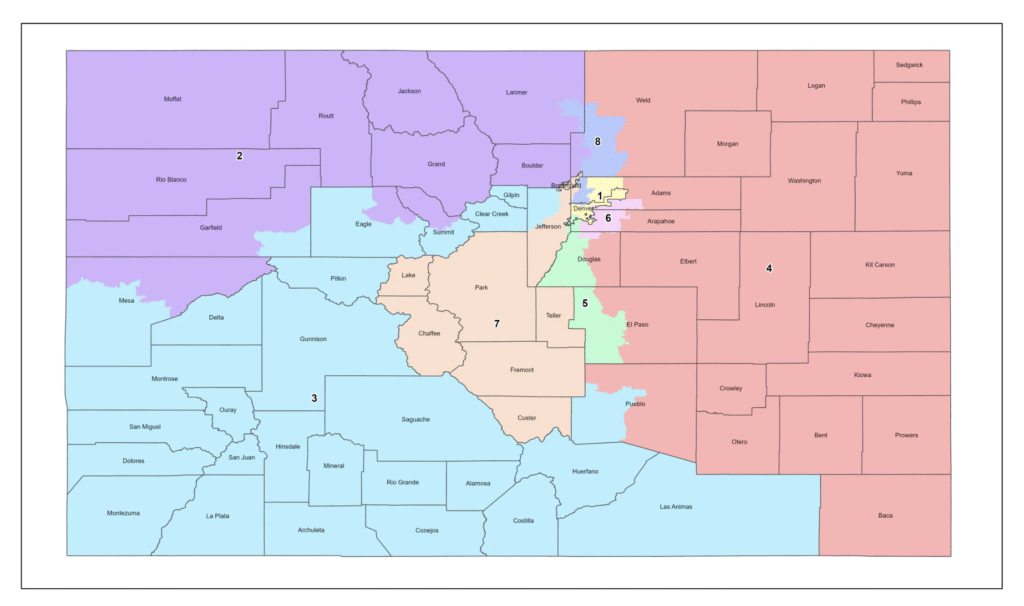
Colorado Title Board advances competing redistricting proposals and revised Pinnacol measure as April ballot deadline nears
Marianne Goodland
marianne.goodland@coloradopolitics.com
Updated 7 hours ago
With just two meetings left before an April 15 deadline, the state’s Title Board on Wednesday pushed through a slate of ballot measures — including a revised proposal to privatize Pinnacol Assurance and dueling plans to redraw Colorado’s congressional map...
SAVE America Act showdown relished by GOP and Democrats alike
Ramsey Touchberry, Washington Examiner
ramsey.touchberry.washington.examiner@gazetteedit.wpenginepowered.com
Updated 8 hours ago
Both political parties have found rare agreement in a divided Washington, convinced that the GOP’s federal voter ID and election bill is a slam-dunk messaging opportunity. But that’s where the bipartisanship quickly ends. The two sides are diametrically opposed over...

Senate panel advances bill to tighten Colorado sports betting rules amid youth addiction concerns
Marissa Ventrelli
marissa.ventrelli@coloradopolitics.com
Updated 7 hours ago
A divided Senate Finance Committee on Tuesday narrowly advanced a bill to impose new restrictions on Colorado’s booming sports betting industry, as lawmakers cited rising concerns about youth gambling and addiction while operators warned the changes could drive bettors to...

Federal judge green-lights trial against Denver officer over race-based enforcement
Michael Karlik
michael.karlik@coloradopolitics.com
Updated 9 hours ago
A federal judge green-lit a jury trial last week on a man’s claim that a Denver police officer engaged in racially selective enforcement of the law by arresting him for video recording at a police station, while not arresting a...

Federal judge says 8 years in solitary confinement not grounds to reduce man’s sentence
Michael Karlik
michael.karlik@coloradopolitics.com
Updated 9 hours ago
A federal judge concluded earlier this month that a man’s eight years allegedly spent in solitary confinement did not justify granting his request for a sentence reduction. However, U.S. District Court Senior Judge William J. Martínez signaled his willingness to...

Democrat Matt Cavanaugh ends campaign in Colorado’s 5th CD, says petition firm came up short
Ernest Luning
ernest.luning@coloradopolitics.com
Updated 6 hours ago
Democratic congressional candidate Matt Cavanaugh said Wednesday that he was ending his bid to challenge Republican U.S. Rep. Jeff Crank in Colorado’s 5th District because the firm his campaign hired to gather petition signatures failed to deliver. Cavanaugh, an Army...

Colorado voters to decide whether to ban gender surgeries for minors
Marissa Ventrelli
marissa.ventrelli@coloradopolitics.com
Updated 4 hours ago
Colorado voters will decide this November whether to prohibit gender surgeries for minors and bar public funding or insurance coverage for procedures that alter children’s biological sex characteristics. The measure qualified for the ballot amid a push by the federal...

Democrats want to bar use of consumer data to set Colorado prices, employee wages
Marissa Ventrelli
marissa.ventrelli@coloradopolitics.com
Updated 7 hours ago
A closely divided House committee advanced a bill aimed at curbing the use of personal data to set individualized prices and wages, reviving a proposal that failed last year and setting up a broader debate over how far the state...

10th Circuit rejects ‘potential for violence’ when police arrest vehicle occupant’s romantic partner
Michael Karlik
michael.karlik@coloradopolitics.com
Updated 12 hours ago
The Denver-based federal appeals court rejected the idea on Tuesday that a vehicle occupant poses a danger to police solely because they are romantically involved with another occupant who officers are arresting. By 2-1, a three-judge panel of the U.S....

Colorado justices grill debt collector about compliance with law
Michael Karlik
michael.karlik@coloradopolitics.com
Updated 6 hours ago
The Colorado Supreme Court repeatedly pressed a debt collection company last week to explain how its lawsuit against a Boulder woman for an unpaid credit card balance complied with the specific requirements that state lawmakers have created. Portfolio Recovery Associates,...
PREV
PREVIOUS

Polis signs Colorado bills on conversion therapy, transgender birth certificates
Gov. Jared Polis, the nation’s first openly gay governor, gave a rousing pre-launch to his first LGBT Pride Month as the state’s chief executive by signing into law Friday two measures that supporters say will make life better for many Coloradans. House Bill 1039 will allow transgender people to obtain new birth certificates instead of amended […]

Package of new Colorado laws to boost electric vehicles
From financing for charging stations to protecting parking spots, Colorado has a truckload of new laws aimed at boosting electric vehicles. Gov. Jared Polis signed five bills Friday in a ceremony attended by fellow Democrats, including environmental activists. “Electric vehicles are a great choice, a cost-effective choice,” the governor said after arriving as a passenger […]